

Use audiobooks and device text-to-speech alongside short, multisensory phonics practice to reduce decoding fatigue while learners keep building skills. That combination gives immediate access to grade-level content without waiting months for a full intervention to take effect.
Here is what you can do today:
- Turn on built-in TTS. iOS VoiceOver, Android TalkBack, and Microsoft's Immersive Reader are already on most devices. No purchase needed.
- Pair audio with follow-along text. Synchronized highlighting keeps the eye on the page while the ear carries the load.
- Switch to a dyslexia-friendly font. Lexend is free on Google Fonts and reduces visual crowding immediately.
- Try a human-narrated audiobook. Engagement stays higher with a real voice, especially for longer texts.
- Keep phonics sessions short. Ten focused minutes of multisensory practice beats a frustrated hour at the table.
Pro Tip: Before buying any third-party app, spend one week with your device's free built-in accessibility tools. Device-level accessibility features let you learn exactly what the learner needs before spending money on premium software.
Table of Contents
- What "reading differences" actually means for parents and teachers
- The best reading alternatives for learning differences, mapped to what each one does
- Where structured literacy fits alongside these alternatives
- Classroom and home practices that actually reduce pressure
- How to pick the right alternative and get it running
- Why audio and multisensory supports actually work: the research
- Key Takeaways
- The gap between "accommodation" and actual access
- Coreforgeaudio gives learners immediate access to narrated content
- Authoritative sources and next resources to explore
What "reading differences" actually means for parents and teachers
Reading differences is an umbrella term covering several distinct processing challenges. Knowing which one a learner has changes which alternatives help most.

Dyslexia is the most common. It is a phonological processing difference, meaning the brain has difficulty mapping printed letters to their sounds. A third-grader with dyslexia may read "was" as "saw" and struggle to sound out unfamiliar words, even after repeated exposure. It has nothing to do with intelligence.
Decoding and phonological deficits sit at the core of dyslexia but can also appear independently. A learner with a decoding deficit reads slowly and inaccurately because the letter-to-sound translation is effortful. Every sentence costs working memory that should be going toward meaning.
Comprehension difficulties are different. Some learners decode fluently but lose the thread of what they just read. This often involves weak vocabulary, limited background knowledge, or attention challenges like ADHD rather than a phonological deficit.
- Dyslexia/decoding problems respond best to structured phonics instruction plus audio access tools that reduce fatigue.
- Comprehension difficulties respond best to vocabulary-rich audiobooks, read-alouds, and discussion-based approaches.
- ADHD-related reading struggles often improve with shorter sessions, movement breaks, and formats that allow speed control.
"Students with learning differences are 2–3 times more likely to experience anxiety or depression. Reading alternatives that remove public pressure and reduce daily failure protect both motivation and mental health — and that matters as much as any skill gain."
The best reading alternatives for learning differences, mapped to what each one does
Not every tool does the same job. The table below maps the main alternatives to the dimensions that matter most for implementation decisions.
| Alternative | Best for | How it helps | Key accessibility features | Cost shape | How to implement |
|---|---|---|---|---|---|
| Human-narrated audiobooks | Access to grade-level content | Reduces decoding fatigue; builds vocabulary | Adjustable speed, synchronized highlighting | Free (library) to paid subscription | Download app or borrow from library; pair with print copy |
| Device TTS (Immersive Reader, VoiceOver) | Low-cost trial; homework support | Reads any on-screen text aloud | Speed control, word highlighting | Free (built-in) | Enable in device settings; takes minutes |
| Lexend font | Visual fatigue reduction | Reduces letter crowding; improves tracking | Adjustable letter spacing | Free (Google Fonts) | Install font; apply to documents and browsers |
| Scanning/reading pens (e.g., C-Pen) | In-class independence | Reads printed text aloud via earpiece | Portable; works on any printed page | Mid-range purchase | Charge pen; practice scanning technique |
| PDF-to-TTS upload tools | Curriculum and homework access | Converts school materials to audio | Upload support, speed control | Free to low-cost | Upload PDF; listen with highlighting |
Assistive technology like text-to-speech, reading pens, and dyslexia-friendly fonts are recognized standard accommodations under the ADA, which means schools and employers are required to consider them as reasonable supports.
Audiobooks and TTS give learners access to grade-level vocabulary and complex content while decoding skills are still developing. That matters because background knowledge compounds: a student who understands the science unit through audio is better positioned to read about it later.
Human-narrated audiobooks with synchronized highlighting improve motivation and sustained listening compared with synthetic voices alone. For longer texts, narration quality is not a luxury.
The ability to upload your own PDFs and school materials is one of the highest-value features in any assistive reading platform. It turns a general-purpose tool into direct curriculum support.
Pro Tip: When evaluating audiobook platforms, check whether the learner can choose audiobooks for learning differences based on narration quality, highlighting, and upload support — not just title count.
Where structured literacy fits alongside these alternatives
Alternatives are access tools. They are not a substitute for teaching a child to decode. This distinction is the most important thing in this article.
"Systematic phonics instruction with intentional practice leads to measurable progress in decoding. Multisensory approaches are most effective when they explicitly reinforce phonics-based instruction — not when they replace it with picture-guessing or whole-language strategies."
The Orton-Gillingham approach, and the structured literacy programs built on it, remains the gold standard for teaching decoding to learners with dyslexia. It is explicit, systematic, and multisensory: learners see the letter, say the sound, write it, and hear it simultaneously. That multi-channel reinforcement is what makes it work.
The practical model is to run both tracks in parallel. A learner uses audiobooks and TTS to access grade-level science, history, and literature content throughout the day. Then, separately, they do a focused 10–15 minute Orton-Gillingham style phonics session. The audio track keeps them engaged with ideas and vocabulary; the phonics track builds the decoding skills that will eventually make independent reading possible. Neither replaces the other.
Pro Tip: If a learner has been in general reading instruction for a year with little progress, that is the trigger to request a formal evaluation. Under IDEA, schools are required to evaluate a child suspected of having a learning disability at no cost to the family. A 504 plan or IEP can then formalize the accommodations and specialized instruction the child needs.
Classroom and home practices that actually reduce pressure
Alternatives to round-robin reading
Round-robin reading, where students take turns reading aloud in front of the class, is one of the most anxiety-producing activities for learners with reading differences. It measures performance, not comprehension. Here are better options:
- Choral reading: The whole class reads aloud together. No individual is exposed, and struggling readers get a model to follow.
- Partner reading: Pairs read to each other. The stronger reader goes first; the learner with differences echoes or reads the same passage second.
- Listening stations: Students use headphones to follow along with a recorded version of the text. Comprehension questions follow.
- Read-alouds with turn-taking on discussion: The teacher reads; students respond to questions. Decoding is off the table; thinking is on it.
What a 10-minute session looks like
In class: The teacher plays a two-minute audio introduction to the day's passage (building background knowledge), students follow along with highlighted text on a tablet, then the class discusses two comprehension questions together. Total decoding demand: minimal. Total engagement: high.
At home: A caregiver and child listen to a chapter of an audiobook together using an audiobook listening routine. After listening, the child retells one thing that happened. Then, separately, five minutes of letter-sound card practice. The two activities stay distinct.
Adapting classroom materials step by step
- Convert the PDF assignment to TTS using the device's built-in reader or an upload-capable app.
- Increase font size to at least 14pt and switch to Lexend or Arial.
- Add line spacing of 1.5 or greater to reduce visual crowding.
- Provide the read-aloud option as the default, not as a special request.
- Use decodable texts for explicit phonics practice; use grade-level audio for content learning.
How to pick the right alternative and get it running
Choosing a tool: what to check first
- Does the learner have control over narration speed?
- Does the platform highlight text in sync with audio?
- Can the user upload their own school materials (PDFs, textbooks)?
- Is the font adjustable, and does the platform support Lexend or similar?
- Is the narration human or synthetic? (Human narration matters for sustained engagement.)
- What is the cost, and is there a free trial or library access option?
Implementation timeline
Immediate (days 1–7): Enable device TTS, install Lexend in the browser, and borrow one audiobook from the public library or the National Library Service (free for qualifying individuals with print disabilities).
Short-term (weeks 2–6): Identify a platform with upload support for school materials. Trial it with one homework assignment. Introduce a 10-minute daily phonics session using an Orton-Gillingham structured approach.
Programmatic (months 2–6): Request a school meeting to document accommodations. If an IEP or 504 plan is not yet in place, ask the school team to begin a formal evaluation. Accommodations can include extended time, read-aloud testing, and assistive technology access.
US legal rights in brief
Under IDEA, schools must evaluate and provide free appropriate public education to eligible students with disabilities, including learning disabilities. A 504 plan under the Rehabilitation Act covers students who need accommodations but may not qualify for special education. The ADA extends reasonable accommodation rights into higher education and the workplace. Disability accommodations documentation follows similar principles across educational settings: the key is a current evaluation from a qualified professional and a clear statement of functional limitations.
Why audio and multisensory supports actually work: the research
The mechanism is straightforward. Decoding a word takes working memory. When a learner with dyslexia spends most of their working memory sounding out each word, almost none is left for comprehension, vocabulary acquisition, or engagement with ideas. Audio removes that bottleneck.
"Access to grade-level content via audio builds background knowledge and confidence, enabling later gains in reading comprehension. Learners who understand more about a topic can decode related texts more easily when their phonics skills catch up."
Harvard Health identifies text-to-speech, dyslexia-friendly fonts, and reading pens as standard, effective accommodations. The Child Mind Institute is direct that systematic phonics is the only proven path to decoding independence, and that multisensory activities must reinforce phonics explicitly to produce results. These two positions are not in conflict. Audio access and structured phonics instruction work on different problems and belong together.
The role of audio in dyslexia learning is not to make decoding unnecessary. It is to keep learners intellectually engaged with grade-level ideas while the slower, harder work of building phonics skills continues in parallel. Students who fall behind in background knowledge and vocabulary because they cannot yet read independently face a compounding disadvantage. Audio closes that gap.
Key Takeaways
The single most effective approach for learners with reading differences is to combine audio access tools with short, systematic phonics practice — not to choose one over the other.
| Point | Details |
|---|---|
| Start with free built-ins | Enable device TTS and Immersive Reader before purchasing any third-party app. |
| Pair audio with follow-along text | Synchronized highlighting keeps visual attention on the page while audio carries comprehension. |
| Keep phonics instruction separate and short | Ten focused minutes of Orton-Gillingham style practice daily builds decoding without burnout. |
| Know your legal rights | IDEA, 504 plans, and the ADA all support formal accommodations; request a school evaluation if progress stalls. |
| Coreforgeaudio for narrated access | Coreforgeaudio offers human-narrated audiobooks with dyslexia-friendly fonts, adjustable speed, and upload support for school materials. |
The gap between "accommodation" and actual access
Most conversations about reading differences focus on what schools are required to provide. That framing is useful legally, but it misses something. A child sitting in a classroom with a 504 plan that says "may use text-to-speech" still needs a platform that actually works, a device that is charged, and a teacher who knows how to set it up. The accommodation on paper and the accommodation in practice are often two different things.
The tools that make the biggest difference are usually the ones with the lowest friction. A built-in TTS that works in three taps beats a premium app that requires a login, a license, and a training session. A human-narrated audiobook a child actually wants to finish beats a synthetic voice reading a textbook chapter they abandon after two minutes. Engagement is not a soft metric. A learner who listens to 30 minutes of a book they care about is building vocabulary, background knowledge, and the habit of sustained attention. That compounds.
What I think gets underestimated is the emotional weight of daily reading failure. The research on anxiety and depression rates among learners with learning differences is not a footnote. It is the reason that removing public pressure, offering format choice, and letting a child succeed at the comprehension task before the decoding task is fully solved matters so much. Skill-building and confidence-building are not competing goals. They run on the same track.
Coreforgeaudio gives learners immediate access to narrated content
If you have worked through this guide and you are ready to put audio access in place today, Coreforgeaudio is built for exactly this situation. The platform provides human-narrated audiobooks with dyslexia-friendly fonts, adjustable narration speed, and the ability to upload your own PDFs and school materials so a learner can hear their actual homework, not just a curated library title.
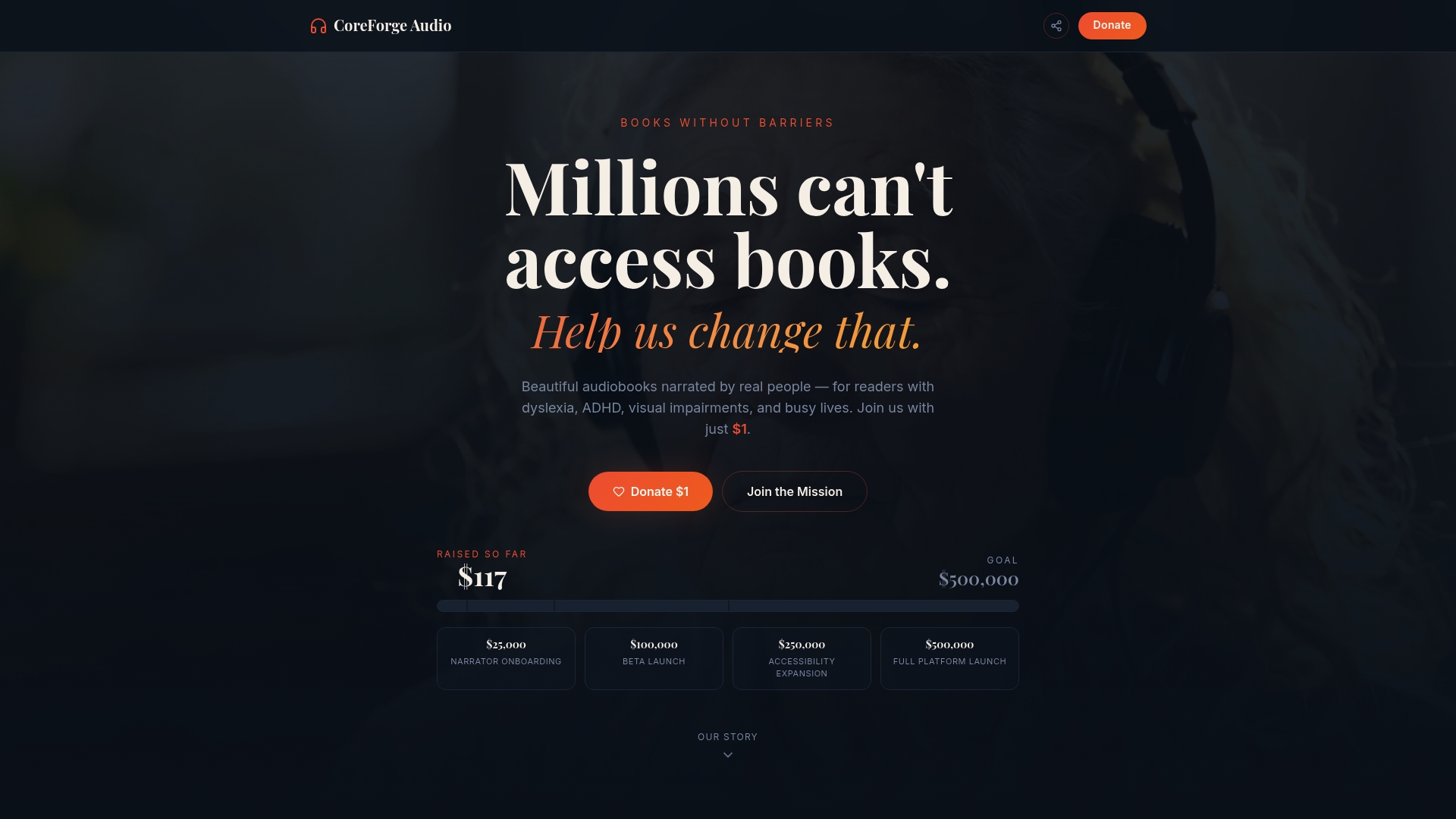
Coreforgeaudio runs on a micro-donation and reward-tier model, which means early access and audiobook credits are available through the fundraising campaign rather than a locked subscription. For educators and school teams, the platform is designed to support classroom adoption with the accessibility features that IEP and 504 plans typically require. Visit Coreforgeaudio to join the early access list, explore reward tiers, or support the campaign and get narrated content in your learner's hands now.
Authoritative sources and next resources to explore
The sources below are the most reliable starting points for parents, educators, and caregivers who want to go deeper on any topic covered in this guide.
- Harvard Health: Dyslexia tools and supports — Covers assistive technology, structured phonics, and legal accommodations in plain language.
- Child Mind Institute: How to teach kids with dyslexia to read — Direct, evidence-based guidance on phonics instruction and what actually works.
- Understood.org — Practical resources for learning and thinking differences, including ADHD, dyslexia, and processing challenges.
- CAST: How to personalize the reading experience — Universal Design for Learning framework and free device-level tool guidance.
- NICHD: Learning Disabilities Resources — Federal research programs, National Reading Panel findings, and IDA practice standards.
- National Library Service (NLS), Library of Congress — Free braille and audio reading materials for qualifying individuals with print disabilities.
- Coreforgeaudio Blog: Assistive technology and reading — Overview of current assistive technologies and nonprofit roles in increasing access.
- Coreforgeaudio Blog: Audiobooks for readers with dyslexia — Selection criteria and setup tips for dyslexic readers specifically.
- Coreforgeaudio Blog: Multisensory learning with audiobooks — Practical examples pairing audio with multisensory phonics activities.
- Coreforgeaudio Blog: How audiobooks reduce achievement gaps — Research-backed piece on audio access and curriculum equity.