

Audio is the most direct tool educators and parents have for reducing the decoding burden that makes reading so exhausting for dyslexic learners. The role of audio in dyslexia learning is to bypass the phonological bottleneck, giving students access to vocabulary, story, and ideas that their reading mechanics would otherwise block. Tools like Learning Ally audiobooks and ReadSpeaker text-to-speech (TTS) software now make this access scalable across classrooms and homes. Research from MIT's McGovern Institute confirms that audio resources improve vocabulary outcomes, but only when paired with explicit instructional strategies. This guide breaks down what works, what does not, and exactly how to structure audio sessions for real comprehension gains.
How does audio technology assist different reading profiles?
Audio support for dyslexia does not work the same way for every learner. The cognitive profile behind dyslexia centers on phonological processing deficits, which means decoding printed text consumes disproportionate working memory. When TTS or audiobooks remove that decoding demand, the brain can redirect resources toward meaning-making. That is the theory. The reality is more nuanced.
An eye-tracking study on TTS found that dyslexic students read faster and with less effort under TTS conditions, but showed no significant comprehension gain compared to silent reading. This finding matters because it reframes what audio actually delivers: relief from effort, not automatic understanding. Educators who expect TTS to close comprehension gaps without additional instruction will be disappointed.

The picture shifts for students with ADHD-related reading difficulties. The same eye-tracking research showed that students with ADHD benefit more in comprehension from TTS than students with dyslexia do. For ADHD profiles, the pacing and auditory signal of TTS appears to sustain attention in ways that improve understanding. For dyslexic profiles, the primary gain remains fluency and reduced effort.
Here is what that means for your planning:
- Dyslexic learners: Use audio primarily to reduce decoding load and increase text access. Set comprehension goals separately through questioning and discussion.
- ADHD-related reading difficulties: Audio pacing can directly support comprehension. Pair TTS with structured note-taking to capitalize on the attention benefit.
- Dual profiles (dyslexia plus ADHD): Both access and attention benefits apply. Prioritize learner control over playback speed and voice.
Pro Tip: Before selecting an audio tool, identify whether your student's primary barrier is decoding effort or sustained attention. That single distinction determines whether you are optimizing for access or comprehension from the start.
Cognitive Load Theory explains the underlying mechanism. When decoding consumes most of a student's working memory, little capacity remains for inference, prediction, or vocabulary acquisition. Audio frees that capacity. But freed capacity does not automatically fill with comprehension. It needs instructional scaffolding to do so.
What does the research say about audiobooks and vocabulary gains?
The most cited recent evidence on the benefits of audio in learning comes from MIT's McGovern Institute. An eight-week randomized controlled trial found that audiobooks paired with tutoring produced significantly larger vocabulary gains than audiobooks alone, particularly for struggling readers. The implication is direct: audio is an access tool, not a standalone intervention.
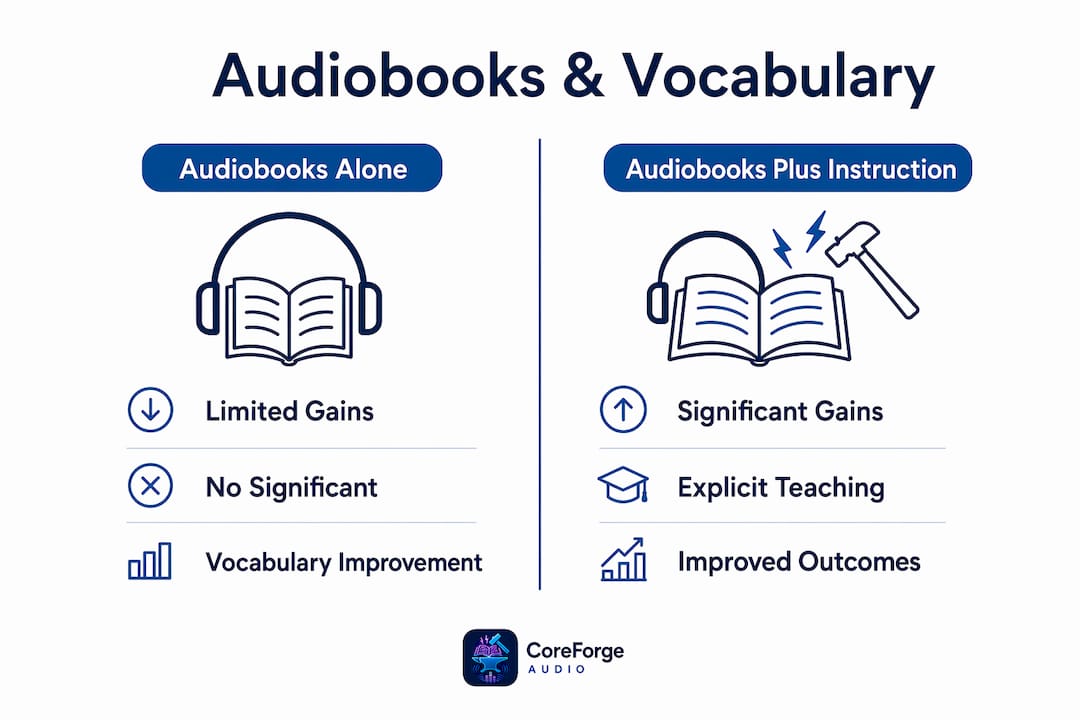
The MIT News report on the same study reinforced this finding. Audiobooks alone did not improve vocabulary for poor readers. Gains appeared only when explicit, one-on-one instruction accompanied the listening. This is not a minor caveat. It is the central design principle for any audio-based dyslexia program.
| Condition | Vocabulary outcome for struggling readers |
|---|---|
| Audiobooks alone | Limited or no significant gain |
| Audiobooks plus explicit tutoring | Significant vocabulary improvement |
| Students from lower socioeconomic backgrounds | Gains less pronounced, even with instruction |
The third row in that table deserves attention. Students from lower socioeconomic backgrounds showed smaller gains even when instruction was added. This suggests that vocabulary exposure outside of school, background knowledge, and access to rich language environments all interact with audio-based learning. A student who hears complex language regularly at home will extract more from an audiobook than one who does not. Designing effective programs means accounting for that gap, not assuming audio alone will close it.
Audiobooks do provide access to rich linguistic content that struggling readers cannot reach through print. A student who reads at a third-grade level can listen to a fifth-grade novel, absorbing syntax, vocabulary, and narrative structure that would otherwise be unavailable. That exposure matters for language development. But exposure without interaction produces limited retention. The MIT McGovern research makes clear that adult-guided questioning and vocabulary focus are what convert audio access into actual learning.
How to structure effective audio sessions for dyslexic learners
Passive listening is the most common mistake educators and parents make with dyslexia audio resources. A student wearing headphones and listening to an audiobook without structured engagement is not necessarily learning. Dyslexia UK's active listening framework addresses this directly, and the structure it recommends is both practical and research-grounded.
Here is a session structure that works:
- Preview vocabulary before listening. Identify two or three words from the upcoming segment that may be unfamiliar. Discuss their meaning briefly. This primes the student's working memory to recognize and retain those words during listening.
- Limit segments to five to ten minutes. Structured sessions with brief segments and intentional pauses keep students cognitively active. Longer stretches invite passive drift.
- Pause and ask a targeted question. Use predictive questions ("What do you think will happen next?") or comprehension checks ("Why did the character make that choice?"). This is not a quiz. It is a thinking prompt.
- Ask for a brief retell. After each segment, have the student summarize in one or two sentences. Retelling consolidates memory and reveals gaps in understanding before they compound.
- Close with a connection task. Ask the student to connect something from the listening to their own experience or to a previous book. This builds inferential thinking, the skill that audio alone does not develop.
Pro Tip: Use sticky notes or a voice memo app to capture words or ideas during listening. Physical or verbal output during audio sessions prevents the passive drift that makes long listening sessions unproductive.
Visual tracking alongside audio strengthens the dual-modality benefit. When students follow along in a physical or digital text while listening, they activate both auditory and visual processing channels. This approach, grounded in Dual Coding Theory, builds stronger memory traces than audio alone. Tools that highlight text in sync with narration, such as those built into many TTS platforms, make this easier to implement without requiring the student to track manually.
The active listening routine recommended by Dyslexia UK also includes praising focus and effort during sessions. For dyslexic learners who have often experienced reading as a source of frustration, positive reinforcement during audio sessions builds the confidence that sustains engagement over time. You can find more on implementing audiobooks in classrooms in Coreforgeaudio's dedicated resource for special educators.
How does TTS software integrate into dyslexia learning?
Text-to-speech is the most widely deployed audio technique for dyslexia in school settings. When embedded directly into digital content, TTS reduces the friction between a student and the text in front of them. ReadSpeaker, one of the leading TTS platforms in education, frames this through both Dual Coding Theory and Cognitive Load Theory. Embedded TTS frees working memory from decoding, creating capacity for comprehension, but only when the tool is designed with learner control in mind.
The features that determine whether TTS helps or hinders:
- Pacing control: Students must be able to slow narration without losing their place. A student processing at 0.8x speed is not struggling. They are self-regulating.
- Voice selection: Monotone or robotic voices increase cognitive effort. Human-quality voices reduce it. This is one reason human-narrated audiobooks outperform many TTS outputs for engagement.
- Visual text highlighting: Synchronized highlighting keeps the student's eyes on the text, reinforcing the print-to-sound connection that phonics instruction targets.
- Seamless curriculum integration: TTS that requires switching between apps or platforms adds friction. Integrated TTS within learning flow produces better outcomes than standalone tools.
One pitfall to avoid is the redundancy effect. When a teacher reads aloud while TTS simultaneously narrates, or when on-screen text duplicates audio word-for-word without visual differentiation, cognitive load can actually increase rather than decrease. The brain processes competing identical inputs less efficiently than a single clear channel. TTS works best as a replacement for silent reading, not an addition layered on top of other simultaneous inputs.
TTS also carries a risk for typically developing students when misapplied. Research shows it can disrupt fluent reading in students who do not need decoding support, by interrupting the natural reading rhythm. In mixed classrooms, TTS should be offered as an opt-in accommodation, not a universal default. For dyslexic learners specifically, the audio boosts differentiated instruction approach that Coreforgeaudio documents offers a practical model for deploying TTS without disrupting the broader class.
Key takeaways
Audio reduces decoding load for dyslexic learners, but comprehension and vocabulary gains require explicit instructional pairing to materialize.
| Point | Details |
|---|---|
| Audio as access, not cure | TTS and audiobooks reduce effort but do not automatically improve comprehension without instruction. |
| Instruction multiplies audio gains | Audiobooks paired with explicit tutoring produce significantly larger vocabulary gains than listening alone. |
| Profile-specific planning | Dyslexic learners gain fluency relief from TTS; ADHD profiles gain more in comprehension. |
| Active listening is non-negotiable | Structured sessions with previewing, pausing, questioning, and retelling convert passive listening into learning. |
| TTS design features matter | Pacing control, voice quality, and text highlighting determine whether TTS supports or overloads the learner. |
What I have learned from watching audio used well and badly
The most common error I see is treating audio as a finish line rather than a starting point. A student gets access to an audiobook, the teacher checks the accommodation box, and everyone assumes learning is happening. It is not. Access is the precondition for learning, not learning itself.
What actually works is treating audio the way a good coach treats a training aid. You use it deliberately, you watch what it reveals about the athlete's gaps, and you adjust. When a student listens to a chapter and cannot retell the main idea, that is not a failure of the audio tool. It is diagnostic information. The student may need more vocabulary previewing, shorter segments, or more explicit modeling of what "paying attention while listening" looks like.
I have also seen educators dismiss TTS because it did not improve test scores immediately. That expectation is misaligned with what the research on TTS actually shows. The first goal is reducing effort and increasing access. Comprehension gains come later, with instruction. Setting realistic, staged goals prevents premature abandonment of tools that are genuinely helping.
The other thing worth saying plainly: human-narrated audio is not equivalent to robotic TTS for engagement and motivation. A student who connects with a narrator's voice will listen longer, retain more, and return to the material voluntarily. That motivation effect is real, and it compounds over time in ways that are hard to measure but easy to observe.
— Sarmed
Explore audio resources built for dyslexia support
Coreforgeaudio is building a platform specifically designed for learners who face reading barriers, including dyslexia, ADHD, and visual impairments. Every audiobook on the platform is human-narrated, with adjustable playback speeds, dyslexia-friendly fonts, and multilingual support built in from the ground up. These are not afterthought accommodations. They are core design decisions made with dyslexic learners in mind. If you are an educator or parent looking for curated audiobooks for dyslexia that pair well with the instructional strategies covered in this article, Coreforgeaudio is worth exploring. Visit Coreforgeaudio to learn more about the platform and its mission to make reading accessible for everyone.
FAQ
Does TTS improve reading comprehension for dyslexic students?
TTS reduces reading effort and time for dyslexic students but does not significantly improve comprehension on its own. Comprehension gains require explicit instructional strategies paired with audio use.
How long should an audio session be for a dyslexic learner?
Sessions of five to ten minutes per segment are most effective. Shorter, structured chunks with pauses for questioning prevent passive listening and keep working memory engaged.
Are audiobooks enough to build vocabulary in struggling readers?
Audiobooks alone produce limited vocabulary gains for poor readers. An eight-week MIT study found that explicit one-on-one instruction combined with audiobook listening is what drives significant vocabulary improvement.
What TTS features matter most for dyslexia support?
Pacing control, human-quality voice options, and synchronized text highlighting are the three features that most directly support dyslexic learners. Seamless integration into existing curriculum materials also reduces friction and improves consistency of use.
How is audio support different for dyslexia versus ADHD?
Dyslexic learners benefit primarily from reduced decoding effort through audio. Students with ADHD-related reading difficulties show greater comprehension gains from TTS, likely because the auditory signal sustains attention more effectively than silent reading.