
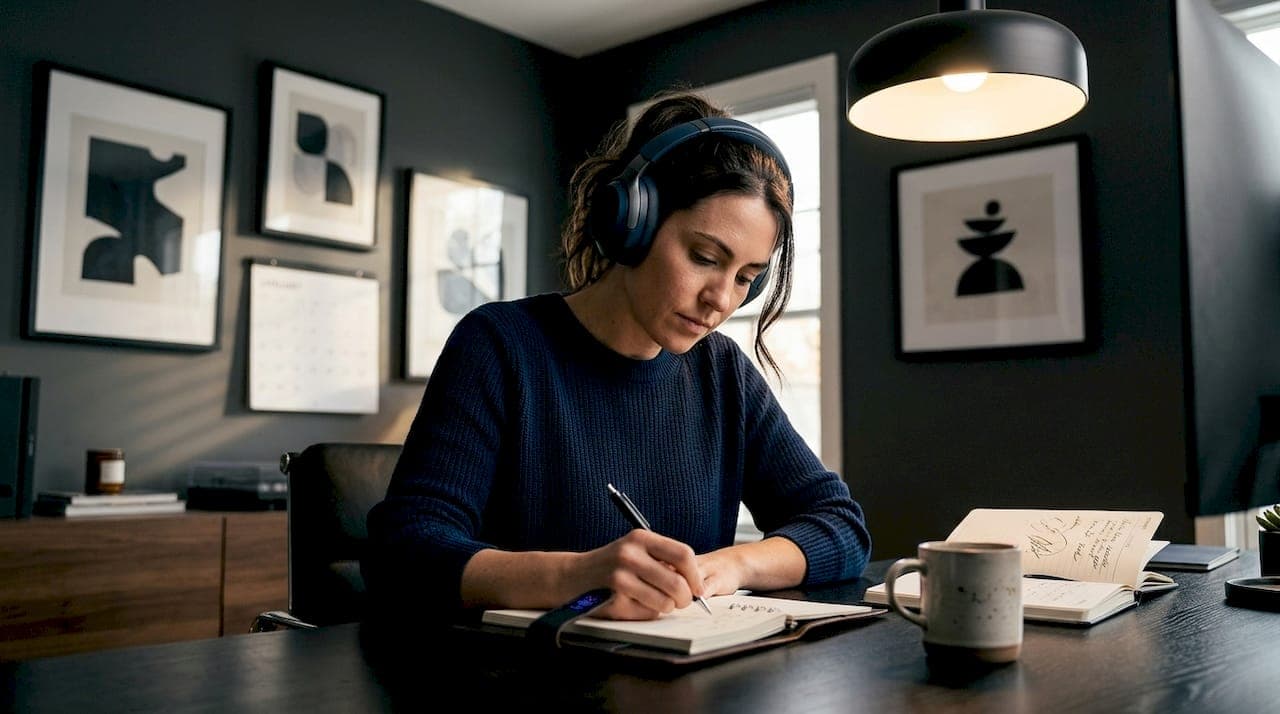
Most people assume the role of audio content in productivity is simple: swap text for sound, and you're done. That assumption misses almost everything that matters. Audio doesn't automatically make you more productive any more than owning a gym membership makes you fit. The real gains come from how audio is used, how well it's produced, and whether it actually matches the listener's cognitive needs. For people with dyslexia, visual impairments, or packed schedules, the difference between audio done right and audio done carelessly is the difference between a genuine breakthrough and an expensive distraction.
Table of Contents
- Why audio content matters for people with dyslexia and learning differences
- Maximizing productivity for visually impaired individuals and busy professionals with audio content
- Ensuring audio quality: listening effort and intelligibility for optimal productivity
- Best practices for integrating audio content to boost comprehension and productivity
- Rethinking audio content: why quality and engagement trump format alone
- Discover expert audio solutions to enhance your productivity
- Frequently asked questions
Key Takeaways
| Point | Details |
|---|---|
| Audio reduces decoding effort | Audio content helps dyslexic individuals by bypassing difficult print decoding tasks, improving comprehension. |
| Hands-free learning | Visually impaired and busy users leverage audio during idle time for effective spaced repetition and review. |
| Listening effort impacts productivity | High-quality, intelligible audio lowers cognitive load, maintaining attention and accuracy. |
| Active engagement is essential | Pause-and-recall and structured audio improve retention versus passive listening. |
| Test your setup | Audio processing can help or hinder; test devices and environments to optimize learning. |
Why audio content matters for people with dyslexia and learning differences
The common framing of dyslexia as a "reading problem" undersells how deep the challenge runs. Dyslexia isn't just about struggling with letters on a page. Research shows that individuals with dyslexia show weaker audiovisual associative learning even in tasks that have nothing to do with language, meaning the brain has a harder time forming reliable links between what it hears and what it sees. That's a significant finding. It means audio content benefits are real, but they're not automatic. The audio has to be trustworthy, well-timed, and paired with meaning anchors to actually reduce cognitive load rather than add to it.
When audio is reliable and synchronized with meaning, it sidesteps the decoding bottleneck that slows dyslexic readers down. Decoding (sounding out written words letter by letter) burns enormous mental energy. Audio hands the meaning directly to the listener, freeing that energy for comprehension, analysis, and recall. That's where the productivity gain lives.
The most effective approach isn't audio alone. It's a two-stage method:
- Listen first for structure. Play the audio through once to absorb the overall shape of the information: the main argument, the sequence, the key terms.
- Review visuals selectively. After listening, return to charts, diagrams, or key passages to reinforce what the audio established.
- Use synchronized formats when possible. Audiobooks or learning tools that highlight text as narration plays give the brain a reliable audiovisual link to hold onto.
- Avoid multitasking during the first listen. Full attention during the structural pass is what makes the visual review efficient.
"The productivity advantage of audio for dyslexic learners is greatest when the audio is reliable and time-aligned with meaning, not simply present." — CoreForge Audio editorial team, drawing on current audiovisual learning research.
This two-stage approach works because it respects how the dyslexic brain actually processes information rather than forcing it to operate like a neurotypical one. Pairing audio with accessible audio solutions that include features like adjustable narration speed and dyslexia-friendly text display makes this method far more practical to apply consistently.
Pro Tip: When using audio for complex material, listen at a slightly slower speed on the first pass. Comprehension at 0.85x beats confusion at 1.5x every time.
Maximizing productivity for visually impaired individuals and busy professionals with audio content
For visually impaired users, audio isn't an accommodation. It's the primary interface with written knowledge. The impact of audio on work for this group is direct and non-negotiable. But for busy professionals, the case is more nuanced and, honestly, more exciting once you see the numbers.

The average college commute adds up to roughly 90 minutes of daily travel time that typically goes unused for learning. That's 7.5 hours a week. Over a semester, that's equivalent to an entire extra week of study time, captured without adding a single minute to your desk schedule. The same math applies to professionals who walk, commute, or exercise.
The key is how you use that time. Passive listening produces weak results. Active listening produces strong ones. Here's a practical framework for improving productivity with audio during mobile moments:
- Choose structured content. Podcasts or audiobooks with clear chapter breaks and verbal summaries give you natural pause points.
- Pause and recall. Every 10 to 15 minutes, stop the audio and mentally summarize what you just heard. This is the single highest-impact technique for retention.
- Self-quiz at the end of each session. Ask yourself two or three questions about the material before moving on.
- Schedule shorter sessions more often. Three 20-minute sessions spread across a day outperform one 60-minute block for long-term retention. That's the spacing effect in practice.
- Use sleep as a memory tool. Reviewing audio content in the 30 minutes before sleep primes your brain's consolidation process overnight.
Stat worth knowing: Spaced repetition through audio micro-reviews can significantly outperform single-session desk study for long-term recall, according to study podcast research on distributed practice.
Pro Tip: Create a short "end-of-day audio recap" playlist of 5-minute summaries from your most important learning sessions. Play it during your evening routine. Your memory will thank you in the morning.
The right audio productivity tools make this workflow easier by offering adjustable playback speeds, bookmarking, and chapter navigation so you can move through content intentionally rather than passively.
Ensuring audio quality: listening effort and intelligibility for optimal productivity
Here's something most productivity guides skip entirely: the quality of the audio signal itself has a measurable effect on how much mental energy you burn just hearing it. This is called listening effort, and it's a real cognitive cost.
Research on noise-reduction algorithms shows that the same processing that helps cochlear implant users hear more clearly can actually degrade speech intelligibility for normal-hearing listeners. More processing is not always better. For someone with a hearing aid or implant, noise reduction in a busy coffee shop might be transformative. For someone without those devices, the same algorithm might make speech sound robotic and harder to follow, increasing cognitive load without the listener even realizing it.
Listening effort is measured by how hard your brain works to extract meaning from a signal. Poor audio quality, background noise, or mismatched processing all raise that effort. And when listening effort goes up, attention and recall go down, regardless of hearing ability. You can be neurotypical with perfect hearing and still lose comprehension when audio quality is poor.
Here's what this means practically:
- Test your setup before long sessions. A 5-minute test in your actual listening environment is worth more than any spec sheet.
- Match the device to the environment. Earbuds with active noise cancellation work well in transit. Open-back headphones are better for quiet office work.
- Avoid over-processed audio. Heavily compressed or algorithmically altered narration can sound fatiguing within 20 minutes.
- Prioritize human narration over synthetic voices for long sessions. Human speech carries natural prosody (the rhythm and stress patterns of language) that reduces listening effort over time.
"Intelligibility and effort are not the same thing. Audio can be technically audible but still cognitively exhausting, and that exhaustion directly undermines productivity." — CoreForge Audio editorial team.
The role of sound in workflow is often invisible until something goes wrong. Investing in improving audio clarity upfront pays dividends in sustained attention across every session.
Best practices for integrating audio content to boost comprehension and productivity
Understanding the benefits and the risks sets you up to actually use audio well. Here's how to build a workflow that holds up.
Core techniques:
- Choose audio with built-in structure. Content that uses clear verbal cues ("here's the key point," "let's summarize") gives your brain signposts. Unstructured rambling, even on good topics, is hard to retain.
- Build active pause points into every session. Set a timer or use chapter breaks as natural stopping points for recall practice.
- Layer audio with selective visual review. Don't try to read along with everything. Save visual review for the sections that felt unclear on first listen.
- Optimize your listening environment. A real-time listening effort model shows that effort changes dynamically with environment. What works at your desk may not work on a crowded train.
- Use the two-stage method for dense material. As the dyslexia research confirms, structural listening followed by selective visual review outperforms either approach alone.
Quick-reference comparison: passive vs. active audio use
| Approach | Retention after 1 week | Cognitive effort | Best for |
|---|---|---|---|
| Passive background listening | Low | Low | Mood or ambient sound |
| Single active listen | Moderate | Moderate | Familiar material |
| Active listen plus recall | High | Moderate to high | New or complex content |
| Two-stage audio plus visual | Highest | High initially, lower over time | Dense or technical material |
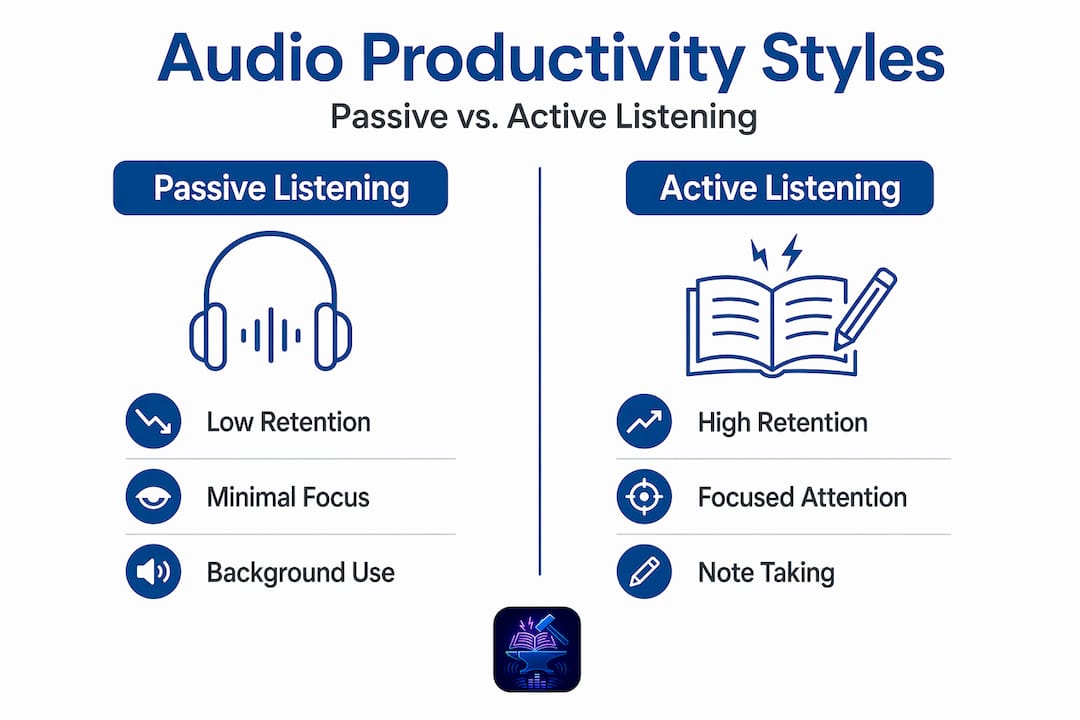
Pro Tip: Treat your audio sessions like meetings with an agenda. Know what you want to get out of the session before you press play. Listeners who set a learning goal before starting retain significantly more than those who simply queue something up.
Exploring audio learning strategies designed specifically for diverse learners can give you a structured starting point rather than building your system from scratch.
Rethinking audio content: why quality and engagement trump format alone
Here's the uncomfortable truth that most content about the effectiveness of podcasts at work and audio tools for productivity avoids saying plainly: audio format alone does not make you more productive. Not even close.
The research is clear. Listening effort, audio quality, and active engagement are the variables that actually determine outcomes. You can hand someone the world's best audiobook and if they're half-distracted, listening on a poorly matched device, in a noisy environment, the benefit evaporates. The format is just a container. What goes inside it and how the listener interacts with it is everything.
This matters especially for the people audio is supposed to serve most: dyslexic learners who need reliable audiovisual alignment, visually impaired users who depend on narration quality as their primary access point, and professionals who are already operating at cognitive capacity. For all three groups, a mediocre audio experience isn't just unhelpful. It's actively costly. It burns attention, raises effort, and can create a false sense of having "done the work" when retention is actually minimal.
The field of rethinking audio strategies for diverse learners is moving toward personalized, effort-aware design. That means audio content built with specific users in mind, tested in real environments, and paired with interaction prompts that force active engagement. It also means rejecting the idea that AI-generated narration at scale is a neutral upgrade. Synthetic voices, however improved, still carry higher listening effort for many users compared to skilled human narration, particularly over long sessions.
The honest standard for audio content that actually enhances work efficiency is this: does it reduce the effort to access meaning, or does it just change the channel through which effort happens? If the answer is the latter, you haven't gained anything.
Discover expert audio solutions to enhance your productivity
Applying everything in this article is easier when you have a platform built specifically for the people it's meant to serve.
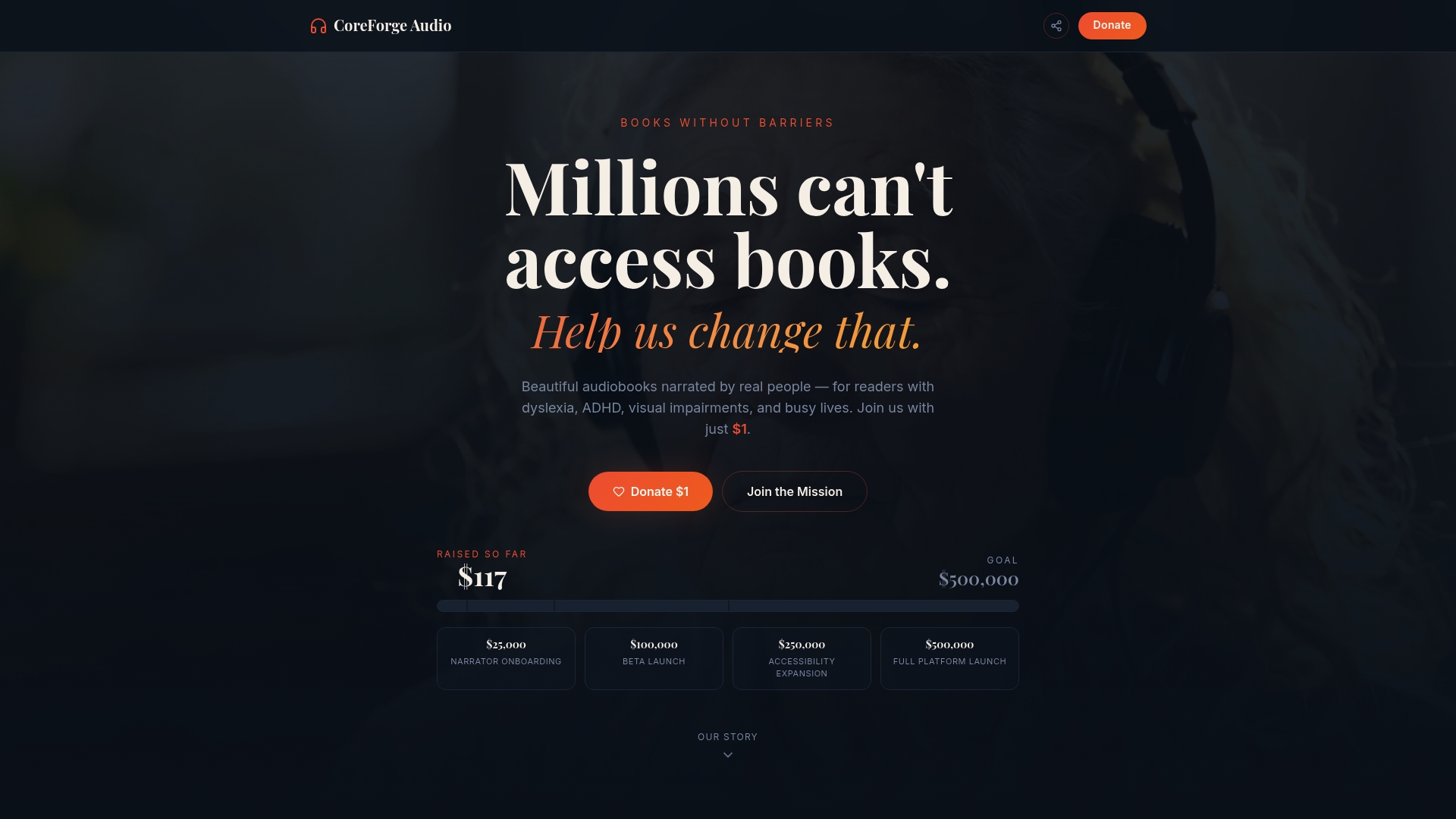
CoreForge Audio services are designed from the ground up for listeners who need more than a generic audio player. The platform prioritizes human-narrated audiobooks for lower listening effort, dyslexia-friendly display options, adjustable narration speeds, and multilingual support so the format actually fits the user. For visually impaired listeners, narration quality and navigation accessibility are central features, not afterthoughts. For busy professionals, the platform's structure supports the kind of intentional, session-based listening that produces real retention. CoreForge Audio is currently fundraising to bring these tools to a global audience, and every contribution directly supports accessible storytelling for people who need it most.
Frequently asked questions
How does audio content specifically help people with dyslexia improve productivity?
Audio content bypasses the decoding difficulties common in dyslexia by providing synchronized speech that reduces reliance on print, improving comprehension and saving time. The productivity gain is strongest when the audio is time-aligned with meaning, not simply playing in the background.
Can busy professionals really use audio content effectively during commutes and multitasking?
Yes, audio facilitates hands-free review during idle times, leveraging the spacing effect to boost retention without cutting into dedicated work hours. The condition is active engagement: passive listening produces almost no durable learning benefit.
Does audio quality affect how productive audio learning or work sessions are?
Absolutely. Poor audio quality or mismatched noise-reduction processing increases listening effort and reduces comprehension, directly undermining the productivity benefits audio is supposed to provide.
What should I do to ensure audio content really boosts my productivity?
Engage actively by pausing for recall, choose audio with clear structure and verbal cues, optimize your listening environment, and treat every session with a defined goal. Background or distracted listening produces almost no learning benefit, so engagement is the non-negotiable variable.