
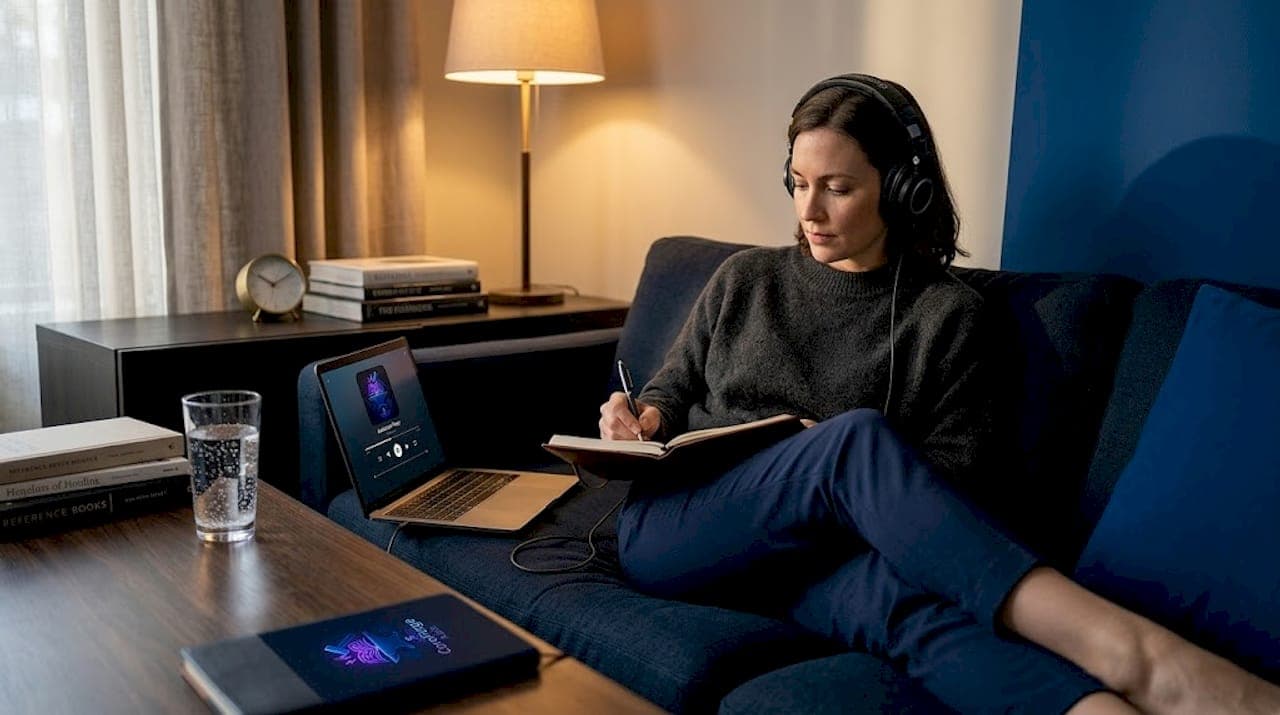
Audio content has a reputation problem. Many people assume it works best in short bursts: news briefs, quick how-to clips, five-minute podcasts. But that assumption shortchanges the real power of audio, especially for people navigating dyslexia, ADHD, or visual impairments. Long-form audio, from full audiobooks to deep-dive storytelling, can match or even surpass traditional reading in comprehension for many listeners, and it does so while removing the barriers that make print frustrating or impossible for millions of people.
Table of Contents
- Understanding long-form audio: what makes it different?
- Breaking barriers: how audio unlocks access for dyslexia, ADHD, and visual impairments
- Comprehension and control: the science behind listening and learning
- Inclusivity in action: real-world strategies for educators and advocates
- Why "suitable for audio" is about more than format
- Explore accessible long-form audio solutions
- Frequently asked questions
Key Takeaways
| Point | Details |
|---|---|
| Accessibility advantage | Long-form audio removes barriers for people with dyslexia, ADHD, or visual impairments, enabling full content engagement. |
| Comparable comprehension | Research finds listening comprehension for long-form audio often matches reading when listeners have control features. |
| Engagement strategies matter | Structured audio, active listening routines, and playback controls significantly boost retention and focus. |
| Inclusivity beyond disability | Universal audio design benefits all learners, not just those with specific accessibility needs. |
| Practical implementation | Combining audio with scaffolds like highlighting and feedback loops maximizes learning and enjoyment. |
Understanding long-form audio: what makes it different?
Long-form audio is not simply "more audio." It is a distinct format with a distinct purpose. Think full audiobooks, serialized storytelling, extended documentary-style podcasts, or lecture recordings that stretch well past the thirty-minute mark. This is fundamentally different from a two-minute explainer clip or a short social media audio post.
Where short-form audio delivers quick information in digestible pieces, long-form audio builds worlds, sustains arguments, and develops ideas over time. For learners and story lovers alike, that depth is the point. The sustained narrative arc of a novel or the thorough unpacking of a complex topic in a multi-hour podcast delivers a kind of engagement that a quick clip simply cannot.
Here is what sets long-form audio apart from shorter formats:
- Sustained context building: Longer content allows ideas to develop gradually, giving listeners time to form mental models before moving on.
- Character and narrative immersion: Storytelling gains power over time. Emotional investment builds across hours, not minutes.
- Deeper topic coverage: Educators and advocates often need to cover complex material that cannot be meaningfully compressed.
- Flexible consumption: Long-form audio can be paused, rewound, and resumed, making it a fit for real life.
- Reduced visual demand: There is nothing to look at, which is a feature rather than a limitation for many users.
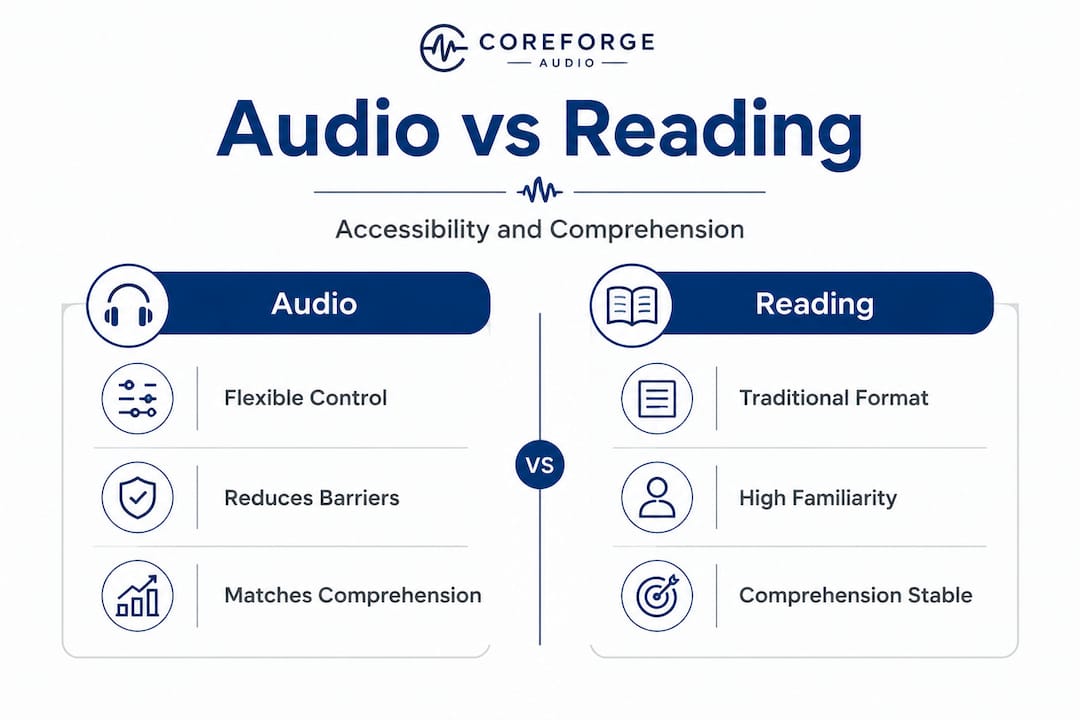
Research confirms what many listeners already know: comprehension from audiobooks can be comparable to reading for the same text, but the advantages depend on pace control and the listening context. That nuance matters. It means the format is not the limitation. The design and delivery of the content is what determines its effectiveness.
When long-form audio is structured thoughtfully, with clear chapter breaks, signposting language, and opportunities for the listener to pause and reflect, it becomes a genuinely powerful learning and engagement tool.
Breaking barriers: how audio unlocks access for dyslexia, ADHD, and visual impairments
Now that we have established the playing field, it is time to see how long-form audio uniquely empowers accessibility.
For someone with dyslexia, the act of reading print is physically and cognitively demanding. Decoding letters into words, tracking lines across a page, and managing the anxiety that comes from slow or error-prone reading all pile onto the actual task of understanding what the text means. Audio removes that decoding layer entirely.
"Long-form audio supports dyslexia and ADHD access mainly by reducing the decoding burden while still delivering meaning through the auditory channel."
That is a significant shift. A listener with dyslexia who struggles to get through a single page in ten minutes can absorb entire chapters of an audiobook at a natural, comfortable pace. The story or information reaches them intact, without the exhaustion that decoding print often creates.
For people with ADHD, the challenge is different. Sustained attention during long reading sessions is notoriously difficult, especially when the visual demands of text compete with environmental distractions. Audio addresses this in a different way. Audio paired with synchronized visual highlighting is a proven methodology for sustaining attention across long passages, essentially giving the brain two reinforcing channels instead of one.

For people with visual impairments, audio is not a workaround. It is a primary access route. A well-narrated audiobook delivers the full experience of a story or educational text without requiring any visual processing at all.
Here are the specific challenges that long-form audio addresses:
- Print-based decoding difficulty (dyslexia)
- Sustained attention and focus during extended reading (ADHD)
- Visual fatigue from screen or print reading
- Complete visual inaccessibility for blind or low-vision users
- Limited access to braille or large-print formats in many communities
- Reading-related anxiety and low reading confidence
Organizations working on inclusive storytelling projects understand that removing barriers is not about lowering the quality of the experience. It is about widening the door so more people can walk through it.
Comprehension and control: the science behind listening and learning
Beyond access, effective learning with long-form audio depends on how the content is delivered and used.
Here is a side-by-side look at how audio and reading compare under different conditions:
| Condition | Reading comprehension | Audio comprehension |
|---|---|---|
| Self-paced with note-taking | High | Moderate |
| Controlled speed with rewind | Moderate | High |
| Fixed pace, no replay | High | Lower |
| Structured with segmentation | High | High |
| Paired with visual highlighting | Moderate | High |
The table tells an important story. When listeners have control, such as the ability to rewind, adjust speed, or jump between chapters, audio comprehension rises significantly. When they do not have those controls, the experience suffers. Comprehension can be weaker than self-paced reading for detailed understanding if listeners cannot control pace or backtrack.
The good news is that these controls are not difficult to build into an audio platform. They are design decisions. Playback speed adjustment, chapter navigation, bookmarking, and synchronized text highlighting are all features that transform passive listening into active learning.
Research into study podcasts adds another dimension to this picture. When the listening task is structured for learning through segmenting, signposting, and pairing with retrieval or active engagement techniques, retention improves significantly. This is the difference between long-form audio as passive background noise and long-form audio as an accessible methodology for real learning.
Dual coding is worth mentioning here. When audio is paired with synchronized text or visual chapter markers, the brain processes the information through two channels simultaneously. This reinforces memory and deepens understanding, particularly for complex material. It is one reason why the best accessible audio platforms do not just play sound. They create an integrated experience.
Pro Tip: When choosing or designing audio content for accessibility purposes, look for tools that offer at minimum pause, rewind, adjustable playback speed, and synchronized text highlighting. These four features alone dramatically improve outcomes for users with dyslexia, ADHD, and visual processing differences. You can explore long-form audio impact stories to see how these features translate into real-world access.
Inclusivity in action: real-world strategies for educators and advocates
Armed with the science, let us turn to the actionable frameworks used by leading educators and advocates.
Step-by-step plan for implementing accessible long-form audio:
- Assess your audience's needs first. Survey learners or community members about their specific challenges. Do they struggle with focus, decoding, visual access, or a combination? This shapes every other decision.
- Choose or create content with clear structure. Good long-form audio has chapter breaks, recaps, and signposting language like "in this section, we will cover..." These cues help all listeners, especially those with ADHD or processing differences.
- Prioritize platform features. Select delivery tools that offer playback control, speed adjustment, and chapter navigation at a minimum. Synchronized highlighting adds significant value for ADHD and dyslexia users.
- Add scaffolds around the audio. Do not rely on audio alone for long sessions. Pair it with brief written summaries, visual chapter maps, or reflection questions at key stopping points.
- Collect ongoing feedback. Build a regular feedback loop with your users. Ask what works, what loses them, and where they hit barriers. Adjust accordingly.
- Combine audio with other accessible technologies. Screen readers, closed captions on any supplementary video, dyslexia-friendly fonts in companion text, and adjustable interface contrast all work together to create a truly inclusive experience.
The research backs this layered approach. Audio access is most effective when paired with additional scaffolds like synchronization, segmentation, and active learning routines rather than relying on audio alone for long sessions.
Here is a quick-reference guide to features and practices that boost audio inclusivity:
| Feature or practice | Who benefits most | Impact level |
|---|---|---|
| Adjustable playback speed | ADHD, dyslexia, busy learners | High |
| Synchronized text highlighting | ADHD, dyslexia | High |
| Chapter navigation | All users | High |
| Pause and rewind | ADHD, visual impairment | High |
| Segmented content | All users | Medium to high |
| Companion text summaries | Dyslexia, visual impairment | Medium |
| Dyslexia-friendly fonts | Dyslexia | Medium |
| Multilingual support | Non-native speakers, diverse communities | High |
It is also worth addressing a common concern head-on. Some educators worry that offering audiobooks instead of print texts is somehow giving students an easier path. The research disagrees firmly. Audiobooks are not cheating, and both print and audiobooks offer distinct advantages. Print enables easier revisiting and note-taking, while audiobooks can be more engaging and accessible for many learners. Framing audio as a lesser option actively harms the students who need it most.
Advocates working on inclusive audio solutions can also benefit from broader guidance on web accessibility strategies that ensure the platforms delivering audio content are themselves accessible to all users.
Pro Tip: Ask users directly what works for them rather than assuming. Feedback forms, short pulse surveys after content sessions, or informal conversations with learners can reveal accessibility gaps that even well-designed tools miss. Real users know their own needs better than any designer or researcher.
Why "suitable for audio" is about more than format
Having explored practical steps, let us zoom out for a bigger-picture look at what "suitability" in audio content really means.
There is a long-running debate about whether listening to audiobooks "counts as reading." It is, frankly, the wrong conversation. The people who get caught up in format purity tend to lose sight of the actual goal: making stories, knowledge, and education available to every person who wants them.
Yes, there are nuances. Long-form audio as accessible storytelling is justified even when some people dispute that audiobooks count as reading, but print does offer unique reprocessing tools like notes and highlighting that audio has traditionally lacked. That gap is closing as more platforms integrate synchronized text and annotation features. The real lesson is that both formats have strengths, and the goal is to use each one intentionally.
At CoreForge Audio, we believe the debate misses the point entirely. A child with dyslexia who listens to an entire novel for the first time and falls in love with reading as a result has not "cheated." They have found their door. An adult with visual impairment who uses audiobooks to stay current in their field is not consuming a lesser form of content. They are accessing the same knowledge as everyone else, just through a channel that works for them.
Long-form audio is not inherently superior to short audio or to print. Its value lies entirely in whether it is designed thoughtfully for the audience it is meant to serve. A poorly narrated audiobook with no playback controls and no chapter markers is not an accessible solution. A beautifully narrated, well-structured audiobook delivered through a platform with speed control, highlighting, and dyslexia-friendly companion text absolutely is.
This is the frame we think educators and advocates need. Stop asking "is this the right format?" and start asking "is this the right design for this audience?" The answer to the format question is almost always "it depends." The answer to the design question can always be "yes, if we do it well."
Inclusive storytelling is not about picking a side in a format debate. It is about meeting people where they are, with the tools they need, in a form that respects both their challenges and their intelligence.
Explore accessible long-form audio solutions
Ready to put inclusive long-form audio into practice? Here is where to start.
At CoreForge Audio, we are building a platform designed from the ground up for the people who need it most. That means human-narrated audiobooks with professional voice actors, adjustable playback speeds, dyslexia-friendly companion fonts, multilingual support, and a commitment to fair pay for every creator involved. We are not cutting corners on accessibility features or on the quality of the narration, because both matter deeply to the communities we serve. If you are an educator, advocate, or someone navigating a reading challenge yourself, we invite you to explore the CoreForge Audio platform and join the movement to make storytelling accessible for everyone.
Frequently asked questions
Does listening to long-form audio actually help people with dyslexia learn better?
Yes, research shows that audio reduces the decoding burden for people with dyslexia, allowing them to focus on understanding and enjoying content rather than struggling through print. This makes learning significantly more accessible and less exhausting.
Is comprehension really the same when listening as when reading?
When listeners have control over pace and can revisit content, comprehension from audio can genuinely match that of reading for the same material. The key variable is user control, not the format itself.
What features make long-form audio more accessible for ADHD?
Active features like adjustable playback controls and synchronized visual highlighting are proven to sustain attention during long audio sessions by engaging both auditory and visual processing channels at once.
Can long-form audio benefit everyone, or just people with disabilities?
Long-form audio boosts engagement and comprehension for a wide range of listeners, including busy professionals, language learners, and multitaskers. It is especially transformative for people with dyslexia, ADHD, and visual impairments, but its accessibility benefits ripple outward to anyone who engages with it.
Do audiobooks "count as reading"?
Both print and audiobooks offer distinct benefits and neither should be viewed as inferior or as "cheating." The format that works for you is the one that connects you to stories and knowledge, and that is what matters.