
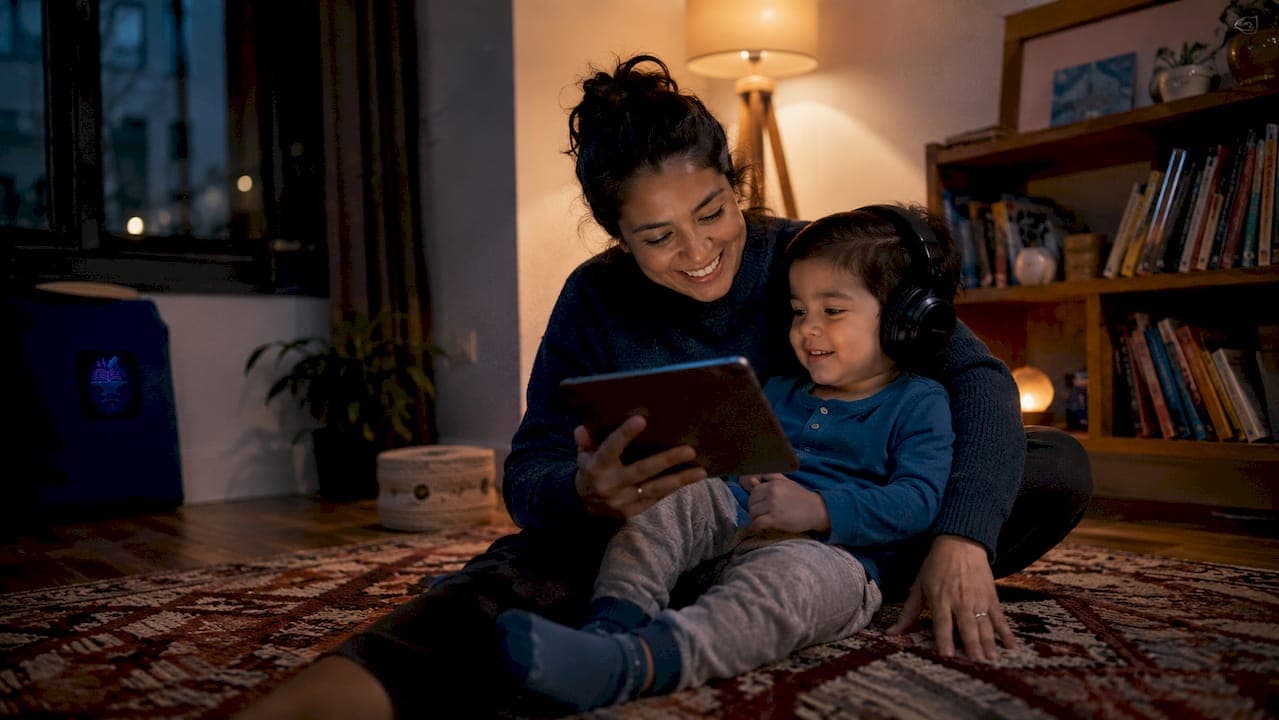
Audiobooks are a proven literacy tool that builds listening comprehension, vocabulary, and narrative understanding in children before they can decode print on their own. The role of audiobooks in early childhood literacy goes well beyond passive entertainment. Research from MIT's McGovern Institute and Harvard both confirm that listening comprehension activates overlapping neural networks with reading, making audio a legitimate entry point into language and story. For parents, educators, and caregivers, understanding how to use audiobooks alongside print, not instead of it, is the key to unlocking their full potential.
How audiobooks support early literacy and language development
The role of audiobooks in early childhood literacy starts with a developmental fact most parents do not know: a child's listening comprehension far outpaces their reading comprehension in the early years. Research shows that a typical 7-year-old may have listening skills at a 5th-grade level while reading at a 1st-grade level. That gap is not a problem. It is an opportunity.
Audiobooks fill that gap by exposing young children to vocabulary, sentence structures, and narrative patterns they cannot yet access through print. A child listening to Charlotte's Web narrated by a skilled voice actor encounters words like "radiant" and "humble" in rich emotional context. That context is what makes vocabulary stick. Studies consistently show that children who hear complex language in meaningful stories retain and use that vocabulary far more than those who encounter word lists alone.
Audiobooks also model narrative structure. Children learn how stories begin, build tension, and resolve. This narrative modeling is a core component of what literacy researchers call "story grammar," and it directly supports reading comprehension once decoding skills catch up.
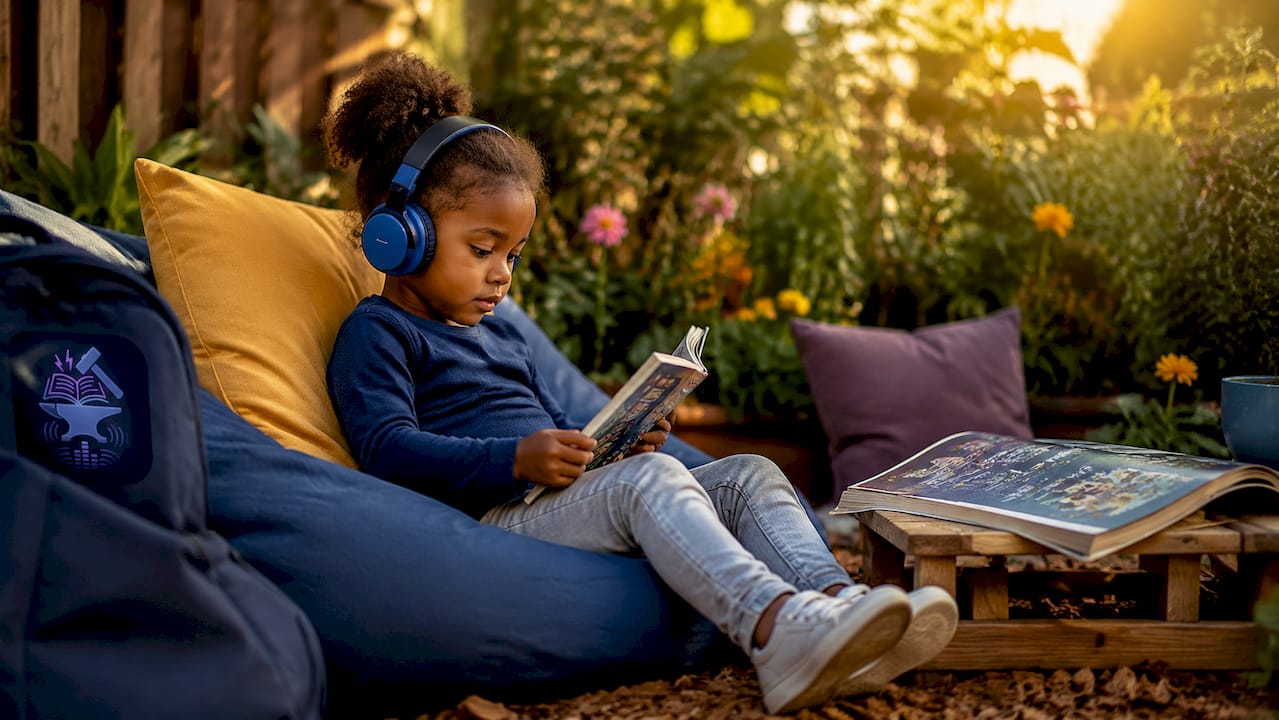
Pro Tip: Choose audiobooks that are one to two grade levels above your child's current reading level. This stretches their listening vocabulary without frustrating them.
Key benefits of audiobooks for early learners include:
- Vocabulary exposure: Children hear words in context, not isolation, which accelerates retention.
- Fluency modeling: Professional narrators demonstrate natural pacing, expression, and intonation.
- Narrative comprehension: Repeated story structures build the mental frameworks children use when reading independently.
- Motivation: Audio removes the decoding barrier, letting struggling readers access stories they love.
Audiobooks vs. print vs. both: which approach works best?
Multi-modal learning, the practice of pairing audiobooks with print books, produces the strongest literacy outcomes. Studies show that children who follow along in print while listening see better results in word recognition and vocabulary than those using either format alone. The reason is straightforward: hearing a word while seeing it on the page reinforces the connection between sound and symbol, which is the foundation of decoding.
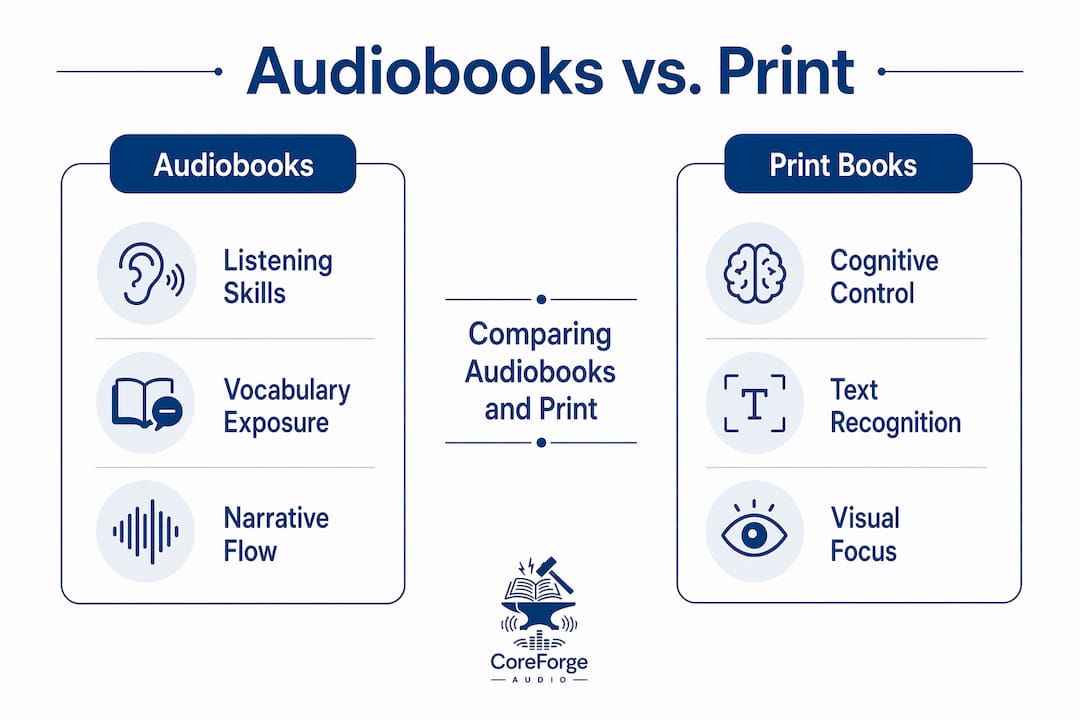
The table below compares the three approaches across key literacy skills:
| Literacy skill | Audio only | Print only | Audio + print combined |
|---|---|---|---|
| Vocabulary acquisition | Moderate | Moderate | High |
| Word recognition | Low | High | High |
| Fluency modeling | High | Low | High |
| Inferential comprehension | Moderate | High | High |
| Engagement for struggling readers | High | Low | High |
Print reading has one clear advantage: cognitive control. Research highlights that print readers naturally pause, reread, and slow down at difficult passages. That self-regulation supports deeper, inferential thinking. Audiobooks run at a fixed pace, which can limit the processing time some children need.
The combined approach captures the best of both. A child listening to a chapter while holding the book builds print awareness, phonics connections, and comprehension simultaneously. For advanced readers, it accelerates fluency. For struggling readers, it removes shame from the equation entirely.
Pro Tip: Use the multisensory learning approach of pointing to words on the page while the audiobook plays. This simple habit dramatically strengthens the sound-to-symbol connection in early readers.
What are the real limitations of audiobooks for young children?
Audiobooks are not a complete literacy solution on their own. Print reading supports inferential and analytical comprehension more effectively because readers control their own pace. A child who hears a confusing sentence in an audiobook cannot easily rewind the way a reader can reread a line. This fixed pacing is the primary limitation educators need to plan around.
A March 2026 MIT McGovern Institute study with hundreds of 3rd and 4th graders found that audiobooks alone produced modest vocabulary gains. Children who received both audiobooks and one-on-one tutoring showed significantly higher literacy improvement. The takeaway is clear: audiobooks work best as one component of a broader literacy plan, not as a standalone intervention.
Strategies to address these limitations include:
- Pause and discuss: Stop the audiobook at key moments to ask comprehension questions. This gives children the processing time that print reading provides naturally.
- Rewind for clarity: Teach children to rewind and relisten when they miss something, building the habit of active listening.
- Guided questions before listening: Preview vocabulary and ask prediction questions before pressing play. This primes comprehension and keeps attention focused.
- Caregiver involvement: Children with auditory processing challenges benefit most when an adult listens alongside them and facilitates discussion.
The goal is to give children cognitive control over the audio experience. That control is what transforms passive listening into active literacy practice.
Practical tips for building audiobook routines at home and in the classroom
Effective audiobook use starts with selection. Children's listening comprehension exceeds their reading comprehension in early years, so choose content that matches their emotional and intellectual maturity, not their reading level. A 6-year-old can handle the emotional complexity of The Phantom Tollbooth as a listener even if they cannot read it independently.
Here is a practical framework for integrating audiobooks into daily routines:
- Start with car rides and bedtime. These low-pressure moments remove performance anxiety. Children absorb stories without feeling tested, which builds a positive relationship with books.
- Pair audio with print for focused sessions. During dedicated reading time, use the audiobook as a guide. The child follows along in the physical book while listening.
- Repeat the same audiobook multiple times. Repeated listening paired with print follow-along is one of the most effective strategies for building fluency and word recognition. Children notice new details on each listen.
- Discuss the story afterward. Ask open-ended questions: "Why do you think the character did that?" This builds inferential comprehension that audio alone does not develop.
- Let children choose. Motivation is a literacy skill. A child who chooses their own audiobook listens more attentively and engages more deeply with the content.
For educators, audiobooks work well in differentiated instruction. A classroom can have struggling readers listening to a grade-level text while following along in print, while advanced readers listen to a more complex title independently. Both groups build literacy skills at their own level without stigma.
Pro Tip: For children with dyslexia or attention challenges, try the audiobook routine strategies that combine adjustable narration speeds with dyslexia-friendly text formats. Slowing narration to 0.8x speed gives struggling readers time to track words on the page.
How audiobooks close the literacy gap for diverse learners
Audiobooks are one of the most effective tools for literacy equity. Research and nonprofit initiatives show that audiobooks produce meaningful literacy gains in underserved and diverse populations, including children with dyslexia, multilingual learners, and those from low-resource households with limited access to print.
The specific populations that benefit most include:
- Children with dyslexia: Decoding is the barrier, not comprehension. Audiobooks bypass that barrier entirely, letting children access grade-level content and build vocabulary while their decoding skills develop separately.
- Multilingual learners: Hearing fluent, expressive narration in English builds prosody and natural language rhythm in ways that silent reading cannot replicate.
- Children from lower-income households: Print access is unequal. A library card and a device provide access to thousands of audiobooks at no cost, leveling the playing field significantly.
- Children with visual impairments: Audio is not an accommodation for these learners. It is the primary literacy channel, and high-quality human narration makes complex literature fully accessible.
The science behind audiobook learning confirms that listening comprehension is a core literacy skill, not a workaround. Treating it as such changes how educators and caregivers approach children who struggle with print.
Key takeaways
Audiobooks build essential literacy skills in early childhood when used alongside print, not as a replacement for it.
| Point | Details |
|---|---|
| Listening comprehension leads reading | A typical 7-year-old listens at a 5th-grade level while reading at a 1st-grade level. |
| Combined approach works best | Pairing audio with print produces stronger vocabulary and word recognition than either alone. |
| Audiobooks alone have limits | MIT research shows modest gains from audio only; pairing with instruction significantly increases outcomes. |
| Equity and access matter | Audiobooks serve children with dyslexia, multilingual learners, and those with limited print access. |
| Active engagement is required | Pausing for discussion and repeated listening turn passive audio into genuine literacy practice. |
Why I think we are underusing audiobooks in early education
I have spent years watching parents and teachers treat audiobooks as a guilty pleasure, something children do when they are too tired to "really" read. That framing is wrong, and it costs children real literacy gains.
The evidence from Harvard, MIT, and literacy researchers like those at The Literature Lady is consistent: listening comprehension is a legitimate cognitive skill that shares neural pathways with reading. A child who listens to 30 minutes of a well-narrated story is not avoiding literacy. They are practicing it.
What I find most compelling is the motivation argument. A child who falls in love with stories through audio is a child who wants to learn to read. That desire is the engine of literacy development. No phonics program, however well designed, can manufacture it. Audiobooks can.
The mistake I see most often is using audiobooks as a reward rather than a routine. When audio is woven into daily life, car rides, bedtime, quiet time after school, it becomes a natural part of how children relate to language and story. That consistency compounds over time in ways that occasional use never does.
The future of early literacy is blended. Print, audio, and conversation working together, each doing what it does best. Audiobooks are not the whole answer. They are a powerful, underused part of it.
— Sarmed
Explore accessible audiobooks for early learners at Coreforgeaudio
Coreforgeaudio is building a platform where every child, regardless of reading ability, background, or learning difference, can access high-quality, human-narrated audiobooks. The platform is designed with dyslexia-friendly fonts, adjustable narration speeds, and multilingual support, making it a genuine literacy tool rather than just an entertainment service. If you are a parent, educator, or caregiver looking for audiobook resources that take accessibility seriously, explore what Coreforgeaudio offers and support a mission rooted in making stories available to every child who needs them.
FAQ
Do audiobooks count as real reading for young children?
Yes. Experts at Harvard confirm that listening comprehension activates overlapping neural networks with reading, making audiobooks a legitimate literacy practice, not a shortcut.
At what age can children start benefiting from audiobooks?
Children benefit from audiobooks from infancy through early childhood. Preschoolers gain vocabulary and narrative understanding through listening well before they can decode print independently.
Are audiobooks better than print books for struggling readers?
Audiobooks are not better than print books. They are most effective when paired with print, which produces stronger outcomes in word recognition and vocabulary than either format alone.
How do audiobooks help children with dyslexia?
Audiobooks bypass the decoding barrier that makes print reading difficult for children with dyslexia, giving them full access to grade-level vocabulary and stories while their phonics skills develop separately.
How often should children listen to audiobooks?
Daily listening, even 20–30 minutes, builds vocabulary and narrative comprehension consistently. Repeated listening to the same title while following the print text is especially effective for fluency development.