

Struggling readers rarely lack intelligence. They often lack access to the right tools. Research is making clear that audiobooks improve student literacy outcomes most powerfully not as a replacement for print, but as a precision complement to instruction. This form of audio-assisted reading, or auditory literacy support, has moved from experimental classrooms into mainstream educational practice. This article walks educators and parents through exactly how it works, what the science supports, and how to make it work in real learning environments.
Table of Contents
- Key Takeaways
- How audiobooks improve student literacy outcomes
- Setting up for audiobook success
- Best practices for integrating audiobooks into reading instruction
- Troubleshooting common audiobook challenges
- Measuring literacy progress from audiobook programs
- My honest take after watching this in classrooms
- How Coreforgeaudio supports accessible literacy learning
- FAQ
Key Takeaways
| Point | Details |
|---|---|
| Audiobooks work best with instruction | Vocabulary gains are strongest when audiobooks are paired with tutoring or guided discussion, not used alone. |
| Immersive reading aids neurodiverse learners | Combining print with audio improves focus for students with ADHD and dyslexia more than listening alone. |
| Preparation matters before listening | Pre-teaching vocabulary before audiobook sessions dramatically improves comprehension and word retention. |
| Progress needs active measurement | Use pre and post assessments for vocabulary and comprehension to track whether the audiobook approach is working. |
| Print reading remains foundational | Audiobooks build motivation and vocabulary exposure, but decoding skills still require print-based practice. |
How audiobooks improve student literacy outcomes
The term "immersive reading" describes what happens when a student listens to an audiobook while following along with printed text simultaneously. This is distinct from passive listening, and the distinction matters enormously. Audiobooks alone helped vocabulary in a study of hundreds of third and fourth graders, but struggling readers only improved significantly when tutoring support was added alongside listening.
The cognitive mechanisms at play are worth understanding. Listening activates different neural pathways than decoding print. When children hear fluent, expressive narration, they absorb sentence structure, pronunciation, and vocabulary in context without the cognitive bottleneck that decoding creates for struggling readers. This frees up working memory to focus on meaning rather than sounding out individual words.
That said, there are real limits. A review of 46 studies found that reading outperforms listening when learners control their own pace and can re-read. Listening provides no natural backtracking signal, so comprehension can suffer with dense material unless students are actively guided.
Key literacy processes that audiobooks directly support include:
- Vocabulary acquisition through repeated exposure to words in context
- Listening comprehension, a foundational skill for later reading fluency
- Phonemic awareness when audio is paired with text highlighting
- Reading motivation, particularly for students who experience print as frustrating
Pro Tip: Pair audiobook listening with the science behind auditory literacy by exploring how listening builds literacy before designing your instructional approach.
Setting up for audiobook success
Before you press play on any audiobook, the setup you create determines most of the outcome. Jumping straight into unstructured listening is the most common mistake educators and parents make.
Step 1: Profile the learner. Understand whether the student struggles primarily with decoding, attention, motivation, or comprehension. A student with ADHD responds differently to audiobooks than one with dyslexia. Text-to-speech aids students with attention difficulties more than those with decoding challenges, according to a Taiwan eye-tracking study. Tailor the tool to the actual problem.
Step 2: Choose synchronized text formats. Where possible, select audiobooks that highlight text word by word as narration plays. This immersive format anchors visual attention to the page and prevents the mind from wandering.
Step 3: Set specific literacy goals. Are you targeting vocabulary growth, reading fluency, comprehension, or motivation? The goal shapes how you use the audiobook during and after listening sessions.
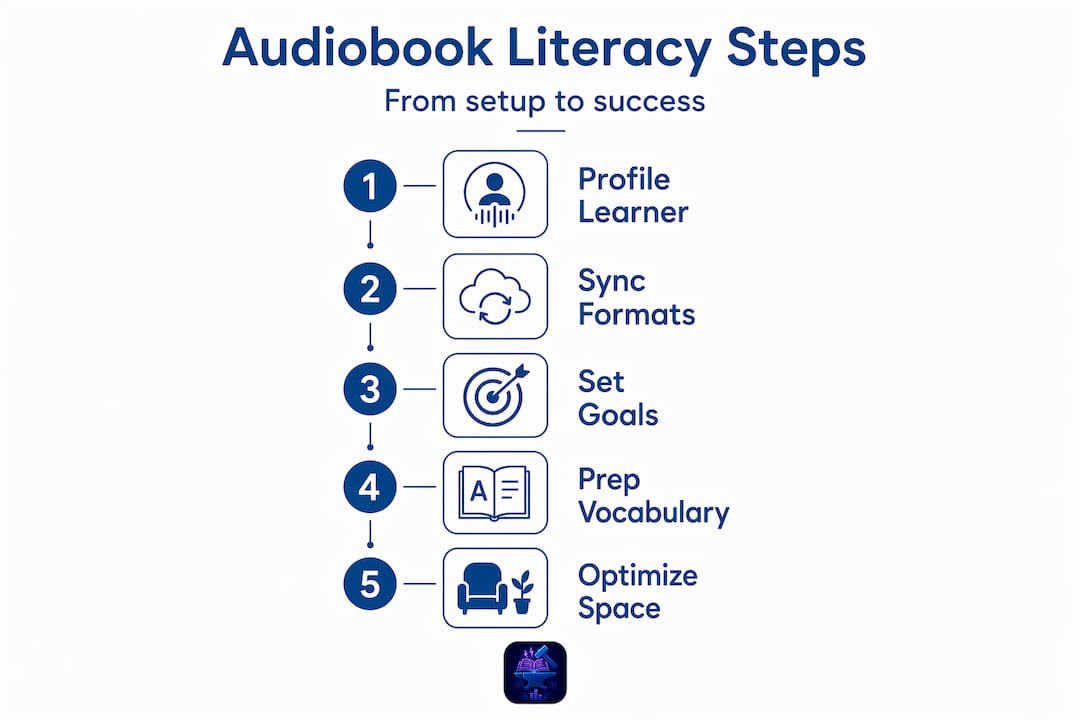
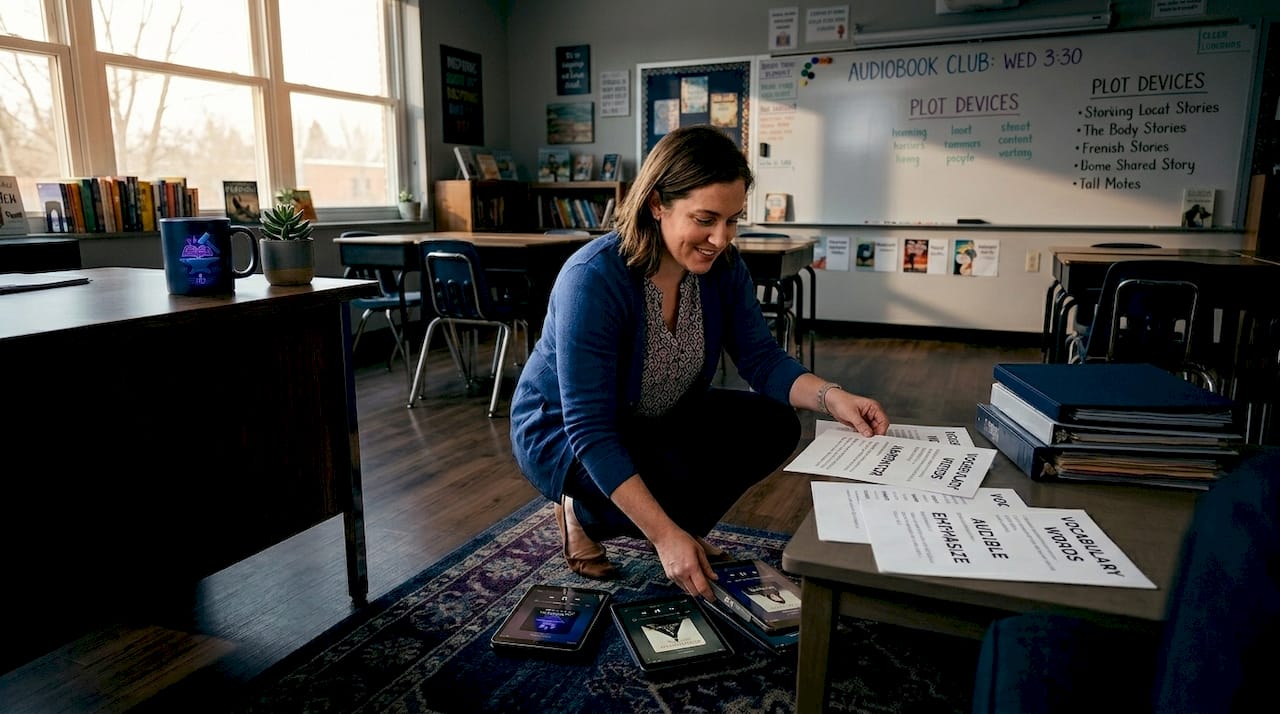
Step 4: Prepare the vocabulary in advance. Select five to ten words from the upcoming chapter that the student is unlikely to know. Teach these explicitly before listening begins.
Step 5: Build a physical environment for focus. Minimize distractions, use headphones where appropriate, and keep session lengths realistic. Twenty to thirty minutes of active listening is more productive than an hour of wandering attention.
Here is a quick reference for matching audiobook formats to learner needs:
| Learner profile | Recommended format | Key priority |
|---|---|---|
| ADHD | Synchronized text plus audio | Maintaining attention |
| Dyslexia | Immersive reading with text highlight | Phonics reinforcement via print |
| Low motivation | Engaging narrator, high-interest titles | Building reading enjoyment |
| ELL students | Slower narration speed with text | Vocabulary and pronunciation |
Pro Tip: For students with dyslexia specifically, dyslexia-friendly audiobook strategies can guide format selection and pairing techniques beyond what standard audiobook apps offer.
Best practices for integrating audiobooks into reading instruction
This is where most well-intentioned audiobook efforts fall apart. The tool gets introduced. Students enjoy it. Progress stalls. The reason is almost always the absence of structured instructional practices around the listening experience.
Before the session: Pre-teach vocabulary explicitly. Do not assume context will do the work. MIT research confirms that vocabulary gains accelerate when educators align pre-teaching directly with audiobook content and follow up with check-ins. Write the target words on a whiteboard or card, discuss their meaning with examples, then begin listening.
During the session: Avoid completely passive listening. Encourage students to:
- Follow along with the printed text where available
- Use a finger or bookmark to track their place on the page
- Make mental predictions about what happens next
- Notice when they do not understand a sentence and flag it
For students with ADHD, immersive reading with synchronized text reduces mind-wandering significantly compared to audio alone. For deeper guidance on keeping these students with the story, explore audiobooks and ADHD focus strategies.
After the session: This is the most underused part of the audiobook learning cycle.
- Discuss what happened in the chapter and what words or ideas stood out
- Ask the student to use two or three of the pre-taught vocabulary words in their own sentences
- Invite them to retell the key events without referring to the text
- For older students, brief written responses to comprehension questions reinforce the connection between listening and literacy
Learning outcomes are similar regardless of print or audio modality, according to Harvard research, but engaging audiobooks paired with book discussions yield strong language development. Discussion is not optional. It is the mechanism through which vocabulary moves from passive recognition to active use.
Troubleshooting common audiobook challenges
Even well-planned audiobook programs run into obstacles. Knowing what to expect makes the difference between abandoning the approach and adjusting it.
"Audiobooks serve as motivation and exposure tools, but they should not function as a stand-alone substitute for print reading in literacy development." — National Literacy Trust
Attention drifts mid-session. This is common and not a sign the student is uninterested. Listening requires sustained auditory attention and working memory in ways that are cognitively taxing. Shorter sessions with built-in pause-and-discuss moments work better than long uninterrupted listening blocks. Break a thirty-minute session into three ten-minute segments with brief check-ins.
The student understands the audiobook but struggles with print. This is a signal that decoding support is still needed. Audiobooks build vocabulary and comprehension, but they do not teach phonics. Print remains central for comprehension confidence. Do not reduce print reading time to add more audiobook time. The two must run in parallel.
The student treats audiobooks as entertainment only. If there are no comprehension checks or vocabulary targets, audiobook listening becomes passive background noise. Set a specific task before each session: "After this chapter, you will tell me what the main character wanted and what got in the way."
Progress seems invisible. Without measurement, progress is invisible by default. Track vocabulary scores before and after each audiobook unit. Compare comprehension quiz performance week over week. Even simple rubrics for retelling accuracy give you data to work with.
Measuring literacy progress from audiobook programs
Assessment does not need to be complicated to be useful. What matters is consistency and alignment with your original goals.
| Assessment type | When to use | What it measures |
|---|---|---|
| Vocabulary pre/post test | Before and after each audiobook unit | Word knowledge growth |
| Oral retelling rubric | After each chapter | Comprehension and sequencing |
| Engagement observation log | During sessions | Focus and active participation |
| Written response prompt | Weekly | Connection between listening and writing |
Qualitative feedback from students matters too. Ask them directly: "Did the narrator's voice help you picture the story? Did any words confuse you?" Their answers often reveal gaps that assessments miss.
Recognize that print and digital formats coexist in modern literacy development, and audio can spark interest for previously disengaged students. When a student's motivation to read visibly increases, that is a measurable outcome worth recording. Engagement is a precursor to skill, not separate from it.
My honest take after watching this in classrooms
I have seen audiobooks treated as two completely opposite things: a silver bullet for struggling readers and a lazy shortcut that bypasses real reading. Neither framing is accurate, and both cause harm.
What I have found in practice is that the audiobook is only as powerful as the instruction around it. When a teacher spends five minutes pre-teaching vocabulary, runs a ten-minute listening segment, then asks three genuine comprehension questions, the results are measurable and often dramatic. When the same teacher plays an audiobook while students zone out for forty minutes, nothing sticks.
The learners who benefit most are not always the ones you expect. Students with strong decoding skills but low motivation often get the biggest engagement lift. Students with ADHD, when given synchronized text to track, frequently show comprehension gains that print-only instruction never produced.
My honest take is that audiobooks are the most underutilized tool in literacy education, not because teachers lack access, but because they lack a framework for using them with intention. The research is there. The tools are available. What is missing is the structured, learner-specific integration that turns audio exposure into genuine literacy growth.
— Sarmed
How Coreforgeaudio supports accessible literacy learning
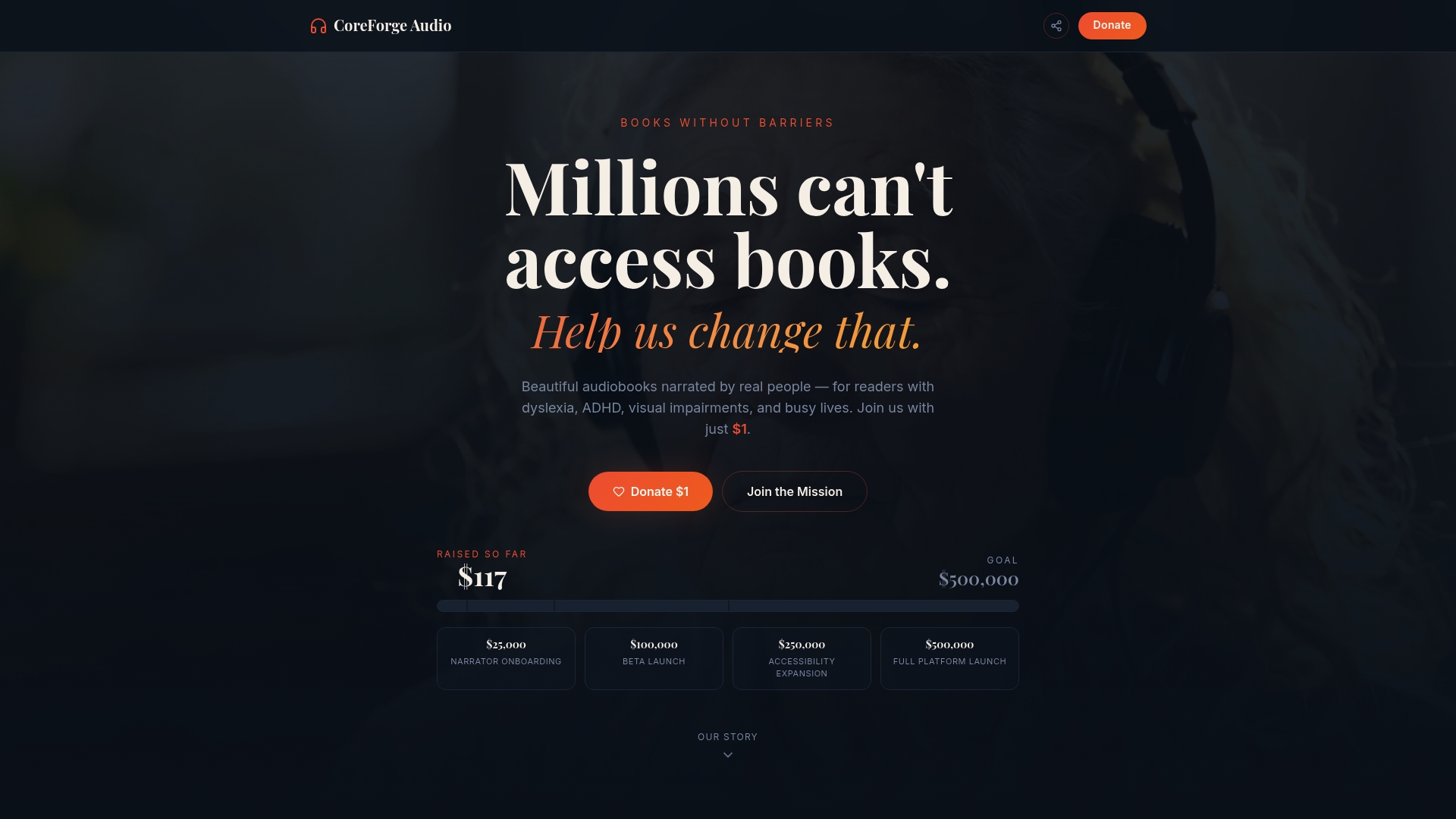
Coreforgeaudio is building an accessible audiobook platform designed with exactly these learners in mind: students with dyslexia, ADHD, visual impairments, and limited access to quality reading materials. The platform features human-narrated audiobooks, adjustable narration speeds, dyslexia-friendly fonts, and synchronized text tools built to support the kind of immersive reading that the research consistently points to as most effective.
For educators and parents ready to put these strategies into practice, Coreforgeaudio offers a growing library of resources aligned with evidence-based literacy instruction. Explore the platform to see how accessible, high-quality audio learning can support your students' reading goals. Every audiobook and feature is designed to make literacy achievable for learners who have been underserved by standard reading tools.
FAQ
Do audiobooks really help students learn to read?
Yes, but context matters. Audiobooks paired with tutoring produce significantly stronger vocabulary and comprehension gains than listening alone, especially for struggling readers.
Are audiobooks a substitute for print reading?
No. Print underpins decoding and comprehension confidence, while audiobooks build vocabulary exposure and motivation. The two formats work best together, not as replacements for each other.
Which students benefit most from audiobooks?
Students with ADHD, dyslexia, low reading motivation, or limited English proficiency show measurable benefits, though effectiveness varies by learner profile and the type of literacy challenge the student faces.
What is immersive reading and why does it matter?
Immersive reading combines synchronized audio narration with highlighted printed text. Adding printed words while listening increases focus and comprehension for neurodiverse learners compared to audio alone.
How do I know if the audiobook approach is working?
Run vocabulary pre and post tests at the start and end of each unit, use oral retelling rubrics after chapters, and track comprehension quiz scores weekly. Visible gains in student engagement are also a meaningful early indicator.