

Mobile audio apps do one thing that changes everything for people with reading difficulties: they turn text into navigable, paced audio that fits inside the actual shape of your day. A 2026 literature review on digital audio and wellbeing frames this as more than convenience, arguing that audio creates personal "sonic soundscapes" that support emotional and psychological health. For people with dyslexia, ADHD, or visual impairments, the role of mobile audio apps in lifestyle isn't a nice extra. It's reliable, independent access to information and stories that print simply doesn't provide. Coreforgeaudio is built around exactly that premise.
Table of Contents
- How mobile audio shapes your daily experience
- Why audio works so well for dyslexia, ADHD, and visual impairments
- What to look for in an accessible audiobook app
- How to build audio into your daily routine
- Human narration vs. AI narration: what you should know
- What Coreforgeaudio gets right about accessible audio
- Key Takeaways
- Why accessibility-first audio is worth defending
- Coreforgeaudio: accessible audiobooks built for real barriers
- Useful sources and further reading
How mobile audio shapes your daily experience
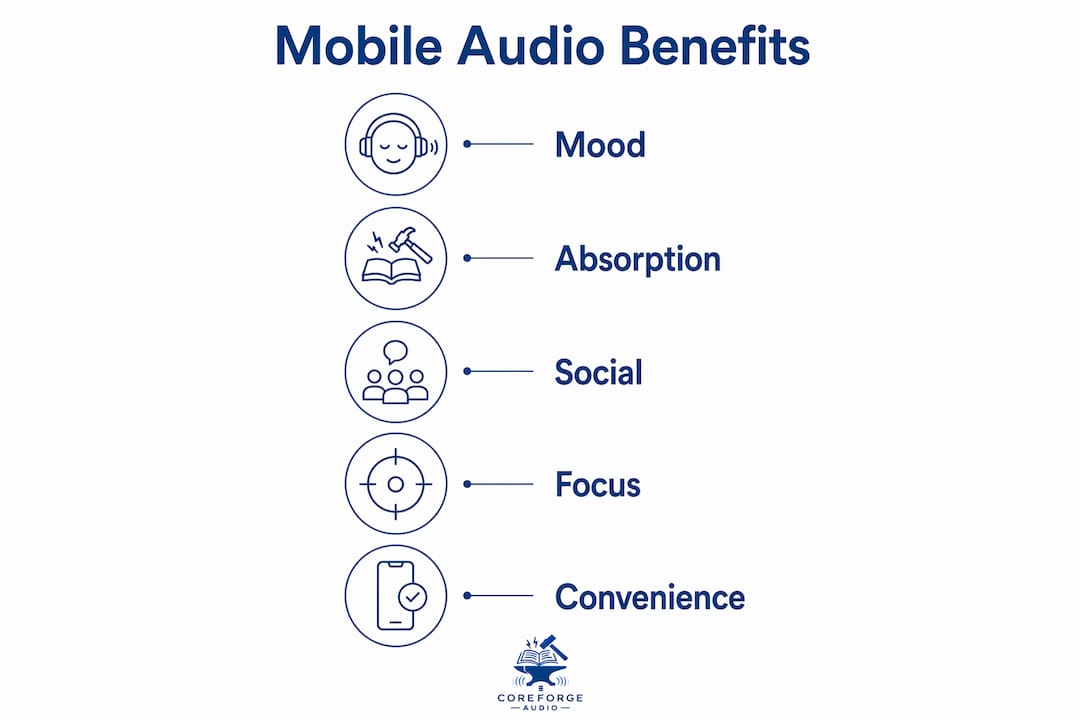
Academic research identifies five principal dimensions that explain why people reach for audio throughout the day:
- Mood Management: Using audio to shift or stabilize how you feel, most often during commutes or transitions.
- Absorption and Aestheticization: Getting lost in a story or soundscape, tuning out the physical environment.
- Social Encapsulation and Self-Focus: Creating a private bubble in public spaces, a way to reclaim mental space.
- Distraction and Passing Time: Filling waiting rooms, grocery lines, or household chores with something worthwhile.
- Auditory Background: Low-attention listening that supports focus without demanding it.
For people with reading difficulties, these five functions become practical tools, not just preferences. Mood Management helps regulate anxiety before a difficult task. Auditory Background supports sustained attention during work. Social Encapsulation lets a listener with ADHD block distracting stimuli without medication adjustments.
In a major study, 89% of respondents reported listening to music while on the move, showing how deeply audio is woven into daily routines rather than reserved for dedicated sit-down sessions.
The same 2026 review recommends treating music, podcasts, and audiobooks as one layered system rather than separate categories, because listeners already combine them. Someone might use music for mood regulation during a commute, then switch to an audiobook chapter while cooking. That layering is the point.
Why audio works so well for dyslexia, ADHD, and visual impairments
People with dyslexia spend cognitive energy decoding letters and words rather than processing meaning. Audio removes that bottleneck entirely. The story or information arrives without the decoding step, which frees working memory for comprehension and retention. Long-form audio is especially effective here because sustained listening builds narrative context in a way that short clips can't.

For ADHD, the challenge is sustaining attention long enough to absorb content. Adjustable playback speed helps: many listeners with ADHD find that slightly faster narration (1.25x–1.5x) keeps their attention engaged rather than drifting. Research on audio streaming habits shows that listeners naturally allocate different audio types to different contexts, which means separating "study mode" audiobooks from background music reduces cognitive friction rather than adding it.
For people with visual impairments, the impact of audio apps is most direct. Screen-reader compatibility and lock-screen playback controls mean the phone doesn't need to be visible or unlocked to keep listening. Practical strategies for visually impaired users show that native device integration, not app-specific workarounds, is what makes continuous access reliable.
Three quick scenarios where this plays out:
- A college student with dyslexia listens to assigned chapters at 1.3x speed during her morning commute, arriving at class having already processed the material once.
- A parent with ADHD uses 15-minute audiobook segments during cooking, bookmarking the stopping point so resuming later takes two taps.
- A retired teacher with low vision listens to new releases through a screen-reader-compatible app, controlling playback entirely through headphone buttons.
Pro Tip: Set a 15–30 second rewind shortcut before your first session. When attention drifts or a passage needs repeating, one tap brings you back without losing your place or your momentum.
What to look for in an accessible audiobook app
Not every app that calls itself accessible actually is. Here's a checklist of features that genuinely matter:
- Adjustable narration speed with preserved prosody — speed changes should sound natural, not chipmunk-pitched.
- Chapter-level navigation and micro-bookmarking — you need to jump to a section, not just scrub a timeline.
- Short-segment resume — the app should remember exactly where you stopped, even mid-chapter.
- Synchronized text and transcripts — following along visually while listening reinforces comprehension.
- Screen-reader compatibility — VoiceOver (iOS) and TalkBack (Android) must work with the app's core controls.
- Dyslexia-friendly font options — OpenDyslexic or similar typefaces reduce visual crowding when text is displayed.
- Native lock-screen and CarPlay/Android Auto integration — playback controls that work without unlocking your phone are non-negotiable for multitasking listeners.
- Offline playback — reliable access shouldn't depend on a WiFi signal.
- Listening queues and curated playlists — auto-queuing keeps sessions going without manual searching.
On cost: U.S. listeners have several access models. The National Library Service (NLS) provides free audiobooks for people with qualifying print disabilities through the Braille and Audio Reading Download (BARD) program. Public library apps like Libby offer free borrowing with a library card. Subscription services run monthly fees, and individual title purchases are available on most major platforms. For a detailed comparison of accessible audio platforms, the feature tradeoffs vary significantly by price tier.
How to build audio into your daily routine
Getting the most from mobile audio means treating it as a scheduled tool, not a passive habit.
- Choose short chapters or summaries first. Start with 10–15 minute segments to build the listening habit before committing to full-length books.
- Configure playback and accessibility settings before you need them. Set your preferred speed, font size, and rewind interval once, so every session starts without friction.
- Schedule micro-listening pockets. Commutes, waiting rooms, household chores, and transition periods between tasks are all usable windows. Audio applications and daily routines work best when listening is attached to an existing habit, not treated as a separate activity.
- Use bookmarks actively. Mark the end of each session so resuming is instant. Many apps let you add a note to a bookmark, which is useful for study or review.
- Separate music from spoken word. Keep a dedicated playlist for mood regulation and a separate queue for audiobooks or educational content. Mixing them creates context confusion and makes it harder to resume where you left off.
Pro Tip: Pair audio sessions with a physical cue, like a specific pair of headphones or a particular chair. The cue signals "listening mode" to your brain, which helps people with ADHD settle into focus faster.
Human narration vs. AI narration: what you should know
The narration choice matters more for accessibility than most people realize.
Human narration strengths: Natural prosody, emotional range, and pacing that responds to the text's meaning. A skilled narrator signals when a sentence is a question, when a character is frightened, when a passage is meant to be funny. That expressiveness carries comprehension cues that listeners with dyslexia or ADHD rely on heavily.
AI narration strengths: Lower production cost, faster turnaround, and consistent pacing. For factual or reference content, AI narration is often adequate.
The fair-pay issue: Voice actors are paid per finished hour of audio. When platforms use AI to replace human narrators without disclosure, they eliminate both the income and the attribution those actors are owed. Transparent platforms state clearly which titles use human narration and which use synthetic voices.
For people with disabilities who depend on audio as their primary reading format, the consent and quality question is direct: synthetic voices trained on a human narrator's recordings without consent undermine the very trust that makes audio a reliable tool. Platforms that disclose their narration methods and compensate voice actors fairly are the ones worth supporting.
What Coreforgeaudio gets right about accessible audio
Coreforgeaudio is built around the checklist above, not retrofitted to meet it. The platform commits to human narration with fair compensation for voice actors, dyslexia-friendly font options, adjustable narration speeds, and multilingual support. Every feature maps to a real barrier: the font choice addresses visual decoding difficulty, the speed control addresses attention and processing pace, and the human narration preserves the prosodic cues that aid comprehension.
The platform is currently fundraising through a micro-donation campaign, which reflects a deliberate choice: keeping the service accessible in cost as well as design. Transparency about licensing, development, and accessibility tool expenses is part of the model.
- Human-narrated titles with disclosed attribution
- Adjustable pacing with natural prosody preserved
- Dyslexia-friendly display options
- Screen-reader compatible interface
- Multilingual content support
- Donation-supported access model
Pro Tip: If you're evaluating Coreforgeaudio for a student or family member, check whether the platform's ADA-compliant audio features align with any existing accommodations plan. Matching the app's features to documented needs makes the case for school or workplace support much easier.
Key Takeaways
Mobile audio apps are the most practical accessibility tool available for people with dyslexia, ADHD, or visual impairments because they remove the decoding barrier and fit listening into the actual shape of daily life.
| Point | Details |
|---|---|
| Five listening dimensions | Mood Management, Absorption, Social Encapsulation, Distraction, and Auditory Background each serve a specific daily-life function. |
| 89% listen on the move | Mobile listening is a daily habit, not a dedicated activity, making audio the most portable accessibility tool available. |
| Checklist features that matter | Adjustable speed with natural prosody, micro-bookmarking, screen-reader compatibility, and offline playback are non-negotiable. |
| Human narration carries comprehension cues | Prosody and emotional range in human narration help listeners with dyslexia and ADHD follow meaning, not just words. |
| Coreforgeaudio | Builds accessibility features in from the start: human narration, dyslexia-friendly fonts, adjustable pacing, and a donation-supported access model. |
Why accessibility-first audio is worth defending
The conventional wisdom treats accessible audio as a niche accommodation. That framing is wrong, and the 2026 literature review makes the case clearly: audio creates layered sonic soundscapes that support wellbeing across emotional, social, and cognitive dimensions. That's not a disability story. It's a human story that people with reading difficulties happen to need more urgently than most.
What gets underestimated is how much the production and ethical choices behind an app affect the listener's actual experience. A platform that uses undisclosed AI narration saves money but strips out the prosodic cues that make audio comprehensible for someone with dyslexia. A platform that skips screen-reader testing saves development time but locks out a visually impaired user entirely. These aren't edge cases. They're the people the technology was supposed to serve.
The checklist in this article isn't a wish list. It's a minimum standard. Any platform that can't meet it isn't accessible, regardless of what its marketing says.
Coreforgeaudio: accessible audiobooks built for real barriers
Coreforgeaudio exists for one reason: to make audiobooks genuinely accessible to people who need them most, not just technically available. Every title is human-narrated, every accessibility feature is built in rather than bolted on, and the funding model keeps cost from becoming another barrier.
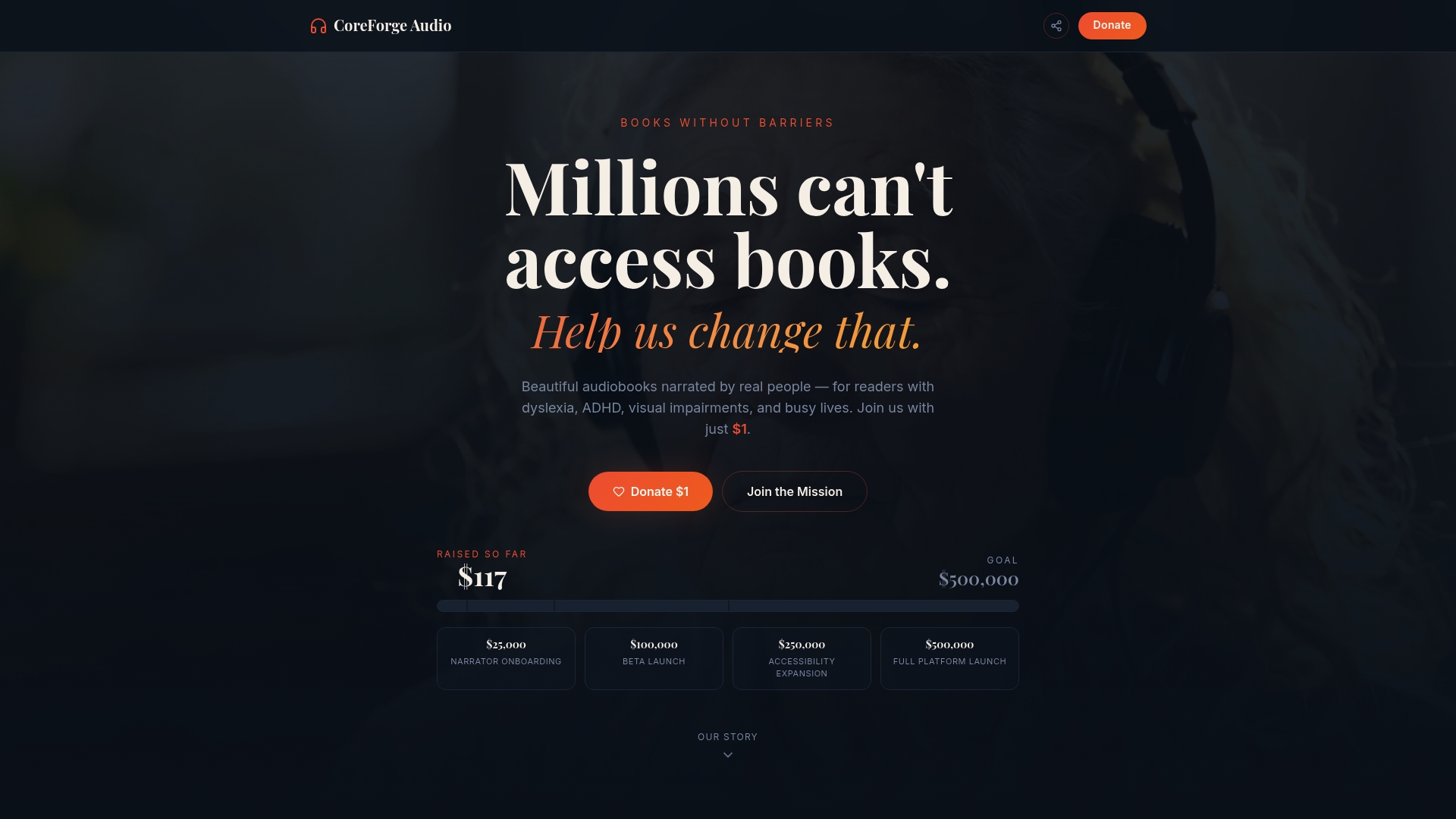
Visit Coreforgeaudio to learn more about the platform, support the micro-donation campaign, or request accessible content. If you're a nonprofit or organization working in disability services, the nonprofit press kit guidance from Hyphenate Consulting is a useful starting point for building media-ready materials around accessible audio initiatives. For readers who want to go deeper on platform features, the accessible audio content platforms guide covers feature tradeoffs in detail.
Useful sources and further reading
- On the Move: Principal Components of the Functions and Experiences of Mobile Music Listening — Defines the five dimensions of mobile listening and provides the 89% mobility statistic used in this article.
- Developing an Integrated and Collective Approach to Digital Audio Entertainment and Wellbeing — The 2026 literature review that frames audio as layered sonic soundscapes supporting hedonic and eudaimonic wellbeing.
- Do Podcasts and Music Compete with One Another? — ACM study on how listeners allocate different audio types to separate time windows; useful for understanding attention management.
- How AI Audio Is Reshaping Modern News Apps — Industry reporting on native device integration and playlist queuing as retention tools.
- Sound Data: The State of Audio in 50 Charts — Edison Research's dataset on U.S. audio consumption by device, age group, and location.
- Accessible Audio Content Platforms Compared: 2026 Guide — Feature-level comparison of audiobook platforms with an accessibility focus.
- How Audio Content Meets ADA Requirements in 2026 — Practical guidance on accessibility compliance for audio production and app features.
- Special Education Audio Resources: A 2026 Parent Guide — Parent-facing resource covering audio tools and strategies for learners with reading challenges.