

Adjustable narration speed is the ability to control audio playback pace, and it is one of the most underused tools in any audiobook listener's kit. Research shows the optimal speed range of 1.25x to 1.5x saves 17–33% of listening time while keeping comprehension fully intact. That single finding changes how you should think about every audiobook session. Whether you listen for learning, relaxation, or accessibility, the benefits of adjustable narration speed reach far beyond simple time savings.
1. How adjustable narration speed improves comprehension and retention
Speed control is not just a convenience feature. It is a precision tool for how well you absorb what you hear.
The "Goldilocks Zone" of 1.25x to 1.5x is where most listeners get the best results. At this range, your brain stays engaged without being overwhelmed. You process words fast enough to stay focused, but slow enough to build meaning from what you hear.
Faster speeds tell a more nuanced story. A 2026 Frontiers in Education study found that playback speeds up to 2.0x do not significantly reduce objective content retention for moderately technical material. That result surprises most listeners. The catch is that perceived clarity drops at 2.0x, even when actual retention stays stable.

This distinction matters. Feeling like you missed something is not the same as actually missing it. For familiar content or material you are revisiting, 2.0x can work well. For dense, complex books you need to retain long-term, staying within the Goldilocks Zone produces better memory consolidation.
Pro Tip: If you are studying dense nonfiction, cap your speed at 1.5x. Save 2.0x for fiction you have already read or lighter content you are reviewing.
Key speed ranges and their best uses:
- 1.0x: Unfamiliar content, emotional narratives, or first-time listening
- 1.25x–1.5x: The sweet spot for most audiobook listeners balancing time and comprehension
- 1.75x–2.0x: Familiar material, review passes, or lighter fiction
- Above 2.0x: Generally risks poorer long-term memory, especially for complex content
2. How variable speed sharpens focus and reduces mind-wandering
Faster playback acts as a forcing function for your attention. When audio moves quickly, your brain has less idle time to drift. Increasing playback speed pushes the brain to focus more sharply, reducing the mental drift that is common during slower audio consumption.
Mind-wandering is a real problem at 1x speed. The average person thinks faster than a narrator speaks. That gap creates space for distraction. Bumping speed to 1.25x or 1.5x closes that gap and keeps your attention locked to the content.
"Speed listening should be used as an active engagement mechanism rather than merely a time-saver. Adjusting speeds to content complexity improves absorption." This principle reframes speed control entirely. It is not about rushing through books. It is about matching the pace of the audio to the pace of your thinking.
Variable speed also lets you respond to what you are hearing in real time. You can slow down for a chapter that hits emotionally or intellectually hard. You can speed up when you hit a section you already know well. This kind of dynamic listening keeps you present and engaged throughout the entire book.
Practical ways to use speed for better focus:
- Slow to 0.75x or 1.0x for complex arguments, poetry, or emotional scenes
- Speed up to 1.5x or higher for plot summaries, familiar backstory, or review chapters
- Use speed changes as a signal to yourself that the content type has shifted
- Treat speed adjustment as an active reading strategy, not a passive setting
3. Adjustable narration speed as an accessibility tool
Speed control is one of the most significant accessibility features on any audiobook platform. For listeners with dyslexia, ADHD, visual impairments, or other learning differences, the ability to adjust pace is not a luxury. It is a functional necessity.
Adjustable narration speed for dyslexia works by letting listeners start slow and build up gradually. Structured speed increases starting at 1x, progressing to 1.25x and then to 1.5x–2.0x over several weeks, help users with learning differences adapt without cognitive overload. This approach treats speed as a skill to develop, not a fixed setting to choose once.
For listeners with ADHD, faster speeds can actually reduce distraction. A quicker pace demands more active processing, which keeps the brain engaged rather than wandering. Variable speed controls are recognized as major usability wins for users with accessibility needs because they allow content pacing to match individual cognitive processing.
Pro Tip: If you have dyslexia or ADHD, pair adjustable speed with word highlighting features. The combination of visual tracking and audio pacing significantly boosts comprehension.
Steps for building speed tolerance as an accessibility strategy:
- Start every new book at 1.0x for the first chapter to calibrate to the narrator's voice
- Increase to 1.25x once the voice feels familiar, typically within one to two sessions
- Move to 1.5x after one to two weeks if comprehension feels solid
- Use 1.75x or 2.0x only for review passes or very familiar material
- Return to slower speeds any time the content becomes dense or emotionally demanding
Long-form audio content is especially well-suited for this kind of gradual speed building because the extended listening time gives your brain repeated exposure to the narrator's voice and the book's structure.
4. Time efficiency and productivity gains from speed control
Speed adjustment is one of the clearest ways audio content contributes to productivity. Saving 17–33% of listening time at 1.25x–1.5x is not a marginal gain. On a 10-hour audiobook, that is 1.7 to 3.3 hours returned to your day.
Most listeners underestimate how quickly they adapt to faster speeds. Speed listening is a learnable skill, with most listeners adapting to 1.5x within 2–3 weeks and to 2.0x within 6–8 weeks for familiar content. The adaptation curve is real, but it is shorter than most people expect.
The productivity case for speed control goes beyond raw time savings. Faster listening means you can finish more books in the same period. More books means broader knowledge, wider vocabulary, and stronger recall across topics. The compounding effect of consistent speed-adjusted listening builds significant intellectual returns over months and years.
5. Practical tips for choosing the right narration speed
Choosing the right speed depends on three factors: content type, your familiarity with the subject, and your listening goal. Getting this right is what separates casual listeners from people who genuinely retain what they hear.
Content type is the most important variable. Dense nonfiction, academic material, and books with complex arguments demand slower speeds. Moderate speed adjustments in the 0.75x to 1.5x range are generally accessible and effective for most listeners. Wider ranges require careful testing because audio quality and cognitive load both shift at extreme speeds.
Familiarity with the subject is the second variable. If you already know the topic well, you can process information faster because your brain is filling in context automatically. A 2.0x speed on a book in your area of expertise feels very different from 2.0x on a subject you have never studied.
Your listening goal is the third variable. First-time learning requires slower, more deliberate pacing. Review passes can run much faster. Use the chapter-by-chapter approach: set your speed at the start of each chapter based on how dense or familiar the material feels, then adjust as you go.
One technique worth trying is the psychological contrast method. Briefly increasing speed above your target and then dropping back helps your brain adapt more comfortably to faster rates. For example, if your goal is 1.5x, spend five minutes at 1.75x and then drop to 1.5x. The target speed will feel noticeably easier.
Speed selection by content type:
| Content Type | Recommended Speed | Reason |
|---|---|---|
| Dense nonfiction or academic | 1.0x–1.25x | High cognitive load requires slower processing |
| Literary fiction, first listen | 1.0x–1.25x | Emotional nuance and language deserve full attention |
| Popular nonfiction | 1.25x–1.5x | Familiar structure supports faster intake |
| Light fiction or genre novels | 1.5x–2.0x | Plot-driven content processes well at higher speeds |
| Review or re-listen | 1.75x–2.0x | Prior knowledge reduces cognitive demand |
Pro Tip: Always start a new narrator at 1.0x for at least 10 minutes. Every voice has a different rhythm, and your brain needs time to calibrate before you speed up.
Listening fuels literacy at every level, and speed adjustment is one of the most direct ways to make that process more effective for your specific needs and goals.
Key Takeaways
Adjustable narration speed delivers the greatest benefit when you match playback rate to content complexity, listener familiarity, and specific listening goals.
| Point | Details |
|---|---|
| Goldilocks Zone for most listeners | 1.25x–1.5x saves 17–33% of listening time while maintaining comprehension. |
| Clarity vs. retention distinction | Feeling unclear at 2.0x does not mean you retained less. Objective retention stays stable. |
| Accessibility requires gradual steps | Build speed tolerance over weeks, starting at 1.0x and increasing incrementally. |
| Speed is an active engagement tool | Faster audio reduces mind-wandering by closing the gap between thought speed and narration pace. |
| Content type drives speed choice | Dense or unfamiliar material needs slower speeds; review passes and light fiction support faster rates. |
Why I think most listeners are using speed control wrong
Most people treat speed control as a single setting they pick once and forget. That is the wrong approach entirely. The real power of adjustable audio speed comes from treating it as a dynamic tool you use throughout a listening session, not a preference you set in the app menu.
I spent months listening to audiobooks at a fixed 1.5x before I realized I was losing nuance in the chapters that needed it most. The emotional climax of a memoir, the core argument of a philosophy book, the twist in a thriller: these moments deserve slower pacing. When I started dropping speed for those sections and speeding back up for exposition and backstory, my retention and enjoyment both improved noticeably.
The research backs this up. For complex material requiring long-term retention, slower speeds within the Goldilocks Zone better support memory consolidation than high-speed listening. That finding should change how every serious audiobook listener approaches their sessions.
My honest recommendation: be patient with yourself when you start. The first week at 1.5x feels uncomfortable. By week three, 1.0x will feel slow. The adaptation is real, and it is worth the short-term discomfort.
— Sarmed
Coreforgeaudio and the listening experience you deserve
Coreforgeaudio is built around the idea that every listener deserves audio that works for them, not against them. The platform integrates adjustable narration speeds directly with accessibility features like word highlighting and dyslexia-friendly fonts, so speed control is never an isolated setting. It works as part of a complete listening environment.
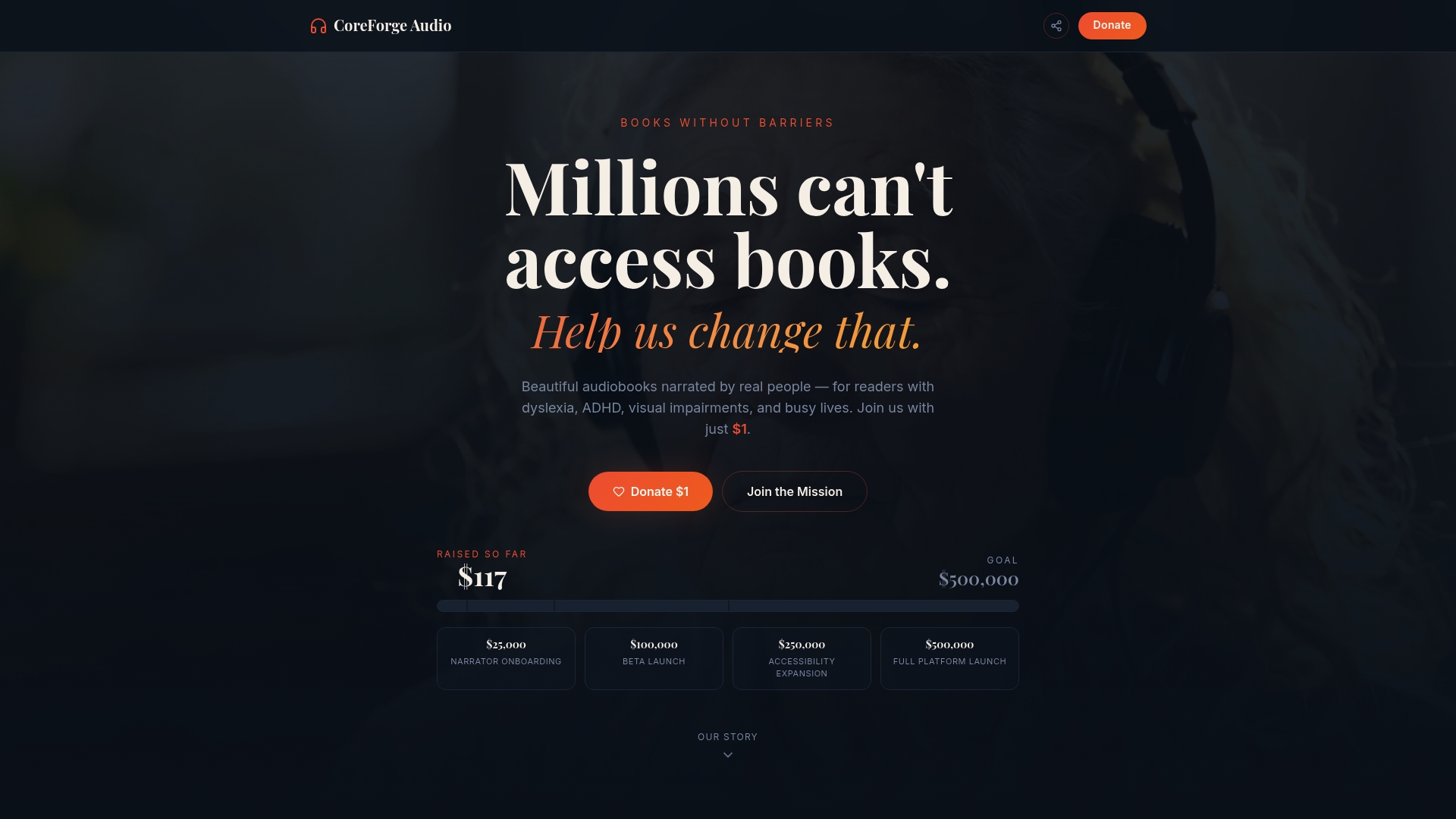
For listeners managing dyslexia, ADHD, or visual impairments, Coreforgeaudio's approach means you can start slow, build your speed tolerance gradually, and always return to a pace that fits your cognitive needs. The platform's human-narrated audiobooks are designed to sound clear and natural at a range of speeds, which matters more than most listeners realize. Explore what accessible audiobook listening looks like when the platform is built around your needs from the ground up.
FAQ
What is the best speed for audiobook comprehension?
The best speed for most listeners is 1.25x to 1.5x, which saves 17–33% of listening time while maintaining comprehension. Dense or unfamiliar content benefits from staying closer to 1.0x.
Does listening at 2.0x hurt retention?
A 2026 Frontiers in Education study found that 2.0x speed does not significantly reduce objective retention for moderately technical content. Perceived clarity drops, but actual learning stays largely intact.
How does adjustable narration speed help with dyslexia?
Adjustable narration speed for dyslexia works by letting listeners start at 1.0x and build gradually over weeks, reducing cognitive overload. Pairing speed control with word highlighting produces the strongest comprehension gains.
How long does it take to adapt to faster audiobook speeds?
Most listeners adapt to 1.5x within 2–3 weeks and to 2.0x within 6–8 weeks for familiar content. Using the psychological contrast technique, briefly going above your target speed before dropping back, speeds up the adaptation process.
What speed range works best for accessibility needs?
The 0.75x to 1.5x range is generally accessible and effective for most listeners with accessibility needs. Wider ranges require individual testing because audio quality and cognitive load both shift at extreme speeds.