

Most parents assume that literacy begins and ends with printed words on a page. If a child struggles to decode text, the instinct is to drill phonics harder, read more books, or practice sight words until something clicks. But that picture leaves out a powerful tool that researchers, educators, and families of children with learning differences are increasingly turning to: listening. Audiobooks and listening activities can support key aspects of literacy when used thoughtfully, and for many children, they open a door that print alone keeps firmly shut.
Table of Contents
- Understanding the role of listening in literacy development
- What research says: Listening vs. reading for comprehension
- Listening activities for building oral language and comprehension
- Adapting listening strategies for children with learning differences
- What most guides miss: Turning listening into true learning
- Help your child thrive with CoreForge Audio
- Frequently asked questions
Key Takeaways
| Point | Details |
|---|---|
| Listening complements reading | Listening activities like audiobooks can build engagement, vocabulary, and comprehension alongside traditional reading. |
| Active discussion is essential | Regular pauses for conversation or questions during listening sessions help deepen understanding and inference skills. |
| Tailor approaches for special needs | Children with learning differences may need personalized listening strategies such as shorter sessions and extra interaction. |
| No one-size-fits-all solution | Track your child’s responses and adapt listening activities to maximize their literacy growth. |
Understanding the role of listening in literacy development
Literacy is not just the ability to sound out words. It involves vocabulary, background knowledge, comprehension, inference, and a love of stories. Listening feeds all of those areas, sometimes more efficiently than print can for children who are still working through decoding challenges.
When a child listens to a rich, well-narrated story, they absorb complex sentence structures, advanced vocabulary, and nuanced ideas that they could never access independently through reading. A seven-year-old with dyslexia who reads at a second-grade level may have the intellectual curiosity of a ten-year-old. Audiobooks meet that child where their mind actually is, not where their decoding skills happen to be.
Listening also removes the barrier of print fatigue. Many children with reading differences describe reading as exhausting, like trying to run through sand. Listening lets them experience stories and information without that physical and cognitive drain, which means they actually finish what they start.
- Exposure to complex vocabulary through listening builds the word knowledge children need for reading comprehension later.
- Audiobooks and podcasts engage learners who find print frustrating, keeping them in the learning zone longer.
- Enjoyment and motivation from listening can spark genuine interest in books, which indirectly strengthens literacy over time.
- Narrative structure absorbed through listening helps children predict, infer, and follow story arcs when they eventually encounter those same patterns in print.
Research backs this up. Audio books are key to reading for pleasure, and reading for pleasure is one of the strongest predictors of long-term literacy growth. When listening makes a child fall in love with stories, that enthusiasm does not stay contained to audio. It spills over into print, into libraries, into requests for "just one more chapter."
"Listening can increase engagement and reading for pleasure, which is a pathway that can indirectly strengthen literacy skills over time."
The key word in that quote is indirectly. Listening is not a magic fix. It is a bridge, and like any bridge, it works best when you know where it leads and how to walk across it carefully.
What research says: Listening vs. reading for comprehension
To appreciate how listening fits into the literacy puzzle, it's helpful to compare evidence from studies that look at both approaches side by side.
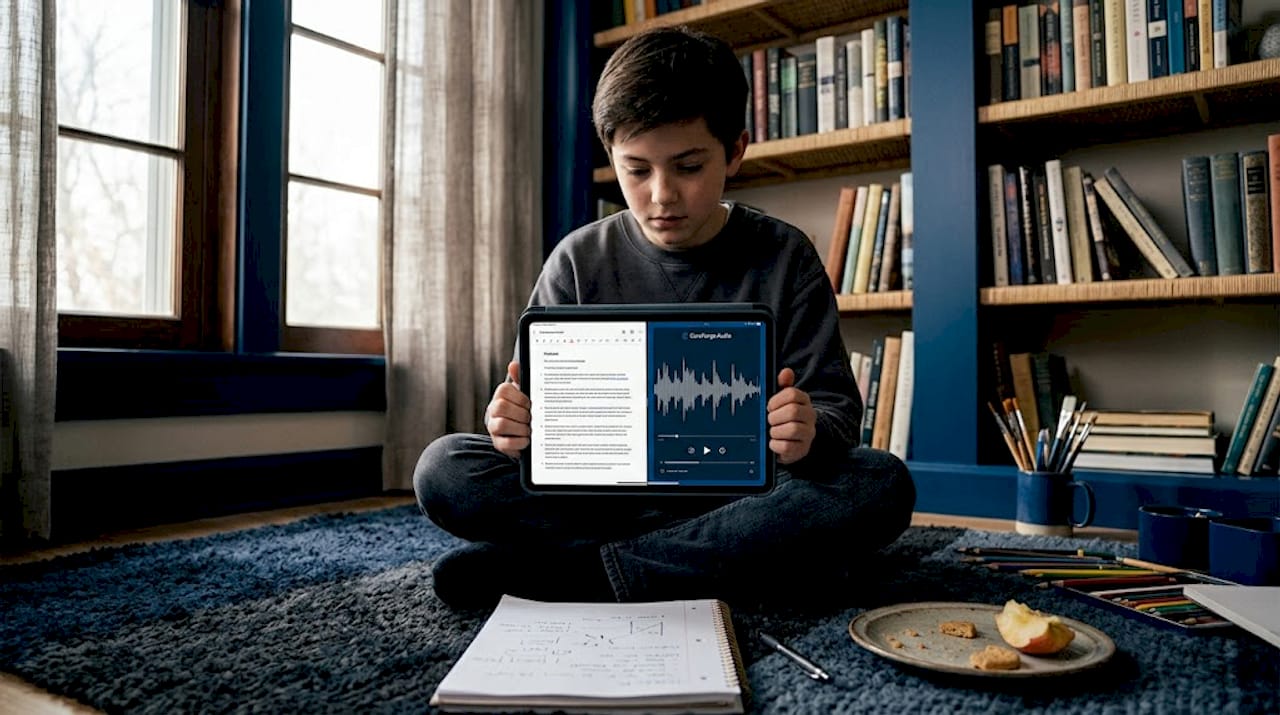
The research picture is more nuanced than most people expect. For basic factual recall, listening and reading produce similar outcomes. A child who hears a passage and a child who reads the same passage can often answer straightforward "who, what, where" questions at roughly the same rate. That finding surprises many parents who assume reading is always superior.
Where the gap opens up is in deeper comprehension tasks, particularly making inferences and analyzing complex ideas. Listening can support some literacy outcomes, but it is not equivalent to reading for all comprehension types, especially when listeners cannot control the pace. A reader can stop, reread a tricky sentence, flip back to check a character's name, or slow down at a confusing paragraph. A listener riding along with a narrator does not have that same natural flexibility unless they are actively using pause and rewind features.
| Skill area | Listening advantage | Reading advantage |
|---|---|---|
| Vocabulary exposure | High (rich narration, expression) | Moderate (context clues in text) |
| Basic recall | Comparable | Comparable |
| Inference and analysis | Lower without active pausing | Higher with rereading ability |
| Engagement and motivation | High for reluctant readers | Varies by child |
| Phonological awareness | Limited direct impact | Direct practice opportunity |
| Background knowledge | High | High |
Statistic worth knowing: Studies consistently show that the comprehension gap between listening and reading narrows significantly when listeners are taught to use active strategies, like pausing to predict or summarizing aloud after each section.
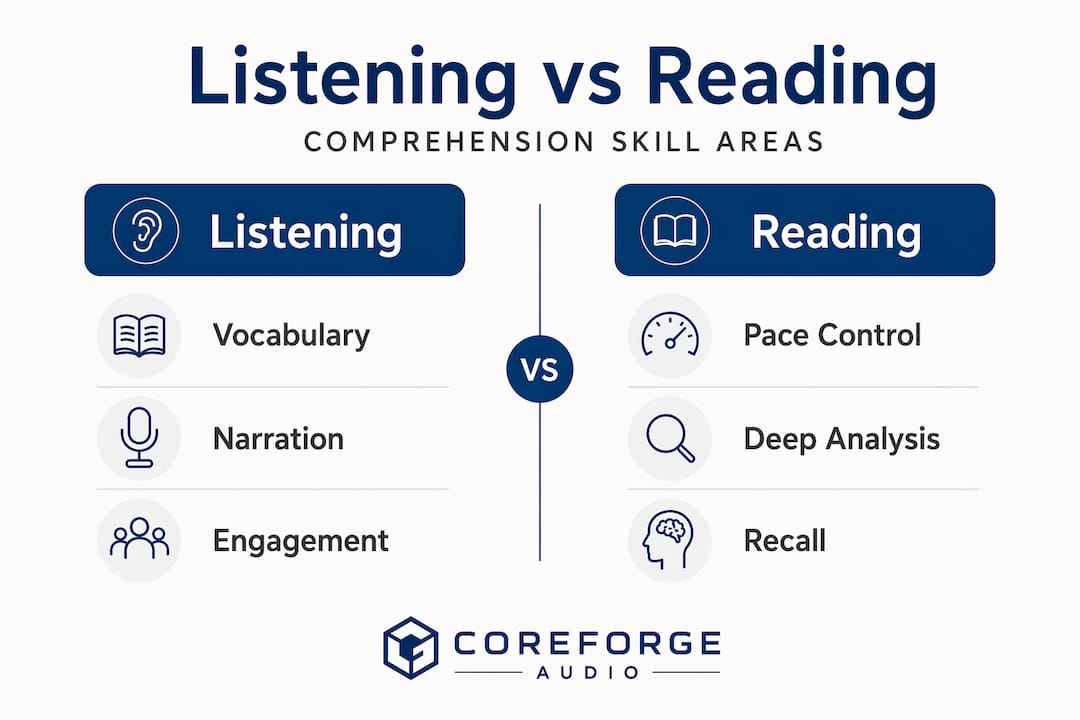
Pace control is the single biggest structural advantage reading holds over passive listening. But "passive" is the operative word. When you turn listening into an active, interactive experience, many of those comprehension gaps close considerably.
Pro Tip: Encourage your child to use the pause button as a learning tool, not just a convenience. Every time they stop to predict what happens next or explain what they just heard, they are doing the same cognitive work that strong readers do automatically.
Discussion is the great equalizer here. When a parent or caregiver sits with a child during or after a listening session and asks open-ended questions, "What do you think will happen next?" or "Why do you think she made that choice?", they are building exactly the inference skills that listening alone does not automatically develop.
Listening activities for building oral language and comprehension
With the research in mind, let's explore the specific listening activities you can use at home. The good news is that most of them require no special equipment and very little preparation.
Oral language development supports reading development directly. Listening-focused activities like read-alouds and conversation are used by educators to strengthen these foundations, and parents can use the exact same tools at home.
-
Read aloud together and extend the conversation. Choose a book slightly above your child's independent reading level and read it aloud yourself or play an audiobook together. Stop every few pages to ask prediction questions ("What do you think the character will do?") and reflection questions ("How would you feel if that happened to you?"). This transforms passive listening into active comprehension practice.
-
Use audiobooks in manageable segments. Long, uninterrupted listening sessions can cause attention to drift, especially for children with ADHD. Break listening into 10 to 15 minute chunks. After each chunk, pause and have a brief conversation about what happened. This builds comprehension stamina gradually without overwhelming your child.
-
Try podcasts designed for kids. Many children's podcasts cover science, history, and storytelling in formats that are engaging and age-appropriate. Podcasts work especially well because episodes are short, self-contained, and often designed to spark curiosity. After an episode, ask your child to teach you something they learned. Teaching requires organizing information, which deepens understanding.
-
Create a listening journal. After a listening session, invite your child to draw a scene, write one sentence, or record a voice memo describing their favorite part. This bridges the gap between audio input and language output, reinforcing comprehension through expression.
-
Check for understanding with quick discussions. Do not wait until the end of a book to check in. Regular, short comprehension checks during listening keep your child engaged and give you real-time feedback on whether the content is landing.
| Activity | Best for | Time needed | Materials |
|---|---|---|---|
| Read aloud with questions | All ages, all learning profiles | 15 to 30 minutes | Any book or audiobook |
| Short podcast episodes | Ages 6 and up, ADHD | 10 to 15 minutes | Device with audio |
| Listening journal | Ages 7 and up | 5 to 10 minutes after session | Notebook or voice recorder |
| Prediction stops | All ages | Built into listening time | None |
| Retelling practice | Ages 5 and up | 5 minutes after session | None |
Pro Tip: Frequency matters more than duration. Three 15-minute listening sessions with active discussion will build more literacy skill than one long passive hour of audio. Consistency and engagement are the real drivers of growth.
Adapting listening strategies for children with learning differences
Because every learner is unique, it's important to adjust listening strategies for children with specific learning profiles. What works beautifully for one child may not work at all for another, and that is not a failure. It is just information.
Children with dyslexia often have strong listening comprehension relative to their reading level, which is one reason audiobooks are such a natural fit. However, the picture is not uniform. Auditory processing in dyslexia is heterogeneous, meaning some children show weaknesses on certain auditory and language perception tasks while others do not. Listening-based approaches should be targeted rather than assumed to automatically fix decoding or phonological skill deficits.
In plain terms: do not assume that because your child has dyslexia, audiobooks will automatically solve everything. Test it. Watch how your child responds. Notice whether they seem to follow the story, whether they can answer questions afterward, and whether they seem engaged or distracted.
- For children with dyslexia: Use audiobooks at a slightly slower narration speed initially. Pair listening with a visual copy of the text when possible, so the child can follow along and begin connecting spoken words to their printed forms.
- For children with ADHD: Keep segments very short. Use physical fidget tools during listening to help the body stay calm while the mind focuses. Predictable stopping points ("We'll stop after this chapter") reduce anxiety and improve attention.
- For children with auditory processing challenges: Choose audiobooks with clear, unhurried narration. Avoid background music during listening sessions. Repeat segments as needed without making it feel like a test.
- For children with visual impairments: Listening is often already a primary learning channel. Focus on building discussion skills and vocabulary expansion through rich, descriptive audiobooks.
"There is no one-size-fits-all approach. The most effective listening strategy is the one you discover by paying close attention to your individual child over time."
Track what you try and what you observe. A simple notebook where you jot down which activities your child responded to, which ones caused frustration, and which ones led to the most conversation will become an invaluable guide over weeks and months.
What most guides miss: Turning listening into true learning
Here is what we have learned from working with families of children with learning differences: most parents start using audiobooks with the best intentions and then quietly wonder why the gains feel slow. The answer, almost every time, is that listening stayed passive.
Exposure is not the same as learning. A child can listen to 50 audiobooks and absorb relatively little if they never stop to process, discuss, or connect what they heard to something they already know. The research is clear on this: pairing audiobooks and read-alouds with short, discussion-based "check for understanding" moments is what supports inference and meaning-making. The audio is the input. The conversation is where the learning actually happens.
We would go further than most guides do and say this: the conversation after listening is more important than the listening itself. A mediocre audiobook with a great discussion will build more literacy skill than a perfect audiobook listened to in silence.
Short pauses for open-ended questions bring learning to life in ways that passive listening simply cannot. "What surprised you?" "What would you have done differently?" "What does that word mean in this story?" These questions do not just check comprehension. They build the habit of thinking while listening, which is exactly the skill that transfers to reading comprehension later.
For children with learning challenges, regular active practice is what unlocks the most benefit. Not intensity. Not longer sessions. Regularity and interaction. Ten minutes a day, five days a week, with real conversation, will outperform an hour on the weekend every single time. Build the habit small and keep it consistent, and you will see the growth.
Help your child thrive with CoreForge Audio
Ready to support your child's literacy journey with the right tools?
At CoreForge Audio, we are building a platform specifically designed for children and families who need more than a standard audiobook app. Our focus is on human-narrated audiobooks, adjustable narration speeds, dyslexia-friendly features, and content curated for children with learning differences. Every feature we build is designed to make listening an active, engaging, and genuinely educational experience.
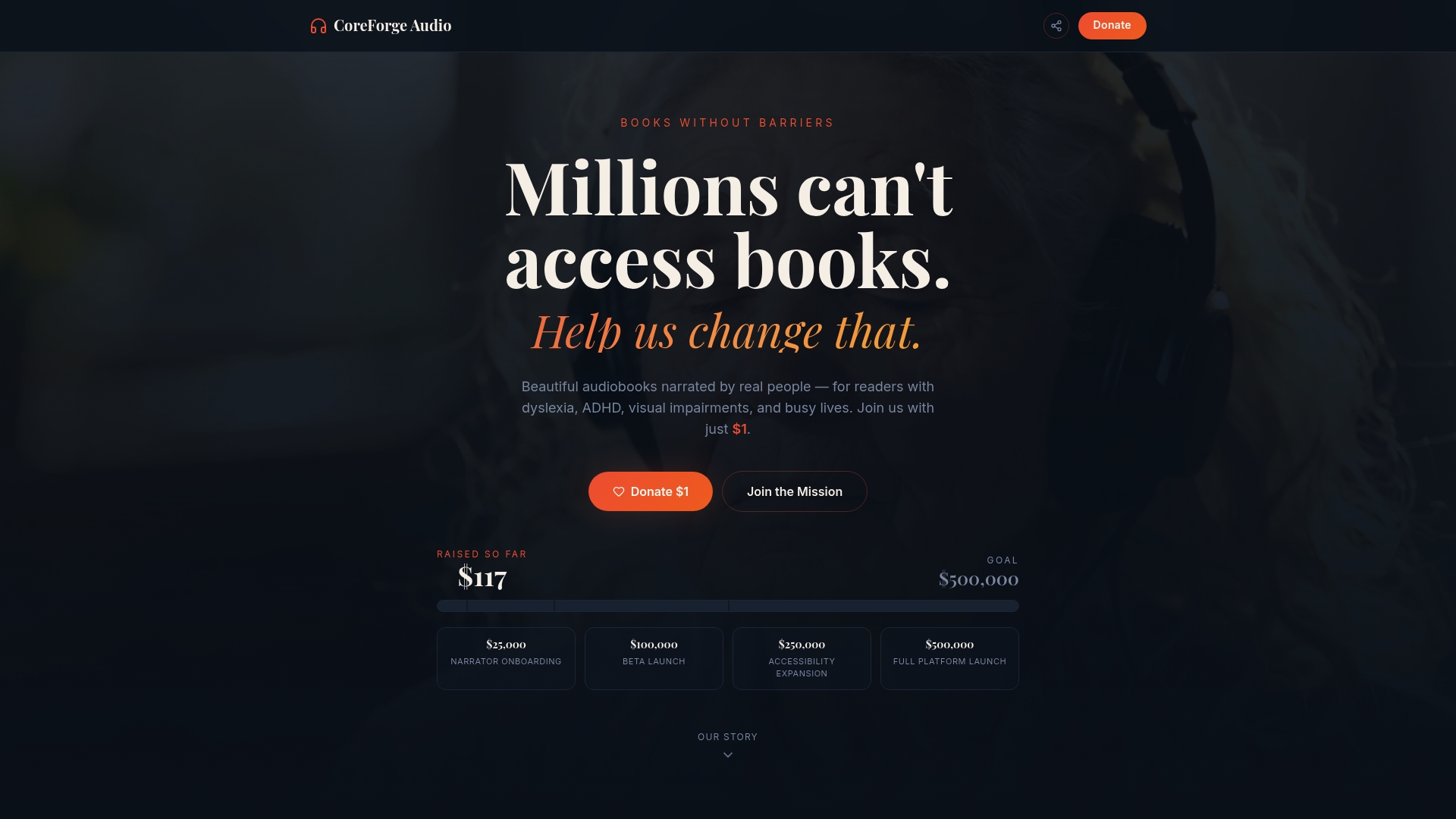
Explore CoreForge Audio resources to discover how our platform supports literacy growth through accessible, high-quality audio content. Whether your child has dyslexia, ADHD, a visual impairment, or simply learns better through listening, we are building something that puts their needs first. Join our community and be part of a mission that believes every child deserves access to the power of stories.
Frequently asked questions
Can listening to audiobooks fully replace reading for children with dyslexia?
No, listening can support literacy but does not fully replace the unique benefits of reading, especially for skills like phonological decoding. Auditory processing in dyslexia varies widely across individuals, so listening-based approaches should complement, not replace, targeted reading instruction.
How can I tell if my child is truly comprehending when listening?
Pause and ask your child to retell the story or answer open-ended questions, which reveals how much they understand. Pairing audiobooks with discussion moments is the most reliable way to check for real comprehension rather than just passive exposure.
Are there kids for whom listening does not help literacy?
Some children with certain auditory processing challenges may not benefit as much and might need different approaches. Evidence on auditory processing predicting reading outcomes is mixed, so always observe your child's individual response and adjust accordingly.
What are easy ways to boost engagement during listening sessions?
Use short segments, set predictable stops, and bring up conversation to check for understanding and keep attention high. If a child struggles with sustained auditory attention, smaller chunks and interaction help maintain engagement far better than long, uninterrupted sessions.