
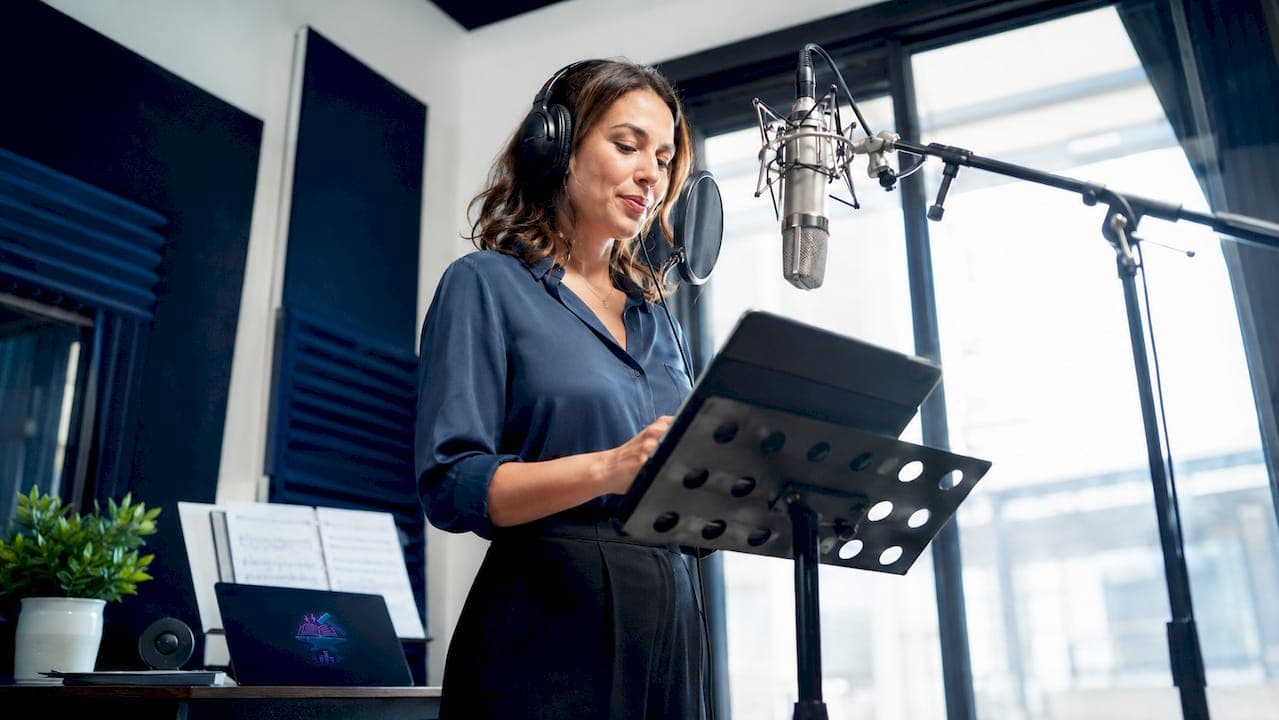
The narrator is the single most important factor in audiobook quality, more than production budget, genre, or even the source material itself. A skilled narrator transforms text into a living experience. A poor one turns a great book into something you abandon before chapter three. The role of narrator in audiobook quality is not a soft preference. It is the defining variable in whether a listener finishes, recommends, or returns to an audiobook. Audiobook revenue reached $2.22 billion in 2024, and narrator-driven demand is a core reason the market keeps growing.
How does a narrator influence audiobook quality?
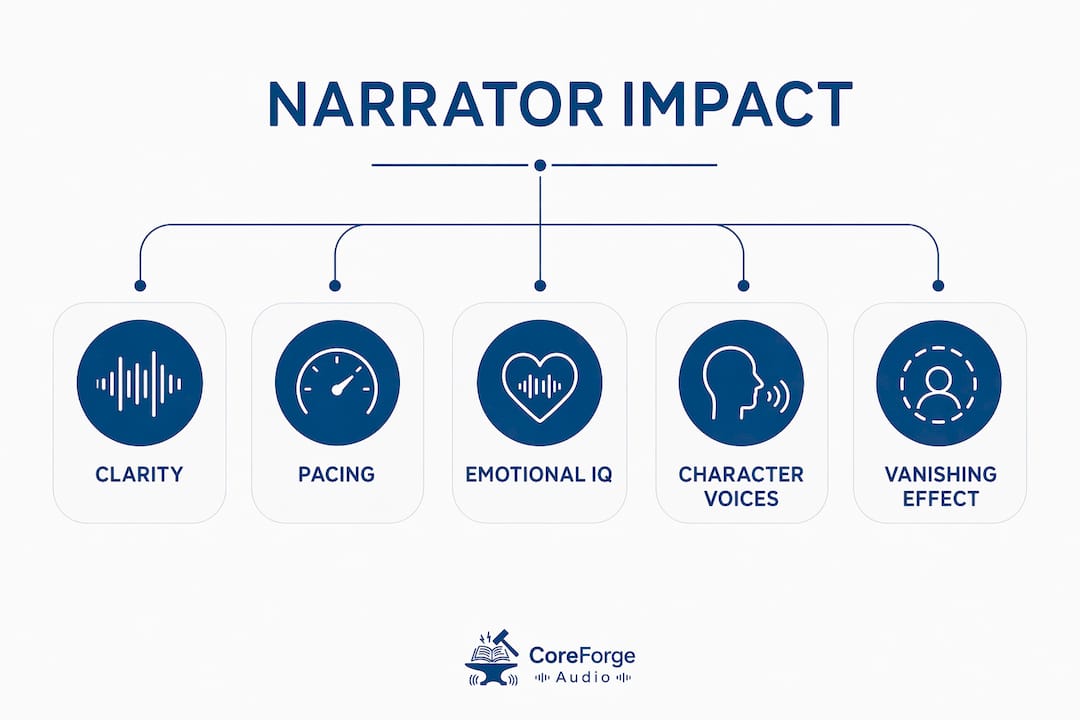
Narrator performance is the technical term the industry uses for what listeners simply call "a good voice." But performance analysis goes much deeper than vocal tone. The role of narrator in audiobook quality breaks down into five distinct craft elements, each of which directly shapes your listening experience.
Clarity and articulation determine whether you follow the story without rewinding. During a three-hour commute, a narrator who swallows consonants or rushes through complex names forces you to work too hard. That friction kills immersion fast.

Pacing and rhythm are what allow words to land. A narrator who rushes every sentence flattens emotional peaks. One who pauses too long between lines makes the story feel sluggish. The best narrators treat pacing the way a musician treats tempo: they vary it deliberately to match the scene.
Emotional intelligence is where great narrators separate themselves from competent ones. Matching cadence and tone to a story moment requires the narrator to understand the text as deeply as an actor understands a script. A grief scene delivered in the same register as a grocery list is a failure of emotional reading.
Character differentiation is the craft of giving each voice enough distinction that you know who is speaking without the narrator announcing it. The risk here is overacting. Excessive dramatization alienates listeners and breaks the story's reality. Restraint almost always outperforms theatrics.
The fifth element is what industry professionals call the "vanishing narrator" effect. Elite narrators become invisible, and listeners forget there is a performer at all. You are simply inside the story. That invisibility is the highest standard in audiobook narration.
Pro Tip: Before committing to a full audiobook, listen to the free sample with your eyes closed. Notice whether you are hearing a voice or experiencing a scene. If you are still aware of the narrator after two minutes, that is a signal worth taking seriously.
Authors who narrate their own books often face a specific challenge here. Author-narrated audiobooks can carry authentic emotional weight, but most authors lack the technical voice training to sustain performance across eight or ten hours. Flat delivery and awkward pacing are the most common results. That does not make author narration wrong. It makes narrator fit the real question.
Does narration style need to match the genre?
The short answer is yes, and the industry has known this for years. Narrator fit matters more than narrator talent in isolation. A voice that commands authority in a Malcolm Gladwell-style nonfiction title may feel cold and clinical reading a romance novel. The same voice that brings warmth to literary fiction may lack the urgency a thriller demands.
Here is how narration style demands shift across major genres:
| Genre | Narration Priority | Common Pitfall |
|---|---|---|
| Literary Fiction | Emotional nuance, measured pacing | Over-dramatizing quiet moments |
| Thriller/Suspense | Tension, controlled urgency | Monotone delivery that kills stakes |
| Nonfiction/Self-Help | Clarity, authority, conversational warmth | Robotic or lecture-style delivery |
| Romance | Intimacy, character chemistry | Flat emotional range across scenes |
| Science Fiction/Fantasy | World-building voice, character range | Inconsistent accent or character voices |
Full-cast productions add another layer. Character-driven works, especially in fantasy and literary fiction, benefit enormously from multiple narrators because each character gets a voice that belongs to them. The trade-off is production cost and tonal consistency across the cast. When a full cast is well-directed, the result is closer to a radio drama than a traditional audiobook. When it is poorly coordinated, the tonal shifts feel jarring.
Consistency across recording sessions is one of the hardest technical challenges in professional narration. A narrator who records chapter one in one emotional register and chapter twelve in another creates a subtle but real sense of disconnection. Listeners may not identify the cause, but they feel it. That is why professional narrators keep detailed session notes on character voices, accent choices, and emotional baselines.
For a deeper look at how narration style maps to specific content types, Coreforgeaudio's guide on audiobook narration styles breaks down the matching process with practical examples.
Are listeners choosing audiobooks based on narrator?
Yes, and the shift is accelerating. By early 2026, narrator-driven discovery has become a mainstream behavior. Listeners are selecting audiobooks based primarily on who is narrating, sometimes ignoring plot summaries entirely. Narrators have become curators, the same way a trusted film director signals quality before you know the plot.
This behavior change has real market consequences. Audiobook revenue grew 13% in 2024, with romance up 30% and science fiction/fantasy up 21%. Those genre spikes are not purely about story trends. They reflect the influence of specific voice talent communities that have built loyal listener followings. Fans of a narrator follow that narrator across titles, across authors, and across genres.
Platforms like Audible have recognized this with features like the Narrator Hall of Fame, which surfaces top-rated voice talent and helps listeners discover new titles through trusted performers. That feature exists because listener data confirmed what enthusiasts already knew: the narrator's name on the cover influences the download decision.
Listeners rely on narrators as guides who maintain pace, clarity, and emotional engagement across long listening sessions. Unlike reading, you cannot skim an audiobook. A narrator who loses your attention has no recovery mechanism. That is why narrator reputation has become a genuine discovery signal, not just a quality indicator after the fact.
The practical implication for you as a listener is that building a short list of narrators you trust is one of the most efficient ways to find your next great audiobook. It works better than browsing by genre alone.
How do you identify quality narration before you commit?
Choosing the right narrator is a skill you can develop quickly with the right framework. Here is a practical process:
- Listen to the sample chapter first. Every major platform offers one. Evaluate pace, clarity, and whether character voices feel distinct without being cartoonish.
- Check narrator reviews separately from book reviews. Many listeners leave specific comments about narration quality. A book with a 4.5-star rating and consistent complaints about the narrator is a warning sign.
- Know your genre preferences. If you primarily listen to thrillers, identify two or three narrators whose pacing and tension-building you respond to, then follow their catalog.
- Watch for flat monotones and over-dramatization equally. Both are signs of a poor narrator-to-material fit. Flat delivery signals a lack of emotional engagement. Over-dramatization signals a narrator who is performing rather than storytelling.
- Use platform features designed for narrator discovery. Audible's narrator ratings and the Narrator Hall of Fame are built specifically for this. Use them before you spend a credit.
Pro Tip: If you are exploring a new genre, search for audiobooks where the narrator has won an Audie Award or received an Earphones Award from AudioFile Magazine. These are the industry's most recognized narrator performance honors, and they are reliable quality signals.
The benefits of human narration go beyond preference. For listeners with dyslexia, ADHD, or visual impairments, a skilled human narrator provides the emotional and rhythmic cues that make comprehension possible in ways that synthesized voices still cannot replicate. Narrator quality is an accessibility issue, not just an entertainment one.
Understanding how narrators prepare for a recording session also helps you recognize quality when you hear it. Preparation shows up in the consistency of character voices, the naturalness of pacing, and the emotional accuracy of scene-by-scene delivery.
Key takeaways
The narrator is the primary determinant of audiobook quality, shaping listener engagement, discovery behavior, and long-term loyalty more than any other single production factor.
| Point | Details |
|---|---|
| Narrator quality drives completion | Poor narration is the leading cause of early audiobook abandonment within the first hour. |
| Genre fit beats overall talent | A narrator suited to the book's tone and genre outperforms a technically superior but mismatched voice. |
| Vanishing narrator effect signals excellence | The best narrators become invisible, pulling listeners fully into the story without drawing attention to performance. |
| Listeners now discover by narrator | By 2026, narrator reputation functions as a discovery signal, influencing downloads more than plot summaries. |
| Samples are your best screening tool | Listening to a sample chapter before committing reveals pacing, clarity, and character voice quality in minutes. |
What i have learned listening to hundreds of audiobooks
I used to evaluate audiobooks almost entirely by author reputation and subject matter. I would pick up a title because the premise was compelling or because a critic I trusted had praised the writing. Then I started noticing something uncomfortable: some of my most anticipated listens felt like work. I was not absorbing the material. I was enduring it.
The variable was almost always the narrator.
What changed my thinking was paying attention to the moments I rewound. I rewound when I missed something, and I missed things when the narrator's delivery did not signal that something mattered. A skilled narrator uses micro-pauses, subtle shifts in register, and deliberate slowing to tell you: this sentence is important. When that guidance is absent, your attention drifts.
The other thing I have noticed is that listener loyalty to specific narrators is real and rational. When you find a narrator whose emotional intelligence matches your own, you are not just enjoying a voice. You are trusting a guide. That trust is built across multiple titles, and it is one of the most reliable shortcuts to a great listening experience.
My honest recommendation: stop treating narrator selection as secondary. Build your own short list of trusted narrators the same way you build a list of trusted authors. The payoff in listening satisfaction is immediate and consistent.
— Sarmed
Experience audiobooks the way they were meant to sound
Coreforgeaudio is built on the belief that narrator quality is not a luxury. It is a right. The platform prioritizes professionally trained human narrators whose performances are matched to content type, audience needs, and accessibility requirements. For listeners with dyslexia, ADHD, visual impairments, or simply a busy schedule, the quality of narration is the difference between access and exclusion. Explore Coreforgeaudio's accessible audiobook platform to hear what thoughtful narrator selection sounds like in practice, and see how the platform is building a library where every voice is chosen with purpose.
FAQ
What makes a narrator good or bad in an audiobook?
A good narrator delivers clarity, consistent pacing, emotional accuracy, and distinct character voices without overacting. Poor narration typically involves flat monotone delivery, inconsistent character voices, or excessive dramatization that pulls listeners out of the story.
How does narrator quality affect whether i finish an audiobook?
Narrator quality is the strongest predictor of early abandonment. Listeners who find the narration grating or flat are most likely to stop within the first hour, regardless of how strong the source material is.
Should i choose an audiobook based on the narrator?
Yes. By 2026, narrator-driven discovery is a mainstream listener behavior. Building a short list of narrators whose style you trust is one of the most reliable ways to find audiobooks you will actually finish and enjoy.
Does the genre affect what narration style works best?
Absolutely. Narrator fit depends on genre and tone. A voice suited for nonfiction authority may feel cold in romance, while a warm literary fiction narrator may lack the urgency a thriller requires. Genre matching is a core part of professional audiobook casting.
Are author-narrated audiobooks lower quality?
Not always, but authors narrating their own work often lack the technical voice training to sustain performance across a full-length recording. The result is frequently flat pacing or inconsistent emotional delivery, even when the author's personal connection to the material is genuine.
Recommended
- How narrators actually prepare for an audiobook (and why it shows) — CoreForge Audio Blog
- Human narrators vs AI: why real voices still matter in audiobooks — CoreForge Audio Blog
- Blog — CoreForge Audio | Accessible Audiobooks for Every Reader
- Blog — CoreForge Audio | Accessible Audiobooks for Every Reader