
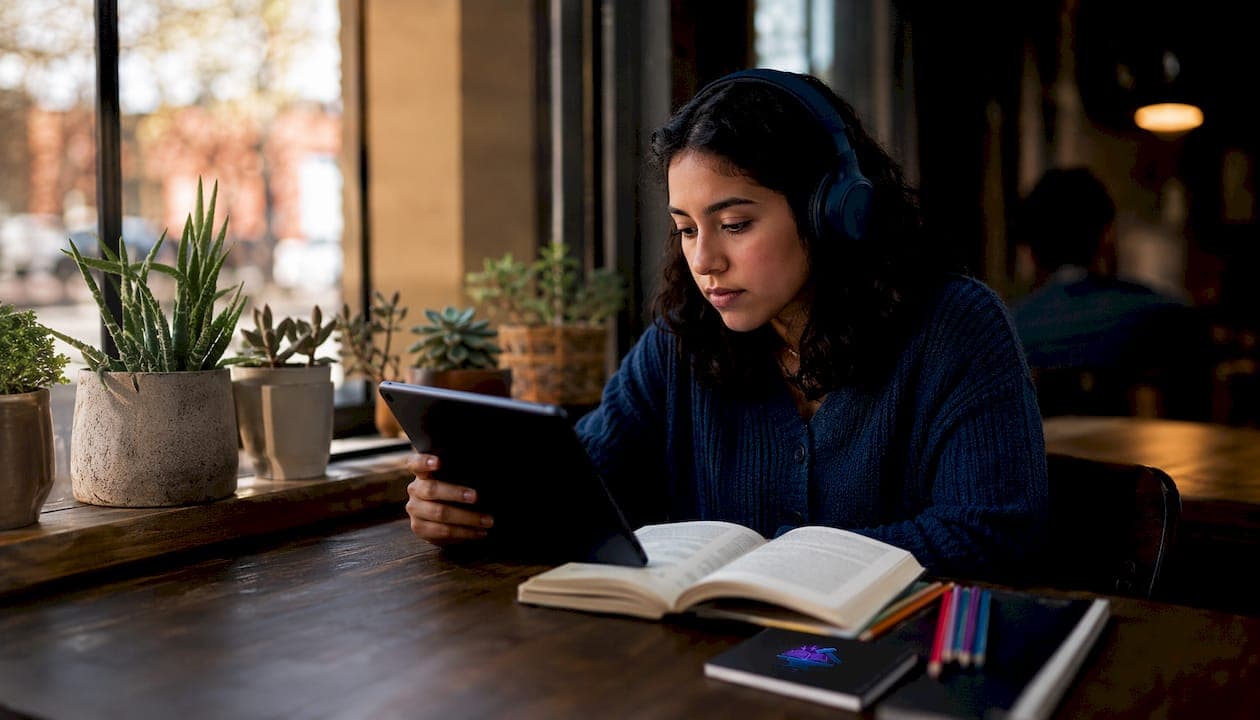
Yes, audiobooks work for English language learners — and the evidence is strong. A 2026 MIT McGovern Institute study found that students gained vocabulary from audiobooks alone, with the largest gains appearing when listening was paired with explicit instruction. Colorín Colorado recommends shared listening followed by discussion as a low-cost, high-impact routine. A JIER listening-literacy review confirms that audiobooks expose learners to authentic pronunciation, intonation, and varied sentence structures that build comprehension across proficiency levels.
Three things you can do this week:
- Start a read-along session: play an audiobook while students follow the printed or on-screen text.
- Pre-teach five to eight key vocabulary words before each listening session.
- Schedule two or three repeated listenings of the same passage before moving on.
Table of Contents
- Why audiobooks help ELLs: the research and learning science
- Practical strategies for using audiobooks with ELLs in class and at home
- How to choose the right audiobooks for ELLs
- Measuring comprehension and tracking progress
- Common challenges and how to work around them
- A ready-to-use 1-week audiobook lesson plan
- Where U.S. educators and families can access audiobooks
- Key Takeaways
- Why accessible audiobooks are worth fighting for
- Coreforgeaudio: built for the learners who need it most
- Useful sources and further reading
Why audiobooks help ELLs: the research and learning science
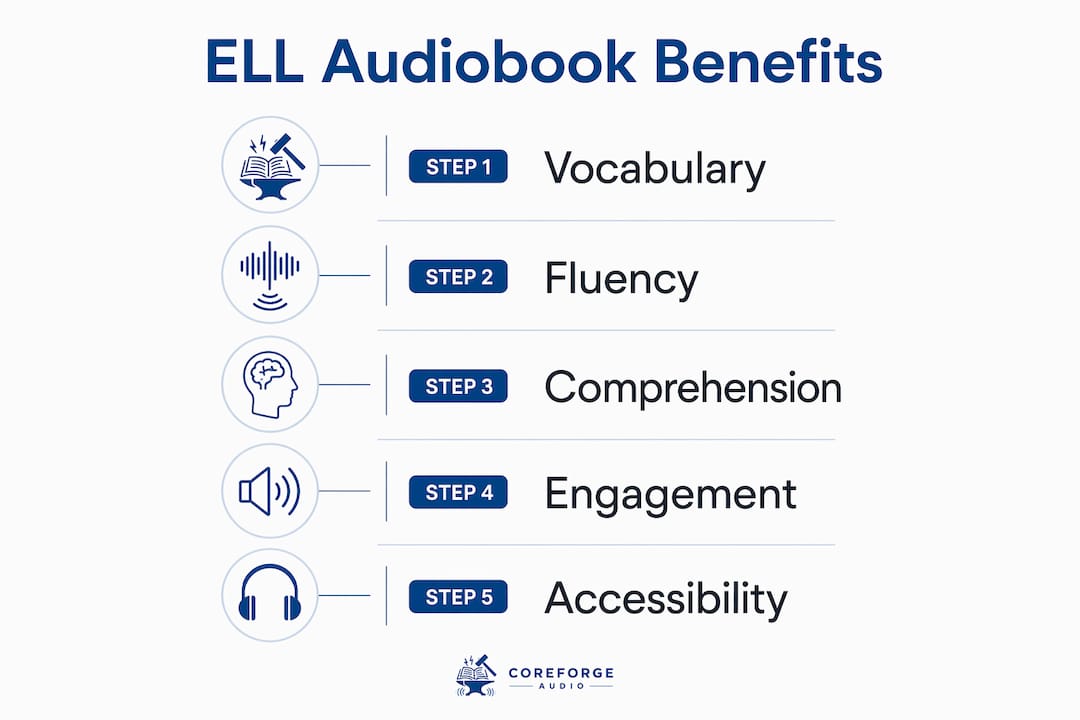
Audiobooks give English language learners something a textbook exercise cannot: authentic spoken English at natural pace, with real intonation, rhythm, and connected speech. That kind of rich input builds vocabulary and comprehension across proficiency levels, as the JIER review documents. Learners hear how words sound in context, not just how they look on a page.
The MIT research adds important nuance. Students in the study gained vocabulary from audiobooks alone, but poor readers showed significant gains only when audiobooks were paired with explicit tutoring. Socioeconomic factors also affected outcomes, which means a one-size approach won't serve every classroom.
Neuroscience adds another layer. Listening and reading recruit different cognitive processes: reading lets a learner pause and reprocess; listening requires keeping up with the speaker's pace in real time. That's not a weakness of audiobooks — it's a reason to combine both modes. When a student follows highlighted text while listening, they get pronunciation modeling AND decoding practice simultaneously. Dr. Ola Ozernov-Palchik and her MIT colleagues have emphasized that this combination is where the real gains live, particularly for learners who struggle with decoding. The science behind audiobook learning consistently points to paired-mode instruction as the most effective approach.
Practical strategies for using audiobooks with ELLs in class and at home
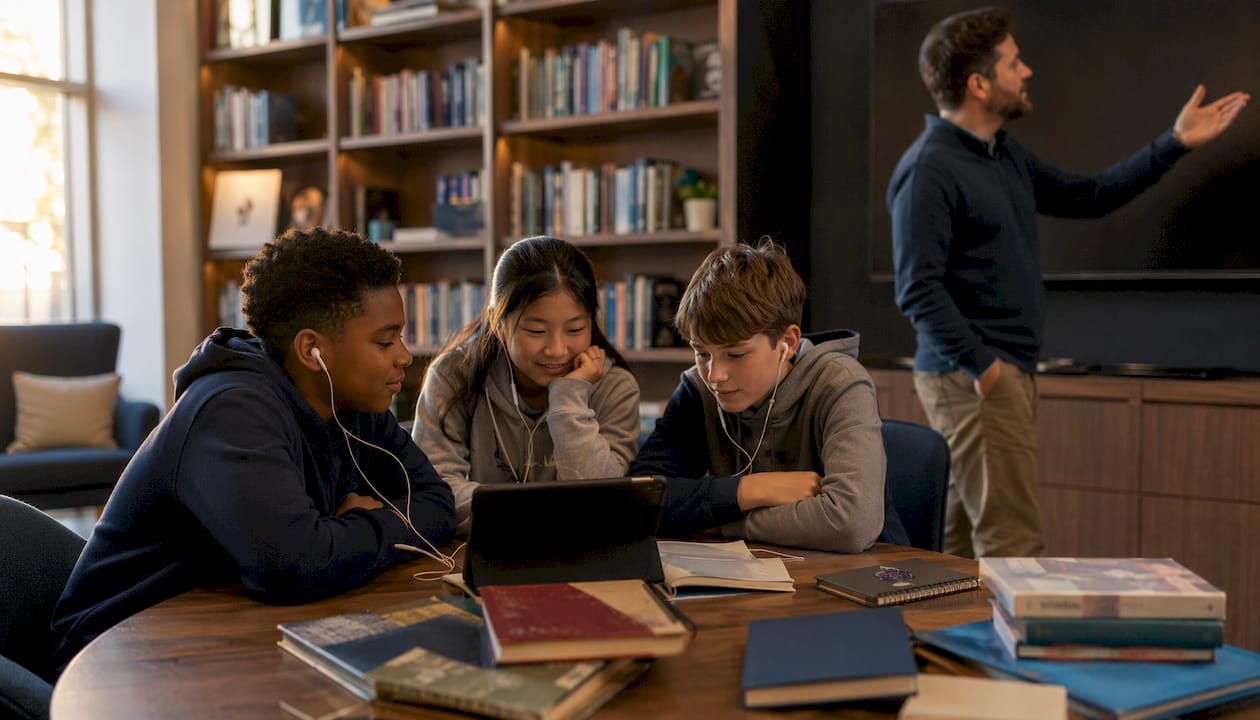
The highest-impact routine you can start today is simple: pre-teach vocabulary for five minutes, listen while following the text, then discuss or retell. That three-part loop is what Colorín Colorado's shared-listening guidance is built around, and it works at home just as well as in a classroom.
Specific activities worth building into your routine:
- Read-along follow-along: Play the audio while students track the text. Highlight-synced versions make this even more effective.
- Shadow reading: Students read aloud quietly along with the narrator, mimicking pacing and intonation. This builds pronunciation faster than most explicit drills.
- Scripted retell: After listening, students retell the passage in their own words — first orally, then in writing.
- Dramatized reading: Students re-read a passage with expression, using the narrator's model as a reference.
- Paired-listening discussion: Two students listen together, then discuss using a prompt card ("What surprised you? What word was new?").
Sample session script (20–25 minutes):
Before listening (5 min): "Today we're going to listen to [title]. Before we start, let's look at three words: [word 1], [word 2], [word 3]. Here's what they mean and how they sound."
During listening (10 min): "Follow along in your book or on screen. If you hear one of our vocabulary words, give a thumbs up."
After listening (5–10 min): "Tell your partner: what happened first? What happened next? What was one word you heard that was new?"
Pro Tip: For learners who need more support, pair the audiobook session with a small-group follow-up where a tutor or aide revisits the same vocabulary. The MIT study found this pairing produced the clearest gains for struggling readers — even a 10-minute one-on-one review makes a measurable difference.
For parents, the early childhood literacy guide from Coreforgeaudio walks through how to adapt these routines at home with young learners.
How to choose the right audiobooks for ELLs
Start with human narration and clear diction. A narrator who speaks at a measured pace, enunciates cleanly, and uses natural intonation gives learners the best pronunciation model. Text-sync (read-along with highlighted text) is the single most valuable feature for beginning and intermediate ELLs, because it bridges spoken and written language simultaneously.
Selection checklist:
- Narrator clarity: natural pace, distinct pronunciation, no heavy regional accent that may confuse beginners
- Adjustable playback speed: lets learners slow down without distorting pitch
- Text-sync or transcript availability: highlighted read-along or downloadable transcript
- Bilingual or dual-language editions: especially valuable for heritage language speakers
- Dyslexia-friendly display options: OpenDyslexic font or similar, high-contrast modes
- Age- and interest-appropriate content: engagement drives repeated listening
- Complexity match: slightly above the learner's independent reading level (i+1 input)
Accessibility features aren't extras for ELLs — they're the core of the selection decision. Adjustable speed lets a learner replay a confusing sentence at 0.75x without losing the natural rhythm entirely. Transcripts support vocabulary lookup and note-taking. Multilingual audiobook options help learners connect new English words to concepts they already know in their home language.
Coreforgeaudio's platform is built around exactly this checklist: dyslexia-friendly fonts, adjustable narration speed, multilingual support, and human narrators paid fairly for their work. For learners with reading barriers layered on top of language learning, those features aren't nice to have. They're what makes the content accessible at all. The guide to choosing audiobooks for learning differences covers how to apply these criteria for specific learner profiles.
Pro Tip: When evaluating a new title, play the first two minutes without the text. If you can follow the meaning comfortably, the narration is clear enough for your learners.
Measuring comprehension and tracking progress
Simple oral retells, targeted cloze tasks, and brief vocabulary checks give reliable signals of audiobook impact — and none of them require a formal test.
| Assessment type | Emerging | Developing | Proficient |
|---|---|---|---|
| Comprehension retell | Names 1–2 story elements with support | Retells main events in sequence with some prompting | Retells accurately with detail and inferred meaning |
| Vocabulary use | Recognizes target words when heard | Uses target words in context with scaffolding | Uses target words accurately in speech and writing |
| Pronunciation/fluency | Approximates sounds; heavy L1 influence | Mostly intelligible; some L1 interference | Clear, natural-sounding production |
Track weekly by noting which level each student hits on retell and vocabulary use. A student moving from Emerging to Developing on vocabulary after two weeks of paired listening is showing exactly the pattern the MIT research predicts. If progress stalls, that's a signal to add explicit one-on-one instruction rather than simply increasing listening time. The audiobook literacy outcomes research provides additional frameworks for interpreting these patterns at the program level.
Common challenges and how to work around them
Most barriers to audiobook use with ELLs are solvable. The key is scaffolded support before, during, and after listening — not abandoning the format when it gets hard.
Common problems and accommodations:
- Rapid speech or connected speech: Slow playback to 0.75x–0.85x; pre-teach high-frequency phrases that appear in the passage.
- Unknown vocabulary density: Provide a glossary of 5–8 words before listening; use visuals or L1 translations for concrete nouns.
- Attention and focus: Chunk audio into 3–5 minute segments with a brief check-in between each.
- Technology access: Download audio files for offline use; print transcripts as a backup; use public library apps (OverDrive/Libby) on shared devices.
- Decoding barriers layered with language learning: Use text-sync so learners see and hear simultaneously; pair with a reading buddy.
For learners with ADHD or dyslexia alongside language learning needs, audiobook implementation in special education contexts offers additional accommodation frameworks. The play-based communication strategies used with neurodiverse learners also complement shared listening routines well.
Pro Tip: Create a "repeat-listen station" — a tablet or device loaded with the week's audiobook passage. Let students revisit it independently during free reading time. Repeated exposure without pressure accelerates vocabulary retention.
A ready-to-use 1-week audiobook lesson plan
A 20–30 minute daily routine that pairs audiobooks with targeted activities drives measurable skill gains over a single week. Here's a reproducible plan.
| Day | Focus | Activity | Time |
|---|---|---|---|
| Day 1 | Background knowledge + vocabulary | Activate prior knowledge; pre-teach 6–8 key words with visuals | 25 min |
| Day 2 | First listen + guided retell | Read-along listen; oral retell with a partner using sentence starters | 25 min |
| Day 3 | Second listen + shadowing | Listen again; shadow-read a key passage aloud; note new words | 20 min |
| Day — | Vocabulary deepening | Cloze activity with target words; vocabulary journal entries | 25 min |
| Day 5 | Performance + assessment | Dramatized reading or recorded retell; teacher completes rubric | 30 min |
Materials checklist:
- Audiobook file (downloaded or streamed)
- Printed or digital text of the passage
- Vocabulary glossary (pre-made)
- Sentence starter cards for retell
- Rubric from the assessment section above
Where U.S. educators and families can access audiobooks
Free and low-cost audiobook access is widely available. Most U.S. families and schools can get started without spending anything.
Access pathways:
- Public libraries via OverDrive/Libby: Free with a library card; thousands of titles including children's and young adult books with read-along features.
- School and district subscriptions: Many districts license platforms that include audiobook collections; check with your media specialist.
- Public-domain sources: FCIT's Lit2Go offers free MP3 audiobooks with PDFs for read-along use, specifically designed for classroom and ELL use.
- Nonprofit platforms: Coreforgeaudio operates on a donation and micro-funding model, with accessibility features (dyslexia-friendly fonts, adjustable speed, multilingual support) built in from the start. Educators can explore educator resources and pilot access through the platform's blog and early-access program.
Cost is rarely the real barrier. The bigger challenge is finding titles with the right accessibility features at the right level. That's where a purpose-built platform like Coreforgeaudio fills a gap that general library catalogs often leave open.
Key Takeaways
Audiobooks support English language learners most effectively when listening is paired with text, explicit vocabulary instruction, and structured discussion.
| Point | Details |
|---|---|
| Pair audio with text | Read-along with highlighted text bridges spoken and written English simultaneously. |
| Add explicit instruction | MIT research shows vocabulary gains are largest when audiobooks are paired with one-on-one tutoring for struggling readers. |
| Use the 3-part loop | Pre-teach vocabulary, listen with text, then retell or discuss — every session, every week. |
| Prioritize accessibility features | Adjustable speed, transcripts, and dyslexia-friendly fonts make content reachable for learners with layered barriers. |
| Coreforgeaudio | Offers human-narrated audiobooks with dyslexia-friendly fonts, adjustable speed, and multilingual support — built for learners with reading barriers. |
Why accessible audiobooks are worth fighting for
The conventional wisdom treats audiobooks as a convenience — something you use when you can't sit down with a book. That framing undersells what they actually do for language learners. For an ELL student who can't yet decode English text fluently, an audiobook isn't a shortcut. It's the only way into a story that's linguistically rich enough to actually stretch their vocabulary.
What the MIT research makes clear is that the format works, but the surrounding instruction is what determines how much. A student listening alone in a corner gains something. A student listening with a text, a glossary, and a five-minute debrief with a teacher gains significantly more. The platform matters less than the pedagogy around it.
That said, accessibility features aren't cosmetic. A learner with dyslexia who also speaks English as a second language is navigating two overlapping barriers at once. Adjustable narration speed, OpenDyslexic fonts, and multilingual support aren't accommodations bolted on for compliance — they're what makes the content usable at all. Platforms that treat those features as optional are, in practice, excluding the learners who need audiobooks most.
Coreforgeaudio: built for the learners who need it most
For ELLs with reading barriers, Coreforgeaudio offers something most general audiobook platforms don't: accessibility features designed from the ground up, not added as an afterthought.
Human narrators, fairly compensated. Dyslexia-friendly fonts. Adjustable playback speed. Multilingual support. These aren't feature bullets — they're the difference between a learner accessing a story and being locked out of it. Coreforgeaudio is currently in its early-access phase, funded through a micro-donation model that keeps the mission community-driven.
- Text-sync and adjustable speed for ELLs at every proficiency level
- Multilingual support for heritage language speakers
- Human narration that models authentic pronunciation and intonation
Educators and parents can support early access and explore the platform's growing library of accessible audiobooks today.
Useful sources and further reading
Use these for lesson planning, grant applications, and deeper research:
- MIT McGovern Institute — Learning with audiobooks: Best for researchers and educators wanting the study methodology and findings on vocabulary gains.
- MIT News — Audiobooks and vocabulary: Accessible summary of the same study; good for sharing with administrators or parents.
- Colorín Colorado — Listen and Learn with Audio Books: Best practitioner resource for classroom routines and shared-listening strategies.
- Reading Rockets — Benefits of audiobooks for all readers: Broad overview; useful for building the case with school boards or families.
- JIER — Audiobooks in English Language Instruction: Academic source for listening-literacy research; cite in grant applications.
- FCIT Lit2Go: Free classroom-ready audiobooks with PDFs; ideal for teachers with no budget.
- Coreforgeaudio Blog — Audiobooks and second-language learners: Practitioner-focused guidance with classroom recommendations for diverse learners.