
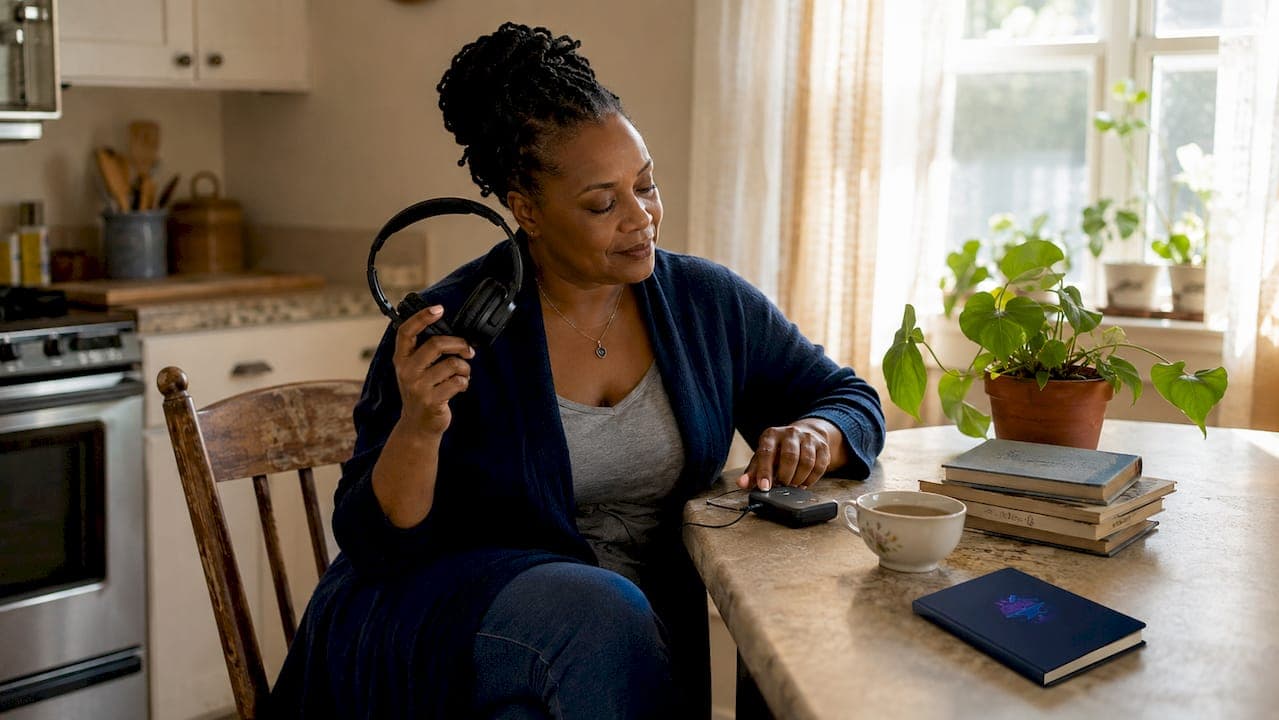
Audiobooks are defined as fully narrated, verbatim recordings of books, and they outperform podcasts for literary listening by delivering higher retention, deeper immersion, and a structured narrative experience that podcasts simply cannot replicate. Research shows audiobooks achieve 75% information retention compared to podcasts' 55%. That 20-point gap is not a minor difference. It reflects a fundamental structural advantage that makes audiobooks the superior audio format for anyone who wants to truly absorb a book. Coreforgeaudio is built on this principle, offering human-narrated audiobooks designed for readers who need more than casual listening.
Why audio outperforms podcasts for books: the retention gap
The core reason audiobooks beat podcasts for literary consumption is narrative structure. Audiobooks follow a linear arc from chapter one to the final page, with every sentence edited for coherence and pacing. That structure gives your brain a clear framework to organize and store information.
Podcasts work differently. They are episodic by design, meaning each episode stands alone. A listener can drop in at episode 47 without losing context. That flexibility is a strength for news and commentary, but it actively works against deep literary absorption. Structured linear content produces better retention for complex topics, while episodic formats suit exploratory or current-events listening.

Professional narration also matters more than most readers realize. A trained voice actor uses prosody, pacing, and emotional tone to signal meaning. That is not decoration. It is a cognitive aid. The narrator's voice guides attention, marks transitions, and signals emotional weight in ways that a conversational podcast host rarely does for a book's text.
| Format | Retention rate | Content structure | Typical length |
|---|---|---|---|
| Audiobook | 75% | Linear, edited narrative | 8–12 hours |
| Podcast | 55% | Episodic, conversational | 30–60 minutes |
Pro Tip: Set a consistent daily listening window of 20–30 minutes for audiobooks. Deliberate daily engagement maintains narrative flow and prevents the comprehension gaps that come from long breaks between sessions.
What are the engagement differences between audiobooks and podcasts?
Sustained attention separates audiobook listeners from podcast listeners in a measurable way. Listeners average 27 minutes per session when consuming audio-based book formats. That level of focused engagement reflects the pull of a continuous story rather than a self-contained episode.
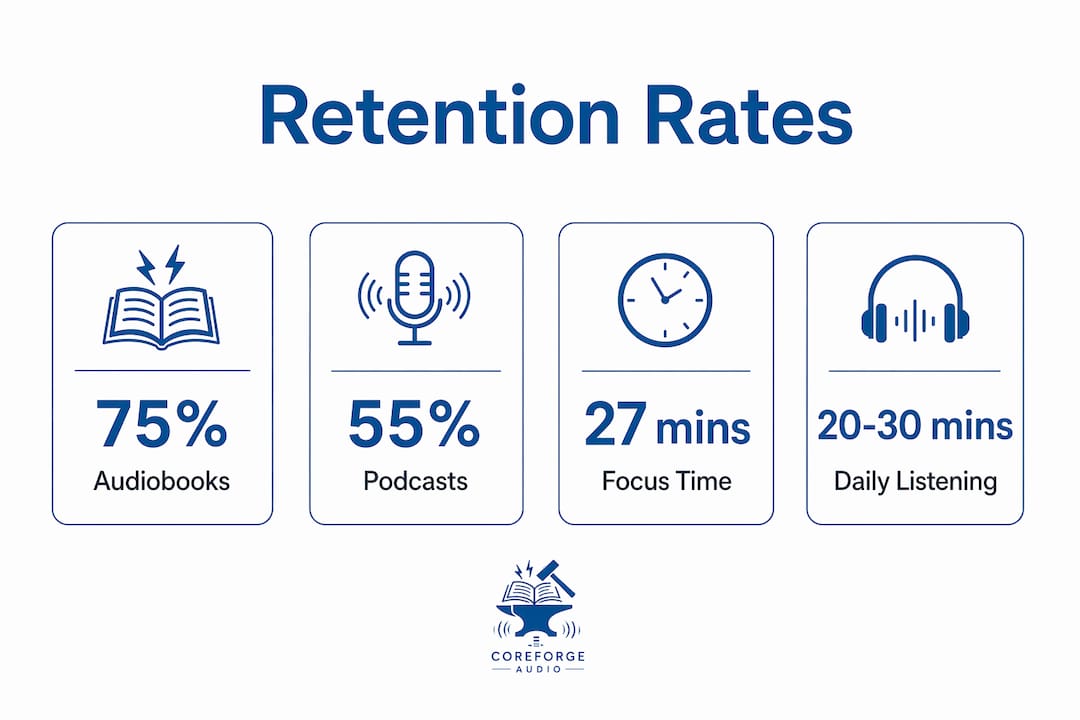
Podcasts are built for flexibility. You can pause, skip, and return without losing the thread. Audiobooks demand a different kind of commitment. Audiobooks require 8–12 hours of sustained listening to complete a single title. That commitment is not a drawback. It is the mechanism that produces deeper comprehension and emotional connection to the material.
The engagement differences show up clearly in specific listening contexts:
- Commuting: Audiobooks turn a 30-minute commute into a chapter. The fixed endpoint of a commute matches the chapter-by-chapter structure of a book better than an open-ended podcast conversation.
- Multitasking: Listeners doing repetitive tasks like cooking or exercising report that audiobook narratives hold attention more reliably than podcast discussions, which require active processing of shifting topics.
- Before sleep: The predictable rhythm of a narrated book is easier to follow in a low-stimulation state than the variable energy of a podcast interview.
- Long-form learning: For readers working through a nonfiction book on a complex subject, the audiobook format preserves the author's argument from premise to conclusion without editorial restructuring.
Pro Tip: Use student engagement metrics to track your own listening habits. Noting where you pause or rewind reveals which sections need a second pass, which is a practice that sharpens retention.
How do audiobooks support diverse learning needs better than podcasts?
Audiobooks reduce visual cognitive load in a way that podcasts do not address at all. For readers with dyslexia, ADHD, or visual impairments, the act of decoding text on a page consumes working memory that could otherwise go toward comprehension. Audiobooks reduce visual load and enhance emotional engagement, freeing up cognitive resources for understanding rather than decoding.
Voice prosody is the technical term for the rhythm, stress, and intonation a narrator uses. It carries emotional information that plain text leaves implicit. A skilled narrator signals irony, urgency, and tenderness through vocal tone. Podcast hosts do this too, but they are responding to a conversation, not serving a written text. The difference is that an audiobook narrator is a precise interpreter of the author's words, not a commentator on them.
"Audiobooks can offer meaningful depth that print text cannot match for those with attention or visual challenges. Active engagement is the key that unlocks those benefits." Michigan State University Health Care
For listeners with ADHD, the continuous narrative of an audiobook provides a structured anchor for attention. Audiobooks for ADHD listeners work because the narrator's voice acts as an external pacing mechanism, reducing the mental effort required to stay on track. Podcasts, with their topic shifts and conversational tangents, offer no equivalent structure.
The accessibility advantages extend beyond diagnosed conditions. Busy readers who cannot sit down with a physical book benefit from the same structural clarity. The audiobook does not require the listener to manage the reading experience. The narrator handles pacing, emphasis, and flow.
How do listener goals shape the choice between audiobooks and podcasts?
Listener intent is the clearest predictor of which format delivers value. Podcasts serve readers who want to stay current, sample ideas broadly, or follow an ongoing conversation. Audiobooks serve readers who want to go deep on a single subject or experience a complete literary work.
The goals are genuinely different, and neither format is wrong. But when the goal is mastering a book, the audiobook format wins on every relevant measure. Enjoyment is the strongest predictor of consistent audiobook use and long-term learning benefits. That finding matters because it reframes the choice. Choosing the format you actually enjoy is not a preference. It is a retention strategy.
Here is how listener goals map to format strengths:
- Deep focus on a single book: Audiobooks preserve the author's complete argument or story. Audiobooks preserve original text with full narration, while podcasts restructure content into conversational summaries. If you want the book, listen to the book.
- Skill development and complex topics: Nonfiction audiobooks on subjects like economics, history, or psychology follow the author's reasoning from foundation to conclusion. That sequential logic is lost when the same content is broken into podcast episodes.
- Education and continuous learning: Platforms like Coreforgeaudio are built around continuous education through audiobooks, recognizing that structured audio content supports learners across age groups and ability levels.
- Leisure reading and fiction: The emotional arc of a novel depends on cumulative investment in characters and plot. Audiobooks sustain that investment across weeks of listening. A podcast episode cannot replicate that experience by design.
- Commuting and daily routines: Audiobooks fit naturally into fixed daily windows. A commuter who listens for 25 minutes each way completes a full-length book in roughly three weeks without any additional time investment.
Key Takeaways
Audiobooks outperform podcasts for books because structured narration, higher retention rates, and sustained engagement combine to produce a genuinely deeper literary experience than episodic podcast formats can deliver.
| Point | Details |
|---|---|
| Retention advantage | Audiobooks achieve 75% retention versus podcasts' 55%, a gap driven by linear narrative structure. |
| Engagement depth | Listeners average 27 minutes per focused session, reflecting the pull of continuous storytelling. |
| Accessibility benefits | Audiobooks reduce visual cognitive load, making them the stronger format for readers with dyslexia, ADHD, or visual impairments. |
| Listener intent matters | Audiobooks suit deep focus and mastery; podcasts suit broad exploration and current-topic sampling. |
| Enjoyment drives retention | Consistent enjoyment of the audiobook format is the strongest predictor of long-term learning outcomes. |
The format debate misses the real point
I have spent years watching readers default to podcasts for book content because podcasts feel easier to start. You tap play, and a host explains the book's main ideas in 40 minutes. That feels efficient. The problem is that efficiency and comprehension are not the same thing.
What I have observed consistently is that listeners who switch from podcast summaries to full audiobooks report something they did not expect: they actually remember the book. Not the main idea. The argument. The examples. The emotional texture of the story. That is what structured narration delivers, and no podcast summary can replicate it.
The common misconception is that podcasts are a reasonable substitute for reading a book. They are not. They are a different product serving a different need. A podcast about a book is like a map of a city. An audiobook is the city itself. The map is useful, but you would not confuse it for the experience of being there.
My honest recommendation is to treat audiobooks as your primary format for any book you genuinely want to absorb, and use podcasts for what they do best: staying current, sampling new ideas, and following ongoing conversations. That division of purpose is not a compromise. It is the most effective use of both formats.
— Sarmed
Coreforgeaudio: audiobooks built for real listeners
Coreforgeaudio is a nonprofit-focused platform that puts human-narrated audiobooks within reach of readers who face barriers to traditional reading. Every title on the platform is narrated by a professional voice actor, preserving the author's original text with the emotional depth and pacing that drives retention.
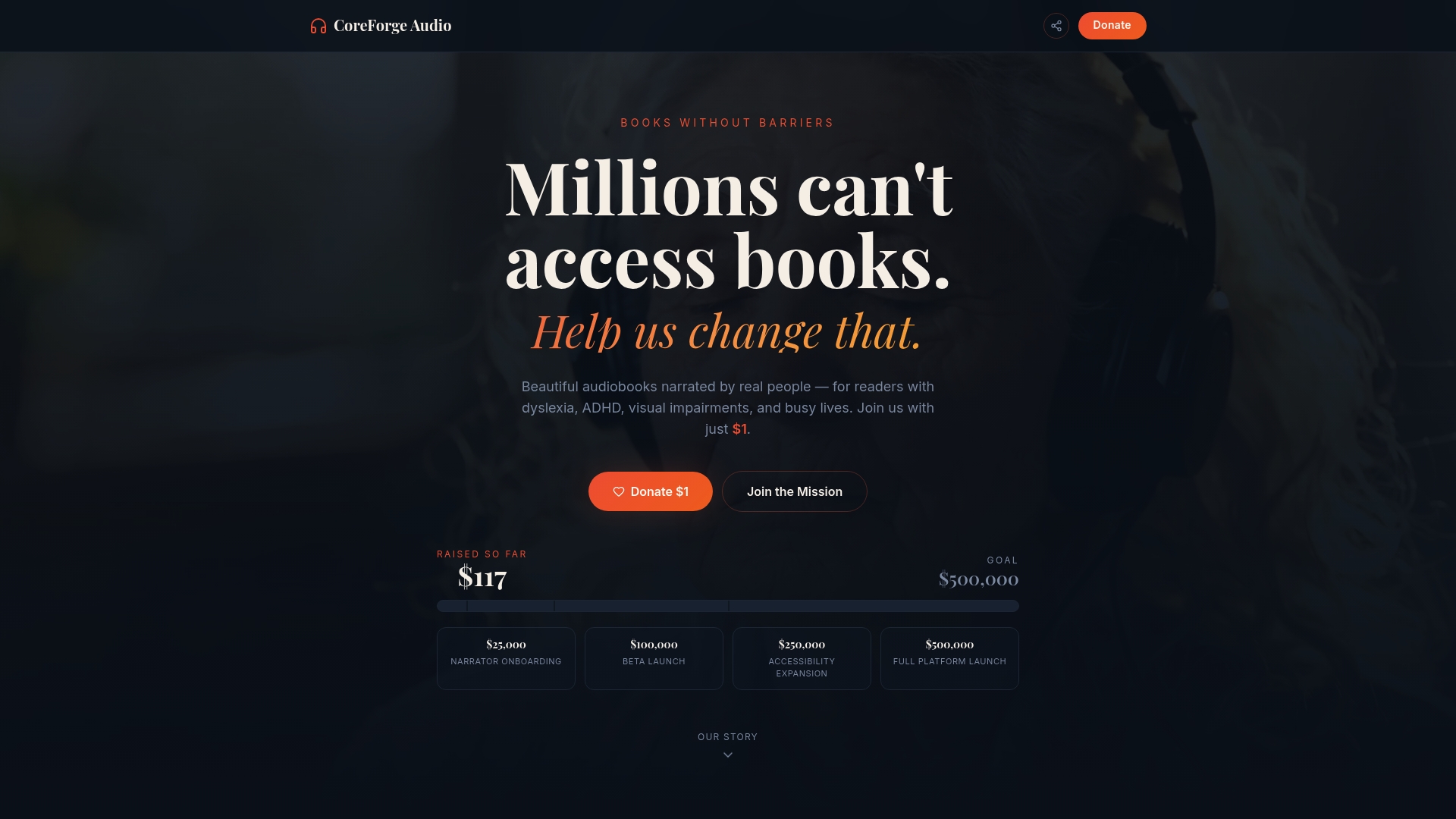
The platform includes dyslexia-friendly fonts, adjustable narration speeds, and multilingual support, making it one of the few audiobook services designed from the ground up for accessibility. Coreforgeaudio is actively fundraising to expand its library and keep access affordable. If you are ready to experience the full audiobook advantage, the platform is the place to start.
FAQ
Why do audiobooks have higher retention than podcasts?
Audiobooks achieve 75% information retention compared to podcasts' 55% because their linear, edited narrative gives the brain a clear structure to organize and store information. Episodic podcast formats lack that sequential coherence.
Can podcasts replace audiobooks for reading a book?
Podcasts cannot replace audiobooks for reading a book. Podcasts restructure content into conversational summaries, while audiobooks preserve the author's original text with full narration, delivering a fundamentally different and deeper experience.
How long do listeners typically focus during an audiobook session?
Listeners average 27 minutes of focused engagement per session when consuming audio-based book formats. That sustained attention reflects the pull of continuous narrative rather than the topic-shifting nature of podcast episodes.
Are audiobooks better for listeners with ADHD or dyslexia?
Audiobooks reduce visual cognitive load and provide a structured narrative anchor, making them the stronger format for listeners with ADHD, dyslexia, or visual impairments. The narrator's voice handles pacing and emphasis, reducing the mental effort required to stay engaged.
When should I choose a podcast over an audiobook?
Choose a podcast when your goal is broad exploration, staying current on a topic, or sampling ideas across multiple perspectives. Choose an audiobook when your goal is mastering a single book, developing a skill, or experiencing a complete literary work.