

Multisensory learning tools for adults are defined as study aids that engage two or more senses simultaneously to improve comprehension, retention, and engagement. The formal term in education research is multimodal instruction, and it covers everything from audio summaries to tactile mind maps. Evidence-based strategies like spaced repetition and retrieval practice show large effect sizes for adult learners, including those with ADHD and dyslexia. Coreforgeaudio builds directly on this science, offering human-narrated audiobooks with dyslexia-friendly fonts and adjustable narration speeds for adults who need more than a single input to learn well.
What makes multisensory learning tools effective for adults?
Effective multimodal education tools do more than add visuals to text. They align with how adult brains actually process and store information.

Adult learners respond best to problem-centered approaches that connect new knowledge to real-world situations immediately. Abstract theory presented without context causes disengagement fast. The best sensory learning resources lead with a clear "why" before introducing any "how."
Three features separate strong tools from weak ones:
- Spaced repetition scheduling: Content surfaces again before you forget it, not after.
- Retrieval practice built in: The tool forces you to recall information without notes, not just re-read it.
- Adaptable sensory inputs: You can switch between audio, visual, and tactile modes based on your context and cognitive style.
AI-powered adaptive platforms take this further. They use dynamic content adjustment based on real-time cognitive profiles, shifting pacing and complexity as you learn. That kind of personalization was unavailable to most adult learners five years ago.
Pro Tip: Use purposeful, sparing audiovisual inputs. Adding more sensory layers does not automatically improve retention. Relevance and clarity matter more than volume.
Top 10 multisensory learning tools for adults
1. Audiobooks with adjustable narration
Audiobooks engage the auditory channel while freeing your hands and eyes for other tasks. Human-narrated audiobooks, like those offered through Coreforgeaudio, add emotional tone and pacing cues that synthetic voices cannot replicate. Adults with dyslexia or visual impairments benefit most from audio-based learning, which removes the decoding barrier entirely. Adjustable narration speeds let you slow down for complex material and speed up for review.
2. Interactive video lessons
Interactive video combines visual and auditory inputs with embedded quizzes that trigger retrieval practice mid-lesson. Pausing to answer a question before continuing forces active recall rather than passive watching. This format works well for busy adults who study in short sessions, because each pause creates a natural stopping point without losing context.
3. Mind mapping software
Mind mapping tools like visual diagram builders engage spatial and visual processing simultaneously. Drawing connections between concepts by hand or on screen activates kinesthetic memory. Adults who struggle with linear note-taking often retain more when they organize ideas as branching maps. The act of building the map is the learning, not just reading the finished product.
4. Flashcard apps with spaced repetition
Spaced repetition flashcard apps schedule reviews at scientifically timed intervals to maximize long-term retention. Retrieval practice has the highest retention effect of any study method, yet most adult learners underuse it in favor of re-reading. These apps force you to test yourself, which is the exact mechanism that builds durable memory. Adults with ADHD benefit from the short, focused bursts these sessions require.
5. Podcast-style audio summaries
Audio summaries of complex topics compress hours of reading into focused listening sessions. They work best when paired with a visual outline you follow along with, engaging both auditory and visual channels at once. Audiobooks for ADHD research confirms that audio narration helps adults with attention challenges stay with content longer than text alone. Podcast-style formats also model expert thinking, which supports problem-centered learning.
6. Tactile learning kits
Physical manipulatives, including 3D models, textured cards, and hands-on experiment kits, engage tactile and kinesthetic senses that screens cannot reach. Medical and science learners use anatomical models to build spatial understanding that diagrams alone cannot provide. Tactile tools are especially effective for adults who work with their hands professionally, because the physical action mirrors real-world application. They are the most underused category in adult self-directed study.
7. AI-powered adaptive learning platforms
AI adaptive platforms build what researchers call a 4D learner model, mapping your skills, pace, and cognitive style to adjust content in real time. If you struggle with a concept, the platform shifts to a simpler explanation or a different modality before moving on. This removes the frustration of one-size-fits-all courses that either bore or overwhelm. Busy professionals benefit most because the platform eliminates wasted review time on material already mastered.
8. Structured online courses with community dialogue
Data from 32,000+ courses shows that community discussion and practice-oriented exercises significantly boost learner engagement and course completion. Structured courses that include peer forums add a social and verbal processing layer to written and visual content. Explaining a concept to a peer is one of the strongest forms of active recall. Adults who study in isolation miss this output channel entirely.
9. Dual-output study sessions
Dual-output practice means explaining a concept aloud while simultaneously sketching a process map. Active recall combined with dual sensory output outperforms passive listening or reading by a significant margin. This technique requires no special tool, only a notebook and your voice. It is the highest-return study method available to any adult learner at zero cost.
10. Interleaved practice sets
Interleaving mixes different problem types within a single study session rather than blocking one topic at a time. Studies by Rohrer & Taylor (2007) and Dunlosky et al. (2013) confirm that interleaving improves understanding and knowledge transfer beyond rote, blocked practice. Most adult learners find interleaving uncomfortable at first because it feels harder. That difficulty is the mechanism. Struggling to retrieve across mixed topics forces deeper processing than drilling one type repeatedly.
Comparing sensory learning resources by learner type
Choosing the right tool depends on your cognitive style, schedule, and specific learning goals. The table below maps tool categories to learner profiles.
| Tool category | Sensory modes | Best for | Pacing |
|---|---|---|---|
| Audiobooks | Auditory | Dyslexia, visual impairment, commuters | Self-paced |
| Interactive video | Visual, auditory | Visual learners, ADHD | Structured with breaks |
| Mind mapping | Visual, kinesthetic | Conceptual thinkers, non-linear learners | Self-paced |
| Flashcard apps | Visual, retrieval | All adults, especially ADHD | Short bursts |
| Tactile kits | Tactile, kinesthetic | Hands-on professionals, science learners | Flexible |
| AI adaptive platforms | Multi-modal | Busy professionals, neurodiverse adults | Fully adaptive |
| Dual-output sessions | Auditory, kinesthetic | All adults, zero-cost option | Self-directed |
Budget matters too. Dual-output sessions and mind mapping cost nothing. Tactile kits and AI platforms sit at the higher end. The most expensive tool is not always the most effective one for your specific cognitive style.
How to build multisensory learning into your adult study routine
The first step is identifying your dominant cognitive style, not to limit yourself to one mode, but to know your starting point. Adults who already learn well through audio can layer in visual sketching without disrupting their flow.
Structured autonomy works best for adult learners: set clear learning objectives, then choose which sensory tools you use to meet them. This keeps you goal-focused without locking you into a rigid format.
Four practical steps to get started:
- Start with the "why." Connect every new topic to a real problem you are trying to solve before engaging any tool.
- Schedule spaced reviews. Set calendar reminders to revisit material at 24 hours, one week, and one month after first exposure.
- Mix your modalities. Pair an audiobook session with a quick visual sketch of the key ideas immediately after listening.
- Avoid sensory overload. Purposeful use of inputs beats cramming every modality into one session. Clear, consistent layouts reduce distraction.
Pro Tip: Build a listening routine for dyslexia around a fixed daily time slot. Consistency reduces the cognitive effort of starting, which is often the hardest part.
Key takeaways
Multisensory learning tools for adults work best when they combine active retrieval, real-world problem context, and purposeful sensory inputs rather than passive consumption of content.
| Point | Details |
|---|---|
| Lead with the "why" | Connect new content to a real problem before introducing abstract concepts to maintain motivation. |
| Prioritize retrieval practice | Self-testing beats re-reading for long-term retention and is the most underused adult study method. |
| Match tools to your profile | Choose sensory modes based on your cognitive style, schedule, and any learning differences. |
| Avoid sensory overload | Sparing, relevant audiovisual inputs outperform cluttered, high-stimulation study environments. |
| Mix modalities actively | Combining audio with visual sketching or peer explanation produces stronger memory than any single mode. |
What I've learned from watching adults struggle with these tools
Adult learners make one mistake more than any other: they confuse exposure with learning. They listen to an audiobook, watch a video, or read a chapter and feel productive. Passive consumption feels like progress. It is not.
The research on retrieval practice is unambiguous. Testing yourself without notes, explaining concepts aloud, sketching what you just heard: these are the methods that build durable memory. Most adults avoid them because they feel harder and less comfortable than re-reading. That discomfort is the signal that real learning is happening.
The second pattern I see constantly is tool hopping. Adults collect apps, platforms, and courses without finishing any of them. The problem is not the tools. The problem is starting with "how" instead of "why." When you know exactly what problem you are trying to solve, the right tool becomes obvious and you stick with it.
My honest recommendation: pick one auditory tool, one retrieval tool, and one output method. Use them consistently for 30 days before adding anything else. Complexity is the enemy of follow-through for busy adults.
— Sarmed
Coreforgeaudio and accessible audio for adult learners
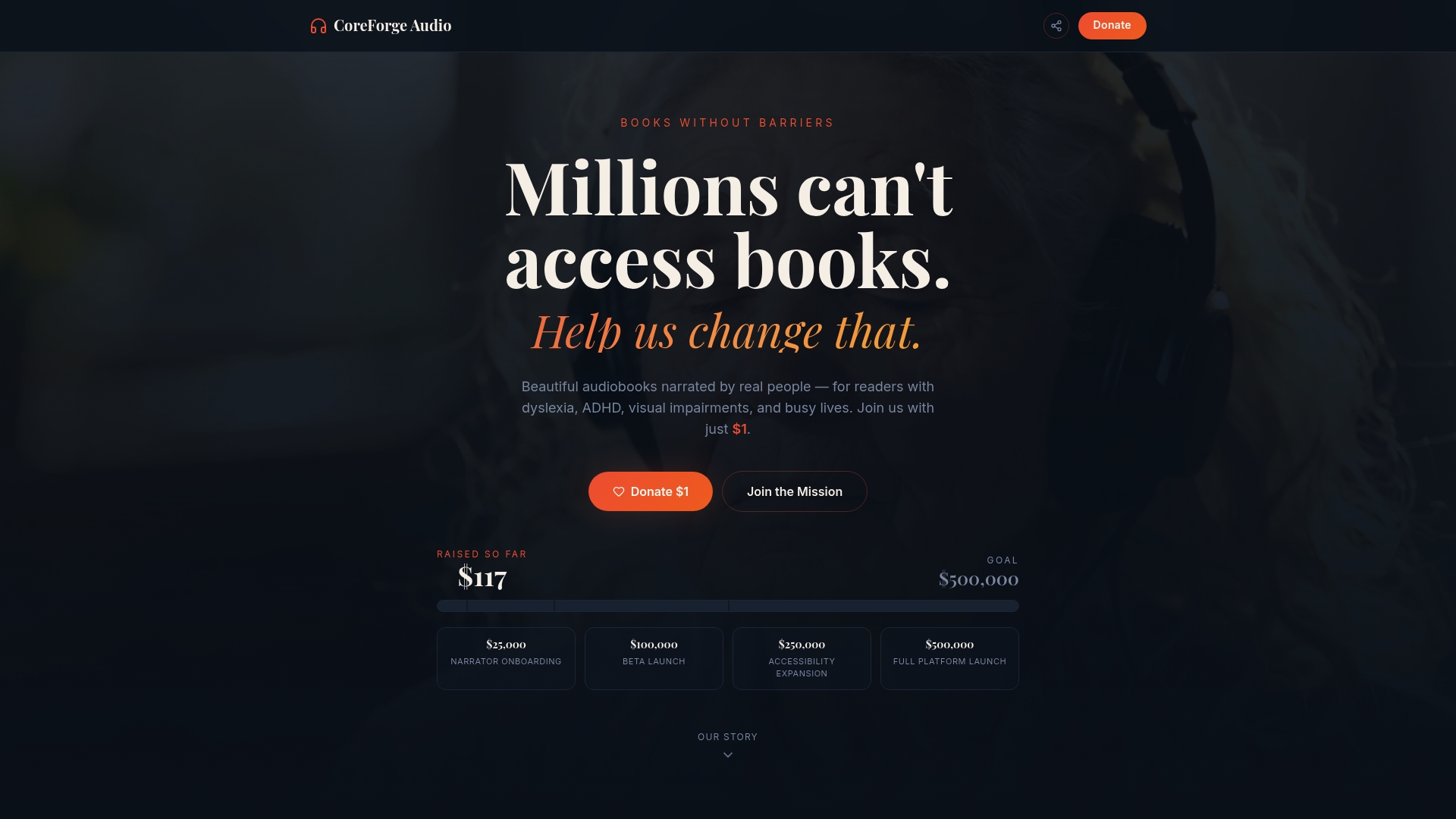
Coreforgeaudio is built for adults who face real barriers to reading, whether that is dyslexia, ADHD, a visual impairment, or a schedule that leaves no time to sit with a book. The platform offers human-narrated audiobooks with dyslexia-friendly fonts, adjustable narration speeds, and multilingual support. Every feature on the platform reflects a commitment to accessibility over convenience. Coreforgeaudio is currently fundraising to expand its library and audio learning resources, with full transparency about where every dollar goes. If accessible, high-quality audio content is part of your study plan, Coreforgeaudio is worth following closely as it builds toward launch.
FAQ
What are multisensory learning tools for adults?
Multisensory learning tools for adults are study aids that engage two or more senses at once, such as audio, visual, tactile, or kinesthetic inputs, to improve comprehension and retention. The formal term in education research is multimodal instruction.
Which multisensory tool works best for adults with dyslexia?
Audiobooks with adjustable narration speeds are the most effective tool for adults with dyslexia because they remove the decoding barrier while preserving full content access. Human-narrated versions add emotional and contextual cues that support comprehension.
How does retrieval practice fit into multisensory learning?
Retrieval practice, or self-testing without notes, has the highest retention effect of any adult study method according to research by Roediger & Karpicke (2006). Pairing it with a sensory output like explaining aloud or sketching amplifies the memory benefit further.
Can adults with ADHD benefit from multisensory learning tools?
Adults with ADHD benefit significantly from audio-based and interactive tools that break content into short, focused segments. Spaced repetition flashcard apps and human-narrated audiobooks both support sustained attention without requiring long, uninterrupted reading sessions.
How many sensory modes should I use in one study session?
Use two to three sensory modes per session at most. Experts advise against cluttering study sessions with too many inputs, as sensory overload reduces focus and undermines the retention benefits of multimodal learning.