

Educational audio is defined as any audio content designed with specific learning objectives, structured activities, and measurable outcomes. Entertainment audio, by contrast, delivers passive listening experiences aimed at enjoyment, general information, or cultural engagement without directed teaching. Understanding what is entertainment vs educational audio matters more than ever for parents choosing content for their children, educators building curriculum, and anyone who wants to get real value from their listening time.
The distinction goes deeper than subject matter. A podcast about history can entertain without teaching. A structured audiobook on the same topic can build genuine comprehension. The format, design, and intent behind the audio determine which category it falls into.
What are the main features that differentiate educational audio from entertainment audio?
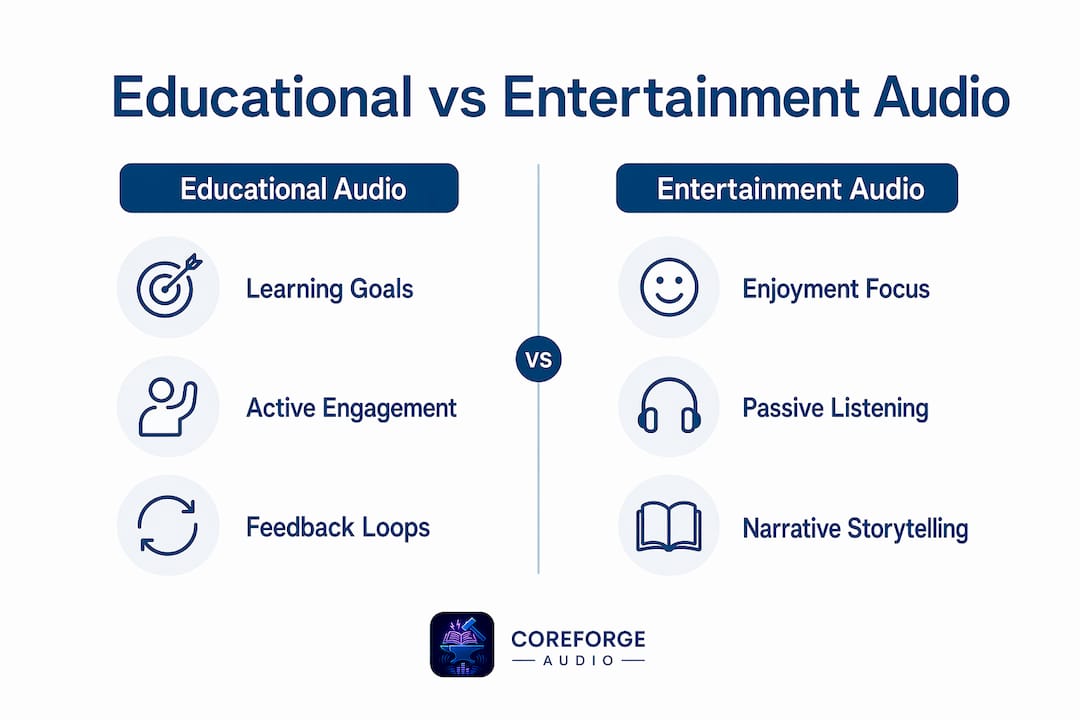
Educational audio follows specific curriculum goals with active engagement and structured activities. Entertainment audio is designed for passive listening without learning objectives. That single design difference shapes everything else about how each format works.
Educational audio uses feedback loops, comprehension checks, and targeted participation to keep listeners mentally active. Interactive Radio Instruction (IRI), a model used in schools across sub-Saharan Africa and Latin America, is the clearest example. IRI broadcasts include pauses for student responses, songs that reinforce vocabulary, and teacher guides that align each session to national curriculum standards. Listeners are never passive.
Traditional radio broadcasts serve entertainment, news, and culture without focused educational goals or curriculum adherence. They are one-way, lack structured participation, and provide no feedback loops. A morning drive radio show and a classroom IRI broadcast may both use audio, but they operate on entirely different principles.

| Feature | Educational audio | Entertainment audio |
|---|---|---|
| Primary purpose | Achieve learning objectives | Entertain or broadly inform |
| Listener engagement | Active, structured participation | Passive, self-directed |
| Feedback loops | Yes, built into design | No |
| Activities | Comprehension checks, exercises | None |
| Target audience | Defined learner groups | General public |
| Voiceover style | Controlled, clarity-focused | Dramatic, expressive, varied |
Pro Tip: Before pressing play on any audio content, ask one question: does this format require me to do anything? If the answer is no, you are listening to entertainment audio, regardless of the topic.
How does the cognitive impact of listening to educational vs entertainment audio differ?
Listening places specific demands on the brain that reading does not. Listening demands auditory attention and working memory, representing a distinct cognitive skill that educators should actively cultivate. This is not a weakness of audio. It is a characteristic that changes how information gets processed.
A meta-analysis of 46 studies involving 4,687 participants found that reading outperforms listening for inferential comprehension because readers can control pace, reread difficult passages, and pause to reflect. Listening imposes a predetermined rhythm that can challenge sustained attention and detailed comprehension. That finding does not mean audio is inferior. It means audio and reading serve different cognitive functions.
Educational audio compensates for these limitations through design. Structured pauses, repetition, and comprehension prompts force the listener to process information actively rather than let it wash over them. Entertainment audio makes no such demands.
"Reading allows a form of inner dialogue and suspension of time conducive to reflection, unlike audio which imposes a predetermined rhythm that can hinder detailed comprehension." The Conversation
The cognitive benefits of educational audio are strongest when listeners bring metacognitive awareness to the experience. Metacognition here means knowing when you understood something and when you did not. Educators should promote metacognitive strategies that allow learners to select audio or reading modalities based on their attention capacity and learning context. A student who knows they lose focus after 15 minutes of audio can use that knowledge to structure their listening sessions.
Key cognitive differences between the two formats:
- Working memory load: Educational audio is paced to match working memory capacity. Entertainment audio sets its own pace for engagement, not comprehension.
- Retention: Active participation in educational audio strengthens memory encoding. Passive entertainment listening produces weaker long-term retention of specific facts.
- Emotional engagement: Entertainment audio, especially storytelling and music, creates strong emotional responses that can aid memory but do not replace structured learning.
- Attention demands: Listening adds auditory immersion and emotional dimension but can challenge sustained attention and backtracking compared to reading.
What are common examples of educational and entertainment audio formats?
The difference between educational and entertainment audio becomes clearest when you look at real formats side by side.
Educational audio formats
Interactive Radio Instruction (IRI) is the most documented educational audio model globally. UNESCO and international development organizations have used it to deliver structured lessons in mathematics, literacy, and science to students without reliable access to trained teachers.
Structured audiobooks are narrated texts designed to build comprehensive mental models of a subject. Podcasts optimized for breadth and conversational discovery differ from structured audiobooks designed for in-depth learning. An audiobook on human anatomy, narrated at a measured pace with chapter summaries, functions as educational audio. The same content delivered as a casual conversation between two hosts functions as entertainment.
Guided learning podcasts follow a curriculum arc across episodes, include recaps, and often provide supplementary materials. They are designed for sequential listening, not random access.
AI multi-voice conversational podcasts represent a newer format. AI multi-voice conversational podcasts enhance engagement and comprehension better than single-voice text-to-speech recordings by promoting active mental processing. Dialogue formats force logical progression and active listening for better educational outcomes.
Entertainment audio formats
Traditional radio broadcasts, music playlists, narrative storytelling podcasts, and true crime series all fall into the entertainment category. They may be informative. They may even teach you something. But their design prioritizes engagement and enjoyment over measurable learning outcomes.
Voiceover style marks another clear difference. Educational voiceover focuses on clarity, pacing, and facilitating comprehension rather than dramatic performance. Commercial and character voice acting uses expressive range, emotional intensity, and personality to entertain. Both are skilled crafts. They serve different purposes.
Coreforgeaudio applies this distinction directly. Its human-narrated audiobooks use controlled, clarity-focused narration designed to support comprehension for readers with dyslexia, ADHD, and visual impairments, not to perform for a general audience.
How can you choose between educational and entertainment audio based on your goals?
The right audio format depends on what you want to accomplish. Choosing well requires honest answers to a few questions.
-
Define your goal first. If you want to relax, commute comfortably, or enjoy a story, entertainment audio is the right choice. If you want to retain specific information, build a skill, or support a child's learning, you need educational audio with structured design.
-
Match format to complexity. Simple, broad topics work well in conversational podcast formats. Complex subjects with layered concepts require structured audiobooks or curriculum-based audio that builds knowledge progressively. Content consumers should choose formats based on structural learning intent.
-
Combine reading and listening for best results. Reading and listening together produce stronger comprehension than either alone. A student who reads a chapter and then listens to a narrated summary reinforces the material through two cognitive pathways.
-
For educators integrating audio into curriculum: Align audio content to specific lesson objectives. Use audio learning in curriculum that includes comprehension activities, not just passive listening sessions. Audio without structured follow-up functions as entertainment, regardless of the topic.
-
For parents choosing content for children: Check whether the audio includes participation prompts, vocabulary reinforcement, or comprehension questions. These features signal educational design. A narrated story without these elements is entertainment audio, which has real value but should not replace structured learning time. The parent's guide to audiobooks from Coreforgeaudio covers this in detail for early childhood literacy.
Pro Tip: Listen to the first five minutes of any audio content and count how many times you are asked to respond, recall, or predict. Zero prompts means entertainment audio. Multiple prompts mean educational audio.
Key Takeaways
Educational audio and entertainment audio differ not by topic but by design: structured participation and learning objectives define educational audio, while passive enjoyment defines entertainment audio.
| Point | Details |
|---|---|
| Design determines category | Educational audio uses feedback loops and activities; entertainment audio does not. |
| Cognitive demands differ | Listening taxes working memory differently than reading; educational audio compensates through structure. |
| Format signals intent | IRI, structured audiobooks, and guided podcasts are educational; radio, music, and narrative podcasts are entertainment. |
| Voiceover style matters | Educational narration prioritizes clarity and pacing; entertainment voice acting prioritizes expression and emotion. |
| Choose by goal | Match audio format to your specific learning objective or enjoyment need for the best outcome. |
Why the line between these two formats matters more than most people realize
Most people treat audio as a single category. They assume that listening to a documentary podcast is roughly equivalent to reading a textbook chapter on the same subject. It is not. The format shapes the cognitive experience as much as the content does.
I have seen this play out repeatedly with parents who report that their child "listened to audiobooks all summer" but showed no improvement in reading comprehension. When you look at what they actually listened to, it is almost always entertainment audio. Engaging stories, well-narrated, but without a single comprehension prompt or vocabulary check. The child enjoyed the experience. They did not build the skills the parent hoped for.
The misconception runs in the other direction too. Educators sometimes dismiss podcasts and audiobooks as entertainment media and exclude them from serious curriculum planning. That is a missed opportunity. Long-form audio supports accessibility and learning for diverse learners in ways that printed text cannot replicate, particularly for students with dyslexia or ADHD.
The real skill for modern learners and parents is not choosing between audio and reading. It is learning to read the design of any audio content and ask: what is this format asking me to do? That metacognitive habit separates passive consumers from active learners. It is also the habit that makes educational audio actually work.
— Sarmed
Accessible educational audio through Coreforgeaudio
Understanding the difference between educational and entertainment audio is the first step. Finding high-quality educational audio that works for every kind of learner is the next one.
Coreforgeaudio is a nonprofit-focused platform built to make human-narrated audiobooks accessible to readers with dyslexia, ADHD, visual impairments, and busy schedules. Every title on the platform uses real voice actors, not synthetic text-to-speech, because clarity and human warmth matter for comprehension. The platform includes dyslexia-friendly fonts, adjustable narration speeds, and multilingual support. If you are a parent, educator, or reader looking for accessible audiobook options that prioritize learning outcomes over passive entertainment, Coreforgeaudio is worth your attention.
FAQ
What is the core difference between educational and entertainment audio?
Educational audio is designed with specific learning objectives, structured activities, and feedback loops. Entertainment audio delivers passive listening experiences without directed teaching or measurable outcomes.
Can an audiobook be both educational and entertaining?
Yes. A well-narrated audiobook can engage emotionally while building knowledge. The key is whether the format includes structured comprehension support, which places it in the educational category regardless of how enjoyable it is.
How does audio influence learning compared to reading?
A meta-analysis of 46 studies found reading more effective for inferential comprehension because readers control pace and can backtrack. Audio supports learning best when paired with active engagement strategies or structured educational design.
What audio formats work best for children's learning?
Interactive Radio Instruction, structured audiobooks with comprehension prompts, and guided learning podcasts are the most effective formats for children. Passive storytelling audio has value but should not substitute for structured educational content.
How can educators tell if an audio resource is truly educational?
Check for curriculum alignment, comprehension activities, vocabulary reinforcement, and feedback mechanisms. Audio content without these features functions as entertainment, regardless of its subject matter.