

Many educators assume that handing a student an audiobook is enough to close the gap. It is not. What is audio supplementation in curriculum is a more structured question than it appears, and the answer matters enormously for how you design support. Audio supplementation is the deliberate use of audio recordings, audiobooks, and listening-based tools as an accessibility layer within a curriculum, not a replacement for instruction. Done right, it opens doors for students with dyslexia, ADHD, visual impairments, and other reading barriers. Done carelessly, it gives the appearance of support without delivering it.
Table of Contents
- Understanding audio supplementation in curriculum
- Research evidence on audio supplementation effectiveness
- Effective methods of implementing audio supplementation
- Nuances and considerations in audio supplementation
- Enhancing curriculum accessibility with audio supplements
- Rethinking audio supplementation: beyond technology to instruction
- Explore CoreForge Audio solutions to enhance your curriculum
- Frequently asked questions
Key Takeaways
| Point | Details |
|---|---|
| Audio supplements accessibility | Audio supplementation provides an accessible curriculum layer for students with reading barriers and learning differences. |
| Research supports pairing | Studies show audio supplementation yields best results when paired with explicit one-on-one instruction. |
| Legal equivalence | Audio recorded lectures are legally equivalent to written notes and must be allowed where note-taking is permitted. |
| Implementation matters | Effective audio supplementation requires thoughtful integration, monitoring, and instructional scaffolding. |
| Audio enhances equity | Audio supplements foster inclusive education by enabling equitable access to core curriculum content. |
Understanding audio supplementation in curriculum
Audio supplementation in education means embedding audio-based access points into your existing curriculum so that all students can engage with the same core content, regardless of their decoding ability. It is not a separate program. It is a layer added to what you already teach.
Audio is a core educational technology with strong policy support, and its role goes back further than most people realize. Before universal print literacy, oral instruction was the primary mode of transmitting knowledge. What we now call audio enhancement in education is, in many ways, a return to that principle, updated with digital tools and research-backed methods.
The students who benefit most from audio supplementation include:
- Students with dyslexia, who process print slowly but comprehend spoken language at or above grade level
- Students with ADHD, who may struggle to stay focused on text but engage well with narrated content
- English language learners, who benefit from hearing correct pronunciation and intonation
- Students with visual impairments, who rely on audio as their primary reading channel
- Students facing socioeconomic barriers, who may have had less exposure to print-rich environments
Understanding how listening fuels literacy helps clarify why audio supplements are not a shortcut but a legitimate pathway to content access. The goal is never to bypass literacy development. It is to make sure a student's reading level does not also determine their learning ceiling. For a practical overview of how accessibility and audio tools intersect with curriculum design, it is worth reviewing current accessibility frameworks before building your implementation plan.
Research evidence on audio supplementation effectiveness
The research picture on audio supplementation is more nuanced than most professional development materials suggest. The benefits are real, but they are conditional.
A 2026 MIT study found that students who learned with audiobooks showed vocabulary gains, but poor readers made significant progress only when those audiobooks were paired with explicit, one-on-one instruction. The audio alone was not enough. This is a critical distinction. For general learners, audiobooks provide meaningful vocabulary exposure. For struggling readers, the audio is the access point, but the instruction is what creates growth.
"Students benefit from audiobooks, but poor readers make significant gains only when audiobooks are paired with explicit one-on-one instruction." — MIT News, 2026
At the institutional level, there is also a legal dimension. Audio recorded lectures are considered an equal accommodation to written notes and are legally required when note-taking is permitted for other students. This is not just a best practice recommendation. It is an access rights issue. Denying a student the audio equivalent of a written resource, when that student has a documented disability, may constitute a legal violation.
Key takeaways from the research:
- Audiobooks reliably support vocabulary development in average and above-average readers
- Poor readers need audiobooks plus structured instruction to show equivalent gains
- Audio supplements reduce cognitive load, freeing working memory for comprehension rather than decoding
- Repeated listening supports retention, especially for content-heavy subjects like science and social studies
Exploring the science behind audiobook learning gives a clearer picture of the neurological basis for these outcomes. And if you want to understand what makes an audiobook program work across different learner types, that is where design details matter most.
Effective methods of implementing audio supplementation
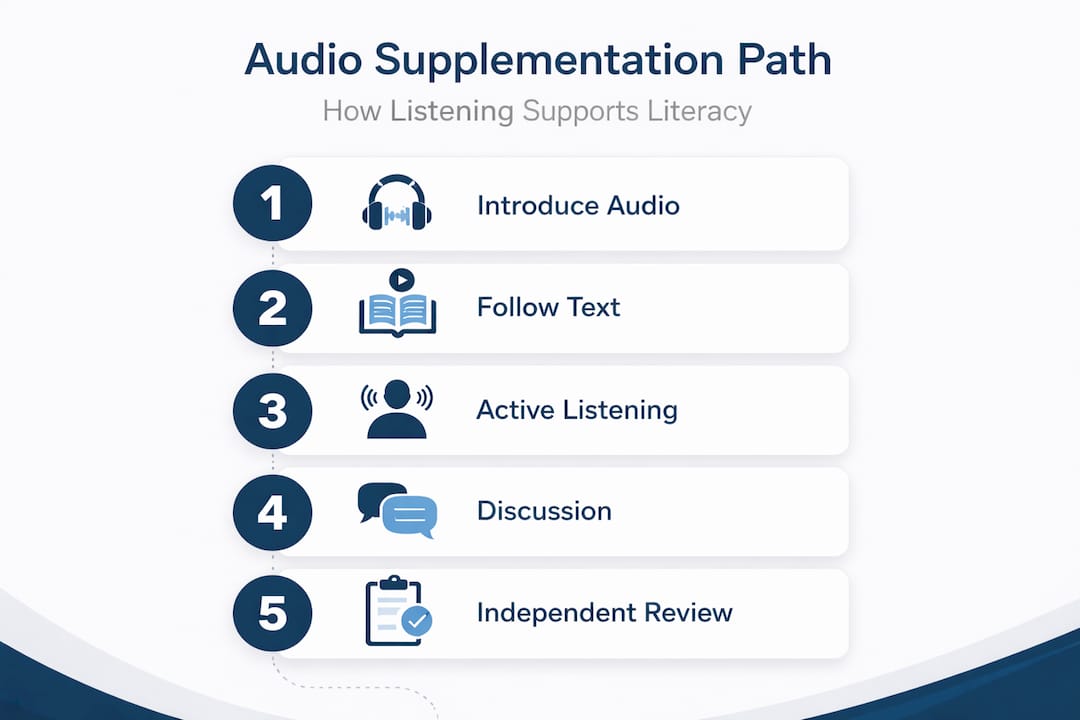
Knowing the research is one thing. Knowing what to do on Monday morning is another. Here is a practical framework for how to implement audio tools in a way that actually serves students.
- Audit your current curriculum for text-heavy barriers. Identify units where decoding difficulty could block comprehension for students with reading differences. These are your highest-priority areas for audio supplementation.
- Choose appropriate audio formats. Human-narrated audiobooks, recorded lectures, teacher-created audio notes, and text-to-speech tools each serve different purposes. Human narration is preferable for literary texts and complex content where expression aids comprehension.
- Pair audio with explicit instruction. Never treat audio as a stand-alone accommodation. Pre-teach key vocabulary before students listen. Give guided listening tasks. Follow with comprehension checks.
- Customize by student need. Not every student needs the same level of audio support. Some need full audiobook access; others may only need audio support for specific content areas. Platforms like IXL for grades 3 through 8 allow teachers to extend audio support on-demand for specific students or whole classes.
- Build in review and adaptation cycles. Monitor whether students are using audio tools and whether comprehension is improving. If a student is listening but not retaining, the instructional pairing needs to change, not just the audio itself.
- Train teachers before deploying tools. The most common failure point in audio supplementation programs is not the technology. It is teachers who were never shown how to integrate it meaningfully into instruction.
Pro Tip: When introducing audiobooks to students with dyslexia for the first time, allow them to follow along with the text while listening. This dual-channel approach builds phonological awareness at the same time as it removes the decoding bottleneck. See our audiobooks for readers with dyslexia guide for specific strategies.
The audiobooks in the classroom checklist is a useful tool to verify that your implementation covers the key elements before you roll out audio support to students.
Nuances and considerations in audio supplementation
This is where many well-intentioned programs go wrong. Audio supplementation looks like a straightforward accommodation. In practice, it carries several traps worth knowing in advance.
| Factor | Audio alone | Audio with scaffolded instruction |
|---|---|---|
| Vocabulary gains (average readers) | Moderate | Strong |
| Vocabulary gains (poor readers) | Minimal | Significant |
| Comprehension outcomes | Variable | Consistent |
| Student engagement | High initially | Sustained over time |
| Equity impact | Partial | Full |
The data in that table reflects a consistent finding: audio supplementation complements instruction but does not replace it. Effective programs blend audio content with instructional scaffolds. When institutions roll out audio tools as a checkbox accommodation without redesigning the instructional environment around them, the achievement gap does not close. It just looks smaller on paper.
The ancillary supports that make audio supplementation effective include:
- Vocabulary pre-teaching before any audio session involving dense academic language
- Guided listening frames, such as structured note-taking prompts students complete during listening
- Comprehension checks that require students to engage with content actively, not just passively consume it
- Chunked listening sessions rather than long uninterrupted periods, particularly for students with ADHD
Pro Tip: Build a "listen twice" expectation for complex passages. First listen is for general comprehension. Second listen is for detail and vocabulary. Students who know this upfront listen differently from the start.
The legal considerations are also worth spelling out clearly for institutional decision-makers. Reviewing the science behind audiobook learning alongside your accommodations policy will help you align your program with both research and legal obligations. And if you want to track whether it is working, the guidance on measuring student engagement in audio programs gives you concrete metrics to monitor.
Enhancing curriculum accessibility with audio supplements
Audio supplementation, when designed intentionally, aligns directly with Universal Design for Learning (UDL), the framework that calls for multiple means of representation in every curriculum. Under UDL, the goal is not to accommodate some students after the fact. It is to build access into the design itself.
Audio recorded lectures allow students to review content at their own pace, which improves engagement and autonomy. This is not a minor benefit. Students who can revisit a recorded explanation the night before a test, or slow down a narrated passage to catch a term they missed, are exercising exactly the kind of self-directed learning that builds long-term academic independence.

| Audio supplement benefit | Practical classroom example |
|---|---|
| Reduces decoding load | Student with dyslexia accesses grade-level science text via audiobook |
| Supports repeated exposure | ELL student replays recorded lecture to review academic vocabulary |
| Enables autonomous review | Student with ADHD re-listens to key segments without disrupting class |
| Increases participation | Student with visual impairment engages with identical curriculum content |
| Builds listening metacognition | All students practice active listening strategies during guided audio sessions |
Additional benefits of audio supplements in curriculum design:
- They allow students to engage with content that would otherwise be inaccessible due to reading barriers
- They reduce anxiety around reading performance in class, which often suppresses participation
- They give teachers real flexibility to differentiate without creating entirely separate instructional tracks
- They are scalable across subjects, from literary texts to recorded math walkthroughs
For educators supporting students with visual impairments, the guide to audiobooks as a lifeline provides targeted strategies. And for anyone designing supplemental audio content themselves, the audio description checklist for inclusive content is a practical starting point.
Rethinking audio supplementation: beyond technology to instruction
Here is the uncomfortable truth that most educational technology vendors will not say out loud: the tool is not the intervention. The instruction is.
We have watched schools purchase audiobook subscriptions, distribute devices, and tell themselves they have solved the access problem. Then test scores stay flat for the students who needed the most help. The technology worked perfectly. The pedagogy was missing.
Effective use of audiobooks depends on pairing audio with explicit, scaffolded teaching. That requires teacher training, curriculum alignment, and ongoing instructional coaching. None of that comes with a software license. At CoreForge Audio, we believe audio tools are transformative within an ecosystem of support, not as substitutes for it.
The importance of audio in teaching is not that it replaces the hard work of instruction. It is that it removes the irrelevant barrier of decoding, so that instruction can actually land. A student with dyslexia who cannot read the textbook is not learning less because they are less capable. They are learning less because the format is blocking the content. Fix the format, keep the instruction rigorous.
Teacher training is the single most underfunded part of any audio supplementation rollout. Most professional development budgets go to the platform and nothing to the pedagogical integration. That is backwards. Understanding what makes an audiobook program work at the structural level should come before any purchasing decision.
The audio learning strategies that produce outcomes share one thing: a teacher who knows why they are using audio, not just how. That distinction is everything.
Explore CoreForge Audio solutions to enhance your curriculum
Implementing audio supplementation well requires more than good intentions. It requires quality audio content built specifically for learners with reading barriers.
CoreForge Audio is built for exactly this. Our platform provides human-narrated audiobooks with dyslexia-friendly display options, adjustable narration speeds, and multilingual support, designed from the ground up for educators and institutions that take accessibility seriously. Whether you are supporting students with dyslexia, ADHD, visual impairments, or language differences, our tools are built to serve as a genuine instructional asset, not an afterthought accommodation. Explore what CoreForge Audio offers and see how it fits within your curriculum design.
Frequently asked questions
What is audio supplementation in curriculum?
Audio supplementation uses audio tools like recordings and audiobooks to provide access to curriculum content, especially for learners with reading challenges. It functions as an accessibility layer within an existing instructional framework, not as a stand-alone intervention.
Does audio supplementation alone improve vocabulary for poor readers?
Audio alone supports vocabulary in general learners, but poor readers gain significantly only when audio supplements are paired with direct, explicit instruction rather than used independently.
Are audio recorded lectures a legal accommodation equivalent to written notes?
Yes. When students are permitted to take written notes, denying them audio recorded lectures as an accommodation can violate legal access rights for students with documented disabilities.
How can educators implement audio support effectively?
Effective implementation pairs audio supplements with teacher instruction, customizes support by student need, and uses digital platforms to provide on-demand audio access tailored to individual or class-level requirements.