
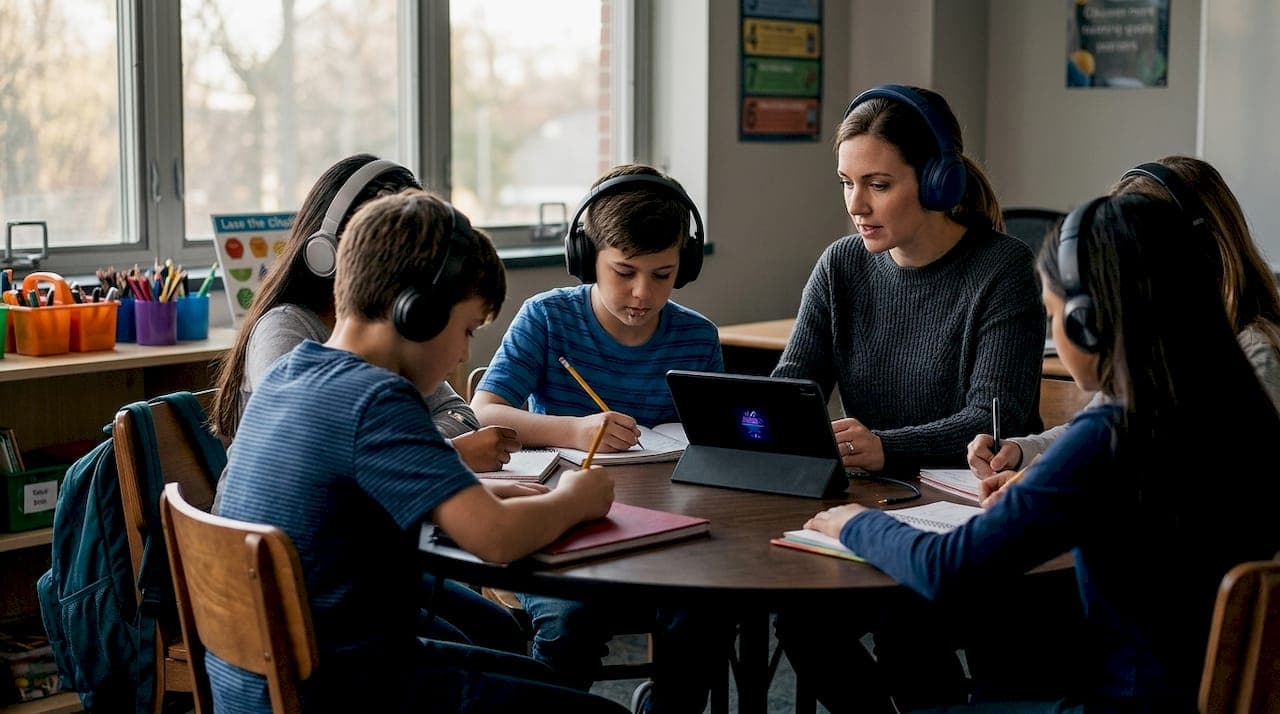
Most educators assume that handing a student a pair of headphones and pressing play counts as a legitimate reading intervention. It does not. The role of licensed audiobooks in teaching is far more nuanced than that. When used correctly, with the right legal framework and paired with direct instruction, licensed audiobooks become one of the most powerful tools in any educator's toolkit. But without those conditions, they are just background noise. This guide gives you the practical framework to use them right.
Table of Contents
- Key takeaways
- Benefits of licensed audiobooks in education
- Licensing requirements for classroom audiobook use
- Teaching strategies that maximize audiobook impact
- Off-the-shelf versus custom audiobook production
- My take on audiobooks as a teaching tool
- How Coreforgeaudio supports educators
- FAQ
Key takeaways
| Point | Details |
|---|---|
| Audiobooks benefit diverse learners | They reduce stress for students with ADHD and provide access for visually impaired learners who struggle with print. |
| Licensing matters legally | Personal subscriptions do not cover classroom use; you need public performance or specific classroom licenses. |
| Pair with instruction for best results | Poor readers gain vocabulary only when audiobooks are combined with explicit, one-on-one instruction. |
| Listening is a teachable skill | Auditory attention and metacognitive strategies must be taught directly, not assumed. |
| Human narration outperforms AI in emotion | AI narration lacks the emotional nuance that keeps students engaged and supports deeper comprehension. |
Benefits of licensed audiobooks in education
The conversation around audiobooks in the classroom often gets reduced to accessibility, and while that is absolutely part of the picture, it undersells what these tools actually do for learners. Professor Paola Uccelli of the Harvard Graduate School of Education points out that audiobooks expose learners to complex linguistic patterns and structures that go well beyond everyday conversation. That kind of rich language input is what builds the vocabulary depth students need for academic success.
The benefits of audiobooks in education extend significantly to students who face barriers with print. Psychologist Dr. Patricia Dixon notes that audiobooks reduce stress and concentration demands for students with ADHD and learning differences compared to physical text. For visually impaired students, they are not a supplement. They are the primary pathway to the same literature everyone else reads.
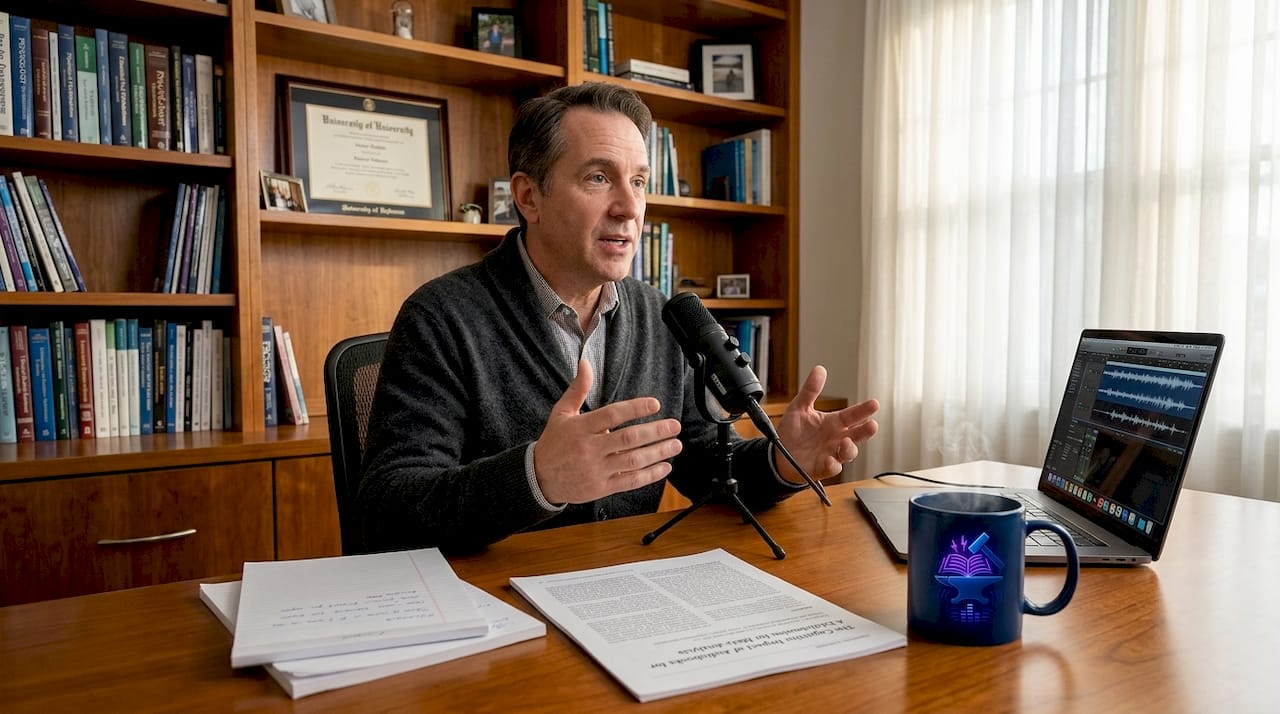
Licensed audiobooks also align naturally with Universal Design for Learning (UDL) principles. UDL asks educators to provide multiple means of representation, and audio is one of the most direct ways to achieve that. When you use audiobooks as teaching tools within a UDL framework, you are not accommodating one student. You are building a classroom that works for everyone by design.
Consider what these benefits look like in practice:
- Students with dyslexia can follow grade-level content without decoding barriers slowing comprehension.
- English language learners receive consistent, modeled pronunciation and sentence rhythm through human narration.
- Advanced readers can engage with texts at a complexity level that outpaces their reading fluency.
- Students with ADHD can use audio to stay focused during independent study when visual text creates concentration fatigue.
"Audiobooks can transform classrooms by increasing accessibility and supporting Universal Design for Learning principles." — Libro.fm
Licensing requirements for classroom audiobook use
Here is where many educators run into problems they did not anticipate. Using an audiobook at home on your personal account is fundamentally different from playing that same audiobook for a class of 25 students. Classroom use requires a specific public performance or classroom license, not a personal subscription. That distinction has real legal consequences.
Classroom licenses for audiobooks typically follow one of these models:
- Per student, per title: Each student is licensed for a specific audiobook. This is common for schools purchasing through library platforms.
- Per title, per year: A single classroom license for one title valid for a set period. Suitable for whole-class novel studies.
- Platform subscriptions with classroom rights: Some platforms bundle educational rights into their institutional pricing. Always verify this in the terms before using.
- Custom licensing agreements: For schools with large-scale programs, publishers sometimes negotiate terms directly. Worth pursuing for high-volume use.
Pro Tip: Read the terms of service before buying. "Educational discount" does not automatically mean "classroom performance rights." Those are two separate things and vendors are not always upfront about the distinction.
Licensing for audiobooks in educational settings distinguishes individual-use rights from group performance rights, and using the wrong license exposes your school to copyright infringement. That is not a theoretical risk. Publishers do enforce these terms.
For educators with tight budgets, there are legitimate free routes worth exploring. Libro.fm offers an Audiobook Listening Copy program that gives education professionals complimentary access to titles designed for classroom and professional development use. Several state library systems also offer institutional audiobook access through apps like Libby and Sora, which carry appropriate educational licensing built in.
Teaching strategies that maximize audiobook impact
This is the section most educators need most and read least. The assumption that students will simply absorb content by listening underestimates how cognitively demanding active listening actually is. Research published in March 2026 found that poor readers gain vocabulary significantly from audiobooks only when the audio is paired with explicit, one-on-one or small-group instruction. Listening without guidance does not close the gap for students who are already struggling. It often widens it.
The cognitive challenge with audio is distinct from reading. Listening requires teaching auditory attention and metacognition, because unlike reading, a student cannot easily backtrack, slow down, or reread a confusing sentence without actively knowing to do so. These are teachable skills, but they require explicit instruction.
Here is how to structure audiobook integration so it actually works:
- Pre-listening vocabulary prep: Introduce 8 to 10 high-frequency or domain-specific words before students press play. This primes comprehension and prevents students from mentally checking out when unfamiliar terms appear.
- Chunked listening with discussion breaks: Play 10 to 15 minute segments, then stop for discussion or written reflection. This builds the habit of active listening rather than passive reception.
- Graphic organizers during listening: Give students a simple framework to track characters, events, or arguments as they listen. It anchors attention and creates a record for post-listening discussion.
- One-on-one follow-up for struggling readers: For students reading significantly below grade level, schedule brief individual check-ins after audiobook sessions to clarify language and build comprehension. The MIT research is clear that this pairing is what makes the difference for those students.
Pro Tip: Teach students how to use playback speed controls and replay functions intentionally. Build one lesson around practicing these features so students develop agency over their own listening experience rather than just pressing play and hoping.
For second-language learners specifically, audiobooks serve a distinct role. You can read more about language acquisition strategies using audio in educational settings. The pronunciation modeling, natural sentence rhythm, and prosody in human narration give language learners something a textbook simply cannot provide.
For students in special education, the strategy layer matters even more. Resources like this guide on special education audiobook use break down practical classroom approaches in ways that are immediately usable.
Off-the-shelf versus custom audiobook production
Not every educational need is met by whatever happens to be available on a licensing platform. Some educators work with proprietary curriculum materials, school-developed texts, or content in languages underserved by commercial publishers. That is when custom audiobook production enters the conversation.
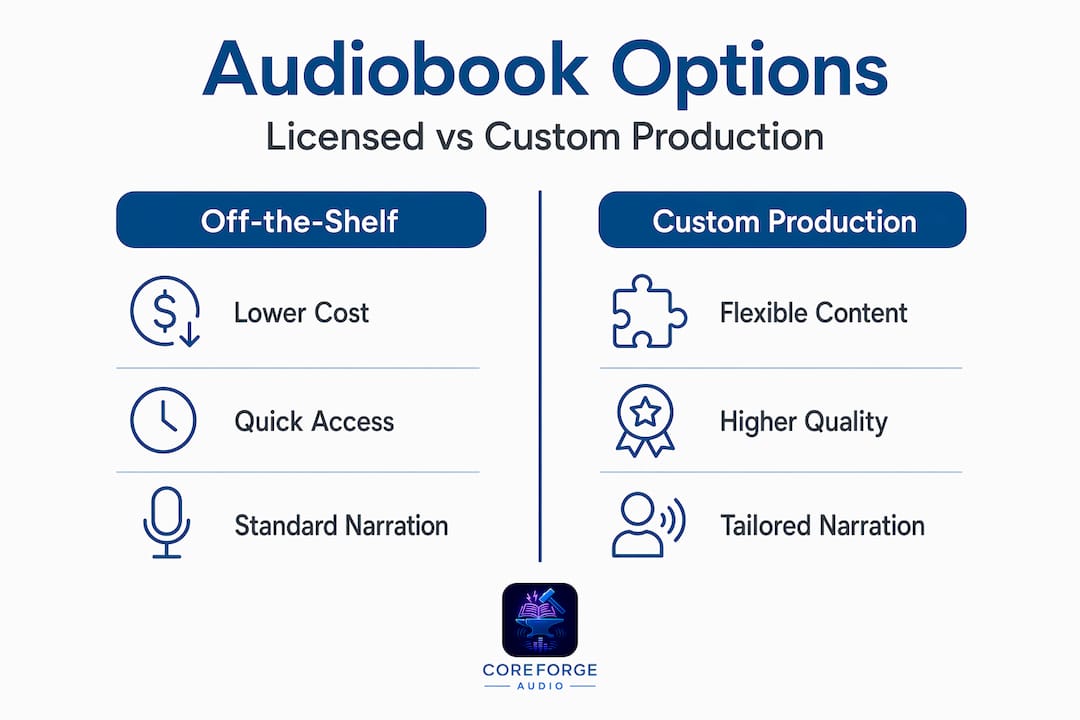
The comparison below helps frame the decision:
| Factor | Off-the-shelf licensed audiobooks | Custom audiobook production |
|---|---|---|
| Cost | Subscription or per-title fee | $300 to $600 per finished hour, scaling with talent and complexity |
| Content fit | Limited to existing catalog | Fully tailored to curriculum needs |
| Narration quality | Professionally produced | Depends on studio and talent; human narration strongly preferred |
| Licensing control | Governed by publisher terms | School or district can own the rights |
| Turnaround | Immediate access | Weeks to months depending on project scope |
| AI narration option | Rarely offered; mostly human | Available but requires educator oversight due to lack of emotional nuance |
The AI narration point deserves more attention than it usually gets. AI-generated voices have improved considerably, but they still lack the emotional register that keeps students engaged, particularly younger learners or those with attention challenges. AI narration may lack the emotional nuance necessary for effective pedagogy, and research on this is consistent. If you are commissioning custom audio for educational use, human narration is worth the additional investment.
My take on audiobooks as a teaching tool
I've worked with enough educators over the years to recognize a pattern. The ones who see real results from audiobooks in their classrooms are not the ones with the biggest budgets or the most technology. They are the ones who treat audiobooks as a scaffold, not a solution.
What I've seen consistently is that educators fall into one of two traps. The first is under-using audiobooks because they are not sure it "counts" as real instruction. The second is over-relying on them as a substitute for direct teaching, especially for struggling readers. Both mistakes are costly.
What I've learned is that the legal compliance piece is not just a bureaucratic obligation. It is a commitment to sustainable practice. Schools that cut corners on licensing end up losing access to programs entirely when publishers tighten enforcement. The educators who invest in proper classroom licenses protect their programs long-term.
My honest recommendation: start with one title, one class, proper licensing, and explicit pairing with instruction. Build from there. You will see a clearer picture of what works for your specific students than any study can tell you in advance.
— Sarmed
How Coreforgeaudio supports educators
Coreforgeaudio was built with educators and accessibility in mind from the start. Whether you need guidance on licensed audio content for your classroom or are exploring custom audiobook production for curriculum materials, Coreforgeaudio connects you with human-narrated, high-quality audio built for real learning environments. The platform prioritizes fair compensation for voice talent, dyslexia-friendly features, and multilingual support so your students get an experience that actually serves their needs. If you are ready to move from theory to a working audiobook program in your classroom, Coreforgeaudio is the place to start.
FAQ
What licenses do educators need for classroom audiobook use?
Personal subscriptions do not cover group or classroom use. Educators need a public performance or specific classroom license, typically purchased per student, per title, or per year.
Do audiobooks actually help struggling readers?
Research from MIT shows that poor readers benefit from audiobooks most when audio is paired with explicit instruction. Audiobooks alone do not produce significant vocabulary gains for students who already struggle with reading.
How do audiobooks support language acquisition?
Audiobooks expose learners to complex linguistic patterns, natural sentence rhythm, and modeled pronunciation that everyday conversation rarely provides, making them a strong tool for language acquisition in both native and second-language learners.
Is AI narration acceptable for educational audiobooks?
AI narration can work for informational content but lacks the emotional nuance that supports engagement and comprehension. For literature and classroom use, human narration consistently produces better outcomes.
Where can educators find free or low-cost licensed audiobooks?
Libro.fm's Audiobook Listening Copy program offers complimentary access for educators, and many state library systems provide institutional access through platforms like Libby and Sora with appropriate classroom licensing already included.