
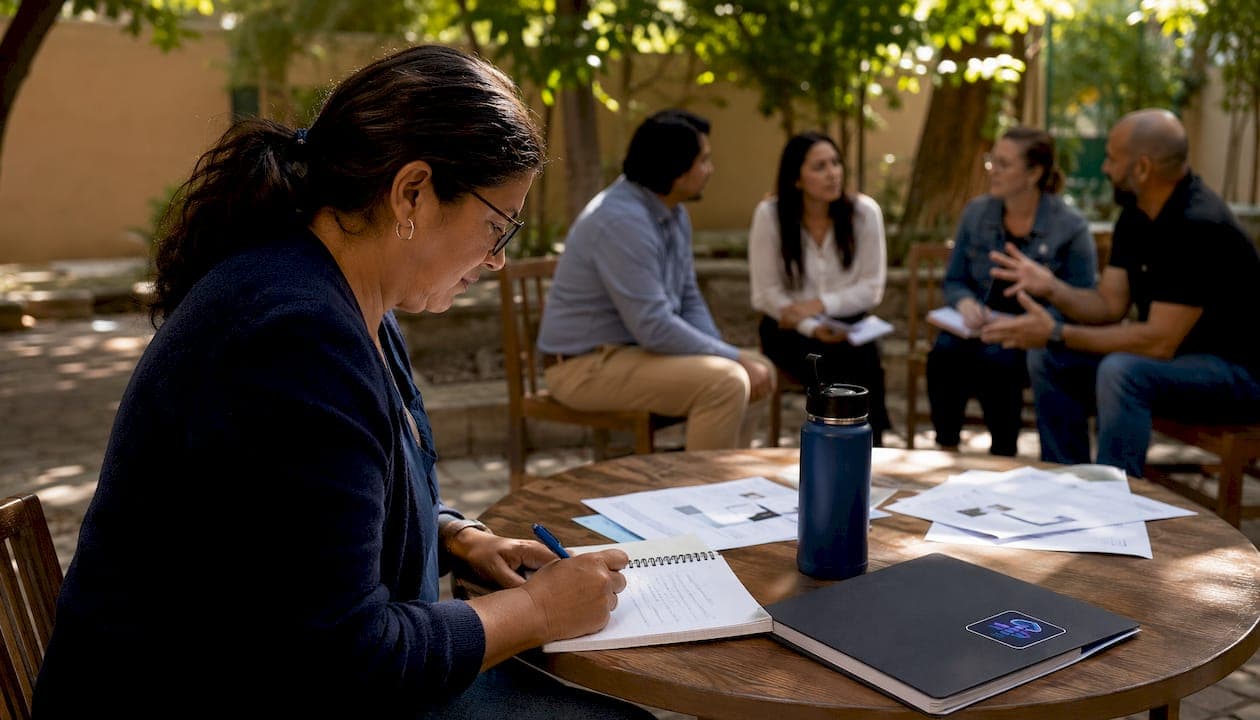
Why accessibility belongs in every teacher's professional development
Teacher professional development includes accessibility because students with disabilities and diverse learning needs cannot wait for educators to figure it out on the job. The Americans with Disabilities Act of 1990, Section 504 of the Rehabilitation Act of 1973, and the Individuals with Disabilities Education Act together create a legal floor that every classroom must meet. But legal compliance alone is not the reason. Accessibility training gives teachers the practical skills and inclusive mindset to reach every learner, not just the ones who learn the way the curriculum assumes they will.
The core rationale breaks down into five interconnected reasons:
- Equitable access is the baseline. Students who grew up under ADA protections now enter higher education with high expectations for accessible instruction. Many instructors are simply not prepared to meet them, as the Department of Education's Office of Civil Rights has documented repeatedly in settlement agreements.
- Teacher attitudes shape practice. Training and attitudes toward persons with disabilities significantly predict whether inclusive pedagogical practices actually happen in the classroom.
- Confidence requires preparation. Embedding accessibility in professional development builds teacher readiness and reduces the anxiety that comes from encountering a student's needs without any framework for responding.
- Systemic capacity depends on it. One prepared teacher helps one classroom. Accessibility woven into every PD program builds school-wide and district-wide capacity for inclusion.
- Legal and policy alignment. Federal law and state policy increasingly require documented accessibility efforts. PD is the mechanism that translates policy into practice.
Coreforgeaudio exemplifies this principle in action. The platform integrates dyslexia-friendly fonts, adjustable narration speeds, and multilingual support directly into its audiobook service, showing what it looks like when accessibility is designed in from the start rather than added as an afterthought.
What does the research actually say about accessibility-focused PD?
The evidence is clear, and it points to a gap that targeted professional development can close. A 2026 study found that training and attitudes toward persons with disabilities significantly predict inclusive pedagogical practices, yet existing training models explain less than 60% of the variance in teacher behavior. That gap is not a minor footnote. It means a teacher can complete a standard PD program and still leave without the specific skills to design an accessible lesson.
Neuroscience-informed approaches and Universal Design for Learning (UDL) frameworks are showing real results. Research published in Frontiers in Education found that UDL-based training increases educators' capacity to design and implement accessible lessons, improving both competency and inclusive mindset. UDL, developed at CAST, is not a checklist. It is a framework for designing instruction that works for the widest range of learners from the start, reducing the need for individual accommodations after the fact.
"The funny thing about that time was that accessibility was going from 'we need to do it' to 'how can we do it.'" This shift, described by a curriculum committee chair at Virginia Tech's Technology-enhanced Learning and Online Strategies unit, captures exactly what well-designed PD produces: a cultural change, not just a compliance check.
Organizational data reinforces the case. Professionals with access to highly effective accessibility training report stronger executive support and a clearer connection between accessibility and meaningful outcomes. In education, that translates to administrators who fund inclusion initiatives and teachers who see accessibility as central to their work rather than peripheral to it.
A few additional findings worth noting:
- Ongoing training embedded in daily workflows produces behavioral change that one-off sessions cannot.
- Teacher self-efficacy in supporting diverse learners improves measurably when PD includes practical, context-based strategies.
- Digital accessibility gaps in teacher preparation programs create systemic inequities that persist without deliberate intervention.
The research consistently points in the same direction: awareness is not enough. Teachers need training that moves them from knowing accessibility matters to knowing exactly what to do on Monday morning.
What formats of professional development actually work for accessibility?
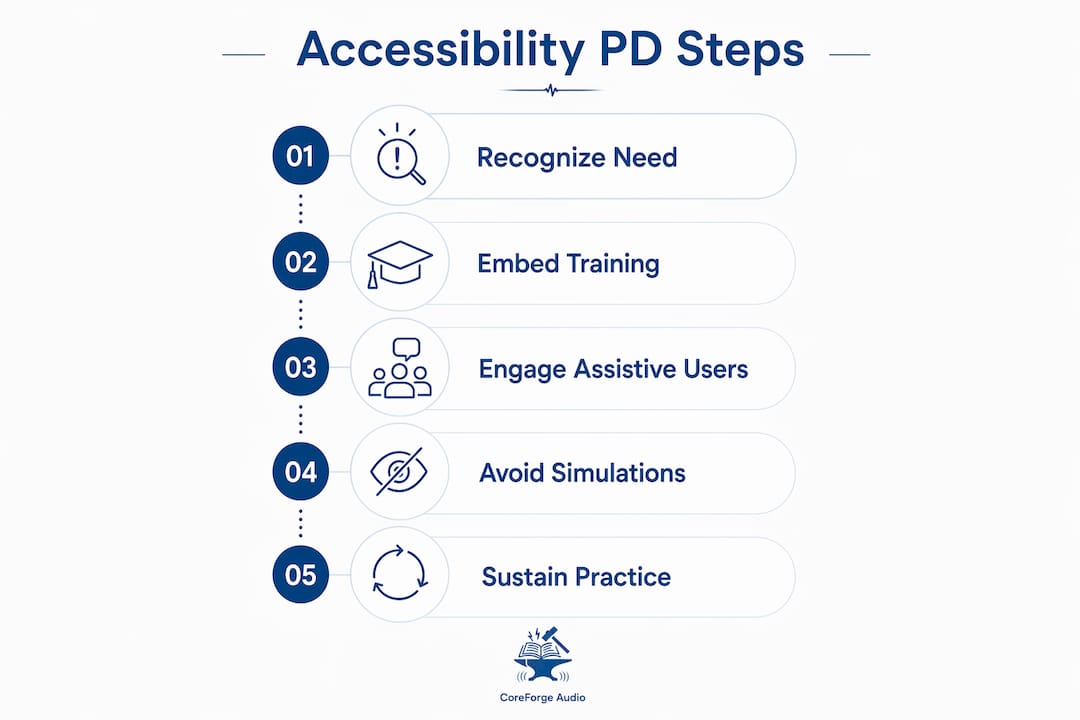
Not all professional development is created equal, and the format matters as much as the content. The shift from one-off workshops to ongoing learning cycles is one of the most well-supported findings in accessibility PD research. A single two-hour session on screen readers does not change how a teacher designs a quiz the following week.
Effective formats include:
- Integrated online workshops and webinars that embed accessibility concepts within broader instructional design training, rather than treating them as a separate module.
- Professional learning communities (PLCs) where teachers work through real accessibility challenges together, share strategies, and hold each other accountable over time.
- Role-specific training tied to the tools teachers already use, such as Google Classroom, Canvas, or Microsoft Teams. When training addresses the exact platform a teacher opens every morning, behavior change follows.
- Embedded "moment of need" support, meaning resources available when a teacher is actually designing a lesson or selecting a resource, not just during a scheduled PD day.
- Certification pathways such as those offered through the International Association of Accessibility Professionals (IAAP), which provide structured, credentialed learning for educators with broader accessibility responsibilities.
The research on role-specific, workflow-embedded training consistently shows higher rates of behavior change compared to generic, one-time sessions. Virginia Tech's integrated curriculum redesign, which wove accessibility concepts into 16 existing workshops on tools like Canvas and Adobe Experience Manager, is a concrete example of this approach working at scale.
Involving assistive technology users in the training itself is another practice that shifts outcomes. When teachers hear directly from students who use screen readers, text-to-speech tools, or accessible audio content to access learning, the abstract becomes concrete fast.
Pro Tip: Avoid disability simulations, such as having teachers wear blindfolds to "experience" visual impairment. Research consistently shows these exercises oversimplify lived experience and can reinforce pity rather than competency. Use authentic user perspectives and scenario-based learning instead.
How does accessibility training benefit teachers, students, and schools?
The benefits of including accessibility in teacher professional development reach every level of the educational system, from the individual student to the district's legal standing.

For teachers, the gains are practical. Accessibility training builds confidence in addressing diverse learning needs, reduces the anxiety of encountering an unfamiliar disability or accommodation request, and expands the instructional toolkit. A teacher who understands UDL principles designs lessons that work for more students from the start, which means fewer last-minute accommodations and less reactive problem-solving.
For students, the impact is direct. Equitable access to instruction improves engagement and achievement, particularly for students with dyslexia, ADHD, visual impairments, and other reading or processing barriers. When teachers know how to use captioning, provide materials in multiple formats, and adjust pacing, students who might otherwise disengage stay in the learning.
For schools and districts, the case is both ethical and practical:
- Documented accessibility training supports compliance with ADA, Section 504, and IDEA requirements, reducing exposure to Office of Civil Rights complaints.
- Systemic accessibility capacity built through ongoing PD reduces the burden on individual special education staff and distributes responsibility across the whole faculty.
- Leadership buy-in increases when administrators see accessibility connected to student retention, achievement data, and legal risk management rather than framed as a separate compliance burden.
- Schools that embed accessibility into culture, not just policy, tend to attract and retain teachers who value inclusive practice.
Coreforgeaudio's model illustrates what accessible educational materials can do at the student level. Human-narrated audiobooks with dyslexia-friendly fonts and adjustable narration speed give students with reading barriers genuine access to content, not a workaround. When teachers know these tools exist and how to integrate them, the benefit compounds.
What challenges should administrators expect when rolling out accessibility PD?
Rolling out accessibility professional development is not straightforward, and administrators who go in without a clear picture of the obstacles tend to get stuck on the same ones.

The most common barrier is perception. When teachers hear "accessibility training," many assume it means a compliance checklist or a technical deep-dive into assistive technology. That framing triggers resistance, particularly among teachers who feel their plates are already full. Reframing accessibility as a dimension of quality instruction, not a separate responsibility, is the first communication challenge administrators face.
Time is the second obstacle. Effective accessibility PD requires sustained engagement, not a single professional development day. Without protected time built into the school calendar and ongoing support structures, even well-designed training fades. Teachers return to their classrooms, the urgency of daily instruction takes over, and the new practices never take root.
Generic training compounds the problem. A one-size-fits-all session on accessibility fails a high school history teacher and an elementary reading specialist in different ways. Embedding accessibility into role-specific, tool-specific training is more work to design but produces far better results.
There is also a subtler risk: training that focuses heavily on student disabilities without providing practical strategies can actually reduce teacher confidence rather than build it. When educators leave a session knowing more about what can go wrong but less about what to do, anxiety increases and inclusive practice decreases. Balance between awareness and practical skill-building is not optional.
The deeper structural challenge is that teacher preparation programs have historically given limited attention to digital accessibility, meaning many teachers enter the profession without a foundation. Ongoing PD cannot fully compensate for gaps in pre-service training. Systemic reform, embedding accessibility across teacher preparation, fieldwork, and continuing education, is the only path to lasting change.
How Coreforgeaudio puts accessibility principles into practice
Coreforgeaudio was built around a problem that accessibility training addresses directly: students with reading barriers, including dyslexia, ADHD, and visual impairments, often cannot access the same content as their peers. The platform's response is not a workaround. It is a purpose-built accessible audiobook service with features designed from the ground up for learners who need them.
The platform's core accessibility features include:
- Human-narrated audiobooks that preserve the nuance, pacing, and emotional tone that text-to-speech synthesis loses, making content genuinely engaging rather than technically accessible.
- Dyslexia-friendly fonts integrated into the reading interface, reducing visual processing load for students with dyslexia.
- Adjustable narration speed so learners can slow down for complex material or speed up when they are confident, putting control in the student's hands.
- Multilingual support that extends access to English language learners and multilingual households.
- Transparent, ethical funding through a micro-donation model that covers licensing, development, and accessibility tool costs openly.
Accessibility is not a feature added to Coreforgeaudio's platform. It is the platform's reason for existing. Every design decision, from fair pay for voice actors to dyslexia-friendly typography, reflects the belief that storytelling belongs to everyone.
For educators, Coreforgeaudio's resources support differentiated instruction in a concrete way. A teacher who has completed accessibility-focused PD knows that offering content in audio format is not accommodation for one student. It is good instructional design for the whole class. Students with reading barriers benefit most, but students who are auditory learners, students who are tired, and students who are commuting all benefit too.
The nonprofit model matters here as well. Coreforgeaudio's commitment to fair compensation for voice actors and ethical AI use signals that accessibility and equity are not marketing language. They are operational commitments, the kind that teacher PD programs can point to as a real-world example of what it looks like to build inclusion into a system rather than bolt it on later.
Key Takeaways
Teacher professional development includes accessibility because equitable instruction requires practical skills, legal compliance, and an inclusive mindset that pre-service training alone does not provide.
| Point | Details |
|---|---|
| Legal and ethical foundation | ADA, Section 504, and IDEA create a legal floor; PD translates policy into classroom practice. |
| Research gap in current training | Existing models explain less than 60% of the variance in inclusive teaching behavior, signaling a need for targeted PD. |
| Format determines impact | Role-specific, workflow-embedded training produces higher behavior change than generic one-off sessions. |
| Systemic benefits | Accessibility PD reduces legal risk, builds school-wide capacity, and improves student engagement and achievement. |
| Accessible materials extend the work | Tools like Coreforgeaudio's human-narrated audiobooks with dyslexia-friendly features give teachers concrete resources for differentiated instruction. |