

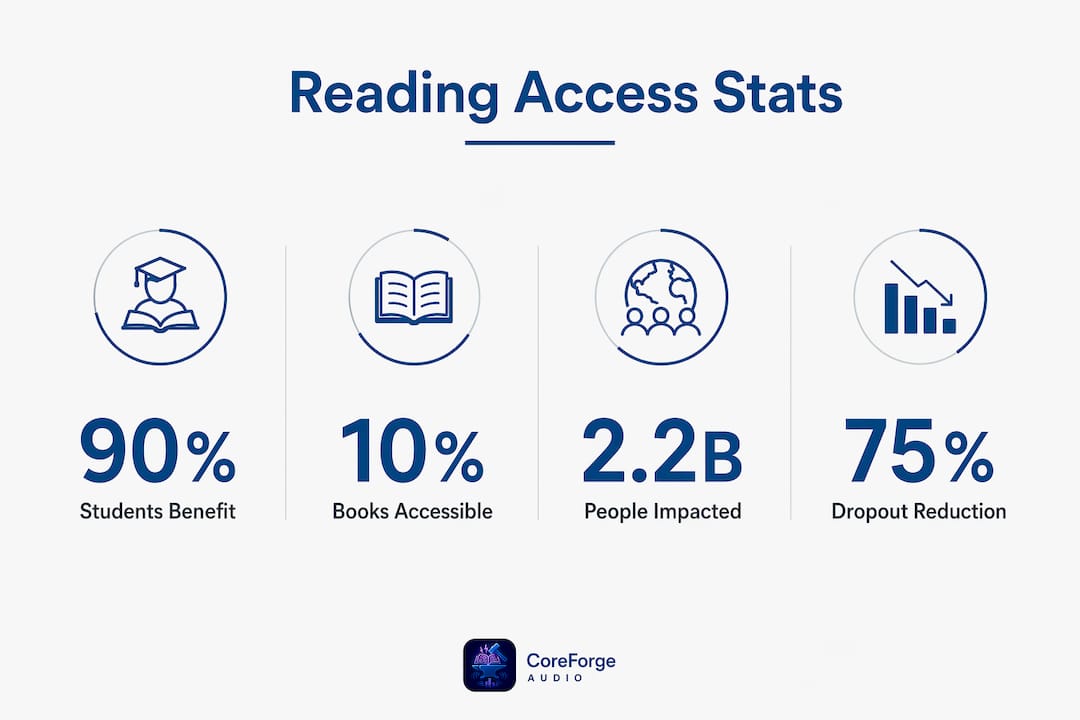
Accessible reading materials are defined as content designed and formatted so that every person, regardless of disability, learning difference, or language background, can fully engage with the text. The importance of accessible reading extends far beyond convenience. More than 2.2 billion people worldwide live with some form of vision impairment, yet fewer than 10% of published books exist in accessible formats. That gap represents a global education crisis. Formats like EPUB 3, screen readers, and audio narration are not optional add-ons. They are the infrastructure that determines whether learning is possible at all. Initiatives from UNESCO, the Marrakesh Treaty, and the UN Convention on the Rights of Persons with Disabilities (UN CRPD) have all recognized accessible materials as a matter of legal rights, not charity.
Why accessible reading materials matter for educational outcomes
Accessible materials directly improve academic performance and reduce dropout rates for students with disabilities and print impairments. UNESCO's ADT Initiative, running since 2016, has reached millions of children globally and identifies the absence of inclusive learning materials as a primary driver of educational exclusion. That is not a secondary factor. It is the leading cause.
Students with dyslexia, ADHD, blindness, and cognitive differences gain measurably when materials match their learning needs. Text-to-speech tools like NVDA and JAWS allow students who cannot decode printed text to access the same content as their peers. Adjustable fonts, including OpenDyslexic, reduce visual crowding that makes reading painful for many learners. High-contrast modes and screen magnification tools serve students with low vision without requiring separate curriculum tracks.
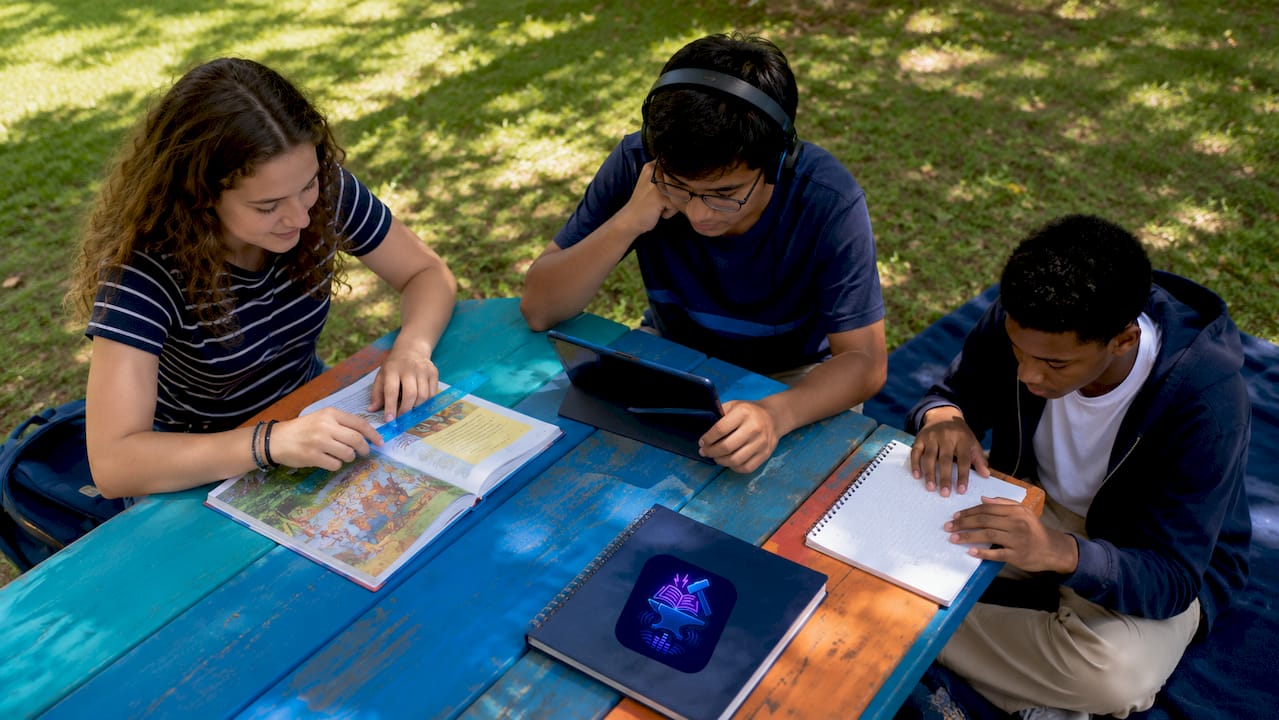
The benefits of accessible texts go beyond individual accommodation. Locally produced inclusive materials, when paired with teacher training, produce the strongest foundational literacy and numeracy gains. World Vision's research confirms that access alone is not enough. The material must be inclusive by design and embedded in a supported education system. A braille textbook sitting in a storage room does nothing. A teacher trained to use it alongside an audio version changes a student's trajectory.
Digital tools now make reading multisensory and personalized in ways print never could. AI-powered simplification tools reduce complex sentence structures for readers with cognitive difficulties. Interactive text with embedded audio cues gives students structured entry points into dense material. These are not experimental features. They are proven supports that close achievement gaps when implemented consistently.
- Students with dyslexia process text more accurately with dyslexia-friendly fonts and wider line spacing
- Screen readers require properly tagged headings and alt text to function; without them, content is inaccessible regardless of format
- Adjustable narration speed in audiobooks allows students with processing differences to control comprehension pace
- Multilingual accessible materials serve English language learners alongside students with disabilities
Pro Tip: When selecting accessible materials for a classroom or library, prioritize formats that offer both visual and audio options simultaneously. A student who can toggle between reading and listening retains more than one who is limited to a single modality.
What makes a reading material technically accessible?
A reading material is technically accessible when its structure, metadata, and format allow assistive technologies to interpret and present it correctly to any user. The most important distinction in publishing today is between "born-accessible" formats and retroactively remediated ones.
Born-accessible EPUB 3 digital books provide first-day access to all readers and eliminate the expensive process of fixing inaccessible files after publication. Publishers who design accessibility into the editorial workflow from the start avoid civil rights litigation and save thousands per title in remediation costs. Scanned PDFs, by contrast, are images of text. A screen reader cannot parse them. A student using JAWS or Apple VoiceOver receives nothing from a scanned PDF except silence.
Semantic structure is the backbone of accessible digital content. Heading tags (H1, H2, H3) tell screen readers how a document is organized. Alt text on images gives blind readers the same informational context sighted readers receive visually. Bookmarks and navigation landmarks allow users to jump between chapters without scrolling through hundreds of pages. Without these elements, even a well-written book becomes a locked room.
| Technical feature | Why it matters |
|---|---|
| EPUB 3 format | Supports semantic tagging, audio sync, and screen reader navigation natively |
| Alt text on images | Allows screen readers to describe visual content to blind or low-vision users |
| Heading structure | Enables non-linear navigation for users who cannot scroll through full documents |
| Accessibility metadata | Tells platforms and assistive tools what features a book contains before download |
| Adjustable text display | Supports font size, spacing, and color contrast changes for low-vision readers |
Digital Rights Management (DRM) creates a separate barrier. Many DRM systems block assistive technologies from accessing content, effectively locking out the readers who need accessible formats most. Publishers committed to true inclusion test their materials with actual users with disabilities, not just automated checkers. True inclusion requires accessibility embedded in editorial workflows, not applied as a last-minute patch.
Pro Tip: If you are evaluating a digital book platform for educational use, ask specifically whether it supports EPUB 3 with accessibility metadata and whether its DRM system is compatible with JAWS, NVDA, and VoiceOver before committing.
What are the broader social and economic benefits?
Accessible reading materials function as vital public infrastructure that upholds equal education rights under international law. The case for accessibility extends well beyond classroom performance into economic productivity, cultural participation, and market growth.
Publishers who build accessible catalogs reach a significantly larger audience. The global disability market represents over one billion people with spending power that most publishers currently ignore. Legal frameworks like the European Accessibility Act now compel publishers to develop accessible editions, which means compliance is no longer optional. Organizations that treat accessibility as a market opportunity rather than a burden gain catalog longevity and reduced litigation exposure.
The social benefits are equally concrete:
- Lifelong learners with acquired disabilities, including adults who lose vision or develop cognitive impairments later in life, depend on accessible formats to remain engaged in education and civic life
- Accessibility as universal design benefits all readers, not just those with disabilities. Captions help viewers in noisy environments. Adjustable fonts help aging readers. Audio narration helps commuters
- Accessible materials amplify diverse voices by enabling authors with disabilities to reach audiences and ensuring readers from all backgrounds can access their work
- AI tools and voice assistants are rapidly expanding what accessible reading can deliver, from real-time language simplification to personalized reading pace adjustment
The PAGE project frames accessibility as a cultural shift from compliance to empathy, where books are designed universally from the start rather than retrofitted for specific users. That shift changes the economics of publishing. It also changes who gets to participate in knowledge and culture.
How can advocates promote accessible reading materials?
Advocates and individuals can drive meaningful change by understanding the legal frameworks that already exist and using them strategically. The Marrakesh Treaty, adopted by the World Intellectual Property Organization (WIPO), permits the cross-border sharing of accessible format copies of books for people with print disabilities. Knowing this treaty exists allows librarians, educators, and disability organizations to legally access and distribute materials that would otherwise be unavailable.
- Learn the legal landscape. The UN CRPD and the Marrakesh Treaty create binding obligations on signatory governments to provide accessible educational materials. Advocates can cite these frameworks directly when lobbying school boards, publishers, or government agencies.
- Demand born-accessible publishing. When purchasing or recommending books for schools and libraries, specify EPUB 3 formats with verified accessibility metadata. Purchasing decisions signal market demand to publishers.
- Partner with organizations producing accessible content. Groups like Bookshare, Learning Ally, and DAISY Consortium produce and distribute accessible materials at scale. Connecting local institutions with these networks multiplies impact without requiring new infrastructure.
- Advocate for training alongside materials. Inclusive materials paired with teacher training produce the strongest outcomes. Push for professional development budgets that include accessibility training, not just procurement of new titles.
- Use and promote accessible digital platforms. Platforms that offer audiobooks for diverse learners alongside dyslexia-friendly fonts and multilingual support demonstrate what inclusive reading infrastructure looks like in practice. Sharing these resources builds community awareness.
Nonprofit organizations working in ADA compliance and accessibility provide practical frameworks for institutions navigating legal requirements. Connecting advocacy work to compliance guidance strengthens both the moral and legal case for change.
Key takeaways
Accessible reading materials are the foundation of equitable education, and the gap between need and availability remains one of the most solvable crises in global literacy.
| Point | Details |
|---|---|
| Scale of exclusion | Fewer than 10% of books exist in accessible formats despite 2.2 billion people having vision impairments. |
| Born-accessible publishing | EPUB 3 designed from the start outperforms retroactive fixes in cost, accuracy, and legal protection. |
| Educational impact | UNESCO and World Vision data confirm accessible materials reduce dropout rates and improve literacy when paired with teacher training. |
| Legal frameworks | The Marrakesh Treaty and UN CRPD give advocates binding legal tools to demand accessible materials from governments and publishers. |
| Universal design benefit | Accessibility features like audio narration, adjustable fonts, and captions improve reading for all users, not only those with disabilities. |
Accessibility is an act of liberation, not a checkbox
I have spent years watching the conversation around accessible reading get reduced to compliance checklists and legal minimums. That framing misses the point entirely. When a child with dyslexia hears a story read aloud in a voice that sounds like a real person, not a robotic synthesizer, something shifts. Reading stops being a source of shame and becomes a door.
The uncomfortable truth is that most institutions treat accessibility as a retrofit. They build the curriculum, select the books, design the classroom, and then ask whether anyone was left out. That sequence guarantees failure. The students who need accessible materials most are the ones most likely to disappear from the data before anyone notices.
What I find genuinely encouraging is the momentum behind universal design as a publishing philosophy. When accessibility becomes a cultural shift rather than a compliance exercise, the entire ecosystem improves. Publishers produce better structured content. Platforms build more flexible interfaces. Teachers gain tools that serve every student without singling anyone out.
The advocates who move the needle are not the ones writing policy papers. They are the ones asking specific questions at school board meetings, specifying EPUB 3 in procurement contracts, and sharing platforms that prove accessible reading is possible right now. The technology exists. The legal frameworks exist. What remains is the will to treat every reader as someone worth designing for.
— Sarmed
How Coreforgeaudio supports accessible reading
Coreforgeaudio is a nonprofit-focused platform built specifically to break down reading barriers for people with dyslexia, ADHD, visual impairments, and other learning differences. Every audiobook on the platform is narrated by a human voice actor, because the research on listening and literacy is clear: human narration improves comprehension and engagement in ways text-to-speech cannot replicate. The platform integrates dyslexia-friendly fonts, adjustable narration speeds, and multilingual support directly into the reading experience. If you are an advocate, educator, or individual looking for accessible literacy resources that reflect genuine inclusion values, explore Coreforgeaudio and support the mission of making every story reachable.
FAQ
What are accessible reading materials?
Accessible reading materials are texts formatted so that people with disabilities, learning differences, or language barriers can fully engage with them. Common formats include EPUB 3 digital books, audiobooks, braille, and large-print editions with screen reader compatibility.
Why is reading accessibility essential for students with disabilities?
Students with disabilities who lack accessible materials face higher dropout rates and lower literacy outcomes. UNESCO's ADT Initiative identifies missing inclusive materials as a primary cause of educational exclusion globally.
What is the difference between EPUB 3 and a scanned PDF?
EPUB 3 is a born-accessible format with semantic tags, alt text, and navigation landmarks that screen readers can interpret. A scanned PDF is an image of text that assistive technologies cannot read, making it functionally inaccessible to blind or low-vision users.
How do audiobooks support accessible learning?
Audiobooks allow students with dyslexia, ADHD, and visual impairments to access the same content as their peers without decoding barriers. Platforms like Coreforgeaudio use human narration and adjustable speeds to maximize comprehension for diverse learners.
What legal frameworks protect the right to accessible reading materials?
The Marrakesh Treaty (WIPO) and the UN CRPD both establish legal obligations for governments and publishers to provide accessible formats. The European Accessibility Act adds enforcement mechanisms that compel publishers to upgrade their catalogs to meet accessibility standards.
Recommended
- Audiobooks as a lifeline: making literature accessible for the visually impaired — CoreForge Audio Blog
- Why long-form audio is ideal for accessibility and learning
- How Audiobooks Improve Student Literacy Outcomes
- How listening builds literacy: the science behind audiobook learning — CoreForge Audio Blog