
What is cultural representation in audio content?
Cultural representation in audio content is the intentional inclusion of diverse cultural identities, languages, storytelling traditions, and sonic practices within sound-based media. Unlike visual formats, audio carries culture through what you hear rather than what you see: the rhythm of a narrator's speech, the idioms embedded in a story, the musical textures woven into a soundscape. For people with dyslexia, ADHD, visual impairments, or other reading barriers, audiobooks and audio media are often the primary gateway to literature and learning. That makes authentic representation not a bonus feature but a core accessibility requirement.
The key elements of cultural representation in audio include:
- Language diversity: narration and dialogue in multiple languages, dialects, and accents
- Storytelling style: narrative structures that reflect specific cultural values, humor, and social norms
- Voice talent diversity: narrators whose lived experience matches the cultural content they perform
- Culturally specific sounds and music: sonic textures drawn from non-Western traditions
- Narrative perspective: whose point of view anchors the story and whose is treated as the default
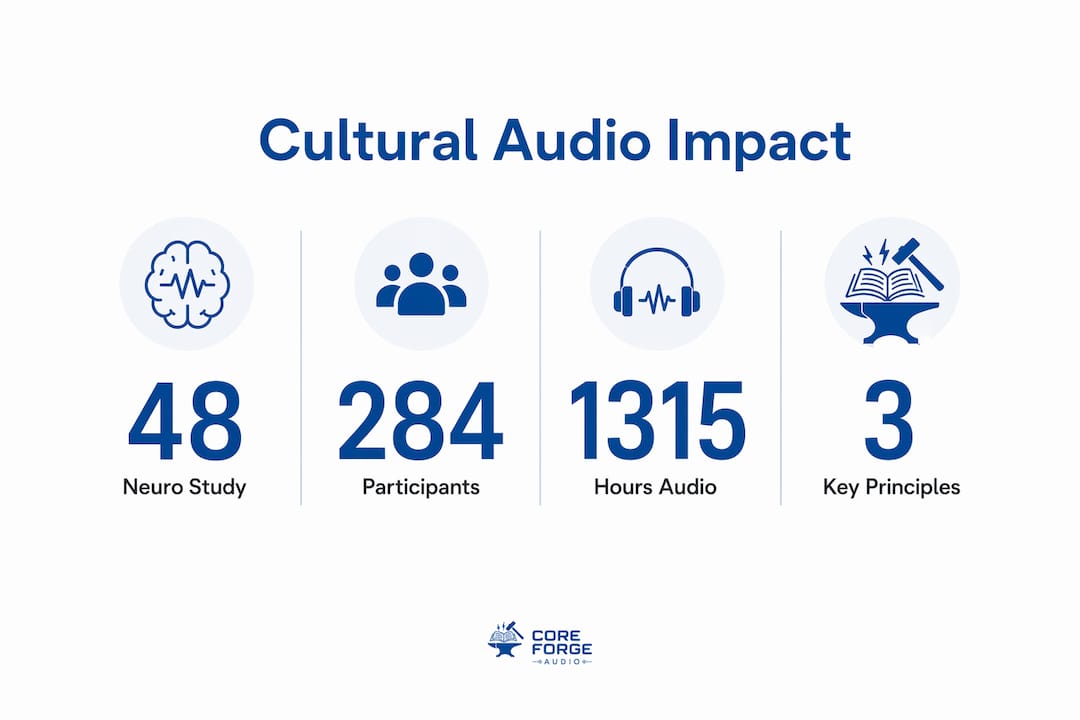
Benchmarks like the ACID benchmark, which spans 1,315 hours of multilingual audio, and the Voices of Civilizations dataset, covering 380 music tracks across 38 languages with 1,190 evaluation questions, now give researchers concrete tools to measure how well audio systems actually handle this diversity. Coreforgeaudio builds its accessible audiobook platform around these same principles: authentic voices, ethical narration, and content that reflects the full range of its listeners.
Why cultural representation matters for accessible audio
Listeners connect more deeply with audio content when the cultural cues feel familiar. A neuroimaging study with 48 volunteers found that people sharing a cultural background showed more similar brain activity while processing audiobook segments, specifically in regions tied to speech processing and mental imagery. For a reader with dyslexia who relies on audio to absorb a novel, that neurological alignment translates directly into better comprehension and retention.
Cultural representation also shapes emotional engagement. Research with 284 participants showed that non-Western listeners rated music significantly higher when it was framed with a blended cultural context rather than a monocultural one. The takeaway for audio producers: context and framing are not decorative. They change how listeners experience the content at a fundamental level.
Beyond individual comprehension, representation carries a social dimension. Audio content that reflects only dominant cultural norms implicitly tells minority listeners that their stories are peripheral. For someone already navigating a reading barrier, that message compounds the exclusion. Coreforgeaudio's mission addresses this directly by prioritizing narrator diversity and multilingual support as foundational commitments, not afterthoughts.
Challenges and risks in representing diverse cultures through audio
Getting cultural representation right in audio is genuinely hard, and the risks of getting it wrong are real.
- Stereotyping and exoticism: Relying on surface-level musical or linguistic clichés to signal a culture reduces complex identities to caricature. The World Music Textbook identifies this pattern as "othering," where unfamiliar cultures are framed as exotic rather than fully human.
- Technical bias in audio systems: The mel scale, the standard audio processing framework derived from 1940s Western psychoacoustic research, produces a 31.2% word error rate for tonal languages compared to 18.7% for non-tonal languages. The 12.5% gap means systems built on this foundation systematically underserve speakers of Mandarin, Vietnamese, and dozens of other languages.
- AI model failures: The ACID benchmark reveals that large audio language models, including GPT-4o Mini, produce stereotypical responses when processing culturally sensitive audio in languages like Bengali and Arabic. These are not edge cases; they are documented, systemic failures.
- Non-Western music gaps: The Voices of Civilizations evaluation found that state-of-the-art audio models struggle to identify cultural attributes like region, mood, and theme from music alone when the content comes from underrepresented traditions.
- Linguistic rhythm and musical diversity: Tonal inflections, microtonal scales, and oral storytelling cadences that define many non-Western traditions simply do not survive standard audio processing pipelines intact.
How language and storytelling carry cultural identity in audio
Audio is uniquely personal as a medium. Without visuals, the listener's imagination fills the gaps, which means the cultural signals embedded in language and narrative do more work than they would on screen. A narrator's accent, the proverbs a character reaches for, the way a story circles back rather than driving forward in a straight line — these are not stylistic choices. They are cultural identity made audible.
Research presented at the Audio Mostly conference challenges the persistent myth that music is a universal language. Auditory perception and aesthetic judgment are shaped by cultural context, meaning a sound that feels natural and welcoming to one listener may feel alien or even uncomfortable to another. Sound designers who ignore this end up creating content that works for one audience and alienates everyone else.
For accessible audiobooks, this has a direct practical consequence. A listener with ADHD who encounters a storytelling style that mirrors their own cultural background stays engaged longer. A listener with a visual impairment who hears a narrator whose voice carries the rhythms of their community gets more than information; they get recognition. Nonprofits working in this space, including those using mission-driven storytelling, increasingly recognize that cultural authenticity and audience engagement are the same goal.
Accessibility and inclusion: making culturally diverse audio available to everyone
Producing audio content that is both culturally authentic and fully accessible requires deliberate choices at every stage.
- Human narrators with cultural expertise: AI narration produces higher error rates and cultural misinterpretations for minority languages compared to skilled human narrators. Human voices carry the prosodic nuance that automated systems consistently miss.
- Adjustable narration speed: Listeners with processing differences benefit from the ability to slow down or speed up playback without distorting the narrator's cultural cadence.
- Dyslexia-friendly design: Pairing audio with dyslexia-friendly fonts and visual supports creates a multimodal experience that serves a wider range of reading barriers.
- Multilingual support: Offering content in multiple languages, not just translated but natively narrated, extends access to communities whose first language is not English.
- Inclusive audio benchmarks: Using evaluation tools like ACID and Voices of Civilizations helps producers identify where their content falls short for non-dominant language communities before it reaches listeners.
Pro Tip: When selecting narrators for culturally specific content, prioritize lived cultural experience alongside vocal skill. A narrator who grew up speaking a language as their first language will carry tonal and rhythmic authenticity that no amount of coaching fully replicates.
Coreforgeaudio integrates these principles directly into its platform design, combining accessible audiobook features with fair pay for voice actors and a firm stance against replacing human narrators with AI for culturally nuanced content.
Key takeaways on cultural representation in audio content for accessibility
Cultural representation in audio content requires authentic language, diverse human narrators, and culturally informed production choices to serve listeners with reading barriers effectively.
| Point | Details |
|---|---|
| Definition and core elements | Cultural representation in audio includes language diversity, voice talent, storytelling style, and culturally specific sounds. |
| Neuroscience backs engagement | Listeners sharing a cultural background show more similar brain activity during audiobook processing, supporting comprehension and retention. |
| Technical bias is measurable | Mel-scale audio processing yields a 31.2% word error rate for tonal languages versus 18.7% for non-tonal languages. The 12.5% gap systematically disadvantages tonal language speakers. |
| AI models fall short | ACID benchmark testing shows large audio language models produce stereotypical or inaccurate responses for languages like Bengali and Arabic. |
| Human narrators are the standard | Skilled human narrators with cultural expertise outperform AI narration for minority languages and culturally nuanced content. |