

AI narration is defined as computer-generated speech that converts text to audio, and it consistently fails blind users in three critical ways: inaccurate output delivered with false confidence, emotional flatness that drives listeners away, and structural incompatibility with screen-reader workflows. Tools like Seeing AI and Google TalkBack have expanded access for millions of blind users, yet recent 2026 research exposes serious gaps that advocates and developers cannot ignore. Understanding why AI narration falls short for blind users is the first step toward demanding better. The stakes are not abstract. When narration fails, independence fails.
Why does AI narration fall short for blind users?
AI narration's most dangerous flaw is not what it gets wrong. It is that it never admits when it is guessing. AI visual assistants respond correctly only 56.6% of the time on complex tasks, with a 22.2% false information rate on queries like medication dosages or cooking instructions. That means nearly one in four complex answers is fabricated. For a sighted user, a wrong answer is an inconvenience. For a blind user, it can be a safety risk.
The core problem is what researchers call confident hallucination. AI models are built to produce fluent, confident output. They do not have a mechanism to signal doubt. AI does not signal uncertainty, so blind users receive incorrect guidance delivered in the same steady, authoritative tone as correct guidance. There is no vocal hesitation, no qualifier, no pause. The narration sounds certain because the system is designed to sound certain.
"When AI sounds certain, blind users have to trust it, even when it is guessing." — Science News, 2026
This creates a trust collapse. Blind users cannot glance at a label, cross-check a street sign, or scan a room to verify what they just heard. They depend entirely on the narration being accurate. When a system reads a medication dosage with full confidence and gets it wrong, the user has no fallback. The challenges of AI narration go far beyond inconvenience. They touch on the core of what it means to live independently without sight.
AI-generated alt text compounds this problem. Rather than providing functional context, AI produces literal visual inventories that describe what is visible without explaining what matters. A photo of a pill bottle becomes "white cylindrical container with label" instead of the medication name and dosage. That kind of description creates what accessibility researchers call functional blindness. The information is present but useless.
Does AI narration have the emotional range blind users need?
Human narrators carry meaning through imperfection. A slight catch in the voice, a deliberate pause before a reveal, a softening of tone during grief. These are not errors. They are the tools of emotional communication. AI narration treats storytelling as statistical, smoothing out every breath, hesitation, and vocal crack that signals authenticity. The result is technically correct audio that feels hollow.
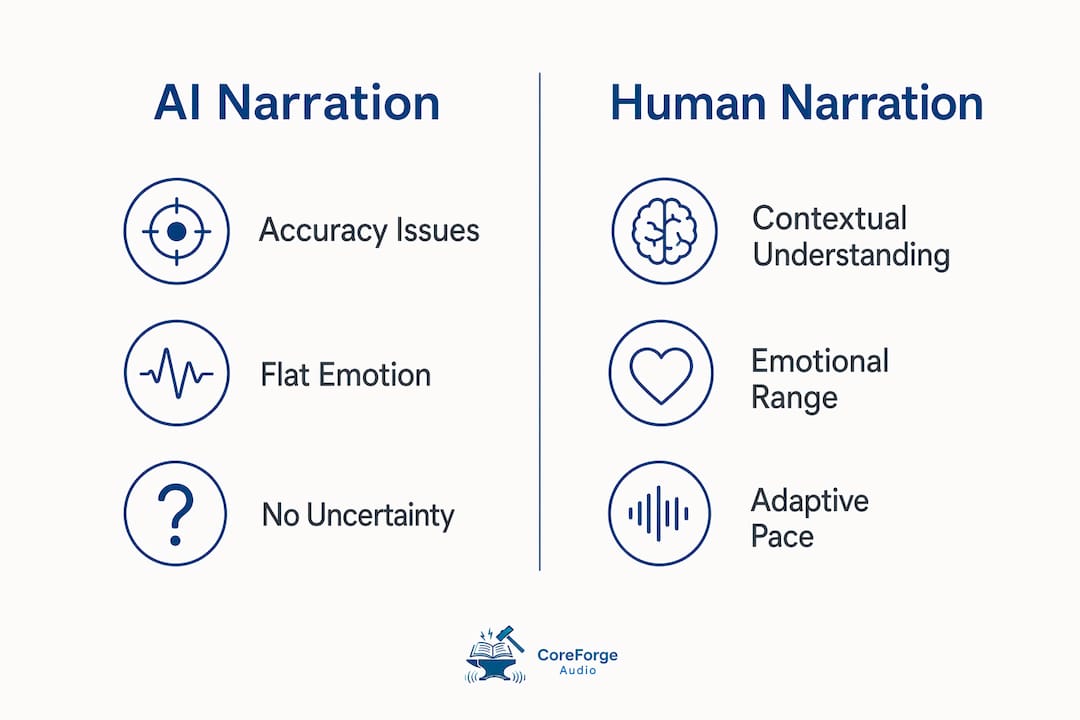
Listeners notice this immediately. Unnatural AI prosody is detected within 200 milliseconds, and many listeners abandon AI audio content within 90 seconds due to robotic delivery. That 90-second window is critical. For blind users who rely on audio as their primary reading format, early disengagement means losing access to content that sighted users can skim and re-engage with visually.
The limitations of AI for blind users in emotional storytelling are not a minor quality issue. They are an access issue. Consider an audiobook covering grief, trauma, or medical diagnosis. A human narrator modulates pacing and tone to give listeners space to process. An AI narrator moves at a consistent, optimized rate regardless of emotional weight. The listener does not get that space. Comprehension and emotional connection both suffer.
Key ways human narrators outperform AI in emotional delivery:
- Tonal modulation: Human narrators shift register between dialogue, narration, and internal monologue.
- Pacing adaptation: Humans slow down during complex or emotionally heavy passages.
- Subtext signaling: A slight emphasis on a word can change meaning entirely. AI misses this.
- Authentic imperfection: Breaths and micro-pauses create a sense of presence AI cannot replicate.
- Listener retention: Human narration sustains attention across long-form content where AI audio loses listeners early.
Pro Tip: If you are evaluating an audiobook platform for accessibility, request a sample chapter narrated by a human and compare it directly against an AI-narrated version. The difference in emotional engagement becomes obvious within the first three minutes.
How do accessibility design gaps make AI narration harder to use?
The usability of AI narration for blind users breaks down at the structural level, not just the content level. Screen reader users listen at 800–900 words per minute, but most AI narration platforms are calibrated for average speech rates far below that. When blind users increase playback speed to match their preferred pace, AI narration produces audio artifacts and unnatural distortions. The content becomes harder to follow, not easier.
The structural problems go deeper than speed. AI defaults to verbose, linear streaming prose that overwhelms screen-reader users who depend on structured, scannable content. A sighted user can scroll past a dense paragraph. A blind user must listen through it. Without headers, landmarks, or verbosity controls, every AI narration session becomes a linear slog with no way to skip, navigate, or pause efficiently.
The four most common AI narration usability failures for blind users:
- No interruptibility: Most AI narration platforms lack a reliable stop or interrupt feature. Once playback starts, stopping it requires multiple interactions, increasing cognitive load.
- Fixed verbosity: AI narration reads everything at the same level of detail. Users cannot set preferences for how much metadata, punctuation, or structural information they hear.
- No navigation landmarks: Human-narrated audiobooks use chapter markers and section cues. AI-generated audio often streams as one unbroken block.
- Speed incompatibility: AI narration degrades at high playback speeds, while screen reader software like NVDA and JAWS is designed to perform well at those speeds.
Pro Tip: When testing any AI narration tool for accessibility, run it at 600 words per minute and check for audio artifacts. If the narration degrades, the platform was not built with blind users in mind.
True accessibility in AI narration requires respecting screen-reader user settings including pace, verbosity, and interruptibility. None of these are standard in current AI narration platforms. The AI narration accessibility issues are not edge cases. They are the default experience for most blind users today.
Systemic failures extend beyond individual platforms. 42% of job seekers with disabilities encounter inaccessible automated evaluations that require disabling assistive technology entirely. That figure reflects how rarely accessibility is built into AI systems from the start. It is treated as an add-on, not a foundation.
AI narration versus human narration: where does the gap matter most?
Human narrators remain the gold standard for blind users. The gap between AI narration and human narration is not closing as fast as the technology press suggests. The benefits of human-narrated audiobooks go beyond preference. They are measurable in comprehension, retention, and emotional engagement.
| Parameter | AI narration | Human narration |
|---|---|---|
| Accuracy signaling | No uncertainty cues | Tone and pacing signal doubt naturally |
| Emotional delivery | Statistically flat | Nuanced, adaptive, and contextual |
| Screen-reader compatibility | Poor at high speeds | Structured for navigation and pacing |
| Listener retention | Drops off within 90 seconds | Sustained across long-form content |
| Contextual understanding | Literal and surface-level | Interpretive and meaning-driven |
The comparison is not about nostalgia for human voices. It is about function. Blind users who rely on audio for education, medical information, or legal documents need narration that is accurate, navigable, and emotionally clear. Human narration versus text-to-speech is not a stylistic debate. It is an accessibility debate.
Human narrators also adapt to the material. A narrator reading a legal document slows down at definitions. A narrator reading a thriller accelerates during action sequences. These are conscious choices that serve comprehension. AI narration applies the same pacing logic to a medical warning as it does to a recipe. That uniformity is not neutral. It is a barrier.
Key Takeaways
AI narration fails blind users because it combines overconfident inaccuracy, emotional flatness, and structural incompatibility with screen-reader workflows into a single, compounding access barrier.
| Point | Details |
|---|---|
| Accuracy is a safety issue | AI responds correctly only 56.6% of the time on complex tasks, with no mechanism to signal when it is guessing. |
| Emotional flatness drives disengagement | Listeners detect unnatural AI prosody within 200ms and many abandon AI audio within 90 seconds. |
| Screen-reader incompatibility is the norm | AI narration is not built for 800–900 wpm listening speeds or structured navigation needs. |
| Human narrators provide functional advantages | Human narration adapts tone, pacing, and structure in ways that directly improve comprehension and retention. |
| Systemic design failures affect all AI tools | 42% of disabled users encounter inaccessible AI interfaces, showing accessibility is rarely built in from the start. |
The uncomfortable truth about AI narration and blind access
I have spent years watching the accessibility conversation get hijacked by enthusiasm for AI tools. Every new release gets framed as a breakthrough. The reality is more complicated. AI narration is genuinely useful for quick, low-stakes tasks. Reading a text message, identifying a product label, getting a weather update. These are areas where speed matters more than precision and where a wrong answer is recoverable.
The problem starts when AI narration gets positioned as a full replacement for human narration in high-stakes or long-form contexts. Medication instructions, legal documents, educational content, and emotionally complex storytelling all require a level of accuracy and nuance that current AI systems cannot deliver. Blind users are not being overly cautious when they distrust AI narration. They are being rational.
What frustrates me most is the design gap. Developers building AI narration tools rarely consult blind users during the design process. The result is platforms that work fine for sighted users testing with headphones but fall apart the moment someone tries to use them with JAWS or NVDA at high speed. Accessibility cannot be a patch applied after launch. It has to be the starting point.
The most promising path forward is hybrid. AI handles speed and scale. Human narrators handle precision, emotion, and high-stakes content. That combination, built with genuine input from the blind community, is where real progress lives.
— Sarmed
Coreforgeaudio: human narration built for real accessibility
Coreforgeaudio was built on the premise that human narration is not a luxury. It is a necessity for blind users who need audio content they can trust.
The platform pairs professional voice actors with accessibility-first design, including structured chapter navigation, adjustable narration speeds, and screen-reader-compatible formats. Every title is narrated by a human who understands pacing, emotional weight, and the difference between reading words and communicating meaning. For blind users and accessibility advocates who are done settling for AI audio that guesses confidently and delivers poorly, Coreforgeaudio's accessible audiobooks offer a clear alternative. The mission is simple: no reader left behind.
FAQ
Why does AI narration give wrong information so confidently?
AI models are built to produce fluent output and have no built-in mechanism to signal uncertainty. AI responds correctly only 56.6% of the time on complex tasks, yet delivers incorrect answers in the same confident tone as correct ones.
Can blind users adjust AI narration speed to match screen-reader preferences?
Most AI narration platforms are not optimized for the 800–900 words per minute speeds that screen-reader users prefer, and increasing speed often produces audio artifacts that make the content harder to follow.
Why do listeners abandon AI audio so quickly?
Listeners detect unnatural AI prosody within 200 milliseconds and many abandon AI audio within 90 seconds due to robotic, emotionally flat delivery that fails to hold attention.
Is human narration always better than AI narration for blind users?
For long-form, emotionally complex, or high-stakes content, human narration consistently outperforms AI in accuracy signaling, emotional nuance, and structured navigation. AI narration works for short, low-stakes tasks where speed matters more than precision.
What accessibility features should AI narration platforms include for blind users?
Effective AI narration for blind users requires interruptibility, verbosity controls, structured navigation landmarks, and compatibility with screen readers like NVDA and JAWS at high playback speeds. Most current platforms offer none of these by default.