
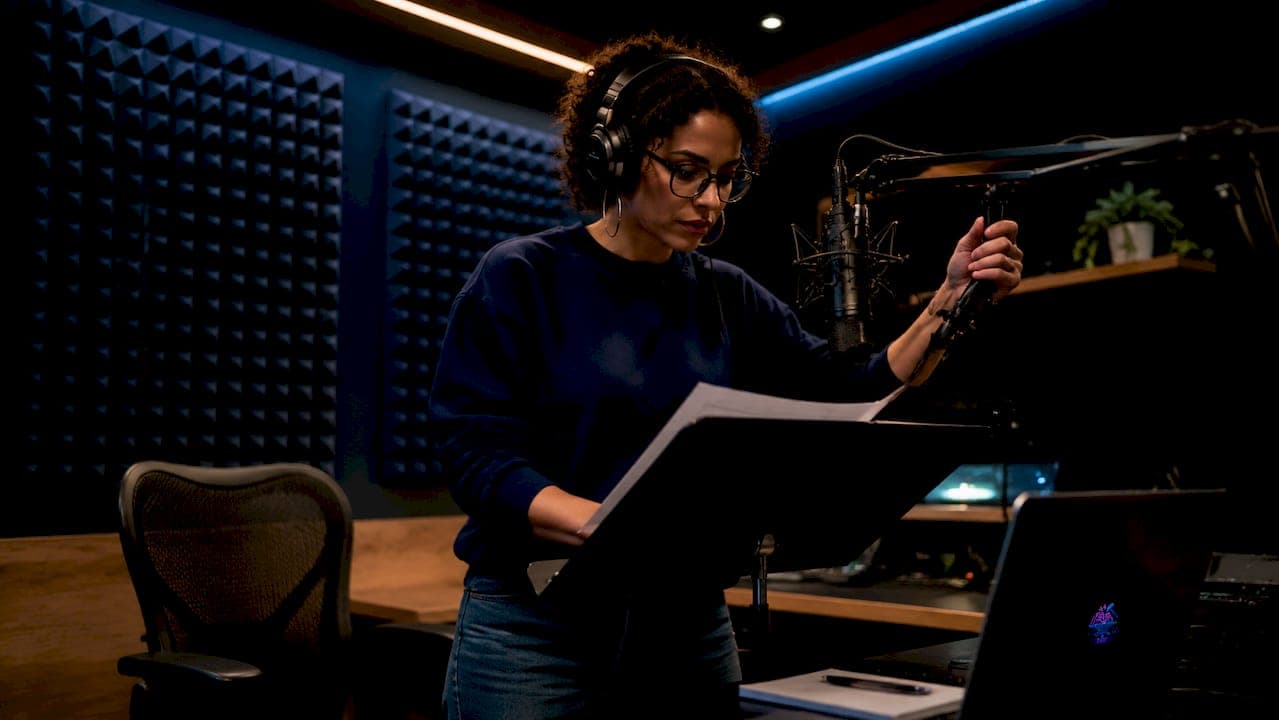
Human narration is the practice of delivering spoken content through a real human voice actor, providing emotional nuance, prosody, and social presence that automated text-to-speech (TTS) systems cannot fully replicate. The role of human narration over text-to-speech is most visible in comprehension and engagement outcomes, where research consistently shows that human voices activate deeper cognitive and emotional processing. For learners with dyslexia, ADHD, visual impairments, or simply busy lives, the choice between human narration and TTS is not just a preference. It is a decision with measurable consequences for how much they understand and retain.
How human narration builds emotional connection and engagement
Human narration does something TTS cannot: it makes listeners feel something. A 2026 psychology study with 665 participants found that human narration outperforms AI in eliciting nostalgia arousal and rewatch intention, specifically when the content is knowledge-rich and explanation depth is high. That finding matters because emotional arousal is not separate from comprehension. It is a driver of it.
The mechanism behind this is prosody. Human narrators naturally vary pitch, pace, and stress in ways that signal meaning, urgency, and emotion. These variations help listeners segment a story into meaningful episodes, a process neuroscientists call event boundary segmentation. Research published in eNeuro shows that brain activation at event boundaries increases during story listening, reflecting active mental model updating. When a narrator's voice guides you through those boundaries with natural timing and intonation, your brain builds a cleaner, more organized memory of the content.
TTS systems produce flat or inconsistently modulated speech that disrupts this process. Listeners must work harder to find the emotional and structural cues that human narrators deliver automatically. Research on humanness perception confirms that native-language listeners detect TTS as less human based on acoustic and linguistic content differences, with German, Spanish, and Turkish speakers all showing sensitivity to these cues. That perception gap reduces listener trust and engagement before the content even has a chance to land.
"Prosodic timing and natural intonation in human narration facilitate cognitive event segmentation and memory for stories." — eNeuro, 2025
Pro Tip: If you are selecting narration for educational or knowledge-rich content, prioritize human narrators for any material where emotional tone, pacing, or explanation depth matters. The engagement lift is not cosmetic. It directly supports retention.
Does TTS or human narration help comprehension more?
The honest answer is: it depends on who is listening. A 2026 eye-tracking study conducted in Taiwan with diverse learner profiles found that TTS improves comprehension for ADHD students but disrupts fluent reading for typical learners without improving their comprehension. That is a critical distinction. TTS is a decoding aid, not a universal comprehension tool.

For students with dyslexia, TTS reduces the cognitive effort required to decode words, freeing up mental resources for meaning-making. But for readers who already decode fluently, adding an audio track creates a redundancy effect. Their visual and auditory channels receive the same information simultaneously, which increases cognitive load rather than reducing it. Human narration sidesteps this problem because it adds interpretive value beyond the text itself, through tone, emphasis, and pacing that guide inferential comprehension.
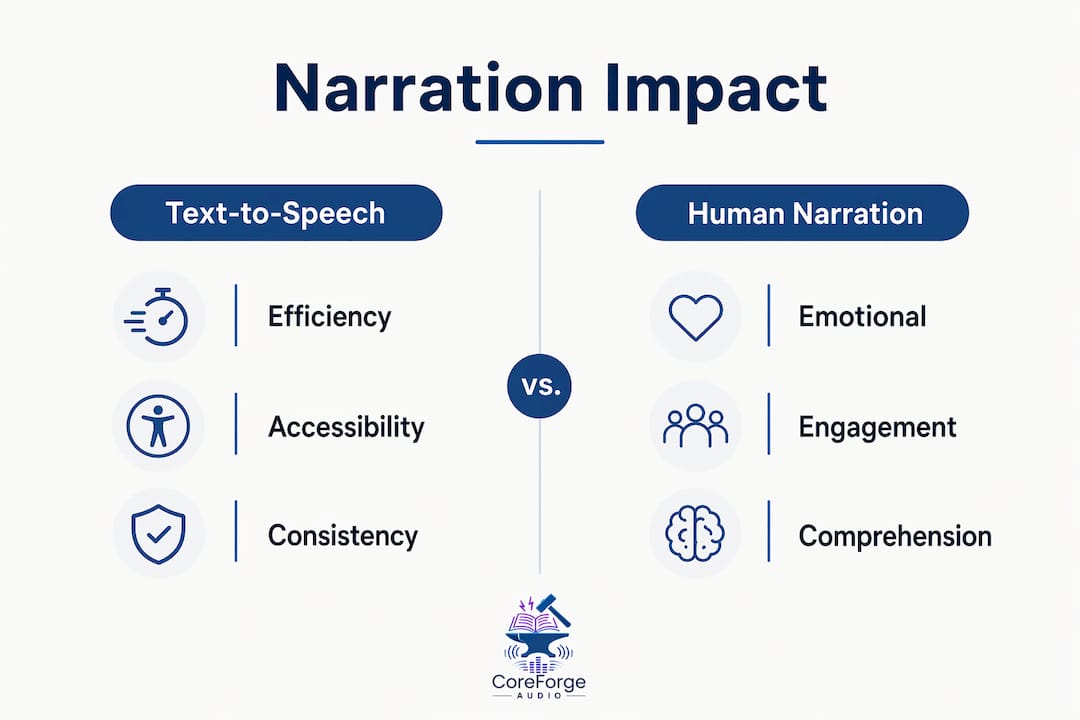
The table below summarizes how TTS and human narration compare across different learner profiles based on current research.
| Learner type | TTS impact | Human narration impact |
|---|---|---|
| Students with ADHD | Improves comprehension by supporting focus and decoding | Supports engagement through emotional cues and pacing |
| Students with dyslexia | Reduces decoding effort, improves fluency | Adds prosodic support that aids inferential understanding |
| Typical fluent readers | Can disrupt reading flow; redundancy effect reduces benefit | Enhances engagement and retention without redundancy |
| Visually impaired learners | Provides functional access to text | Delivers richer, more emotionally resonant listening experience |
| Remote or independent learners | Offers consistent, scalable delivery | Builds stronger connection to content and narrator |
Pro Tip: Before choosing a narration format for an educational program, identify the primary learner profile. For mixed classrooms or platforms serving diverse audiences, human narration is the safer default because it adds value across profiles rather than helping some while disrupting others.
For more on how audio supports different learners, Coreforgeaudio's guide on audio and differentiated instruction breaks down practical applications by learner type.
What neuroscience says about how we process narration
The brain does not passively receive narration. It actively tracks speech in real time, and the quality of that tracking depends heavily on cognitive load and narration format. An EEG study published in 2026 found that delta-band neural tracking decreases under concurrent cognitive load, even without any degradation in speech quality. This means that narration styles requiring extra processing effort, such as monotone TTS or unnaturally paced speech, reduce the brain's ability to follow and encode the content.
Researchers have also developed real-time comprehension measurement tools to study these effects with greater precision. A validated slider method now allows listeners to rate their moment-to-moment understanding during audiobook playback, and these continuous ratings correlate with neural recordings and post-hoc comprehension scores. This technique has revealed that comprehension does not decline uniformly across a listening session. It dips at specific points, often where narration quality drops or speech rate increases abruptly.
Human narrators naturally modulate their delivery to prevent these dips. They slow down at complex passages, raise pitch to signal importance, and pause at transitions. TTS systems apply these adjustments algorithmically, and the results are inconsistent. For content where sustained comprehension matters, such as educational audiobooks, training materials, or long-form storytelling, the difference in neural engagement between human and synthetic narration is not trivial.
| Narration condition | Neural tracking quality | Comprehension outcome |
|---|---|---|
| Human narration, natural pacing | High delta-band tracking | Strong, sustained comprehension |
| TTS, standard rate | Moderate tracking | Variable; depends on learner profile |
| Any narration under high cognitive load | Reduced tracking accuracy | Comprehension declines regardless of format |
| Degraded speech (noise or distortion) | Maintained engagement at event boundaries | Active mental model updating persists |
When to choose human narration over TTS
The decision comes down to three factors: content complexity, audience profile, and whether interaction is possible. Human narration is the stronger choice when content requires emotional interpretation, when the audience includes mixed learning profiles, or when the goal is long-term retention rather than functional access.
Face-to-face interactive storytelling strengthens neural synchrony between teacher and learner, producing comprehension and engagement gains that remote or passive audio delivery cannot match. This does not mean recorded human narration is ineffective. It means that the social and interactive dimensions of human voice add layers of benefit that TTS cannot approximate, even in recorded form.
Here are the scenarios where human narration consistently outperforms TTS:
- Complex storytelling and fiction: Emotional arcs, character voices, and narrative tension require human interpretation to land with full impact.
- Knowledge-rich educational content: Explanation depth amplifies the emotional engagement advantage of human narration, as the 2026 nostalgia study confirmed.
- Accessibility-focused platforms: Learners with dyslexia, ADHD, or visual impairments benefit from the prosodic richness and natural pacing of human voices.
- Long-form audio: Sustained listening sessions demand narration that maintains engagement without increasing cognitive fatigue.
- Multilingual or culturally specific content: Human narrators carry cultural authenticity that TTS systems trained on generic datasets cannot replicate.
TTS remains a practical choice for short-form, functional content where emotional engagement is not the goal, such as navigation prompts, form-reading tools, or quick reference materials. For anything requiring comprehension, retention, or emotional resonance, human narration is the more effective format. Coreforgeaudio's resource on long-form audio for learning explains why sustained listening formats benefit most from human delivery.
Key takeaways
Human narration outperforms TTS in comprehension and engagement because it delivers prosodic cues, emotional resonance, and natural pacing that reduce cognitive load and support mental model building across diverse learner profiles.
| Point | Details |
|---|---|
| Emotional engagement drives retention | Human narration elicits nostalgia and rewatch intention, directly supporting comprehension in knowledge-rich content. |
| TTS benefits are learner-specific | TTS improves comprehension for ADHD and dyslexic learners but can disrupt fluent readers through redundancy effects. |
| Neural tracking reflects narration quality | High cognitive load reduces delta-band speech tracking; human narration's natural pacing prevents these dips. |
| Prosody supports event segmentation | Natural intonation helps listeners organize stories into memorable episodes, improving long-term recall. |
| Interaction amplifies narration benefits | Live or interactive human narration produces neural synchrony gains that recorded TTS cannot replicate. |
Why I still believe human narrators are irreplaceable
By Sarmed
I have spent years watching the TTS conversation swing between two extremes. Either people dismiss synthetic voices entirely, or they treat the latest AI voice model as a solved problem. Neither position holds up when you look at what actually happens to comprehension and engagement in practice.
The research from 2026 does not surprise me. The nostalgia and emotional engagement findings, the neural tracking data, the learner-specific TTS effects. These confirm what anyone who has listened to both formats already senses. A human narrator is not just reading words. They are making interpretive decisions on every sentence, decisions that shape how you receive the content.
What I find underappreciated is how much this matters for accessibility specifically. Platforms serving learners with dyslexia, ADHD, or visual impairments often default to TTS because it is cheaper and faster to produce. But those are precisely the audiences who benefit most from the prosodic richness and emotional presence of a human voice. Cutting corners on narration quality for accessibility-focused content is a contradiction in terms.
TTS will keep improving. Some use cases genuinely belong to it. But for content where comprehension and emotional connection are the point, human narrators are not a legacy choice. They are the right one.
— Sarmed
Discover human narration done right with Coreforgeaudio
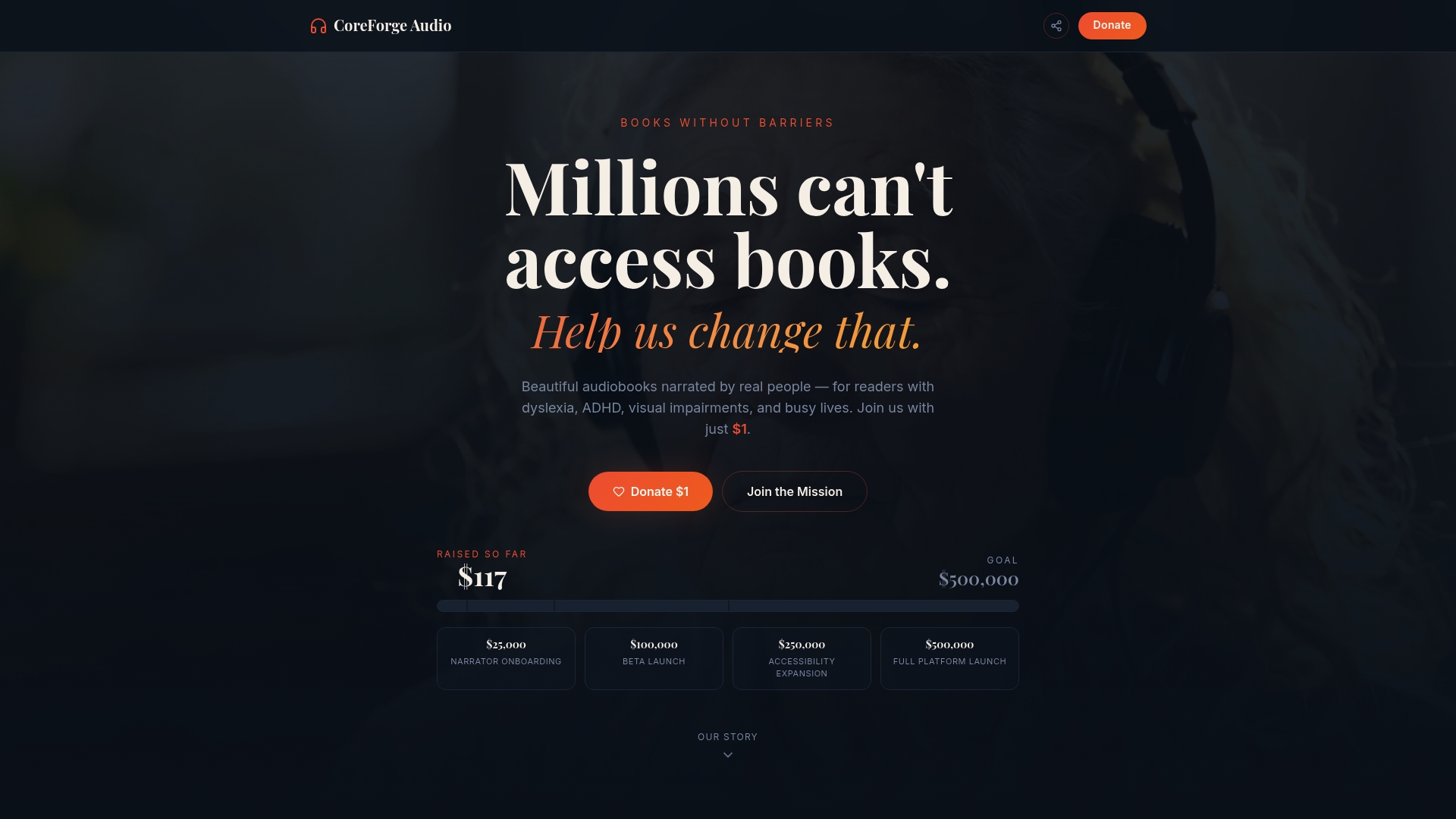
Coreforgeaudio is built on the conviction that human-narrated audiobooks deliver what TTS cannot: genuine emotional connection, prosodic richness, and the kind of listening experience that actually supports comprehension for every type of learner. The platform is designed specifically for individuals with dyslexia, ADHD, visual impairments, and anyone who learns better through audio. Every title is narrated by a real voice actor, fairly compensated, and delivered through an interface with dyslexia-friendly fonts, adjustable narration speeds, and multilingual support. If you are serious about accessible, high-quality audio content, Coreforgeaudio is where that commitment takes shape.
FAQ
What is the main difference between human narration and TTS?
Human narration delivers emotional nuance, natural prosody, and interpretive pacing that TTS systems cannot consistently replicate. These qualities directly support comprehension and engagement, especially for complex or knowledge-rich content.
Does TTS ever outperform human narration for comprehension?
Yes, for specific learner profiles. A 2026 eye-tracking study found TTS improves comprehension for students with ADHD by reducing decoding demands, though it can disrupt fluent readers through redundancy effects.
Why does human narration improve retention?
Human narrators use prosodic timing and natural intonation to guide listeners through event boundaries in a story. Research shows that brain activation at these boundaries supports active mental model updating, which strengthens long-term memory for content.
Is human narration better for learners with dyslexia?
Human narration adds prosodic support that aids inferential comprehension, while TTS primarily reduces decoding effort. For dyslexic learners who need both decoding support and deeper understanding, combining accessible platforms with human narration offers the strongest outcome. Coreforgeaudio's guide on audiobooks in special education covers this in detail.
Can TTS replace human narration for audiobooks?
Current TTS technology cannot fully replace human narration for audiobooks where emotional engagement and sustained comprehension matter. Native-language listeners consistently perceive TTS as less human, and that perception gap reduces trust and engagement with the content.