
What is word recognition and how does audio strengthen it?
Word recognition is the ability to identify printed words accurately and automatically, without conscious effort. It sits at the foundation of the simple view of reading framework, which holds that reading comprehension depends on two equally necessary components: word recognition and language comprehension. Neither works without the other.
Audio supports word recognition by giving readers an accurate phonological model to map onto printed text. When a student hears a word spoken clearly while simultaneously seeing it on the page, the brain receives two reinforcing signals at once. That dual input reduces the mental effort required to decode unfamiliar words, freeing up cognitive resources for meaning-making instead.
The cognitive benefits are concrete:
- Reduced decoding load: Synchronized audio lets struggling readers bypass letter-by-letter sounding out, directing attention toward comprehension.
- Accurate pronunciation models: Hearing a word spoken correctly anchors its phonological form in memory, which accelerates later recognition.
- Improved prosody awareness: Expressive narration signals phrasing, stress, and sentence boundaries that silent text cannot convey.
- Multisensory reinforcement: Auditory and visual input processed together build stronger, more durable word representations than either channel alone.
For audio to deliver these benefits, quality matters. Narration must be clear, expressive, and well-paced. Active engagement, meaning the reader tracks text while listening rather than simply hearing the audio in the background, is what converts listening into genuine word recognition practice.
Key factors that shape how well audio supports word recognition
Not all audio input produces the same results. Several variables determine whether auditory support accelerates word recognition or simply adds noise to the learning environment.
Auditory processing ability is the starting point. Students who struggle to distinguish phonemes from speech, a deficit common in dyslexia, benefit most from high-fidelity recordings where consonant boundaries and vowel distinctions are crisp. Low-quality audio blurs exactly the acoustic features these learners need most.
Phonological awareness interacts directly with auditory input. A student who already understands that spoken words are made of discrete sounds can use audio to confirm and reinforce those mappings. A student who lacks that foundation needs explicit phonics instruction alongside audio, not audio alone.
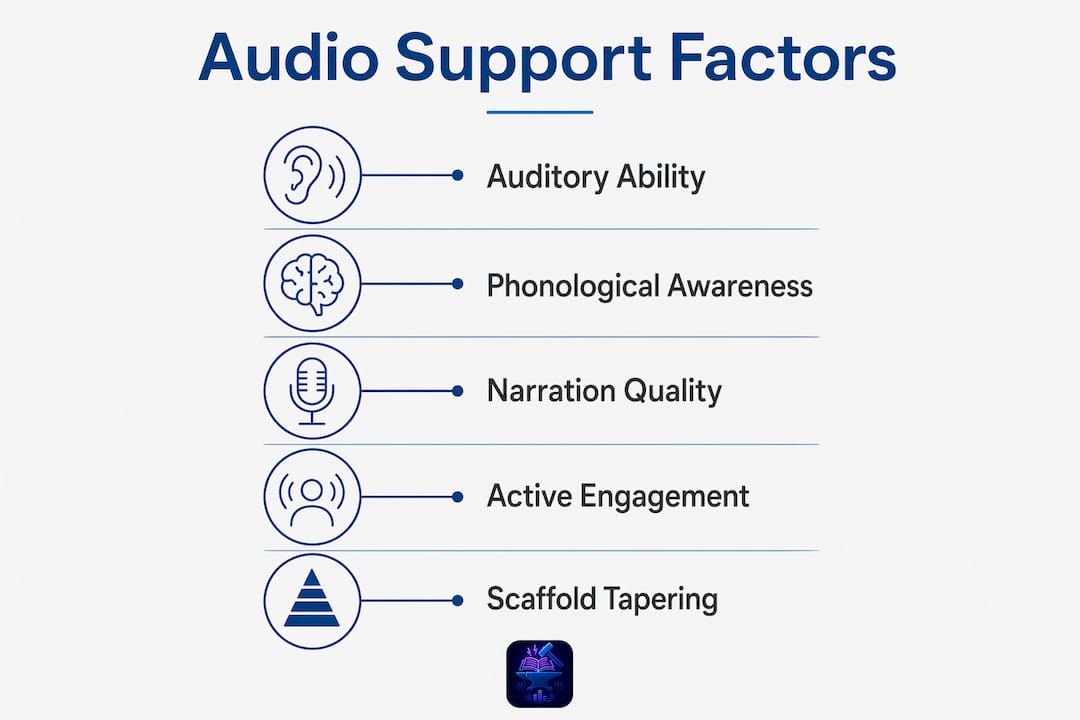
Active versus passive listening is one of the most consequential distinctions in audio-supported reading. Students must follow along visually while listening to gain correct pronunciations and build sight word recognition. Passive listening, where the audio plays while the reader's eyes wander, produces little measurable benefit for word recognition.
Sound environment quality shapes outcomes in ways educators often underestimate:
- Traffic noise and unpredictable environmental sounds increase reading errors and visual fatigue compared to silence or preferred music.
- Background music with lyrics competes directly with text processing by triggering automatic semantic activation, a particularly disruptive effect for struggling readers.
- Instrumental music without lyrics does not show the same disruptive pattern, making it a safer ambient choice when silence is not possible.
Prosody and semantic context in the narration itself also matter. A flat, robotic voice delivers phonological information but strips away the intonation cues that help listeners parse sentence structure and predict upcoming words. Expressive human narration does both.
Instructional strategies that use audio to build word recognition skills
The research points toward several specific approaches that work, and a few common mistakes worth avoiding.
Bimodal reading is the most consistently supported method. Students read printed or digital text while simultaneously listening to a high-quality audio recording of the same passage. Synchronized audio-text presentation results in shorter gaze durations on words compared to silent reading, which reflects reduced processing effort and faster lexical access. For word learning specifically, children in bimodal conditions learn new vocabulary more efficiently than those reading without audio support.
Audio-assisted phonics drills extend bimodal reading into explicit skill-building. A teacher or recording models a target phoneme or word pattern, the student repeats it while tracking the printed form, and the cycle repeats with new examples. Repeated listening to the same passage also builds fluency: each pass through familiar text requires less decoding effort, which trains the automaticity that defines skilled word recognition.
Differentiated audio support addresses the range of learners in any classroom:
- Students with dyslexia benefit from digital tools enabling synchronized text and audio access, which increase fluency and reduce eye fatigue.
- English language learners gain pronunciation models and prosodic context that written text alone cannot supply.
- Students with ADHD or attention difficulties benefit from the pacing structure that audio provides, keeping them anchored to the text.
Tapering audio support is the step many educators skip. Audio used as a scaffold must be gradually reduced as students build automatic word recognition skills. Permanent reliance on audio bypasses the decoding practice that develops fluency. The goal is to use audio to get students across a functional reading threshold, then systematically shift responsibility back to the reader.
Platforms like Coreforgeaudio, which pair human-narrated audiobooks with accessibility features such as adjustable narration speeds and dyslexia-friendly fonts, give educators a practical tool for implementing these strategies. You can explore how audiobooks improve literacy outcomes for students at different skill levels.
Pro Tip: Pair audio-assisted reading with a phonics-based curriculum like All About Reading to give students both the explicit code instruction and the auditory modeling they need for durable word recognition gains.
How word recognition connects to language comprehension and oral language development
Word recognition and language comprehension are not competing priorities. They are interdependent, and audio support develops both simultaneously.
The simple view of reading makes this explicit: reading comprehension equals word recognition multiplied by language comprehension. A student with strong decoding but weak oral language will plateau. A student with rich vocabulary and syntax knowledge but poor decoding cannot access text independently. Audio-supported reading addresses both sides of this equation at once, providing decoding scaffolds while also exposing students to complex vocabulary and sentence structures through listening.
Oral language development feeds directly into phonological and semantic processing. Students who hear varied, expressive language build larger mental lexicons, which speeds word recognition because familiar words are recognized faster than unfamiliar ones. Synchronized audio narration accelerates this process by pairing spoken words with their printed forms repeatedly across a text.
Fluency sits at the intersection of these processes. When word recognition becomes automatic, readers can allocate full attention to comprehension. Audio support helps students reach that automaticity faster by reducing the cognitive friction of decoding, particularly for students whose oral language is stronger than their print skills. For educators working with students who have reading disabilities, the implementation of audiobooks in special education settings offers structured guidance on balancing these goals.
What the research says about audio and word recognition
The neuroscience behind audio-supported reading has grown considerably more specific in recent years.
The DIANA neurocognitive model describes auditory word recognition as a process of mapping acoustic signals into spectro-temporal receptive fields in the brain. In plain terms, the brain converts incoming sound into neurophysiological representations that enable efficient word identification. This model favors rich, human-narrated audio because the acoustic complexity of a real human voice provides more information for the brain's lexical access processes than synthetic or low-fidelity recordings can.
Research on cue integration adds another layer. Listeners near-optimally integrate acoustic and semantic cues during spoken word recognition, weighting each source of information according to its reliability in real time. This means that audio quality and semantic context work together: a clear recording of a word used in a meaningful sentence is processed more accurately than the same word in isolation or in degraded audio.
The interference research is equally instructive. Lyrical music and intelligible speech are equally distracting to readers, and both disrupt reading more than non-lyrical music or environmental noise. The mechanism is semantic competition: the brain automatically begins processing the meaning of heard words, which pulls resources away from processing the meaning of read words. For classroom audio use, this finding has a direct implication. The audio students listen to during reading must be the text itself, not background music with words.
Research insight: High-quality, human-narrated audio provides superior acoustic signals that support the brain's lexical decision processes far more effectively than synthetic or low-fidelity recordings, according to the DIANA model of auditory word recognition.
One critical boundary condition runs through all of this research. Audio support must be tapered as students develop skill. There is a measurable threshold in reading development where audio transitions from scaffold to crutch. Effective instruction guides students through that threshold by gradually reducing audio support as automatic word recognition takes hold. Educators who keep audio support in place indefinitely may find that students become dependent on it rather than developing the independent decoding fluency that defines proficient reading.
Coreforgeaudio's approach to human narration and ethical audio production reflects these findings directly. The platform's commitment to professional voice actors over synthetic text-to-speech aligns with what the DIANA model and cue integration research both suggest: acoustic richness matters for word recognition, and that richness comes from human voices. For educators looking at the broader science, the science behind audiobook learning offers a deeper look at how listening builds literacy across skill levels.
For students who need both audio scaffolding and explicit language instruction, resources like ELA skills for struggling students provide a structured framework that complements audio-supported reading with targeted skill-building.
Key Takeaways
Audio supports word recognition most powerfully when it is high-quality, synchronized with text, and paired with active visual tracking rather than passive listening.
| Point | Details |
|---|---|
| Bimodal reading reduces effort | Synchronized audio-text presentation produces shorter gaze durations on words, reflecting faster lexical access. |
| Audio quality determines outcomes | Human-narrated audio provides richer acoustic signals than synthetic recordings, supporting stronger lexical processing per the DIANA model. |
| Lyrics disrupt reading | Background music with lyrics competes with text semantic processing, impairing comprehension even at slow tempos. |
| Active tracking is required | Students must follow text visually while listening to gain pronunciation models and build sight word recognition. |
| Scaffolding must be tapered | Audio support should decrease as automatic word recognition develops, preventing long-term decoding dependency. |