

Theodore Roosevelt's most requested lines are right here, each with a one-line attribution so you can use or cite them immediately.
These are the Teddy Roosevelt quotes that appear most often in archives, classrooms, and speeches:
- "Do what you can, with what you have, where you are." — Autobiography, 1913 (widely attributed; some curators note possible paraphrase)
- "Believe you can and you're halfway there." — This line is widely attributed to Roosevelt, but no confirmed primary source has been verified.
- "Speak softly and carry a big stick; you will go far." — Letter to Henry L. Sprague, January 26, 1900
- "Far better it is to dare mighty things, to win glorious triumphs, even though checkered by failure, than to take rank with those poor spirits who neither enjoy much nor suffer much." — "The Strenuous Life" speech, Chicago, April 10, 1899
- "With self-discipline most anything is possible." — This line is widely attributed to Roosevelt, but no confirmed primary source has been verified.
- "Keep your eyes on the stars, and your feet on the ground." — This line is widely attributed to Roosevelt, but no confirmed primary source has been verified.
- "The only man who never makes mistakes is the man who never does anything." — This line is widely attributed to Roosevelt, but no confirmed primary source has been verified.
- "In any moment of decision, the best thing you can do is the right thing." — This line is widely attributed to Roosevelt, but no confirmed primary source has been verified.
- "To educate a man in mind and not in morals is to educate a menace to society." — This line is widely attributed to Roosevelt, but no confirmed primary source has been verified.
- "People ask the difference between a leader and a boss. The leader leads, and the boss drives." — This line is widely attributed to Roosevelt, but no confirmed primary source has been verified.
A note on authenticity: Several of these lines circulate widely online but lack a confirmed primary source. The Theodore Roosevelt Center and the Theodore Roosevelt Association actively verify and annotate quotations. Before using a line in formal writing or a speech, cross-check it against those archives.
Table of Contents
- Teddy Roosevelt quotes grouped by theme
- Where Roosevelt's most famous lines actually come from
- How to attribute Roosevelt quotes correctly
- Why Roosevelt's words still carry weight
- Key Takeaways
- Why accessible storytelling and Roosevelt's legacy belong together
- Authoritative sources and further reading
Teddy Roosevelt quotes grouped by theme
Roosevelt left behind a large body of speeches, books, and letters. Grouping his words by theme makes it easier to find the right line for a specific purpose.
Leadership and courage
- "The credit belongs to the man who is actually in the arena." Use this when arguing for action over commentary.
- "People ask the difference between a leader and a boss. The leader leads, and the boss drives." A sharp contrast for management talks; primary source unverified.
- "Do what you can, with what you have, where you are." Practical encouragement; attributed to his Autobiography but verify before formal citation.
- "In any moment of decision, the best thing you can do is the right thing." Widely used in ethics discussions; primary source unverified.
- "The most important single ingredient in the formula of success is knowing how to get along with people." Frequently attributed; primary source unverified.
- "With self-discipline most anything is possible." Popular in coaching contexts; primary source unverified.
Strenuous life and personal growth
Roosevelt's "Strenuous Life" philosophy held that comfort was the enemy of character. These lines reflect that conviction directly.
- "Far better it is to dare mighty things, to win glorious triumphs, even though checkered by failure." From the Strenuous Life speech, Chicago, 1899.
- "Believe you can and you're halfway there." Motivational staple; primary source unverified.
- "Keep your eyes on the stars, and your feet on the ground." Frequently attributed; primary source unverified.
- "The only man who never makes mistakes is the man who never does anything." Encourages risk-taking; primary source unverified.
- "It is hard to fail, but it is worse never to have tried to succeed." From "The Strenuous Life" speech, 1899.
- "Nothing in the world is worth having or worth doing unless it means effort, pain, difficulty." Frequently attributed; primary source unverified.
Conservation and nature
The National Park Service curates Roosevelt's environmental language and connects it directly to his work establishing national parks and conservation policy. These quotes were not decorative; they were political arguments.
- "Here is your country. Cherish these natural wonders, cherish the natural resources, cherish the history and romance as a sacred heritage." Frequently attributed; primary source unverified.
- "The nation behaves well if it treats the natural resources as assets which it must turn over to the next generation increased, and not impaired, in value." From The New Nationalism, 1910.
- "There can be no greater issue than that of conservation in this country." Frequently attributed; primary source unverified.
- "We have fallen heirs to the most glorious heritage a people ever received." Frequently attributed; primary source unverified.
- "To waste, to destroy our natural resources, to skin and exhaust the land instead of using it so as to increase its usefulness, will result in undermining in the days of our children the very prosperity which we ought by right to hand down to them." From his Seventh Annual Message to Congress, 1907.
Politics and citizenship
- "A vote is like a rifle: its usefulness depends upon the character of the user." From his Autobiography, 1913.
- "The government is us; we are the government, you and I." Frequently attributed; primary source unverified.
- "To educate a man in mind and not in morals is to educate a menace to society." Widely circulated; primary source unverified.
- "Patriotism means to stand by the country. It does not mean to stand by the president." Frequently attributed; primary source unverified.
- "No man is above the law and no man is below it." From his Third Annual Message to Congress, 1903.
Wit and aphorisms
- "Speak softly and carry a big stick; you will go far." Cited in a letter to Henry L. Sprague, January 26, 1900; later became shorthand for his foreign policy.
- "I am only an average man but, by George, I work harder at it than the average man." Frequently attributed; primary source unverified.
- "Old age is like everything else. To make a success of it, you've got to start young." Frequently attributed; primary source unverified.
- "When you're at the end of your rope, tie a knot and hold on." Frequently attributed; primary source unverified.
| Theme | Typical tone | Common original source | Best uses |
|---|---|---|---|
| Leadership & courage | Assertive, direct | Speeches, autobiography | Commencement, management training |
| Strenuous life & growth | Motivational, personal | Speeches (Chicago, 1899) | Social posts, coaching, personal essays |
| Conservation & nature | Civic, urgent | Congressional messages, speeches | Environmental education, policy talks |
| Politics & citizenship | Principled, civic | Speeches, congressional messages | Civics class, political essays |
| Wit & aphorisms | Dry, memorable | Letters, informal remarks | Social media, casual speeches |
Where Roosevelt's most famous lines actually come from
Knowing the source of a quote is what separates a credible citation from a Pinterest caption. The table below covers the four lines people request most.
| Quote (opening words) | Primary source | Date | Provenance note |
|---|---|---|---|
| "It is not the critic who counts..." | "Citizenship in a Republic" speech, Sorbonne, Paris | April 23, 1910 | Verified primary source; full text archived by the Theodore Roosevelt Association |
| "Do what you can, with what you have..." | Theodore Roosevelt: An Autobiography | 1913 | Widely attributed to this volume; some curators flag it as a possible paraphrase of a line by Squire Bill Widener |
| "Speak softly and carry a big stick..." | Letter to Henry L. Sprague | January 26, 1900 | Roosevelt cited it as a West African proverb; the Theodore Roosevelt Association notes it appeared in earlier political remarks before becoming foreign-policy shorthand |
| "Far better it is to dare mighty things..." | "The Strenuous Life" speech, Chicago | April 10, 1899 | Verified primary source; one of the most cited lines from that address |
The "Man in the Arena" passage is the single most requested excerpt from Roosevelt's entire body of work. Historians at the Theodore Roosevelt Association emphasize that it was written as a civic duty argument, not a self-help slogan. Roosevelt was speaking to a French audience about the responsibilities of democratic citizenship. The personal-hustle reading is accurate but incomplete.
For lines where the table above shows no verified primary source, the Theodore Roosevelt Center's quotes archive is the best starting point for verification. The Center actively annotates which lines are confirmed and which remain disputed.
How to attribute Roosevelt quotes correctly
Getting the attribution right matters whether you're writing a college essay, preparing a keynote, or posting to social media. Here is how to do it cleanly across different formats.
Short format (social media or casual use): "Do what you can, with what you have, where you are." — Theodore Roosevelt, Autobiography, 1913
Full academic citation (Chicago style): Theodore Roosevelt, Theodore Roosevelt: An Autobiography (New York: Macmillan, 1913), [page number if available].
Speech or presentation attribution: "In his 1910 Sorbonne address, 'Citizenship in a Republic,' Roosevelt argued that 'the credit belongs to the man who is actually in the arena.'"
Paraphrase attribution: "Roosevelt argued, in his 1899 Chicago speech, that daring to attempt great things — even at the risk of failure — was preferable to cautious inaction."
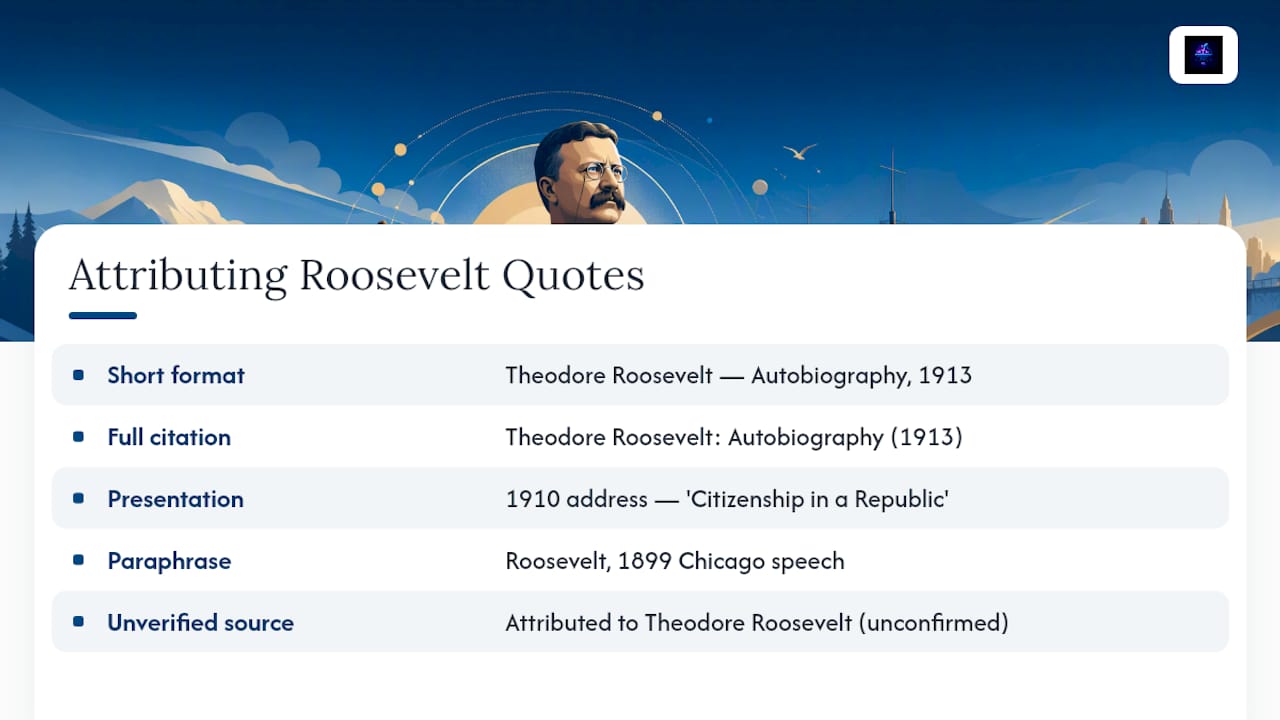
When the source is unverified: "Attributed to Theodore Roosevelt (primary source unconfirmed)."
Checklist before you publish or present a Roosevelt quote
- Search the Theodore Roosevelt Center quotes archive for the exact line.
- Check the Theodore Roosevelt Association's quotations page for speech or book attribution.
- If the line appears only on aggregator sites like BrainyQuote or Goodreads, treat it as unverified until you find a primary source.
- Note whether you are quoting exactly or paraphrasing — both are legitimate, but they require different attribution language.
- For classroom or academic use, include the speech title, date, and location when available.
Pro Tip: If you cannot find a primary source after checking both the Theodore Roosevelt Center and the Theodore Roosevelt Association, write "attributed to Theodore Roosevelt" rather than presenting the line as a confirmed quotation. That single word protects your credibility.
Why Roosevelt's words still carry weight
Roosevelt served as the 26th President of the United States from 1901 to 1909, and his public career was unusually wide: military hero, conservationist, trust-buster, author of more than 35 books, and Nobel Peace Prize recipient in 1906. That breadth is part of why his Wikipedia biography reads like three careers compressed into one life, and why his language covers so much ground.
The lines that endure are not accidental. Roosevelt wrote and spoke with a deliberate philosophy behind every major address. The "Strenuous Life" speech was a direct argument against what he called the life of slothful ease. The "Citizenship in a Republic" address was a defense of democratic participation against cynicism. His congressional messages on conservation were policy arguments dressed in moral language. These were not motivational posters; they were political acts.
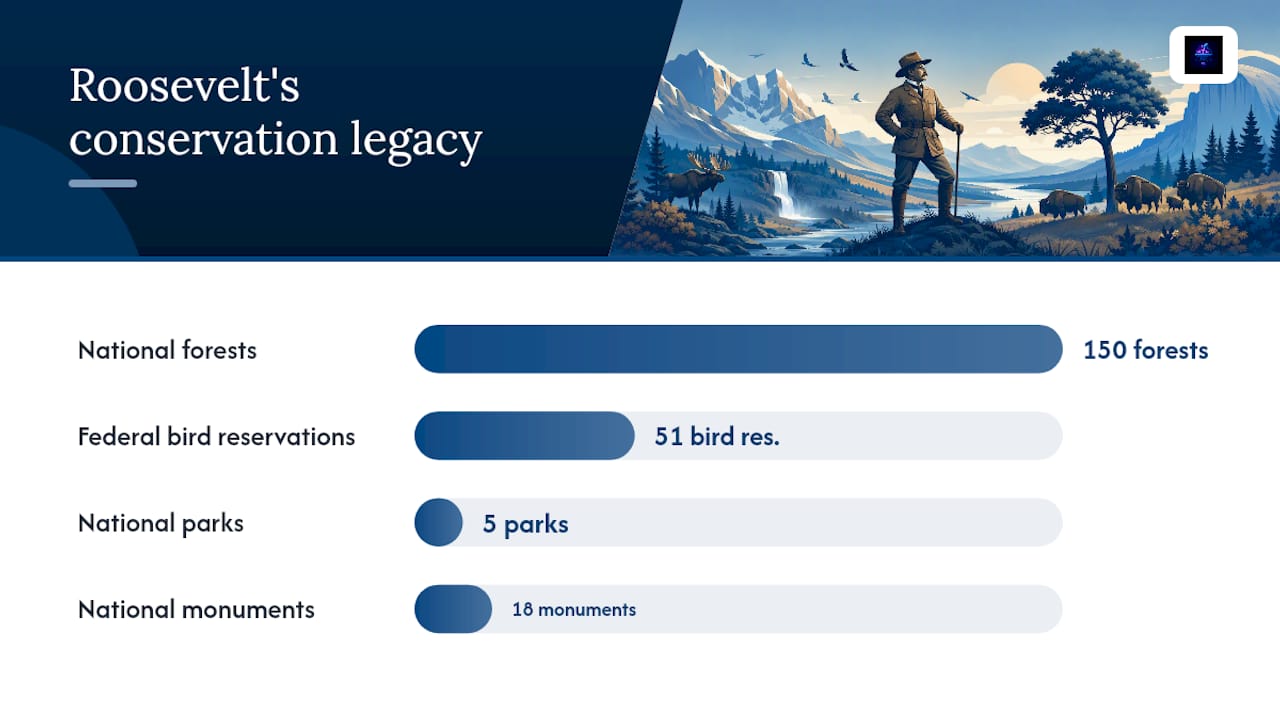
The National Park Service draws a direct line between Roosevelt's environmental language and his concrete policy achievements: 150 national forests, 51 federal bird reservations, 5 national parks, and 18 national monuments established during his presidency. His conservation quotes were not rhetorical flourishes. They described what he was actually doing.
The civic dimension of his most famous lines is often flattened by modern use. "The Man in the Arena" gets quoted in startup pitch decks and locker rooms, which is fine, but the original argument was about democratic responsibility. Roosevelt was telling his French audience that a republic fails when its citizens choose to watch rather than participate. That reading gives the passage considerably more weight than the standard "keep going despite criticism" gloss.
Key Takeaways
Roosevelt's most durable quotes come from verified primary sources, and using them accurately requires checking archival records rather than relying on aggregator sites.
| Point | Details |
|---|---|
| Verify before you cite | Many popular Roosevelt lines lack a confirmed primary source; always check the Theodore Roosevelt Center or Theodore Roosevelt Association first. |
| "Man in the Arena" has a specific origin | The passage comes from "Citizenship in a Republic," delivered at the Sorbonne on April 23, 1910, not from a general motivational context. |
| Theme shapes the right quote | Leadership, conservation, civic duty, and personal growth each draw from different speeches and writings; match the theme to the occasion. |
| Aggregators show popularity, not provenance | Sites like BrainyQuote and Goodreads are useful for finding lines but rarely supply primary-source citations for formal use. |
| Label paraphrases honestly | When quoting a line without a verified source, write "attributed to Theodore Roosevelt" to protect your credibility. |
Why accessible storytelling and Roosevelt's legacy belong together
Roosevelt believed that an educated, engaged citizenry was the foundation of a healthy republic. That conviction runs through his speeches on conservation, civic duty, and the strenuous life alike. At Coreforgeaudio, the mission follows a similar thread: the words of history's most compelling voices should be available to every reader, regardless of whether they can access a printed page. Dyslexia, ADHD, visual impairment, and a packed schedule are not reasons to be excluded from the ideas that shaped American public life. Human-narrated audiobooks, dyslexia-friendly fonts, and adjustable narration speeds are the practical tools that close that gap. Roosevelt's words deserve to be heard, not just read.
Authoritative sources and further reading
The sources below range from primary archives to popular aggregators. Knowing which is which helps you decide how much weight to give each one.
"Quote aggregators are useful for assessing popularity but usually lack the archival footwork needed for academic citation; always cross-check with primary collections." — Theodore Roosevelt Center
Primary and archival sources:
- Theodore Roosevelt Center — Quotes
- Theodore Roosevelt Association — The Man in the Arena: Citizenship in a Republic
- Theodore Roosevelt Quotes - Theodore Roosevelt National Park (NPS)
- Parade — 75 Classic Teddy Roosevelt Quotes
- Goodreads — Theodore Roosevelt quotes
- BrainyQuote — Theodore Roosevelt quotes
- Theodore Roosevelt — Wikipedia
Popular aggregators (useful for finding lines, not for formal citation):
- Parade — 75 Classic Teddy Roosevelt Quotes: A large-format roundup that reflects which lines modern audiences share most widely.
- Goodreads — Theodore Roosevelt quotes: Community-rated collection; good for gauging popularity, weak on provenance.
- BrainyQuote — Theodore Roosevelt quotes: Broad collection of aphorisms; typically omits primary-source citations, so treat as a discovery tool only.
Verification note: The Theodore Roosevelt Center and the Theodore Roosevelt Association are the two primary-source archives for quotation verification. Everything else on this list is a secondary source or aggregator. For a classroom, publication, or formal speech, confirm the line in one of those two archives before attributing it to Roosevelt.