

Reading aloud builds confidence because it converts private, silent processing into practiced speech, strengthening memory, vocal control, and the comfort of being heard. Two bodies of research explain the mechanism. The production effect, studied extensively by cognitive psychologist Colin MacLeod, shows that speaking words aloud makes them more distinctive in memory than silent reading does. Bibliotherapy research adds a second layer: engaging with stories reduces physiological stress and increases empathy, both of which lower the social anxiety that keeps many readers silent.
Three things you can try in the next five minutes:
- Read one paragraph of a familiar book aloud, alone, at any pace you choose.
- Record yourself on your phone and play it back once without judgment.
- Notice one word you said clearly. That is your baseline.
Table of Contents
- What does the science say about reading aloud and memory?
- How does reading aloud translate to social and speaking confidence?
- Step-by-step exercises to build confidence through reading aloud
- How can you adapt read-aloud practice for dyslexia, ADHD, or visual impairment?
- How long does it take to notice a difference?
- Are common worries about reading aloud actually valid?
- How Coreforgeaudio supports accessible read-aloud practice
- Key Takeaways
- The part nobody talks about enough
- Coreforgeaudio: a resource worth knowing about
- Selected sources and further reading
What does the science say about reading aloud and memory?
The production effect is straightforward: words you say out loud are remembered better than words you read silently. MacLeod's research shows this holds across the lifespan, from children to older adults. The reason is distinctiveness. Your brain tags spoken words with extra sensory information, motor signals from your mouth and throat, and the sound of your own voice. That multi-channel encoding makes the memory stickier.
Neuroscience reporting in The Atlantic notes that reading aloud activates motor control systems, auditory processing, and self-referential brain networks simultaneously, engaging the hippocampus more deeply than silent reading. That is the neurological reason why reading aloud feels different and why the gains transfer to real speech situations.
Bibliotherapy research adds the emotional side. Literary fiction links to improved mood and measurable increases in empathy. When you feel less stressed and more connected to other people's inner lives, social situations feel less threatening. Confidence, in that sense, is partly a stress-reduction outcome, and reading is one of the lowest-cost ways to get there.
How does reading aloud translate to social and speaking confidence?
The pathway is simple: vocal practice reduces the novelty of being heard. Every time you read aloud, you rehearse the physical act of producing speech, modulating tone, finding rhythm, and expressing emotion. When a real speaking situation arrives, your nervous system has already done a version of it.
Research on children shows that read-aloud practice transfers directly to public-speaking skills, and the mechanism generalizes to adults. A job interview, a group meeting, a phone call with a doctor's office: these all draw on the same vocal fluency you build by reading a paragraph aloud at home. The content is different, but the skill is the same.
Listening to someone else read aloud also strengthens social bonds and deepens emotional processing for the listener. Shared reading, whether in person or through an audiobook listened to together, creates a low-pressure social experience that builds the kind of comfort that carries into conversation.

Pro Tip: Start with private recordings, then share one with a trusted friend or family member before attempting any group setting. This gradual exposure, private to trusted listener to small group, is what literacy practitioners call building "vocal courage."
Step-by-step exercises to build confidence through reading aloud
A short, repeatable routine works better than occasional long sessions. Here is one that scales to your available time.
- Warm up (2 minutes). Hum gently, then say the alphabet slowly, exaggerating each sound. This loosens your vocal cords and signals to your brain that speech is coming.
- Choose your text. Pick something familiar: a passage you have heard before, a short poem, or a paragraph from a book you enjoy. Familiar text lowers anxiety and maximizes the production effect.
- Read one paragraph aloud. Pace yourself. Pause at punctuation. Do not rush.
- Record and replay (optional but powerful). A 30-second recording on your phone is enough. Listen once. Note one thing that sounded good.
- Repeat with a second paragraph. Two paragraphs is a complete 10-minute session. Add a third for 20 minutes, or read a full page for 30.
Sample practice script: "The morning was quiet. I sat by the window and watched the light change. It moved slowly across the floor, the way time moves when you are paying attention." Read that three times. Each pass will sound different, and by the third, your voice will be steadier.
Track small wins: fewer stumbles, a longer stretch before pausing, a moment when your voice felt natural. Those are real gains.
How can you adapt read-aloud practice for dyslexia, ADHD, or visual impairment?
One routine does not fit every reader. Here is how to adapt based on your specific barrier.
For dyslexia: Use short, decodable, or highly familiar text. Paired reading, where you follow along with an audio track while reading the same text, reduces decoding pressure and lets you focus on voice and rhythm. Finger tracking or a reading guide keeps your place without mental effort. Building an audiobook listening routine alongside read-aloud practice is one of the most effective combinations available.

For ADHD: Short timed sprints work better than open-ended sessions. Try a 5-minute read-aloud followed by a 2-minute movement break, then another sprint. High-interest material matters more for ADHD readers than for most: if the text bores you, your attention will drift before the practice delivers any benefit.
For visual impairment: Human-narrated audiobooks with adjustable playback speed let you follow along and read aloud simultaneously, or alternate between listening and speaking. Tactile supports, like a physical book in Braille alongside an audio version, allow multi-sensory engagement. Audiobooks as a resource for visual impairment covers this combination in practical detail.
Features to look for in any platform: adjustable narration speed, dyslexia-friendly companion fonts, bookmarking, and the option to replay short segments.
Pro Tip: If performance anxiety is your main barrier, record yourself reading privately and never share the recording. The goal is not an audience. The goal is repetition. Private recordings build the same neural pathways as public reading, with none of the social pressure.
How long does it take to notice a difference?
Many readers notice improvements within a few weeks of consistent daily practice, usually a shorter pause before speaking, fewer self-corrections, or a willingness to read aloud to another person. More sustained confidence, especially in unfamiliar social situations, often develops over several months of consistent practice. Frequency matters more than session length.
Use this table to track your own progress. Copy it into a notebook or a notes app.
Objective measures to watch: number of self-corrections per paragraph, length of fluent stretches, and whether you chose to read to another person that week. Subjective confidence ratings, even a simple 1–10 score, are surprisingly reliable over time.
Are common worries about reading aloud actually valid?
Most of them are not. Here is the short version.
- "I'm too embarrassed." Every reader stumbles. Literacy practitioners consistently find that normalizing mistakes, not eliminating them, is what builds fluency. A stumble is data, not failure.
- "Reading aloud only helps kids." The production effect works across the lifespan. Adults who read aloud report clearer speech and better comprehension of dense material.
- "I have to be perfect." Practice is not performance. The goal is repetition, not delivery. A hesitant reading of a familiar paragraph still activates the same memory and motor systems as a polished one.
Mistakes during read-aloud practice are not signs that you are doing it wrong. They are the mechanism by which your brain learns where the gaps are. Decodable texts and repeated readings are specifically designed to let you encounter those gaps in a low-stakes setting, so they stop feeling threatening.
How Coreforgeaudio supports accessible read-aloud practice
Coreforgeaudio is a nonprofit-focused platform built specifically for readers who face barriers: dyslexia, ADHD, visual impairment, or simply a life that does not leave room for silent reading. The platform offers human-narrated audiobooks, adjustable playback speeds, and dyslexia-friendly companion text features, all designed to complement the kind of read-aloud routines described in this article.
The platform's transparency about its mission is worth noting. Coreforgeaudio publishes its costs openly, compensates voice actors fairly, and takes a firm position against replacing human narrators with AI-generated audio. For readers who rely on the warmth and expressiveness of a real human voice, that matters. The science behind audiobook learning supports exactly this: human narration engages emotional processing in ways that synthetic audio does not replicate.
Key Takeaways
Reading aloud builds confidence by activating memory, reducing speaking anxiety, and giving you repeatable, low-stakes vocal practice grounded in the production effect and bibliotherapy research.
| Point | Details |
|---|---|
| Production effect is the core mechanism | Speaking words aloud makes them more memorable than silent reading, across all ages. |
| Bibliotherapy reduces social anxiety | Reading and listening to fiction lowers stress and increases empathy, both of which support confidence. |
| Gradual exposure works best | Start privately, record yourself, then share with one trusted listener before any group setting. |
| Adapt the routine to your barrier | Dyslexia, ADHD, and visual impairment each call for specific text choices, pacing, and support tools. |
| Coreforgeaudio complements practice | Human-narrated audiobooks with adjustable speed and dyslexia-friendly text support the routines in this article. |
The part nobody talks about enough
The conventional wisdom says reading aloud is for children learning to decode. That framing does real harm to adults who could benefit from it. The production effect does not care how old you are. Bibliotherapy does not require a classroom. And the social confidence that comes from hearing your own voice in a low-stakes setting is available to anyone willing to read one paragraph into their phone.
What actually holds most adults back is not ability. It is the belief that practice requires an audience. It does not. The gains happen in private, in repetition, in the small moment when you notice your voice sounded steadier than last time. That is the whole thing. Start there.
Coreforgeaudio: a resource worth knowing about
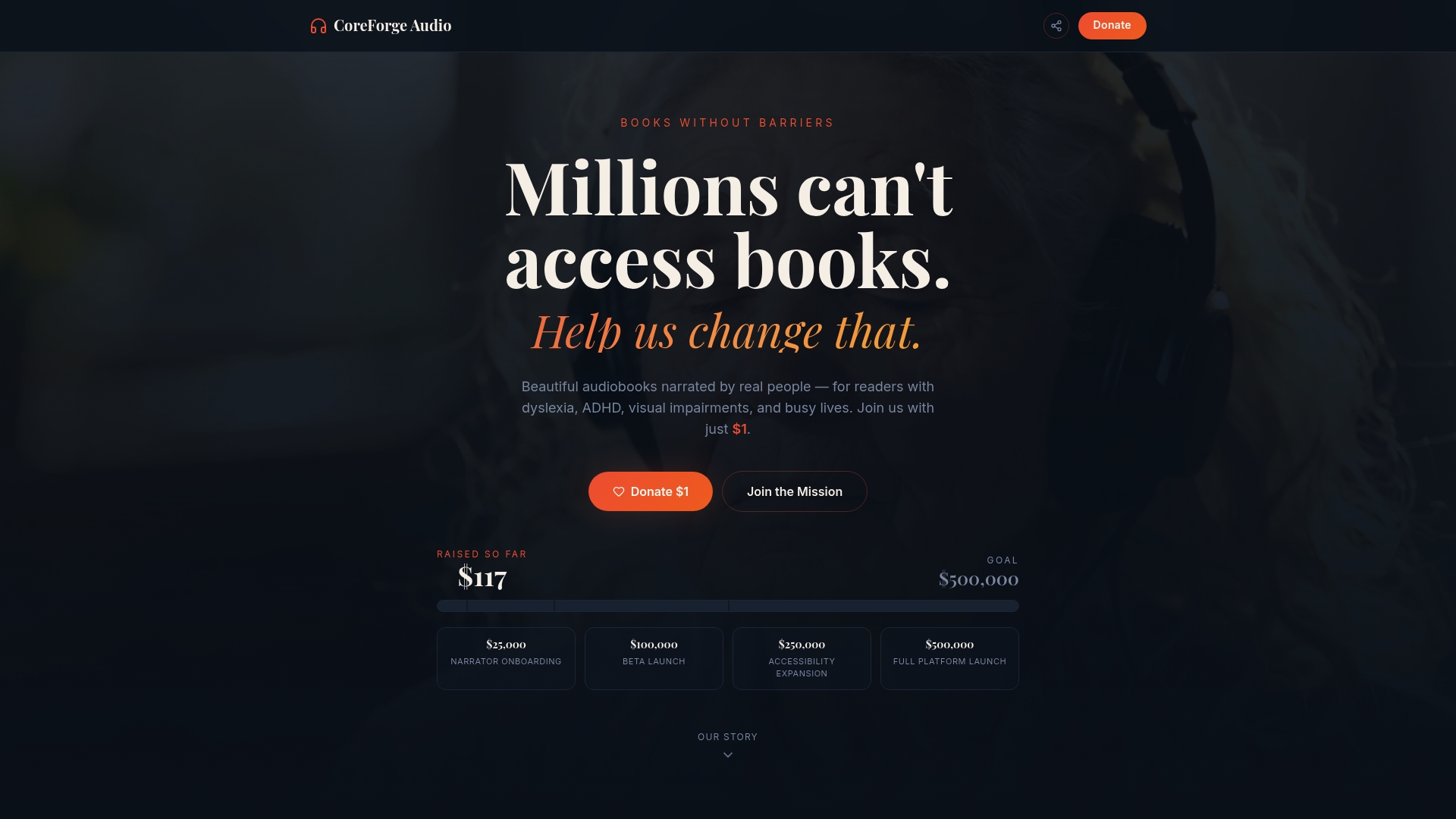
For readers who want a listening companion that was built with their barriers in mind, Coreforgeaudio offers something most platforms do not: human-narrated audiobooks with adjustable playback, dyslexia-friendly text options, and a nonprofit mission that keeps access at the center. It is not a replacement for active read-aloud practice. It is the material you practice with, narrated by real people who were paid fairly to do it.
The platform is currently in its fundraising phase, which means early supporters are part of building something genuinely different. Visit Coreforgeaudio to learn more about the platform and how it supports accessible reading for people who need it most.
Selected sources and further reading
- Production effect research, PubMed (Colin MacLeod) — Primary research on how speaking text aloud improves memory distinctiveness across age groups.
- The Atlantic: We're all reading wrong — Neuroscience reporting on brain activation during aloud reading and hippocampal engagement.
- BBC Future: The surprising power of reading aloud — Covers social bonding, adult benefits, and shared reading research.
- Psychology Today: Can reading fiction make you happier? — Bibliotherapy evidence linking fiction to mood improvement and empathy.
- K-12 Dive: Reading aloud can boost students' confidence and fluency — Classroom techniques including choral reading, echo reading, and partner reading.
- Manaiakalani Share: Reading as a means to build confidence — Practitioner guidance on normalizing mistakes and using decodable texts.
- Coreforgeaudio: How listening builds literacy — Platform-specific science on audiobook learning and literacy development.