

Pacing in audio comprehension is defined as the deliberate control of speech speed, pauses, and rhythm to maximize how well a listener understands and retains spoken content. Speech rate, the standard industry term for this concept, directly shapes both objective retention and the subjective feeling of clarity. Get it wrong, and even the most carefully written script fails. Get it right, and listeners absorb more, stay engaged longer, and feel less mental strain. The role of pacing in audio comprehension applies equally to classroom recordings, audiobooks, and professional voiceover work.
How does pacing impact the brain during audio comprehension?
The brain has a hard speed limit for processing speech, and it is biological. Alpha-band neural oscillations in the auditory cortex set a physiological ceiling on how fast the brain can decode incoming sound into meaning. When speech arrives faster than these oscillations can process it, comprehension drops. Predictable language helps override this limit, but only partially.
Working memory plays a central role here. Faster speech compresses the time available for the brain to chunk words into phrases and phrases into meaning. When that window shrinks, working memory fills up before the listener has finished processing the previous sentence. The result is not just confusion. It is fatigue.

A 2026 study published in Frontiers in Education found that playback at 2.0x speed does not significantly impair objective test scores but causes a statistically significant drop in perceived clarity, with an effect size of beta = -0.311, p < 0.001. That finding matters because it reveals a gap between what listeners retain and how hard they work to retain it. High cognitive effort at fast speeds erodes motivation over time, even when scores stay stable.
The brain also does not passively follow external speech rhythm. Research shows the brain engages in top-down prediction, using lexical context to anticipate upcoming words and fill processing gaps. A narrator who speaks at a consistent, predictable pace gives the brain's prediction system time to work. A narrator who rushes or varies speed erratically forces the brain to abandon prediction and scramble to catch up.
- Alpha-band oscillations set a physiological ceiling on speech decoding speed.
- Working memory capacity limits how much compressed speech a listener can hold.
- Perceived clarity drops sharply at 2.0x playback even when retention holds steady.
- Lexical predictability helps the brain compensate for faster speech, but only up to a point.
What audio pacing techniques improve listener comprehension?
Professional narrators treat silence as a tool, not a failure. Pauses and varied pacing serve as storytelling devices that signal importance, allow emotional weight to land, and give listeners a moment to process what they just heard. Uniform pacing, by contrast, produces listener fatigue because the brain has no cues to distinguish critical information from filler.
Here are the core techniques that experienced narrators and audio producers use:
- Use strategic silence before key points. Adding 500–800ms of silence before a critical sentence boosts retention more than any increase in words per minute. That half-second pause tells the listener's brain: pay attention, something important is coming.
- Vary tempo to match content. Slower pacing works for suspense, complex data, or emotional moments. Faster pacing suits action sequences or transitional content. Narrative pacing adapted to genre and scene emotion deepens listener immersion.
- Alternate sentence lengths. No more than four short sentences in a row without a longer one. Alternating short and long sentences prevents the metronome effect, where uniform rhythm lulls listeners into passive hearing rather than active comprehension.
- Treat punctuation as pacing cues. Commas signal a brief breath. Periods signal a full stop. Narrators who ignore punctuation rhythm produce audio that feels rushed even at moderate speeds.
- Tighten silences rather than rush words. When a script runs long, the professional approach is to tighten short silences between sentences, not to speed up individual words. Rushing words destroys the natural, authoritative tone that listeners trust.
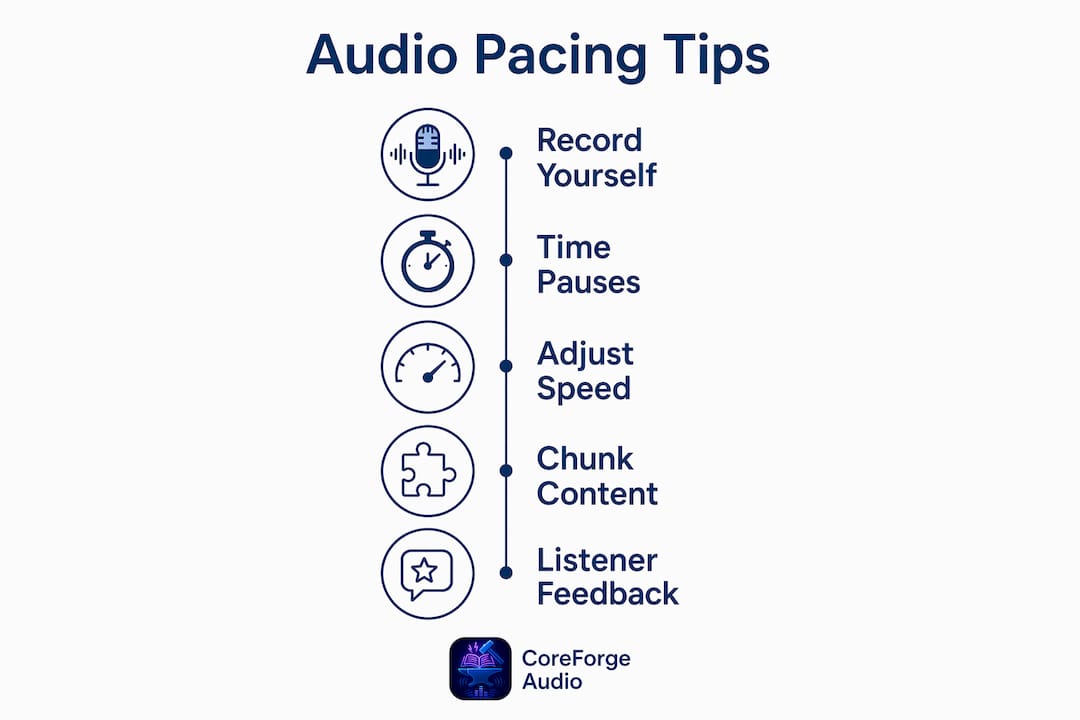
Pro Tip: Record yourself reading a passage at your natural speed, then listen back with a stopwatch. If you never pause longer than one second, you are almost certainly rushing. Add deliberate two-second pauses after key claims and re-listen. The difference in perceived authority is immediate.
Why does pacing matter more for learners with reading challenges?
Learners with dyslexia, ADHD, or slower processing speeds face a compounded challenge with audio. Their working memory capacity is often reduced, and their phonological processing is slower. Fast speech leaves them no recovery time when they miss a word. The result is not just a comprehension gap. It is a confidence gap.
Self-pacing supports L2 listening comprehension for learners with specific learning difficulties by compensating for slower processing speeds and limited working memory. When learners control playback speed themselves, they can pause, rewind, and replay without the social pressure of a live classroom. That control alone measurably improves outcomes.
Slower speech, deliberate segmentation, and repeated cues reduce cognitive load for struggling listeners. When audio is paced to match a learner's processing speed rather than a narrator's comfort level, memory encoding improves and comprehension gaps close faster.
For second-language listeners, the challenge is similar but distinct. They must simultaneously decode pronunciation, parse grammar, and retrieve vocabulary, all in real time. Faster speech collapses the window for each of those steps. Paced audio that fuels literacy strategies for diverse learners gives second-language listeners the processing time they need without making the content feel condescending.
Instructional strategies that work include segmenting audio into shorter chunks, inserting natural pauses between concepts, and offering adjustable playback speed as a standard feature rather than an afterthought. Coreforgeaudio builds these features directly into its platform because the research is clear: pacing adaptations are not accommodations for the few. They are improvements for everyone.
How does playback speed affect perceived clarity in digital audio?
The relationship between playback speed and comprehension is more nuanced than most listeners assume. Objective retention, measured by test scores, holds up reasonably well at 1.5x speed. Perceived clarity, meaning how easy the content feels to process, starts declining before that.
| Playback Speed | Objective Retention | Perceived Clarity |
|---|---|---|
| 1.0x (normal) | High | High |
| 1.25x | High | Moderate to high |
| 1.5x | Moderate to high | Moderate |
| 2.0x | Moderate | Significantly reduced |
Age and technological familiarity moderately influence perceived clarity at faster speeds, though neither factor significantly affects objective comprehension. Younger, more tech-familiar listeners tolerate 1.5x speed with less discomfort. Older listeners report greater effort at the same speed. The practical significance of this difference is low, but it matters for platform design.
The real risk of fast playback is motivational, not cognitive. Experts caution that increased mental effort at faster speeds can reduce learner motivation and engagement over time, even when short-term retention appears unaffected. A listener who finds audio exhausting will stop listening. That is the comprehension failure that speed-focused platforms miss. Adjustable narration speed features that let listeners find their own clarity threshold are more effective than any fixed speed recommendation.
Pro Tip: For educational audio, 1.25x is the sweet spot for most adult listeners. It saves time without the clarity penalty that appears at 1.5x and above. Offer listeners the option to adjust, and most will self-select a speed that balances efficiency with comfort.
Key Takeaways
Pacing is the single most controllable variable in audio production that directly affects both how much listeners understand and how hard they work to understand it.
| Point | Details |
|---|---|
| Brain oscillations set a speed limit | Alpha-band neural activity caps how fast the brain decodes speech, making pacing a physiological issue, not just a stylistic one. |
| Strategic pauses boost retention | Silence of 500–800ms before key points increases retention more than any increase in narration speed. |
| 2.0x speed hurts perceived clarity | Objective scores hold at 2.0x, but perceived clarity drops significantly, raising cognitive effort and reducing motivation. |
| Self-pacing helps struggling learners | Learners with dyslexia, ADHD, or limited working memory benefit most from controlling their own playback speed. |
| Sentence variety prevents fatigue | Alternating short and long sentences stops the metronome effect and keeps listeners actively engaged. |
Pacing is the variable most audio producers underestimate
I have spent years listening to audio content across every format, from academic lectures to commercial audiobooks to educational recordings. The single most consistent mistake I hear is narrators treating pacing as a byproduct of reading speed rather than a deliberate craft choice.
Most people assume that faster means better. They think speed signals confidence and respects the listener's time. The research says otherwise. A listener who finishes a 2.0x recording with a passing score but feels mentally drained is not a success story. That listener is less likely to return. They are less likely to recommend the content. And they are far less likely to act on what they heard.
The misconception I find most damaging is the idea that pauses waste time. Professional narrators know the opposite is true. A two-second pause after a complex claim gives the listener's brain time to file that information before the next sentence arrives. Remove that pause, and the next sentence overwrites the previous one before it has been stored. You have not saved two seconds. You have erased two sentences worth of comprehension.
The challenge for audio producers is that pacing feels invisible when it works. Listeners do not notice good pacing. They just feel like the content was clear and easy to follow. They notice bad pacing immediately, even if they cannot name it. That invisibility makes pacing easy to deprioritize. It should make it the first thing you protect.
— Sarmed
Coreforgeaudio and the science of pacing for every listener
Coreforgeaudio applies the science of pacing directly to its audiobook platform, built specifically for listeners who need more than a standard narration speed. The platform offers adjustable narration speeds alongside human-narrated content, dyslexia-friendly fonts, and multilingual support, because pacing is not a one-size-fits-all setting. Learners with dyslexia, ADHD, visual impairments, and second-language listeners all process audio differently. Coreforgeaudio's approach reflects that reality. The platform also supports differentiated instruction for educators who need audio tools that adapt to a range of processing speeds in the same classroom. Every feature is built around one principle: the listener's comprehension comes first.
FAQ
What is the role of pacing in audio comprehension?
Pacing controls speech speed, pauses, and rhythm to match the listener's cognitive processing capacity. When pacing aligns with how the brain decodes sound, comprehension and retention both improve.
What is the optimal speech rate for understanding audio?
Research supports 1.0x to 1.25x speed as the range where most listeners achieve high retention without significant clarity loss. At 2.0x speed, perceived clarity drops significantly even when objective scores remain stable.
How does pacing help learners with dyslexia or ADHD?
Self-paced audio compensates for slower phonological processing and limited working memory. Learners who control playback speed can pause and replay without pressure, which measurably improves comprehension outcomes.
Why do pauses improve audio comprehension?
Silence of 500–800ms before key points gives the brain time to encode the previous sentence before the next one arrives. Removing pauses does not save time. It reduces how much the listener retains.
Does faster playback speed hurt comprehension?
Faster playback at 2.0x does not significantly reduce objective test scores, but it does raise cognitive effort and reduce perceived clarity. Over time, that extra effort reduces listener motivation and engagement.