

Audiobook listening speed boost productivity is achieved by calibrating playback to match your auditory processing capacity and the complexity of the content, letting you absorb more information in less time without losing comprehension. The widely accepted productive benchmark is 1.5x speed, which saves 33% of listening time with minimal comprehension loss for most listeners. A 10-hour audiobook at 1.5x takes 6 hours 40 minutes, freeing up 3 hours 20 minutes per session. That time compounds fast across a week of daily listening. The key is not simply pressing play faster. It is training your auditory processing system to keep up, then adjusting speed dynamically based on what you are hearing.
What is the optimal audiobook listening speed to boost productivity?
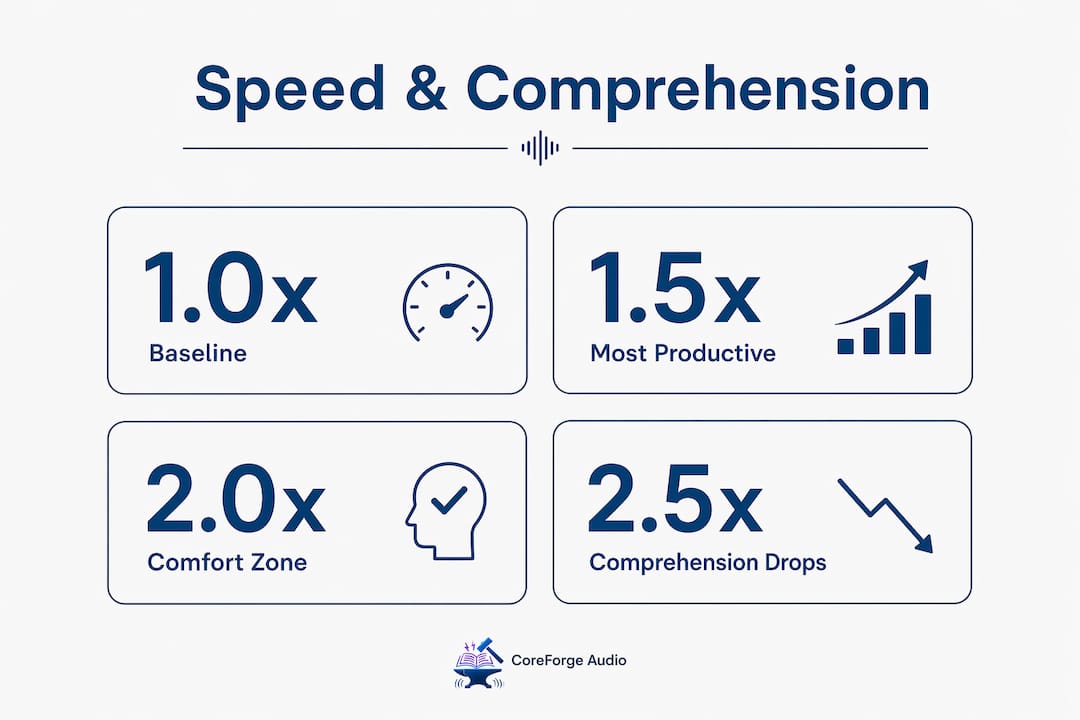
The 1.5x playback speed is the most productive starting point for the majority of listeners. It delivers meaningful time savings without the comprehension drop that kicks in at higher speeds. Most listeners can adapt to speeds up to 2x over roughly two weeks of gradual increases. Beyond 2x, the returns diminish quickly for new material.
Comprehension drops significantly above 2.5x unless you are already familiar with the content. Experienced listeners sometimes use 2x to 2.5x for re-reads or familiar series, where the brain fills in gaps from prior knowledge. For new nonfiction or complex material, staying at 1.5x to 2x protects retention.
The table below shows how common playback speeds affect listening time and comprehension for a 10-hour audiobook.
| Playback speed | Listening time | Time saved | Comprehension expectation |
|---|---|---|---|
| 1.0x (default) | 10h 0m | 0m | Full, no adaptation needed |
| 1.25x | 8h 0m | 2h 0m | High, easy for most listeners |
| 1.5x | 6h 40m | 3h 20m | High with brief adaptation period |
| 2.0x | 5h 0m | 5h 0m | Moderate, requires training |
| 2.5x | 4h 0m | 6h 0m | Low for new material |
Pro Tip: Use an audiobook speed calculator to preview your exact time savings before committing to a new speed. Seeing the numbers makes the habit easier to build.
The formula is simple. Divide the total runtime by your playback speed to get your new listening time. A 12-hour book at 1.5x takes 8 hours. At 2x, it takes 6 hours. Knowing the math in advance helps you plan listening sessions into your schedule with real precision.
How to gradually increase audiobook speed without losing comprehension
The most reliable method for increasing speed is called speed stacking. It means raising your playback rate in small increments over days or weeks, giving your auditory processing system time to recalibrate at each new level. Rushing this process is the single most common mistake listeners make.
Follow this step-by-step progression:
- Start at 1.25x. This feels almost normal for most listeners and builds early confidence. Stay here for 3 to 5 days before moving up.
- Increase by 0.1x to 0.25x. Granular increments of 0.1x give your brain a manageable jump. Larger leaps cause fatigue and frustration.
- Hold each speed for 3 to 5 days. New speeds feel rushed initially. Auditory processing adaptation requires several days per increment for narration to sound normal again.
- Watch for overload signals. If you find yourself rewinding the same passage three or more times, your speed is too high. Drop back 0.1x and hold there longer.
- Disable notifications during sessions. Notifications reduce cognitive resources, which directly impairs comprehension at elevated speeds. Airplane mode or Do Not Disturb is not optional at 2x.
- Summarize out loud after each session. If you cannot recall the main points from the last 20 minutes, your current speed exceeds your processing capacity.
Pro Tip: Begin speed training on a book you have already read once. Familiarity removes the cognitive burden of new content, letting your brain focus entirely on processing faster speech.
The adaptation timeline varies by person, but most listeners reach a comfortable 2x within two to three weeks of consistent practice. Patience at this stage pays off for months of faster listening ahead.
How does content type affect the right audiobook speed?
Content complexity is the most overlooked variable in speed listening. A business narrative like a founder memoir reads well at 1.75x to 2x. A dense philosophy text or a grief memoir demands something closer to 1.0x to 1.25x. Applying the same speed to every book is a reliable path to burnout and poor retention.
Matching playback speed to cognitive load improves both productivity and retention. The brain has a working memory ceiling. When narration speed pushes past what working memory can process, comprehension collapses even if the words are technically audible.
"Faster is not always more productive. Listening at 1.5x with full comprehension beats 2.5x with poor retention every time. Speed without understanding is just noise."
Use these guidelines to match speed to content:
- Dense nonfiction (economics, philosophy, science): Stay at 1.0x to 1.25x. These books reward slow processing and note-taking.
- Narrative nonfiction (biography, history, business stories): 1.5x to 2x works well. The storytelling structure carries comprehension even at higher speeds.
- Fiction with rich prose or poetry: 1.0x to 1.25x. Performance and rhythm are part of the experience. Speed strips them out.
- Self-help or familiar material: 1.75x to 2.5x is reasonable, especially on a re-read.
- Technical training content: 1.0x to 1.5x, with frequent pausing to take notes.
Experienced listeners switch speeds mid-book based on content density. A business book might open with a dense research chapter, then shift to case studies. Dropping to 1.25x for the research section and returning to 1.75x for the stories is a normal and productive practice. Audiobooks that support continuous education benefit most from this dynamic approach, since the material often shifts in complexity across chapters.
Active engagement matters as much as speed selection. Pausing to summarize, rewinding a confusing passage, and jotting a quick note all protect retention without requiring you to slow down permanently.
What tools and app settings support audiobook speed control?
The right app makes speed listening significantly easier. Most major platforms offer variable speed controls, but the range and precision differ. Audible supports speeds from 0.5x to 3.5x. Speechify reaches up to 4.5x with AI voice enhancements that maintain intelligibility at high speeds. Both platforms support fine increments that allow the gradual progression described in the speed stacking method.
The table below compares key speed control features across app categories.
| Feature | Entry-level apps | Advanced apps |
|---|---|---|
| Speed range | 0.5x to 2.0x | 0.5x to 4.5x |
| Increment control | 0.25x steps | 0.05x to 0.1x steps |
| AI voice clarity | Not available | Available at high speeds |
| Auto-download | Limited | Full offline support |
| Distraction blocking | Not available | Built-in focus modes |
Granular speed increments matter more than maximum speed. An app that jumps from 1.5x to 2.0x forces a large cognitive leap. An app with 0.1x steps lets you move from 1.5x to 1.6x, which is far easier to absorb. For anyone serious about multitasking with audiobooks, fine speed control is the feature that separates a productive session from a frustrating one.
Pro Tip: Set your preferred speed as the app default so every new book starts where you left off in your training. Resetting to 1.0x each time erases your adaptation progress.
AI voice enhancement is worth seeking out if you plan to listen above 2x. Standard narration at 2.5x can sound clipped and unnatural. AI-processed audio smooths the pitch and pacing, keeping the voice intelligible even at aggressive speeds.
Common mistakes that kill audiobook speed productivity
The most damaging mistake is increasing speed too fast, too soon. Listeners who jump from 1.0x to 2.0x in a single session almost always give up within a week. The brain interprets the sudden change as noise, not language, and comprehension collapses.
Watch for these specific pitfalls:
- Uniform speed for all content. Dense material at 2x produces fatigue and poor recall. Vary your speed by book type.
- Ignoring retention signals. Inability to recall key points after a session is a direct signal to slow down, not push through.
- Skipping the summarizing habit. A practical test for ideal speed is the ability to summarize the last 20 minutes. Failure means overload.
- Listening in noisy environments at high speeds. Background noise competes with narration. At 1.5x or above, even moderate noise causes comprehension loss.
- Treating speed as the only metric. Retention and application of what you hear matter more than the number on the screen.
"Speed listening without active engagement is just fast forgetting. The goal is not to finish books faster. The goal is to retain more in less time."
Troubleshooting is straightforward. If comprehension drops, reduce speed by 0.1x to 0.25x and hold for three days before trying again. If motivation drops, switch to a lighter book at your current speed to rebuild confidence. Balance between speed and learning quality is the actual productivity gain.
Key Takeaways
Audiobook listening speed boost productivity works best when speed is matched to content complexity and increased gradually through a structured adaptation process.
| Point | Details |
|---|---|
| Start at 1.5x for best results | This speed saves 33% of listening time with minimal comprehension loss for most listeners. |
| Use the speed stacking method | Increase speed by 0.1x to 0.25x every 3 to 5 days to let your auditory system adapt. |
| Match speed to content type | Dense nonfiction needs 1.0x to 1.25x; narrative nonfiction handles 1.5x to 2x comfortably. |
| Test retention after every session | If you cannot summarize the last 20 minutes, your current speed is too high. |
| Use apps with fine speed controls | Platforms with 0.05x to 0.1x increments make gradual adaptation far more manageable. |
Speed listening taught me patience, not shortcuts
When I first started pushing my audiobook speed past 1.5x, I assumed the gains would be immediate. They were not. The first week at 1.75x felt like listening through a wall. I kept rewinding, losing the thread, and finishing sessions with almost nothing retained. I nearly quit the practice entirely.
What changed everything was treating speed as a skill, not a setting. I dropped back to 1.5x, held it for a full week, and only moved up when I could summarize each chapter without effort. That discipline felt slow at the time. Looking back, it was the only approach that actually worked.
The other thing I got wrong early on was applying the same speed to every book. I tried to push a dense behavioral economics text at 2x and retained almost nothing. The same week, I flew through a business biography at 2.25x with full comprehension. Content type is not a minor variable. It is the variable.
My honest recommendation is to resist the urge to chase high speeds for their own sake. A listener who finishes 40 books a year at 1.5x with strong retention will outlearn someone who rushes through 80 books at 2.5x and retains fragments. Speed is a tool. Comprehension is the goal.
— Sarmed
Coreforgeaudio and adjustable narration for every listener
Coreforgeaudio is built around the idea that every listener deserves control over how they experience audio content. The platform is designed with adjustable narration speeds as a core accessibility feature, not an afterthought. Whether you are building a speed listening habit from scratch or fine-tuning your settings for a specific book type, Coreforgeaudio gives you the controls to do it on your terms.
The platform also supports dyslexia-friendly fonts, multilingual content, and human-narrated audiobooks with fair compensation for voice actors. For listeners who want both productivity and quality, that combination matters. Visit Coreforgeaudio to learn more about the platform and support a mission built around accessible storytelling for everyone.
FAQ
What is the best audiobook speed for productivity?
The 1.5x playback speed is the most productive starting point for most listeners. It saves 33% of listening time with minimal comprehension loss.
How long does it take to adapt to faster audiobook speeds?
Most listeners adapt to each new speed increment within 3 to 5 days. Reaching a comfortable 2x typically takes two to three weeks of consistent practice.
Does listening speed affect comprehension?
Comprehension drops significantly above 2.5x for new material. Staying at 1.5x to 2x preserves retention for most content types.
Should I use the same speed for every audiobook?
No. Dense nonfiction and poetry require slower speeds, around 1.0x to 1.25x. Narrative nonfiction and familiar material handle 1.75x to 2x without comprehension loss.
How do I know if my audiobook speed is too fast?
If you cannot summarize the last 20 minutes of what you heard, your speed exceeds your processing capacity. Drop back by 0.1x to 0.25x and hold that level for several days.