

Most people underestimate how much learning they're leaving on the table every single day. The productivity benefits of audio learning go far beyond convenience. Research shows listeners retain 22% more information through audio than through reading visual notes alone, yet the format still carries a reputation as the "lazy" option. It isn't. For students juggling coursework, professionals drowning in documentation, and lifelong learners who barely have time to breathe, audio learning is one of the few methods that genuinely fits how modern life works.
Table of Contents
- Key takeaways
- 1. Audio learning retention is higher than most people expect
- 2. Reclaiming dead time is the real productivity multiplier
- 3. The right audio environment sharpens your focus
- 4. Audio-based learning effectiveness in professional workflows
- 5. AI transcription tools extend the productivity gains further
- 6. Active engagement techniques that maximize every session
- My honest take on audio learning after years of watching it work (and fail)
- Start building your audio learning library with Coreforgeaudio
- FAQ
Key takeaways
| Point | Details |
|---|---|
| Retention is measurably higher | Audio learners retain up to 40% more content after one week compared to text-only study. |
| Dead time is a learning asset | Commutes and chores can unlock up to 90 minutes of productive learning time daily. |
| Active listening changes everything | Pause-and-recall every five minutes transforms passive listening into deep comprehension. |
| Your audio environment matters | Ambient sound around 70 dB sharpens creative focus more effectively than silence. |
| AI tools multiply the advantage | Voice-to-text and transcription tools cut documentation time by up to 70%. |
1. Audio learning retention is higher than most people expect
The most common objection to audio learning is that it doesn't "stick" the way reading does. The data says otherwise. Participants who studied with audio retained 22% more than those using visual notes alone. When learners re-listened to lectures, that number jumped to a 40% retention boost after just one week.
Two theories explain why. First, the modality effect: the brain processes auditory and visual information through separate channels, so combining them reduces cognitive overload instead of multiplying it. Second, dual coding theory confirms that audio plus visuals produce stronger, more durable recall than either channel alone.
Voice also activates emotional centers in the brain in ways that plain text simply cannot. Voice nuances and tone trigger the limbic system, the same region responsible for memory formation. A skilled narrator reading a complex concept out loud engages your brain differently than scanning a page. That emotional layer is what makes audio stick.
- Retention improves by 22% with audio alone and up to 40% with repeated listening
- Combining audio with visual notes activates dual encoding for deeper memory
- Narrator tone and emotional delivery strengthen memory formation over text
Pro Tip: When you finish a chapter or lesson, write three bullet points from memory before looking at your notes. This single habit dramatically deepens what audio learning delivers.
2. Reclaiming dead time is the real productivity multiplier
The average college student's daily commute runs 25 to 45 minutes each way. Add morning routines, gym sessions, grocery runs, and household chores, and you're looking at 60 to 90 minutes of time every day that typically goes to music or silence. That time can become a learning session without sacrificing anything.
This is where the audio learning advantages over traditional study formats become hard to argue with. Reading requires your eyes and physical stillness. Audio doesn't. A nurse can review pharmacology while commuting. A marketing manager can absorb a leadership book while running. A language learner can train their ear while doing dishes.
- Commute time alone can generate 4 to 7 hours of learning per week
- Exercise paired with audio study actually enhances memory consolidation 48 hours later
- Consistent daily audio habits build momentum that sporadic deep study sessions cannot match
The key distinction is consistency over intensity. Thirty focused minutes daily beats a three-hour Sunday cram session. Audio makes that daily habit frictionless because you're not carving out separate time. You're doubling up on time you were already spending.
For learners exploring efficient workflows, the principles behind audio in productivity apply whether you're studying for an exam or sharpening professional skills.

3. The right audio environment sharpens your focus
How does audio learning improve focus? A large part of the answer has nothing to do with the content itself. It has to do with your listening environment.
Research shows that ambient noise around 70 dB produces measurable improvements in creative thinking and sustained focus. That's roughly the volume of a busy coffee shop. Silence, counterintuitively, can increase awareness of minor distractions and raise mental restlessness. Moderate, predictable background sound keeps the brain engaged without overwhelming it.
Brown noise has become a popular choice among professionals specifically because its lower-frequency rumble provides consistent auditory cover without triggering the brain's novelty response. Predictable audio patterns help maintain mental focus by minimizing distraction, which is exactly what focused learning requires.
Equipment matters too. High-fidelity ANC headphones reduce the cognitive effort your brain expends filtering out background noise. That preserved energy goes directly to comprehension and retention.
Pro Tip: If you work in a noisy environment, try brown noise at moderate volume through noise-canceling headphones during audio study sessions. You'll likely notice your reading comprehension and recall both improve within days.
And the benefits extend beyond focus. 50% of young people report that audio learning reduces stress and anxiety, which matters enormously for productivity. Stress and learning are physiological opposites. Lower anxiety means better working memory, better decision-making, and better retention of whatever you're trying to absorb.
4. Audio-based learning effectiveness in professional workflows
Podcast-style audio training has entered the workplace in a serious way. The engagement numbers support the shift. 94% of users who experienced audio-based training wanted more of it, and 85% reported it positively changed their on-the-job behavior. Those are not passive consumption metrics. That's behavior change at a measurable scale.
For professionals, the audio learning advantages translate into more than absorbed content. They translate into faster skill application. When training content is delivered through narrative audio instead of slide decks, learners engage emotionally with the material. Stories create context. Context creates application.
Consider a project manager who listens to a focused audio course on negotiation during a 40-minute commute. By the time they reach the office, they've processed real-world examples, heard failure scenarios narrated with emotional weight, and mentally rehearsed responses. That kind of preparation doesn't come from reading a bulleted handout.
Maximizing productivity with audio in professional settings also means understanding when not to use it. Audio learning is not ideal for highly technical material that requires referencing diagrams or formulas. The format works best for conceptual frameworks, narrative case studies, soft skills, and language development.
5. AI transcription tools extend the productivity gains further
Maximizing productivity with audio doesn't stop at listening. For professionals, the tools that capture and process spoken content can be equally transformative.
AI transcription tools reduce documentation time and cost by up to 70% compared to manual note-taking or typing. Voice-to-text tools that automatically organize, summarize, and tag spoken input don't just save time. They eliminate context switching, which is one of the biggest productivity drains in knowledge work.
| Method | Time per task | Cognitive cost | Output quality |
|---|---|---|---|
| Manual meeting notes | 45 to 60 minutes | High (writing + listening) | Variable |
| AI voice-to-text | 5 to 10 minutes | Low (speaking only) | Consistent, searchable |
| Recorded + transcribed | Real-time | Minimal | Structured, taggable |
The workflow shift is significant. Instead of stopping a thought to type it out, you speak naturally. The AI captures, structures, and tags. What used to require two steps now requires one. In a meeting, a lecture, or a brainstorming session, that difference compounds over dozens of interactions per week.
- Dictated voice notes get turned into structured documents automatically
- Real-time transcription removes the need to split attention between listening and writing
- Searchable audio archives make knowledge retrieval far faster than scanning notebooks
For learners working across multiple languages, audio tools also open new doors. Research on audiobooks and second-language learners shows that consistent audio exposure accelerates comprehension in ways that text-only study rarely achieves alone.
6. Active engagement techniques that maximize every session
Passive listening is where audio learning loses most of its potential. You can have perfect headphones, an ideal ambient environment, and excellent content. If you're not actively engaging, you're getting maybe 30% of the benefit.
The pause-and-recall method is the highest-leverage technique available to audio learners. Pausing every five minutes to mentally summarize what you just heard forces retrieval, which is the strongest known driver of long-term retention. It feels slow. It works fast.
Here's a practical sequence that compounds these benefits:
- Listen actively during your commute or workout. No background scrolling.
- Pause and recall every five minutes. Speak your summary aloud if possible.
- Review before sleep. Listening to key audio clips 30 minutes before bed leverages the brain's memory consolidation during slow-wave sleep.
- Use spaced repetition. Re-listen to the same content after 24 hours, then 72 hours, then one week. Each pass reinforces the neural pathway.
- Pair with visuals. After an audio session, review one page of notes or a diagram. The dual coding effect locks in what the audio planted.
Pro Tip: Record yourself summarizing a concept immediately after listening. Playback reveals exactly where your understanding is fuzzy, which is information no quiz or test can give you until much later.
The goal isn't just to consume audio. It's to convert what you hear into working knowledge that changes how you think and act.
My honest take on audio learning after years of watching it work (and fail)
I'll say this plainly: audio learning changed how I use my time. But it didn't change everything, and it doesn't work the same way for every person or every subject.
What I've observed is that audio learning rewards the people who treat it as a practice, not a shortcut. The ones who get the biggest results are listening with a purpose: they have questions they're trying to answer before they press play. The ones who struggle are using audio as background noise and wondering why nothing is sticking.
I've also seen the enormous difference quality narration makes. A flat, robotic reading of a textbook is almost useless for retention. A skilled human narrator who conveys emphasis, pacing, and emotional weight? That's a different cognitive experience entirely. This is part of why I think human-narrated audiobooks remain superior to machine-generated alternatives for actual learning, not just entertainment.
Audio learning is not a replacement for reading, practice, or hands-on application. It's an accelerant. Use it to absorb frameworks and stories. Use visual study to anchor details. Use practice to build skill. The learners who integrate all three see results that none of the three would produce alone.
For anyone with ADHD, dyslexia, or other reading barriers, audio isn't just an alternative. The research on audiobooks for ADHD makes it clear that audio removes the friction that prevents engagement in the first place. That's not a workaround. That's access.
— Sarmed
Start building your audio learning library with Coreforgeaudio
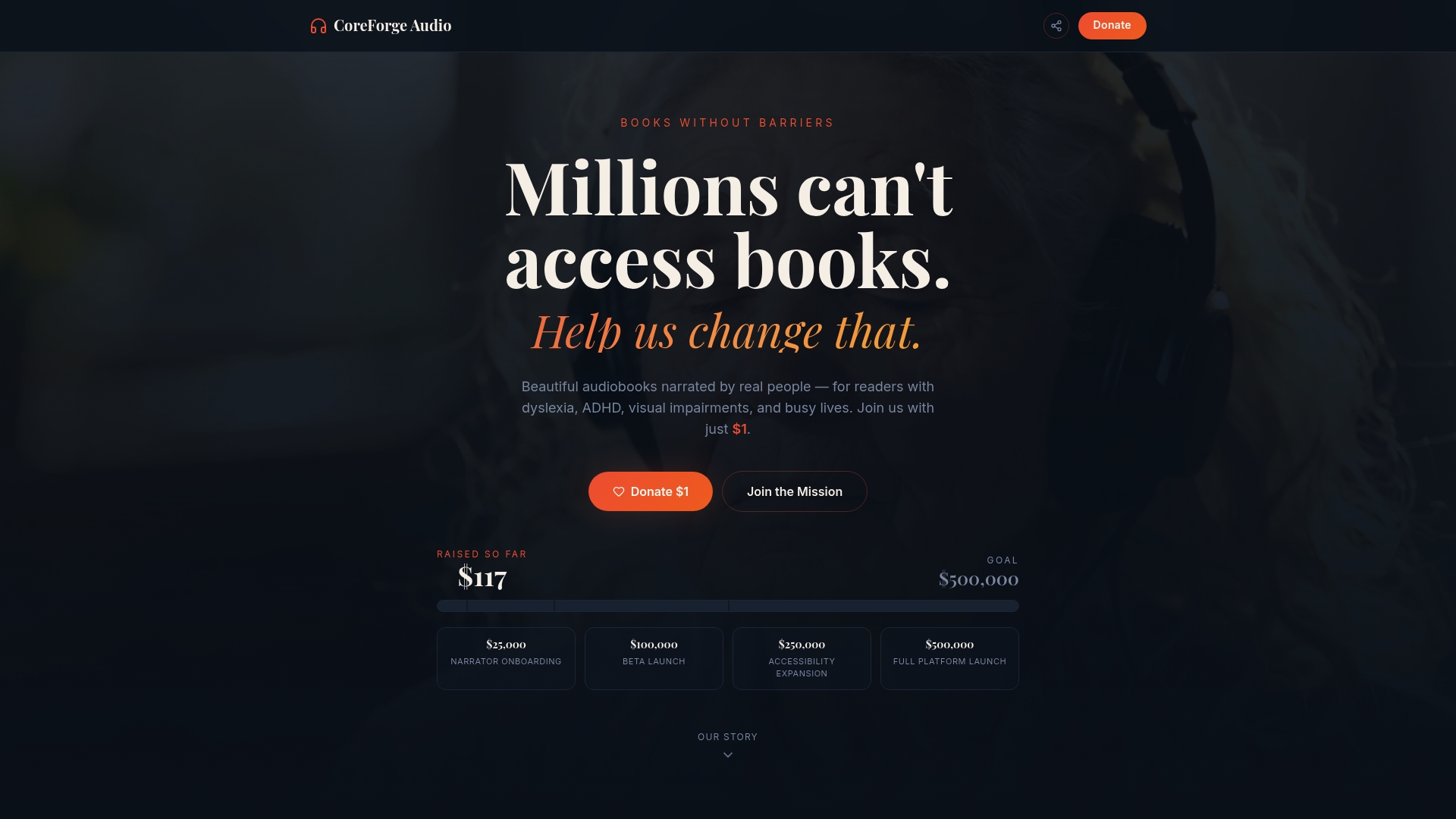
If these productivity benefits have you thinking about where to start, Coreforgeaudio was built precisely for this moment. The platform offers high-quality audiobooks narrated by real human voice actors, with accessibility features built in from the ground up. Adjustable narration speeds, dyslexia-friendly fonts, and multilingual support mean the platform serves learners others platforms routinely leave behind.
Coreforgeaudio is actively fundraising to expand its library and keep access free or low-cost for everyone who needs it. Whether you're a student trying to reclaim commute time, a professional building new skills, or a lifelong learner who finally found a format that works for your brain, this is where your audio learning journey begins.
FAQ
How much more do people retain with audio learning?
Listeners retain 22% more than visual-only learners on average, and re-listening to the same material boosts retention by up to 40% after one week.
Can audio learning work while multitasking?
Yes, when paired with low-attention physical activities like commuting, exercising, or doing chores. Cognitive tasks that require active thinking will compete with audio comprehension and reduce both.
What is the best technique for audio learning retention?
The pause-and-recall method is the most effective technique. Pausing every five minutes to verbally or mentally summarize what you heard forces retrieval, which strengthens long-term memory formation.
Does background noise help or hurt audio learning?
Moderate ambient noise around 70 dB, like a coffee shop environment, enhances creative focus and is more effective for many learners than complete silence.
Who benefits most from audio-based learning?
Students, professionals, and lifelong learners all see gains, but the format is especially powerful for individuals with dyslexia, ADHD, or visual impairments, where audio removes barriers that text-based study creates.