

Multitasking effectively with audiobooks is achievable when you pair listening with activities that engage different cognitive channels. Neuroscience confirms the brain processes spoken narratives similarly to written text, which means the medium itself is not the barrier. The barrier is task selection. Busy professionals, parents, and students who understand the principle of cognitive channel matching can absorb books during commutes, workouts, and household chores without sacrificing comprehension. This guide covers compatible activities, proven listening techniques, practical tools, and the most common mistakes to avoid.
Which tasks are compatible with audiobook multitasking?
The core principle behind effective audiobook multitasking is cognitive stacking. Cognitive stacking means pairing activities that use different brain channels so neither task competes for the same mental resources. When you walk and listen, your motor system handles movement while your language processing system handles the audio. No conflict occurs.

The distinction that matters most is verbal versus nonverbal. Language processing is a single-channel resource. When a task requires reading, writing, or active verbal reasoning, it pulls from the same channel your audiobook uses. The result is poor retention for both.
Tasks that work well with audiobooks:
- Walking, jogging, or cycling
- Cooking, washing dishes, or folding laundry
- Commuting by car or public transit
- Light cleaning or organizing
- Filing, data entry, or repetitive administrative work
Tasks that undermine retention:
- Writing emails or reports
- Reading any text, including social media
- Editing documents or proofreading
- Attending meetings or conversations
Audiobooks perform best during low-cognitive tasks like organizing or filing, and lose their effectiveness the moment a task demands language output. That finding is practical and immediate. If you catch yourself rereading the same email sentence twice, your audiobook is competing for attention and losing.
Pro Tip: Pause your audiobook for 10 seconds and ask yourself whether your current task requires you to produce or process language. If yes, pause the audio. If no, press play.
How to optimize audiobook listening for multitasking
Optimizing your listening setup is the difference between finishing a book in two weeks and abandoning it after chapter three. These steps apply whether you are a student fitting in study material between classes or a professional using a commute for continuous learning.
-
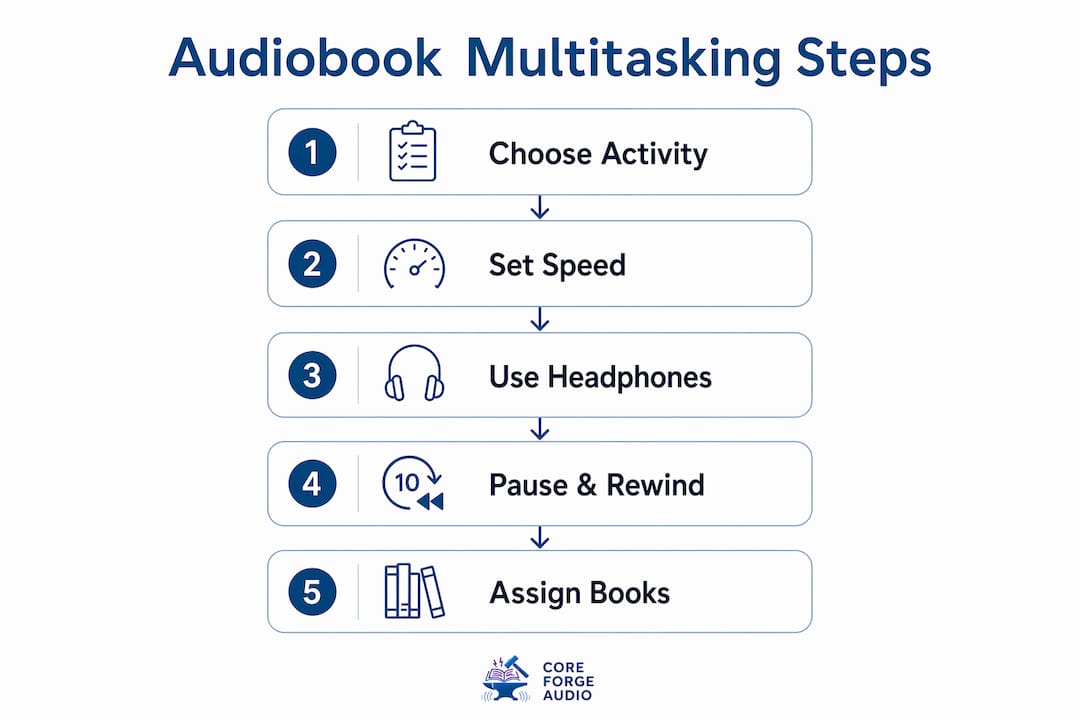
Set playback speed between 1.25x and 1.5x. Faster playback speeds reduce dead space in narration and keep your attention from drifting. Standard speed often leaves too many pauses that invite distraction. Start at 1.25x and increase once the narrator's voice feels natural.
-
Use mental visualization actively. As you listen, picture the scene, concept, or argument being described. Visualization creates a second memory anchor beyond the audio itself. Readers who visualize retain significantly more than those who listen passively.
-
Use the 30-second rewind button without hesitation. Experienced listeners hit the skip-back button the moment they realize their mind has wandered. This single habit prevents the anxiety spiral of "I missed too much to continue." One tap and you are back in the story.
-
Match content type to your task. Narrative fiction and story-driven nonfiction work best during multitasking. Dense academic material, technical manuals, or books requiring note-taking belong in focused listening sessions. Save complex material for times when you can sit still and give full attention.
-
Preload your audiobook before you start the task. Buffering interruptions during a workout or commute break immersion and make it harder to re-engage. Download the next two or three chapters before you leave the house.
Pro Tip: Assign specific audiobooks to specific activities. A "gym-only" book becomes a behavioral trigger that makes you look forward to working out. The habit forms faster because the reward is tied to the location.
What tools and settings support multitasking with audiobooks?
The right setup removes friction before it becomes a reason to stop listening. Hardware and app features both matter here.
Useful audiobook app features for multitasking:
| Feature | Why it matters for multitasking |
|---|---|
| Adjustable playback speed | Keeps narration dense enough to hold attention |
| 30-second skip-back | Recovers missed content without losing your place |
| Bookmarks and chapter markers | Lets you return to key moments after the session |
| Sleep timer | Prevents missed content when listening before bed |
| Offline download | Eliminates buffering during workouts or commutes |
For hardware, over-ear headphones with passive noise isolation work best during workouts and commutes. Open-ear bone conduction headphones are safer for outdoor running and allow ambient sound awareness. A Bluetooth speaker is the right choice for household tasks where you move between rooms.
Coreforgeaudio builds adjustable narration speeds and accessibility features directly into its platform. Readers who need dyslexia-friendly fonts or multilingual support get those tools without switching apps. That kind of integrated design reduces the setup friction that causes most people to abandon audiobook habits within the first month.
For commuters, the best workflow is simple. Download the next session the night before. Set your speed. Press play the moment you start moving. The educational value of audiobooks compounds when listening becomes automatic rather than deliberate.
What are the common challenges when multitasking with audiobooks?
The most honest thing to say about audiobook multitasking is this: retention drops when attention divides. Divided attention research shows a significant reduction in information absorption during multitasking. That is not a reason to stop. It is a reason to choose the right content for the context.
"The best audiobook format is the one that engages you most consistently over time. Consistency matters more than the conditions of any single listening session."
Mind-wandering is the most common complaint. Humans lose focus roughly 30–50% of the time during sustained attention tasks. Audiobooks are not uniquely prone to this. Reading a physical book produces the same rate of mind-wandering. The difference is that a book sits still while your eyes drift. An audiobook keeps moving.
Strategies to manage the most common challenges:
- Match content complexity to your energy level. Listen to lighter narrative content in the morning or during high-activity tasks. Save denser material for quiet evenings when you can give more focus.
- Recognize the tipping point. If you have rewound the same 30 seconds three times in a row, the task is too demanding for simultaneous listening. Pause the book and return later.
- Use fatigue as a signal, not a failure. Losing focus after 45 minutes of listening during a workout is normal. Reduce speed slightly or switch to a more engaging chapter.
- Accept partial retention as a win. Audiobooks are not a substitute for focused reading when deep analysis is the goal. But absorbing 60% of a book during otherwise dead time is a genuine gain.
A flexible mindset is the most underrated tool in this list. Audiobooks are productivity aids, not performance tests. The goal is consistent exposure to ideas, stories, and information across time.
Key Takeaways
Pairing audiobooks with low-cognitive, nonverbal tasks is the single most effective strategy for maintaining both comprehension and productivity across any listening session.
| Point | Details |
|---|---|
| Match tasks to cognitive channels | Pair audiobooks with motor tasks like walking or cooking, never with writing or reading. |
| Use 1.25x–1.5x playback speed | Faster speeds reduce dead space and keep your attention from drifting. |
| Use the 30-second rewind immediately | Hitting skip-back the moment focus lapses prevents anxiety and preserves comprehension. |
| Choose content by context | Save dense or technical books for focused sessions; use narrative content for multitasking. |
| Build behavioral triggers | Assign specific books to specific activities to form consistent listening habits faster. |
What I have learned from years of audiobook multitasking
The advice I see repeated most often is "just listen while you commute." That is fine as far as it goes, but it misses the more interesting question: which books actually stick when you are doing something else at the same time?
My honest answer is narrative-driven books. Memoirs, story-based business books, and well-produced fiction hold attention during physical activity in a way that dense policy analysis or technical writing simply does not. I have tried listening to complex nonfiction during a run and arrived home with almost nothing retained. The same book during a quiet evening walk? Completely different experience.
The 30-second rewind habit changed my relationship with audiobooks more than any other single adjustment. Before I started using it consistently, I would miss a section, feel behind, and eventually abandon the book. Now I treat it as a normal part of listening, the same way a reader glances back at the previous paragraph. It removes the pressure entirely.
One thing I believe strongly: audiobooks work best when you stop treating them as a compromise and start treating them as a primary format. For readers who benefit from accessible audio content, whether due to dyslexia, ADHD, visual impairment, or a packed schedule, the audio format is not second-best. It is the right tool for the situation. Matching the format to the reader matters more than any debate about whether listening equals reading.
— Sarmed
Coreforgeaudio and the tools that make listening work
Coreforgeaudio is built for readers who need more than a standard audiobook app. The platform offers human-narrated audiobooks, adjustable narration speeds, dyslexia-friendly fonts, and multilingual support, all designed to reduce the friction that stops people from building consistent listening habits.
Whether you are a student fitting books into a packed schedule, a parent listening during the school run, or a professional using a commute for continuous learning, Coreforgeaudio provides the accessibility features and content quality that make the habit sustainable. The platform is actively fundraising to expand its library and keep human narrators at the center of the experience. Visit Coreforgeaudio to learn more about the mission and explore audiobooks built for real multitasking life.
FAQ
What activities work best for audiobook multitasking?
Walking, commuting, cooking, and light cleaning are the most compatible activities. These tasks use motor skills rather than language processing, which leaves your listening channel free.
Does multitasking reduce audiobook comprehension?
Divided attention does reduce retention compared to focused listening. Choosing narrative content and low-demand tasks minimizes the drop and keeps listening worthwhile.
What playback speed is best for multitasking?
A speed between 1.25x and 1.5x keeps narration dense enough to hold attention without becoming difficult to follow. Start at 1.25x and adjust based on the narrator's pace.
How do I stop losing focus during audiobooks?
Use the 30-second rewind button the moment your mind wanders. Combine this with listening strategies like mental visualization and matched content complexity to reduce how often focus lapses.
Can I use audiobooks for learning while multitasking?
Audiobooks support general concept absorption and continuous learning during multitasking. For deep analysis or critical skill development, focused listening sessions produce better results.