
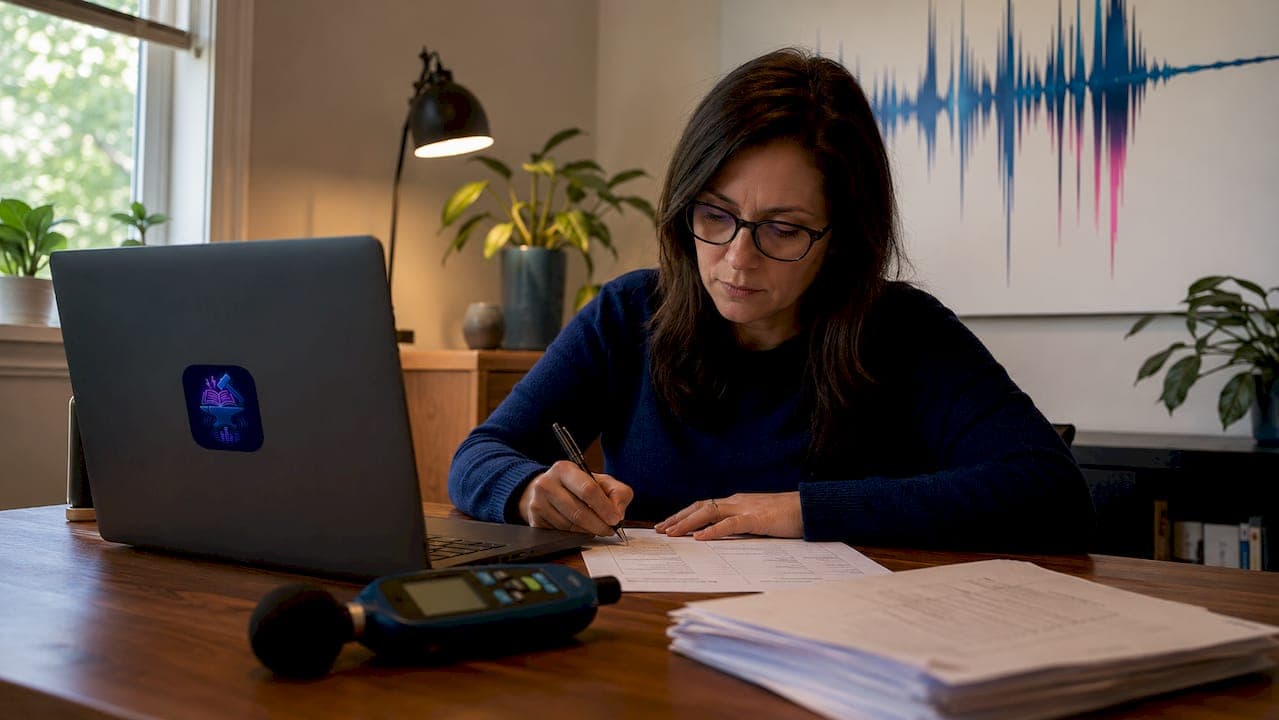
Audio quality evaluation in education is defined as the systematic process of measuring and assessing how clearly spoken content reaches and is understood by learners. How educators evaluate audio quality determines whether students with dyslexia, ADHD, auditory processing differences, or language barriers can access instruction at all. The field relies on two parallel tracks: objective acoustic measurement using standards like ANSI S12.60 and BB93, and subjective assessment through structured rubrics and listener panels. The Speech Transmission Index (STI) serves as the primary objective metric, with a minimum threshold of 0.60 required for reliable speech understanding. Getting both tracks right is not optional for inclusive classrooms. It is the foundation of equitable learning.
How educators evaluate audio quality: objective metrics that matter
Objective audio assessment uses measurable acoustic parameters to determine whether a learning environment meets minimum intelligibility standards. These parameters remove guesswork and give educators and audio specialists a shared, defensible baseline.
The Speech Transmission Index is the most critical single metric in classroom audio evaluation. An STI value of 0.60 marks the boundary between fair and good intelligibility per IEC 60268-16 standards. For students with hearing loss or language barriers, scores below that threshold translate directly into missed instruction.
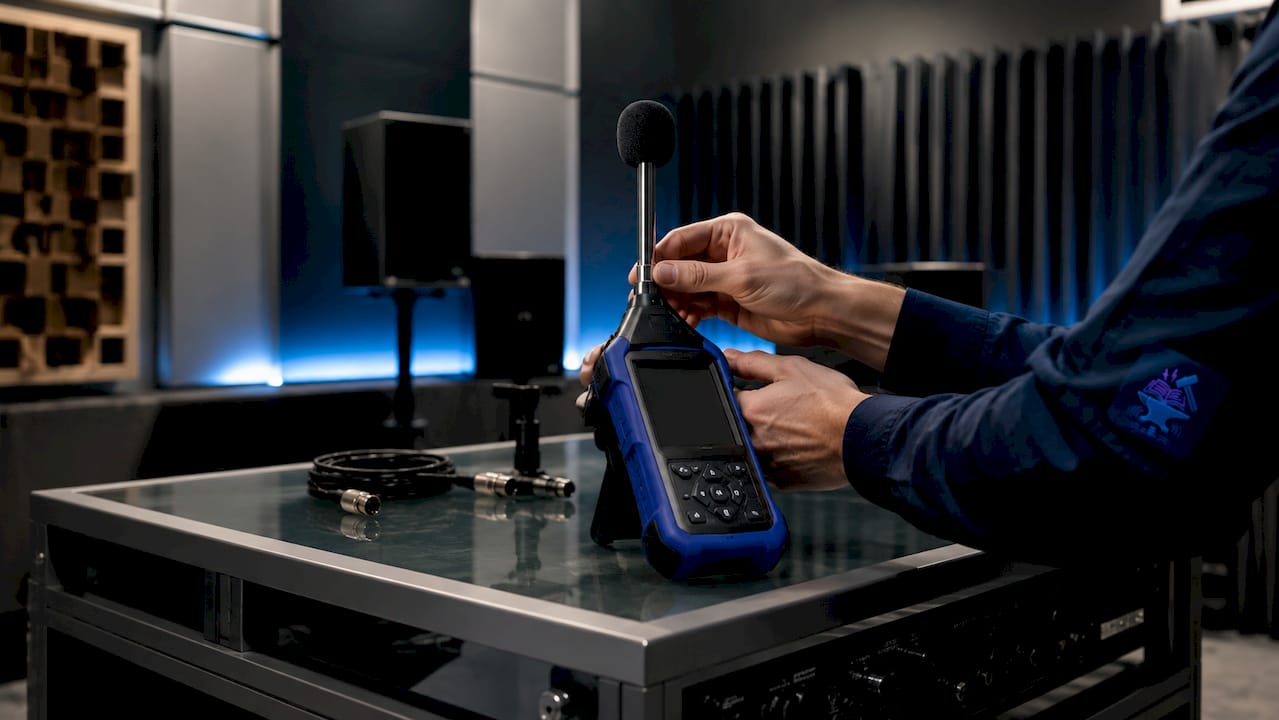
Background noise is often the bigger threat to STI than reverberation. Moving from NC-30 to NC-40 background noise levels drops STI by 0.17, a significant degradation in speech clarity. Low-frequency HVAC noise is the most common culprit, and it is frequently underestimated during informal walkthroughs.
Reverberation time, measured as RT60, describes how long sound lingers in a room after the source stops. ANSI S12.60 and BB93 both target RT60 values below 0.5 seconds for standard classrooms, with background noise measured over a 30-minute period to capture real operating conditions. Rooms with longer reverberation blur consonants, making speech harder to parse for any listener and nearly impossible for those with auditory processing challenges.
Signal-to-noise ratio (SNR) quantifies how much louder the speech signal is compared to ambient noise. A positive SNR of at least 15 dB is the general target for educational settings. Below that threshold, listeners must work harder to extract meaning, which increases cognitive load and reduces retention.
Speech rate adds another measurable dimension. A rate of 125–150 words per minute is ideal for educational video comprehension. Rates below 116 wpm reduce speaker credibility, while rates above 180 wpm begin to outpace processing for many learners. This metric matters especially for recorded content, where narrators and educators can control pacing deliberately.
| Metric | Standard or Target | Educational Significance |
|---|---|---|
| Speech Transmission Index (STI) | 0.60 minimum (IEC 60268-16) | Below this, speech intelligibility is unreliable for diverse learners |
| Reverberation time (RT60) | Below 0.5 seconds (ANSI S12.60, BB93) | Longer times blur consonants and reduce comprehension |
| Background noise | NC-30 or lower | NC-40 drops STI by 0.17, degrading clarity significantly |
| Signal-to-noise ratio (SNR) | +15 dB minimum | Lower SNR increases cognitive load and reduces retention |
| Speech rate | 125–150 wpm | Below 116 wpm reduces credibility; above 180 wpm overloads processing |
How do educators incorporate subjective audio evaluations?
Objective metrics tell you whether a room meets a standard. Subjective evaluation tells you whether real listeners actually understand and trust what they hear. Both are necessary, and neither replaces the other.
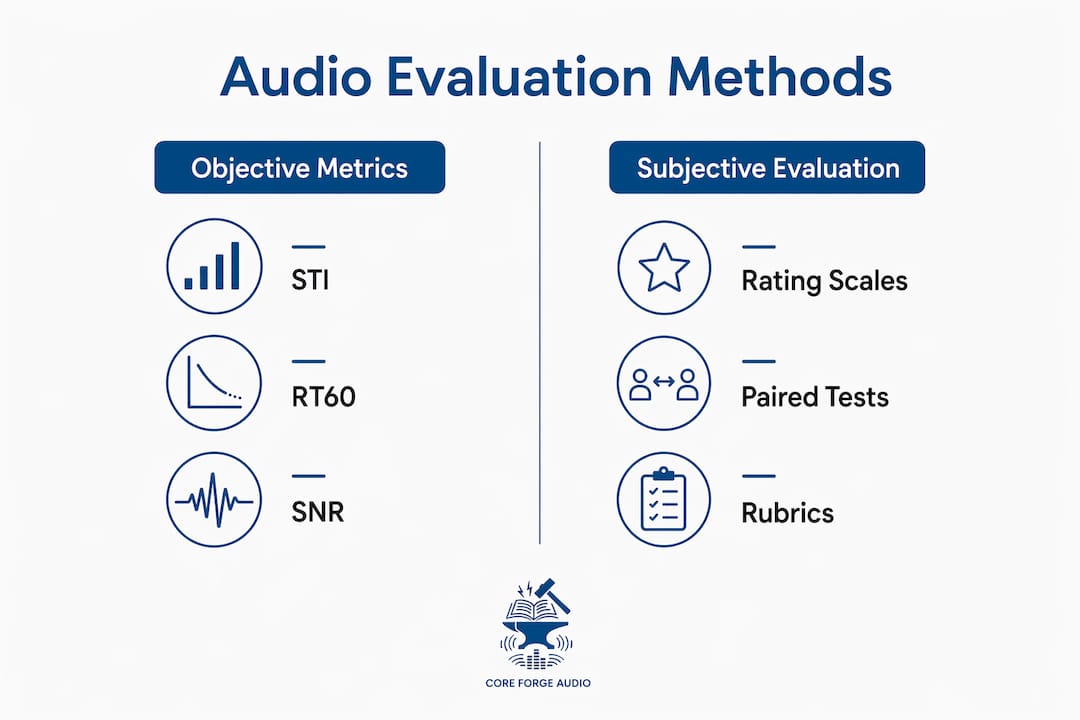
The most common subjective methods are voting, rating scales, and paired comparison tests. In a paired comparison, listeners hear two audio samples back to back and choose which one is clearer or more natural. Rating scales ask listeners to score samples on dimensions like clarity, tone, and fluency, typically on a 1–5 or 1–10 scale. Voting aggregates quick impressions across a group and works well for rapid screening.
Structured rubrics that assess tone, fluency, clarity, and expressiveness are the most reliable subjective tool. Multi-level rubrics reduce evaluator inconsistency by giving each criterion a defined description at each score level. Without that structure, educators tend to rely on overall impressions, which neglect technical aspects like noise artifacts and pitch accuracy.
Evaluator training matters as much as the rubric itself. Untrained listeners conflate volume with clarity, a common error that leads to over-amplification rather than noise control. Training raters to listen for specific features, such as sibilance distortion or consonant smearing, produces feedback that audio specialists can actually act on.
Steps in a structured subjective evaluation:
- Define criteria. Select the dimensions to assess: clarity, tone, fluency, expressiveness, and absence of noise artifacts.
- Calibrate raters. Play reference samples at known quality levels so all evaluators share a common baseline before scoring.
- Use blind presentation. Remove identifying information from samples to prevent bias toward familiar voices or formats.
- Score independently. Each rater completes the rubric without consulting others to preserve individual judgment.
- Aggregate and discuss. Average scores, flag outliers, and hold a brief consensus discussion to resolve large disagreements.
- Document findings. Record scores and qualitative notes for each criterion to support iterative improvement.
Pro Tip: Run at least one blind listening session with learners who have auditory processing differences or are non-native speakers. Their feedback surfaces problems that trained adult raters consistently miss.
Why combining objective and subjective methods is critical
Relying on objective metrics alone creates a false sense of compliance. A room can pass an RT60 audit and still deliver poor audio for a student with ADHD if the narration pace is too fast or the vocal tone is flat and monotonous. Metrics measure the acoustic container. Subjective evaluation measures the human experience inside it.
Manual listening checks alone are labor-intensive and biased. The same source confirms that hybrid evaluation frameworks combining objective acoustic data with blind human assessments produce the best results for learners with ADHD and language barriers. That finding has direct implications for how audio specialists design evaluation protocols for educational content.
A practical example illustrates the gap. A recorded lecture might score an STI of 0.72, well above the 0.60 minimum. But if the narrator speaks at 185 words per minute with minimal pausing, students with dyslexia report losing comprehension within minutes. The metric passes. The learner fails. Subjective feedback from a diverse listener panel catches exactly that kind of problem.
Accessibility-focused evaluation also surfaces issues that standard acoustic audits ignore entirely, such as whether narration speed can be adjusted, whether audio is paired with transcripts, and whether the voice actor's pacing allows time for cognitive processing. These are learner-centered criteria that no STI measurement captures. Platforms like Coreforgeaudio build these criteria into their content standards from the start, treating adjustable narration speed and human voice quality as non-negotiable accessibility features rather than optional add-ons.
Pro Tip: Schedule one combined evaluation session per semester: run the acoustic audit first, then immediately follow with a blind listening panel using the same space. The two datasets together reveal mismatches that neither method finds alone.
How to implement audio quality evaluation in educational settings
Implementation requires a clear sequence. Ad hoc checks produce inconsistent data and miss the systemic issues that affect learners most.
-
Conduct a baseline acoustic audit. Measure RT60, background noise, and STI at multiple positions in the room per ANSI S12.60 and BB93 requirements. Use acoustic compliance templates that generate pass/fail summaries for stakeholders. Measure background noise over a full 30-minute period during normal operating hours to capture HVAC cycling and hallway noise.
-
Identify noise sources. Walk the room during the measurement period and log all noise sources: HVAC vents, projector fans, exterior traffic, and adjacent classrooms. Low-frequency HVAC noise is the most common cause of STI failure and the least obvious to the ear.
-
Set target thresholds before remediation. Define the minimum acceptable STI (0.60), maximum RT60 (0.5 seconds), and minimum SNR (+15 dB) before making any physical changes. Having targets in writing prevents scope creep and gives contractors a clear brief.
-
Assemble a subjective evaluation panel. Recruit at least five listeners, including at least one learner with an auditory processing difference or language barrier. Use a structured rubric covering clarity, tone, fluency, and noise artifacts. Run the session blind.
-
Analyze speech rate in recorded content. For pre-recorded lectures, audiobooks, or instructional videos, measure words per minute using transcription tools. Flag any content below 116 wpm or above 180 wpm for re-recording or speed adjustment. This step is especially relevant for audio learning in curriculum design.
-
Remediate and retest. Address the highest-priority findings first, typically background noise control, then retest STI at the same positions. Document before-and-after scores.
-
Build a monitoring schedule. Acoustic conditions change with seasons, renovations, and new equipment. Schedule quarterly noise checks and an annual full audit. Pair monitoring with digital equity tools to track whether audio improvements translate into measurable engagement gains for diverse learners.
The implementation process works best when educators and audio specialists collaborate from step one. Educators know which learners struggle most and where in the room comprehension breaks down. Audio specialists know which measurements to take and how to interpret them. Neither group has the full picture alone.
Key Takeaways
Effective audio quality evaluation in education requires combining objective acoustic metrics with structured subjective assessments to serve all learners, especially those with auditory processing differences or language barriers.
| Point | Details |
|---|---|
| STI is the primary metric | An STI score of 0.60 or higher is the minimum for reliable speech intelligibility per IEC 60268-16. |
| Background noise outweighs reverberation | Moving from NC-30 to NC-40 drops STI by 0.17, making noise control the top priority in most classrooms. |
| Structured rubrics reduce bias | Multi-level rubrics covering clarity, tone, and fluency produce more consistent and actionable subjective scores than intuitive impressions. |
| Hybrid evaluation is best practice | Combining STI, SNR, and RT60 data with blind human listening panels catches problems that neither method finds alone. |
| Speech rate affects credibility and access | Narration between 125–150 wpm maximizes comprehension; rates below 116 wpm reduce speaker credibility for all listeners. |
What I've learned from watching educators get audio evaluation wrong
By Sarmed
The most common mistake I see is treating audio evaluation as a one-time compliance exercise. A school runs an acoustic audit, gets a passing STI score, and considers the job done. Then a teacher with a soft voice stands at the back of the room, and half the class misses the lesson. The metric passed. The instruction failed.
The second mistake is the opposite: relying entirely on gut feel. Educators are perceptive, but audio quality affects trust and credibility in ways that are not always conscious. A narrator speaking below 116 wpm reads as uncertain, not accessible. A room with an STI of 0.55 feels "a little echoey," not "cognitively exhausting for a student with ADHD." Without numbers, the problem stays vague and the fix stays elusive.
What actually works is building a feedback loop. Run the acoustic audit. Run the listener panel. Share the results with the educators who use the space daily. Then retest after changes. The loop is what turns a one-time measurement into a living standard.
The future of this field will involve AI-assisted evaluation tools that flag intelligibility problems in real time. That is genuinely useful, but only if the underlying criteria come from learner-centered research, not just signal processing benchmarks. Technology should serve the learner, not just the engineer. The educators who understand both sides of that equation will build the best audio environments for the widest range of learners.
— Sarmed
Audio quality resources for educators at Coreforgeaudio
Educators who want to move from evaluation theory to real classroom impact have a clear next step.
Coreforgeaudio is built on the principle that audio quality is an accessibility issue, not just a technical one. The platform pairs human-narrated content with adjustable narration speeds, dyslexia-friendly display options, and multilingual support, all designed around the same learner-centered criteria that the best audio evaluations measure. For educators working to close the gap between acoustic compliance and genuine comprehension, Coreforgeaudio's mission connects directly to the standards and practices covered here. The platform also supports differentiated instruction through audio, giving educators a practical model for what high-quality, accessible audio looks like in practice.
FAQ
What is the minimum STI score for a classroom?
The minimum acceptable Speech Transmission Index for educational settings is 0.60, per IEC 60268-16 standards. Scores below this threshold indicate unreliable speech intelligibility, particularly for students with hearing or language barriers.
How do ANSI S12.60 and BB93 differ?
Both ANSI S12.60 and BB93 set acoustic standards for classrooms, including RT60 targets below 0.5 seconds and background noise measurement procedures. BB93 is the UK standard, while ANSI S12.60 applies in the United States, but both require a 30-minute background noise measurement period.
Why is background noise more critical than reverberation?
Background noise, especially low-frequency HVAC noise, degrades STI more directly than reverberation in most classroom conditions. Moving from NC-30 to NC-40 noise levels drops STI by 0.17, which is a larger impact than most reverberation increases of the same magnitude.
What speech rate works best for educational audio?
A narration rate of 125–150 words per minute produces the best comprehension in educational video and audio content. Rates below 116 wpm reduce perceived speaker credibility, while rates above 180 wpm exceed comfortable processing speed for many learners.
How do structured rubrics improve subjective audio evaluation?
Structured rubrics define specific criteria, such as clarity, tone, fluency, and noise artifacts, at each score level, which reduces evaluator inconsistency. Training raters with reference samples before scoring further improves reliability and produces feedback that audio specialists can act on.