

Audio retention and visual reading are distinct learning modalities that engage the brain differently, shaping how information is absorbed and remembered. Audio retention is defined as the memory and comprehension formed through listening to spoken information. Visual reading comprehension is the process of decoding and retaining information through written text. Understanding what is audio retention vs visual reading matters because the differences directly affect how well you learn, how long you remember, and which method fits your situation best. Coreforgeaudio was built on the recognition that both modalities serve real human needs, and that access to high-quality audio content changes lives.
What is audio retention vs visual reading, and how does the brain process each?
Audio retention and visual reading both activate the brain's language processing regions, but the cognitive demands of each modality are fundamentally different. Reading gives you control. You set the pace, re-read a confusing sentence, and use visual cues like headings and bold text to organize meaning. Listening removes that control. The audio stream moves at a fixed tempo, and your working memory must hold information in sequence without the ability to pause and scan back.
Dr. Praveen Gupta notes that reading demands focus and active cognitive control, which produces more durable memory traces over time. That active engagement is why reading tends to build stronger long-term retention for complex material.
Listening, by contrast, places a heavier load on auditory attention and working memory. When the speaker moves on, the information moves with them. This creates what researchers call a "temporal context" challenge: audio's linear pace makes it hard to locate or anchor specific information in memory after the fact.
- Reading: Non-linear, self-paced, supports annotation and re-reading
- Listening: Linear, speaker-paced, relies on sustained auditory attention
- Shared ground: Both activate language comprehension networks in the brain
- Key difference: Reading supports cognitive control; listening demands working memory endurance
Pro Tip: If you are listening to dense or technical content, treat it like a focused reading session. Put your phone down, close other tabs, and give the audio your full attention.
What are the pros and cons of audio retention compared to visual reading?
Neither modality wins outright. Each has clear strengths and real limitations depending on context.
Audio retention: strengths and limits
Audio learning benefits are most visible in specific situations. A 2026 linguistics study confirmed that listening to audiobooks produced significantly higher vocabulary gains for university language learners, with retention holding after three weeks. That result makes audio a strong tool for language acquisition and immersive storytelling.
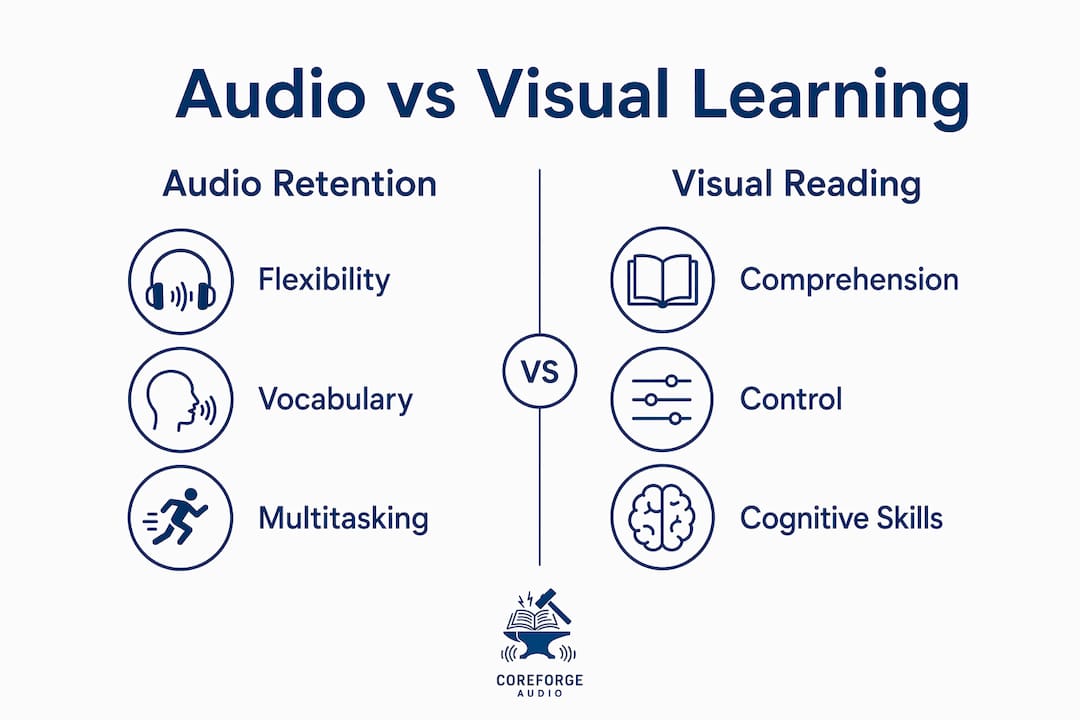
Audio also works well during physical tasks. Commuting, exercising, or doing household chores are all moments when reading is impossible but listening is not. The human voice carries tone, emotion, and rhythm that text cannot fully replicate, which aids immersion and emotional engagement.
The limits are equally real. Multitasking while listening severely reduces retention because divided attention lowers how much the brain encodes. Audio is also linear: if you miss a key point, rewinding and relocating it takes effort that re-reading a paragraph does not.
Visual reading: strengths and limits
Reading gives you control that audio cannot match. You can slow down for a difficult passage, skip ahead to a summary, or annotate the margin with your own interpretation. A 2025 longitudinal study found that incorporating visual supports with text improved literal comprehension with an effect size of Cohen's d = 0.81. That is a large effect by any standard in educational psychology.

Reading also builds cognitive skills over time in ways passive listening cannot. Developmental psychologist Robert Sternberg emphasizes that reading develops distinct cognitive skills that audio alone does not replicate. The downside: reading requires a physical or digital text, a quiet environment, and visual stamina. For readers with dyslexia, ADHD, or visual impairments, sustained reading can be exhausting or inaccessible.
Pro Tip: Use audio for your first pass through new material to build familiarity, then read the text version to consolidate detail and deepen understanding.
How can combining audio retention and visual reading improve learning outcomes?
The most effective learning strategy uses both modalities together. Allan Paivio's dual coding theory, validated by recent cognitive psychology research, explains why: dual coding through audio and visual channels creates stronger memory traces than either channel alone. When the brain encodes information in two formats simultaneously, retrieval becomes easier and more reliable.
"Effective learners use audio to prime and engage, then deepen understanding through reading, leveraging the strengths of both modalities. This sequence is a proven practice in curriculum integration and is supported by research in applied linguistics and educational psychology."
Practical integration does not require elaborate systems. A straightforward sequence works well for most learners:
- Listen first. Use audio to get a broad sense of the material, the narrative arc, and the key concepts. This primes your brain for what follows.
- Read for detail. Return to the text version to slow down on complex sections, annotate, and build precise understanding.
- Review with audio. Use a summary or re-listen to reinforce what you read. This repetition strengthens long-term retention.
- Add visual supports. Charts, diagrams, and highlighted text used alongside audio produce the strongest comprehension outcomes, as the visual-audio combination research consistently shows.
This approach is especially powerful for learners with reading barriers. An MIT study found that audiobooks paired with explicit instruction produced the strongest vocabulary outcomes for struggling readers. Audio alone was not enough. The combination was the key. Coreforgeaudio is built around this principle, offering human-narrated audiobooks alongside accessibility features like dyslexia-friendly fonts and adjustable narration speeds so that learners can move fluidly between listening and reading.
For learners exploring multisensory learning strategies, the research points in one direction: use both modalities deliberately, not interchangeably.
What does recent research say about retention rates for audio vs visual learning?
The research on audio vs visual learning styles is more nuanced than most summaries suggest. A 2022 meta-analysis of 46 studies found that literal comprehension scores were similar for reading and listening. That finding surprises many people. It means that for basic factual recall, audio and reading perform comparably.
The gap opens at higher-order comprehension. Readers scored better on general comprehension tasks and inferential reasoning. Inference requires holding multiple ideas in mind and drawing conclusions. Reading's self-paced nature supports that process. Audio's fixed tempo makes it harder.
The vocabulary finding cuts the other way. Audio consistently outperforms reading for vocabulary acquisition in language learners, likely because spoken language provides phonological context that text alone does not. That distinction matters for anyone learning a second language or building domain-specific vocabulary through listening.
Attention is the variable that changes everything. Research confirms that divided attention during audio learning lowers retention dramatically. A learner who listens while driving retains far less than one who listens with full focus. Reading, because it demands visual engagement, naturally discourages the kind of casual multitasking that undermines audio retention.
The practical implication is clear: the differences between audio and visual learning are real, but context determines which modality wins. For factual recall and vocabulary, audio holds its own. For inference, analysis, and complex reasoning, reading has the edge. For learners who want to understand how listening builds literacy, the science points toward intentional, focused audio engagement as the foundation.
Key Takeaways
Audio retention and visual reading each serve distinct cognitive functions, and combining both modalities produces stronger comprehension and memory than relying on either alone.
| Point | Details |
|---|---|
| Literal comprehension is comparable | A 2022 meta-analysis of 46 studies found similar literal recall scores for reading and listening. |
| Reading wins for inference | Self-paced reading supports general and inferential comprehension better than audio's fixed tempo. |
| Audio leads for vocabulary | Listening to audiobooks produces higher vocabulary gains for language learners, retained after three weeks. |
| Multitasking kills audio retention | Divided attention during listening dramatically reduces how much the brain encodes and stores. |
| Dual coding is the strongest strategy | Combining audio and visual channels creates stronger memory traces than using either modality alone. |
My take on choosing between audio and visual learning
People treat this as a competition, and it is not. I have spent years reading about learning science and watching how people actually absorb information, and the pattern is consistent: the learners who get the most out of audio are the ones who treat it like reading. They sit down, they focus, and they engage. The ones who listen while scrolling through their phone retain almost nothing.
The research on multitasking confirms what observation already shows. Audio is not a passive medium if you want it to work. It demands the same attentional commitment as reading, just through a different channel.
Where I think audio has a genuine, underappreciated edge is in emotional engagement. A skilled human narrator does something text cannot: they carry tone, urgency, and warmth directly into your comprehension. That is not a soft benefit. It affects how deeply you process and how long you remember. Coreforgeaudio's commitment to human narration over synthetic voices reflects exactly this understanding.
My practical advice: use audio to enter a subject and build familiarity. Use reading to go deep. Never use audio as background noise and call it learning. And if you have a reading barrier, do not let anyone tell you that audio is a lesser path. For many learners, it is the only path that actually works.
— Sarmed
How Coreforgeaudio supports audio and visual learning together

Coreforgeaudio is a nonprofit-focused platform built for learners who need more than a standard reading experience. Its library of human-narrated audiobooks is designed to complement visual reading, not replace it. Features like adjustable narration speeds, dyslexia-friendly fonts, and multilingual support make it possible for learners to move between listening and reading without friction. The platform's mission is access: getting high-quality audio content to people with dyslexia, ADHD, visual impairments, and busy schedules who deserve the same depth of learning as anyone else. If you want to put the research in this article into practice, start with Coreforgeaudio and experience what intentional audio learning actually feels like.
FAQ
What is audio retention vs visual reading?
Audio retention is memory and comprehension formed through listening to spoken content. Visual reading comprehension is the process of decoding and retaining information through written text. Both activate the brain's language networks, but they differ in cognitive demands and retention outcomes.
Is visual reading more effective than listening for comprehension?
Reading produces better results for general and inferential comprehension, according to a 2022 meta-analysis of 46 studies. For literal recall and vocabulary acquisition, audio and reading perform at comparable or equal levels.
How does audio retention work in the brain?
Audio retention relies on working memory and sustained auditory attention to hold and process spoken information in sequence. Because audio is linear and speaker-paced, the brain cannot re-access earlier content the way a reader can re-read a sentence.
What are the audio learning benefits for people with reading difficulties?
Audio learning gives learners with dyslexia, ADHD, or visual impairments access to content that text alone cannot deliver. An MIT study found that audiobooks paired with explicit instruction produced the strongest vocabulary outcomes for struggling readers.
Can combining audio and visual learning improve retention?
Combining both modalities produces stronger memory traces than either alone, based on Allan Paivio's dual coding theory and supporting research. Listening first for broad understanding, then reading for detail, is a proven sequence for improving long-term retention.