

Audio in ESL learning is often treated as a nice bonus, a podcast here, a listening exercise there. That framing undersells it badly. Understanding why multilingual audio aids ESL learners goes deeper than convenience. Research from 2024 and 2026 now shows that audio learning reshapes how learners process language at a cognitive level, affirms cultural identity, and builds real fluency in ways that text alone simply cannot replicate. Whether you are a learner struggling with comprehension or an educator looking for methods that actually stick, this article covers the science, the strategies, and the tools worth knowing.
Table of Contents
- Key takeaways
- Why multilingual audio aids ESL learners cognitively
- The identity factor: language, culture, and belonging
- Practical strategies for using multilingual audio
- Comparing multilingual audio methods and tools
- My take: audio is the most underused tool in ESL education
- Bring high-quality audio into your ESL practice
- FAQ
Key takeaways
| Point | Details |
|---|---|
| Audio reduces cognitive load | Freeing the visual channel lets learners build stronger mental images and process language more deeply. |
| Home language scaffolds comprehension | Multilingual audio that incorporates L1 support accelerates transfer of skills to English acquisition. |
| Active listening beats passive exposure | Techniques like pause-and-recall dramatically improve retention compared to continuous playback. |
| Cultural affirmation improves outcomes | Translanguaging approaches validate learner identity and produce stronger collaboration and belonging. |
| Audio quality directly affects trust | Poorly produced audio creates cognitive friction that reduces learner engagement and perceived credibility. |
Why multilingual audio aids ESL learners cognitively
Most people assume learning a second language is primarily a visual task. You see a word, you memorize it, you move on. The cognitive science tells a very different story.
Audio-first learning reduces extraneous cognitive load by freeing the visual channel entirely, which allows the brain to build richer mental imagery and focus processing power on the language itself. A 2024 EEG study found that listening activates both language networks and the mind's eye simultaneously. That dual activation is something a grammar worksheet simply cannot trigger.
For ESL learners specifically, the benefits go further when the audio incorporates the learner's home language. Home language audio support acts as a cognitive scaffold, helping learners transfer comprehension skills they already have in their first language directly into English. Think of it as building a bridge using familiar architecture. The new structure feels less foreign because the learner already understands the engineering.
Here is where multilingual audio does something no monolingual tool can: it gives the brain two reference points instead of one. When a learner hears an English concept alongside or near an equivalent in their home language, the neural pathways connecting meaning to sound become stronger in both directions.
Key cognitive advantages of multilingual audio for ESL learners include:
- Reduced working memory strain: Familiar language cues free up mental bandwidth for processing new English vocabulary.
- Deeper mental imagery: Audio without visual clutter activates the imagination more powerfully than text-heavy slides.
- Stronger recall: Metacognitive strategies paired with multimedia instruction show significant gains in listening comprehension over traditional methods.
- Speed sensitivity: Playing audio above 1.8x speed causes a 38% comprehension drop because idea integration breaks down even when word recognition is intact.
Pro Tip: Start ESL audio sessions at 0.85x speed for dense content. Increase only after the learner can summarize main ideas accurately at the slower pace.
The identity factor: language, culture, and belonging
The benefits of audio aids for ESL go well beyond test scores and vocabulary gains. They reach something more fundamental: how learners see themselves in the classroom.

English-dominant classrooms carry an implicit hierarchy. When a learner's home language is absent from instruction, the message received is subtle but damaging. It signals that their linguistic background is an obstacle rather than an asset. Multilingual audio disrupts that hierarchy in a concrete way.
Research on translanguaging pedagogy shows that classrooms where multilingual audio is used intentionally produce stronger collaboration between students and a markedly higher sense of belonging. Translanguaging means using all of a learner's languages as active resources, not parking the home language at the door.
"Multilingual audio is not a support tool. It is a fundamental pedagogy that affirms who the learner is while teaching them something new."
That distinction matters for educators. When you select an audiobook narrated in both English and Spanish, or a podcast that code-switches naturally between two languages, you are not accommodating a deficiency. You are honoring a learner's full linguistic identity and making the content more cognitively accessible at the same time.
The equity argument is equally practical. Learners who feel seen in their language are more likely to participate, take risks with new vocabulary, and persist through difficulty. Motivation and identity affirmation are not soft outcomes. They are the engine underneath every measurable academic result.
For educators working in diverse classrooms, incorporating multilingual audio into even one lesson per week can shift the dynamic noticeably. The importance of audio in language learning is not just phonological. It is deeply social and emotional.
Practical strategies for using multilingual audio
Knowing the benefits is one thing. Knowing how to apply them is where most learners and educators get stuck. The following strategies are grounded in current research and work across settings from classroom to self-study.
-
Choose authentic, comprehensible materials. Audiobooks narrated by native speakers at natural pace, podcasts designed for language learners, and bilingual recordings all qualify. The key word is comprehensible. Content should sit just above the learner's current level, not so far ahead that it causes frustration. Resources like audiobooks for second-language learners explain why that level of challenge matters for acquisition.
-
Use the pause-and-recall method. Passive listening yields minimal learning benefit. Instead, play 2 to 3 minutes of audio, pause, and ask the learner to summarize what they heard in their own words. This single technique creates stronger memory retrieval than replaying the same content five times.
-
Target pronunciation and rhythm deliberately. Extensive listening programs that run for 12 weeks or longer produce marked improvements in natural speech patterns, intonation, and learner confidence. Shadow a speaker by listening and repeating overlapping with the audio. This builds rhythm in ways reading transcripts alone never will.
-
Adjust playback speed to content complexity. Dense academic content should be played slower than familiar conversational content. Variable speed, matched to what is being learned, enhances comprehension better than a constant fast pace.
-
Prioritize audio quality. Poorly produced audio increases cognitive friction and causes listeners to rate content as less trustworthy and credible. For learners already working hard to decode a new language, bad audio is a genuine barrier, not just an annoyance.
-
Combine audio with movement or drawing. Listening while sketching the scene being described, or acting out vocabulary words, anchors language in multiple sensory pathways. This is especially effective for younger ESL learners.
Pro Tip: Build a personal "listen list" organized by topic rather than level. Familiarity with subject matter reduces cognitive load and helps learners focus energy on the language rather than the content.
Comparing multilingual audio methods and tools
Not all audio resources serve the same purpose. Understanding the differences helps educators and learners select the right tool for each specific goal.

| Format | Best use case | Unique advantage | Limitation |
|---|---|---|---|
| Bilingual audiobooks | Deep comprehension, vocabulary | Rich narrative context in two languages | Requires focused attention; not portable |
| ESL podcasts | Conversational fluency, cultural context | Authentic speech patterns, accessible topics | May lack formal structure for grammar goals |
| Classroom audio supplements | Directed skill building | Aligns with curriculum objectives | Dependent on teacher facilitation quality |
| Speed-adjustable audio apps | Personalized pacing for all levels | Learner controls own comprehension challenge | Risk of staying too slow; no push to grow |
| Narrated bilingual texts | Vocabulary and reading alignment | Connects audio to written word simultaneously | Higher production cost; fewer options available |
A few patterns emerge from that comparison worth calling out directly.
Audiobooks narrated by skilled human voice actors offer something no AI-generated recording currently replicates: emotional nuance, natural pacing, and the subtle rhythm cues that help learners internalize how a language actually sounds when spoken by someone who grew up with it. That specificity matters when you are learning by ear.
Educators integrating these tools into curriculum will find practical guidance in resources on audio supplementation in curriculum, including suggestions on sequencing audio materials alongside reading tasks.
The combination that produces the strongest outcomes for most ESL learners pairs an extensive listening program using audiobooks or podcasts with structured active listening exercises in class. Neither alone is as effective as both together.
My take: audio is the most underused tool in ESL education
I have watched ESL learners go from silent and disengaged to visibly confident after a few weeks of consistent, intentional audio practice. The shift is not subtle. It shows up in how they hold themselves during speaking activities, how willing they are to guess at meaning, and how much they retain between sessions.
What strikes me most is how often educators reach for a new grammar workbook before they consider turning the lesson into a listening experience. The workbook feels like teaching. Audio feels like a supplement. That instinct is worth challenging directly.
The learners I have seen struggle most are not the ones with the weakest grammar. They are the ones who have never heard enough of the language at natural speed, in authentic contexts, with their own identity respected in the room. Multilingual audio addresses all three of those gaps at once.
The discomfort some educators feel about using home language audio in English classrooms is understandable. There is real pressure to maximize English exposure time. But using multilingual support for language learners is not a concession. It is a more sophisticated understanding of how acquisition actually works. You learn through meaning. Meaning comes faster when your full linguistic self is in the room.
If I could give one piece of advice to any ESL educator starting fresh in 2026, it would be this: build your audio library before you build your vocabulary list. The sounds come first. Everything else follows.
— Sarmed
Bring high-quality audio into your ESL practice
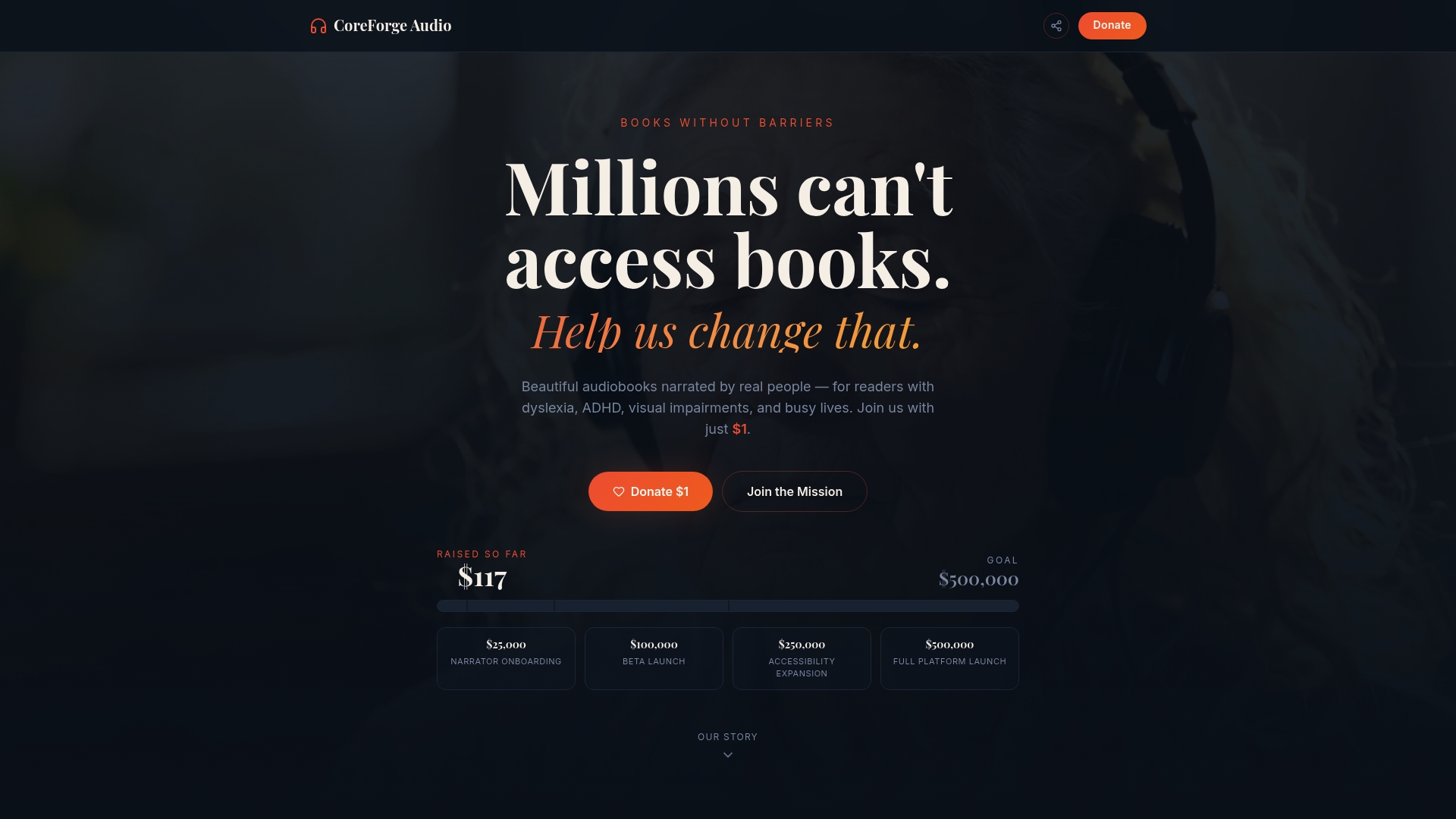
Coreforgeaudio was built on the belief that access to great audio should not depend on where you were born, what language you grew up speaking, or whether you can afford premium subscriptions. For ESL learners and the educators who support them, that mission translates directly into practice.
The platform features human-narrated audiobooks with adjustable playback speeds, multilingual support, and dyslexia-friendly accessibility tools built in from the ground up. Every narrator is a professional voice actor paid fairly, which means the audio quality you hear is the kind that actually reduces cognitive friction rather than adding to it.
Explore the professional voice catalog to see how Coreforgeaudio pairs high-quality narration with the accessibility features ESL learners and educators need most. This is audio built for real learning, not just listening.
FAQ
What makes multilingual audio better than English-only ESL resources?
Multilingual audio activates home language comprehension skills as a cognitive scaffold, helping learners transfer meaning to English faster. Research confirms that L1 support directly improves second language reading and listening comprehension.
How often should ESL learners use audio for best results?
Daily exposure of 20 to 30 minutes using active techniques like pause-and-recall produces the strongest gains. Extensive listening programs show measurable fluency improvements after 12 consistent weeks.
Does audio playback speed affect ESL learning outcomes?
Yes, significantly. Comprehension drops by 38% when audio exceeds 1.8x speed, making it harder for learners to integrate ideas even when individual words are recognized. Match speed to content complexity for best results.
Can multilingual audio help with pronunciation?
Absolutely. Shadowing exercises using human-narrated audio at natural pace build intonation, rhythm, and pronunciation accuracy in ways text study cannot replicate. Human narrators provide the authentic speech patterns learners need to model.
Why does audio quality matter for ESL learners specifically?
Poor audio quality creates cognitive friction that causes listeners to subconsciously distrust the content. For ESL learners already using extra mental energy to decode a new language, that added friction compounds the difficulty and reduces retention.