
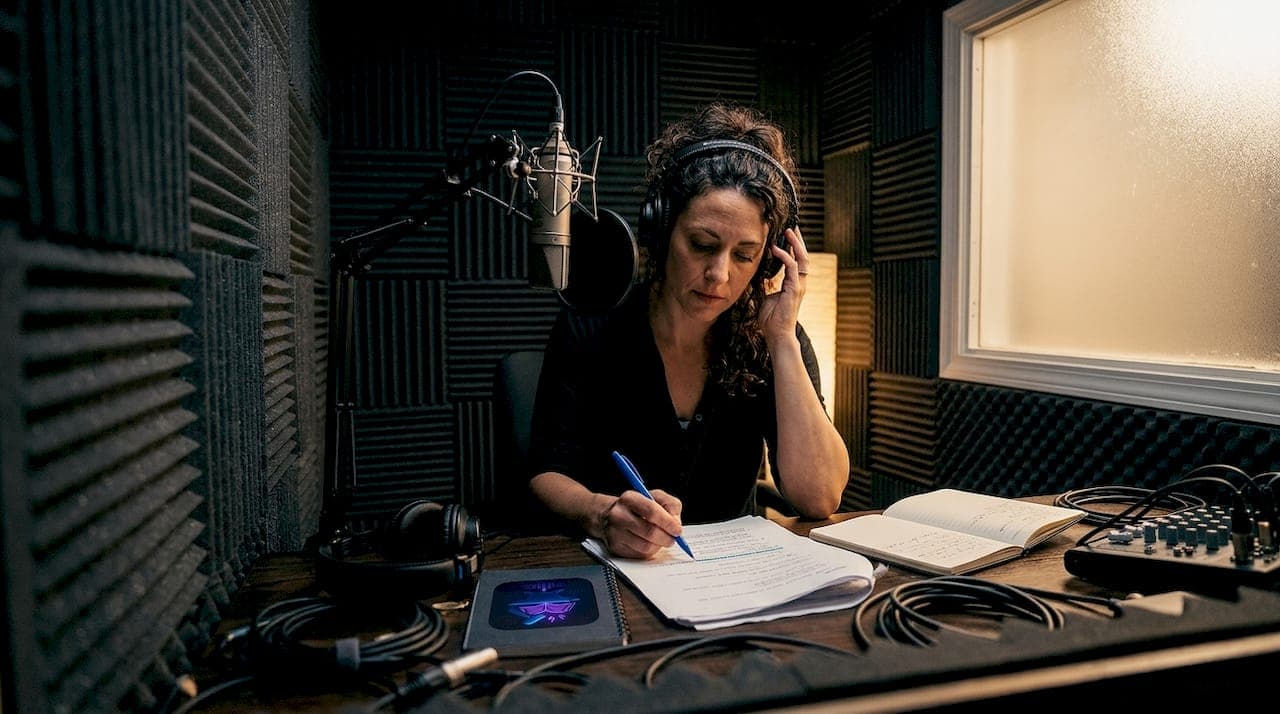
Most people assume audio description exists purely as a compliance checkbox for visually impaired viewers. That assumption undersells one of storytelling's most powerful tools. Understanding why audio description enhances stories means recognizing how a well-crafted narration layer transforms passive watching into genuine emotional immersion, for blind audiences, neurodiverse learners, multitaskers, and anyone who has ever missed a critical visual detail. With Netflix adding over 13,000 audio description hours in 2025 and AI tools accelerating production, this is the right moment to understand what audio description actually does to a story.
Table of Contents
- Key takeaways
- Why audio description enhances stories: the fundamentals
- Benefits of audio description beyond accessibility
- Audio description in education and inclusive storytelling
- The evolving production landscape
- Integrating audio description into your projects
- My perspective on what audio description really does to a story
- Bring your stories to life with Coreforgeaudio
- FAQ
Key takeaways
| Point | Details |
|---|---|
| AD enriches storytelling | Audio description deepens emotional immersion for all viewers, not only people with visual impairments. |
| Neurodiverse audiences benefit | AD clarifies nonverbal cues and visual context that neurodiverse individuals often need stated explicitly. |
| Education gains from AD | Universal Design for Learning principles applied with AD improve comprehension and engagement for all students. |
| AI is changing production | AI tools are reducing costs and scaling multilingual audio description faster than ever before in 2026. |
| Creators can act now | Practical integration of AD requires emotional tone alignment, precise timing, and testing with real audiences. |
Why audio description enhances stories: the fundamentals
Audio description, often abbreviated as AD, is a narration track that fills the natural pauses between dialogue and significant sound effects. It describes what is happening visually: a character's expression, a critical object in frame, a shift in setting, or an action that drives the plot forward. What it is not is a running commentary that describes every pixel on screen.
There are two main styles worth knowing. Standard AD fits descriptions into existing silent gaps without altering the original audio mix. Extended AD actually pauses the media to allow more detailed narration when the natural gaps are too brief. The choice between them depends on the content type and how visually dense the storytelling is.
Here is what separates functional AD from exceptional AD:
- Timing precision. A description delivered half a second too late breaks the viewer's narrative thread entirely.
- Script economy. The best AD scripts use the fewest words to convey the most meaning. Brevity is not laziness; it is craft.
- Tone matching. A horror film and a children's animated series require completely different narration voices and pacing, even if both describe a character running across a room.
- Narrative integration. Effective AD narration aligns with the emotional truth of a scene rather than producing a clinical list of visual elements.
Good audio description becomes invisible. Viewers stop noticing it as an add-on and begin processing it as part of the story itself. That is when it works.
Benefits of audio description beyond accessibility
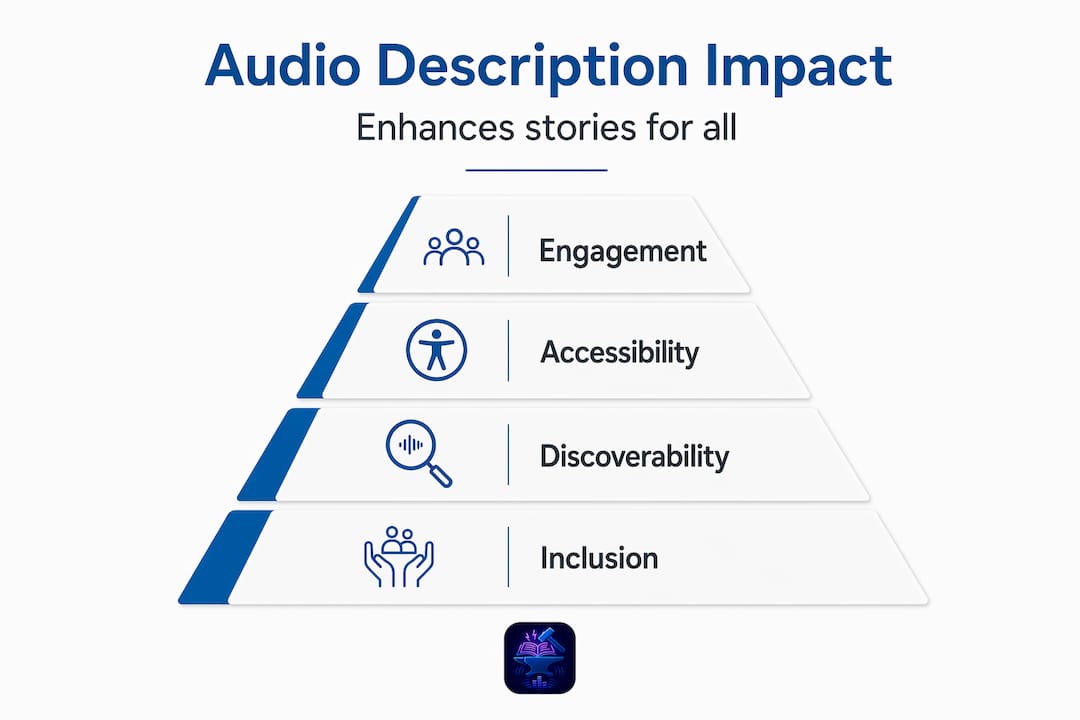
The benefits of audio description stretch well beyond serving blind or low-vision audiences. Research shows high-quality AD significantly improves the sense of "presence," meaning the immersive feeling of genuinely being inside a story. That benefit applies to any viewer whose attention, environment, or processing style creates gaps between the visual content and their experience of it.
Consider the range of people who gain from audio description in concrete, everyday situations:
- Visually impaired viewers receive the narrative context that lets them experience the full emotional arc of a film or series, not just its dialogue.
- Neurodiverse individuals, including many people with autism or ADHD, process nonverbal visual cues more reliably when those cues are verbalized rather than assumed.
- Sighted viewers in low-visibility situations, such as someone watching in a bright room, exercising, or cooking, follow the story without losing critical visual information.
- Language learners benefit because AD describes what characters do and feel, adding a second layer of comprehension reinforcement.
There is also a discoverability angle that most content creators overlook entirely. Audio description adds metadata that search engines and AI content indexers can read, which improves video discoverability and drives organic traffic. Creating AD is not just an act of inclusion. It is a strategic content decision that serves your audience and your reach simultaneously.
Pro Tip: If you publish educational or marketing video content, treating your AD script as a second SEO layer will compound its value. Write descriptions that include character names, setting details, and emotionally relevant actions.
Audio description for better engagement is a measurable outcome, not a theory. Platforms that have invested in AD report improved retention metrics among users who enable it, which reflects how much richer the story experience becomes when visuals and audio work as a unified narrative.
Audio description in education and inclusive storytelling
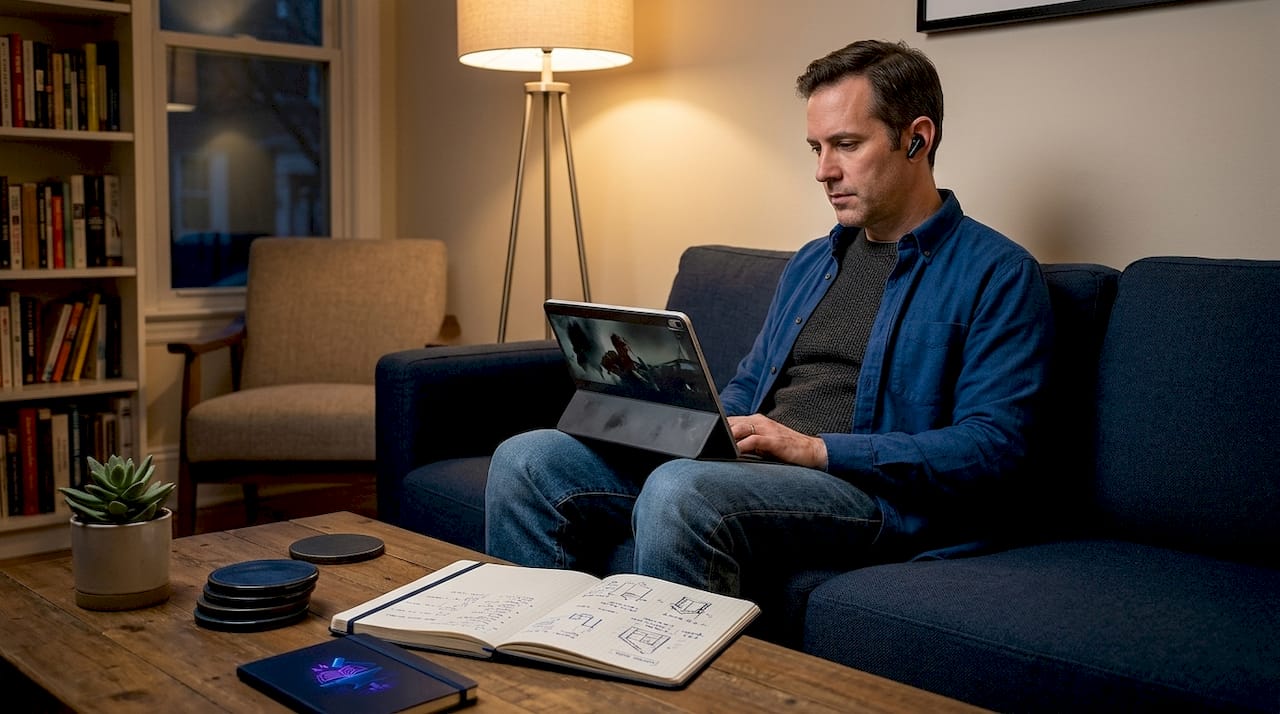
The classroom may be where audio description's impact on storytelling is most visible and most under-discussed. When educators integrate AD into video-based instruction, they are applying the core principle of Universal Design for Learning: design the learning experience so it works for the widest possible range of students from the start, rather than retrofitting accommodations afterward. Proactive use of AD with UDL principles improves engagement and learning outcomes for all students, not just those with identified disabilities.
Here is how educators and content creators can put audio description into practice effectively:
- Audit your existing video content. Identify which videos carry the most instructional weight and prioritize those for AD first. Not every video requires full production.
- Use AD to teach visual literacy. When students hear a description of a historical photograph or a scientific diagram, they learn to read visual information more critically. The description models the thinking process.
- Pair AD with transcripts. Students who read along while listening to AD develop stronger comprehension across modalities. This is especially effective for students with dyslexia or language-processing differences.
- Test with your actual audience. Record a short AD track, play it for students, and ask them what they understood versus what felt confusing. Feedback at this stage is cheap; guessing later is expensive.
- Train yourself to describe emotions, not just actions. Saying "Maria closes the book slowly" is less informative than "Maria closes the book, her shoulders dropping." The second version carries the story forward. Listening fuels literacy in ways that purely visual or text-based instruction cannot replicate.
Pro Tip: When creating AD for educational videos, read your script aloud against the video before recording. If you find yourself rushing or cutting off dialogue, the script needs editing. Timing problems almost always show up in the read-aloud phase.
The impact of audio description on storytelling in educational settings is not limited to students with disabilities. Sighted students in a study-hall environment, students whose first language is not English, and students who are simply more auditory than visual in their processing all benefit from a well-crafted AD track.
The evolving production landscape
The production side of audio description is changing faster than most educators and content creators realize. Understanding where costs, technology, and languages currently stand helps you make smarter decisions for your own projects.
| Factor | Traditional AD | AI-Assisted AD |
|---|---|---|
| Cost per minute | $4 to $8+ per minute | Significantly lower with AI drafting |
| Production speed | Days to weeks per hour of content | Hours to days per hour of content |
| Language scalability | Requires separate human teams per language | Single workflow scales across many languages |
| Quality ceiling | High, with experienced narrators | High when combined with human editorial review |
| Best use case | Prestige content, sensitive topics, live events | High-volume, budget-conscious, multilingual projects |
Producing high-quality AD is labor-intensive work. A single hour of content can require separate scripts, voice recording sessions, and audio mixing passes, repeated for every language version. Netflix currently supports 34 languages in their AD library, which gives you a sense of the operational scale involved.
AI-powered audio description is key for scaling accessibility affordably, but quality requires human oversight, especially for content with cultural nuance, humor, or emotional complexity. The practical sweet spot for most creators right now is AI-generated first drafts reviewed and adjusted by a skilled narrator or accessibility specialist.
Integrating audio description into your projects
Knowing why audio description enhances stories is only half the work. The other half is implementing it without disrupting the viewing experience. These principles apply whether you are creating a short educational clip or a full-length documentary.
- Describe what matters narratively, not everything. A character's red jacket is worth mentioning if it connects to the plot. It is not worth mentioning if it is simply clothing. Use this AD checklist to identify what genuinely moves the story forward.
- Match your narration voice to the content's emotional register. A grief scene described in the same flat tone as an action sequence loses its power. The narrator is a storyteller, not a camera.
- Synchronize with purpose. Every description should land before the viewer needs the information, not after. If a character picks up a weapon, the AD should describe the action as it begins, not after the scene has moved on.
- Explore available tools. Several AI platforms now offer AD drafting at accessible price points, and audio supports independence for a wider audience when these tools are used thoughtfully.
- Build in audience testing. Share an early version with blind or low-vision viewers and ask specific questions about moments that felt unclear. Their feedback will surface issues no sighted reviewer would catch.
Creative AD uses metaphor and culturally aware language to convey visual emotion and context. This is the element most creators skip because it feels less mechanical than describing actions. It is also the element that separates memorable AD from forgettable AD.
My perspective on what audio description really does to a story
I have spent years working at the intersection of audio, storytelling, and accessibility, and the most persistent misconception I run into is that audio description is a technical accommodation. People treat it like closed captioning: necessary, somewhat awkward, and separate from the "real" creative work.
That framing is wrong, and it costs creators real audience connection.
When I read AD scripts that perform at the highest level, they read like literature. They capture emotional truth over literal reporting, which means the writer made creative decisions about what a scene means, not just what it shows. That is storytelling. Done badly, AD is a list of visual facts that interrupts a film. Done well, it is a second narrator who deepens what the original director intended.
The other thing I keep coming back to is how much creators underestimate who benefits. I have seen AD tracks change the experience for parents watching with children in dark rooms, for people with migraines who cannot focus on screens, for students processing trauma who cannot maintain visual attention. The impact of audio description on storytelling is not narrow. It is wide and often invisible until someone tells you it changed their experience.
On AI: I think it is genuinely useful for AD production at scale, but I worry about teams using AI output without editorial review on emotionally sensitive content. The technology is not yet consistent enough at reading tone and nuance. Use it to move faster. Do not use it to skip the human judgment step entirely.
— Sarmed
Bring your stories to life with Coreforgeaudio
If you are working on a project where audio accessibility matters, Coreforgeaudio is building exactly the kind of platform that takes these principles seriously. From human-narrated audiobooks to accessibility tools designed for diverse learners, every decision at Coreforgeaudio connects audio quality with genuine inclusion.
Whether you are an educator looking for resources or a content creator ready to make your work reach more people, explore what Coreforgeaudio is building. The platform is designed from the ground up for audiences who deserve more than the minimum: better narration, fair compensation for voice actors, and accessibility features that treat inclusion as a creative standard rather than an afterthought. Your story deserves to reach everyone.
FAQ
What is audio description and why does it matter?
Audio description is a narration track that describes key visual elements during pauses in dialogue, making video content accessible to blind and low-vision viewers. It also benefits neurodiverse audiences, multitaskers, and anyone who needs additional context to follow a story.
How does audio description improve narrative engagement?
High-quality AD improves the sense of emotional presence in a story by translating visual storytelling into audio, which deepens immersion for a wider range of viewers and can measurably improve content retention on video platforms.
Is audio description only for people with visual impairments?
No. Research shows AD assists neurodiverse individuals, language learners, and sighted viewers in low-visibility situations, while also improving video discoverability through richer metadata that search engines can index.
How much does it cost to produce audio description?
Professional AD services typically range from $4 to $8 or more per minute of content. AI-assisted tools reduce this cost substantially, though human review remains important for maintaining narrative quality and cultural accuracy.
Can educators create their own audio description?
Yes. Educators can write and record AD for their own video content using basic audio tools. The key is timing scripts carefully, focusing on narrative-relevant visual details, and testing with students who have different learning needs.