

Self improvement through audio is the deliberate use of auditory formats, including audiobooks, podcasts, and subliminal affirmations, to actively shift mindset, build skills, and accelerate personal growth. This approach works because the human brain is wired for spoken language processing, making audio one of the most direct paths to learning and behavior change. Platforms like Audible, tools like Sublimind, and protocols like Seismic Mindshifts have built entire systems around this principle. For busy professionals and lifelong learners, audio removes the biggest barrier to self development: finding time to sit down and read.
What is self improvement through audio, and why does it work?
Audio-based self improvement is grounded in neuroscience, not habit hype. The brain processes spoken language through dedicated neural pathways that evolved long before written text existed. This means listening is cognitively natural in a way that reading is not, and that advantage translates directly into learning efficiency.
Audio learning is comparable to reading for comprehension and often outperforms it for conceptual retention when paired with active recall. That finding matters because it dismantles the assumption that reading is always the superior format. If you listen actively, you learn just as well, and sometimes better.
Neuroplasticity is the mechanism behind long-term mindset change through audio. Repeated auditory input reshapes neural pathways over time, especially when the content is emotionally resonant and personally relevant. The Seismic Mindshifts protocol recommends 20–30 minutes daily for 60 consecutive days to produce meaningful mindset shifts. Consistency over two months matters more than audio quality or session length.
"Successful audio learners treat content as a dialogue, using active recall and note-taking to prevent cognitive drift." — Podhoc Audio Learning Analysis
Active engagement is what separates transformation from background noise. Two techniques stand out:
- Shadowing: Repeating spoken content aloud in real time. Active shadowing practice improves pronunciation accuracy by 22% in 8 weeks, making it especially powerful for language learning and communication confidence.
- The Feynman Technique: Pausing audio to explain the concept back to yourself in plain language. This forces genuine comprehension rather than passive absorption.
Pro Tip: Set a specific intention before each listening session. Ask yourself: "What one idea do I want to walk away with?" That single question activates focused attention and dramatically reduces cognitive drift.
Passive listening alone produces minimal lasting change. Audio self improvement works when you treat every session as an active conversation, not background entertainment.
How do different audio self improvement techniques compare?
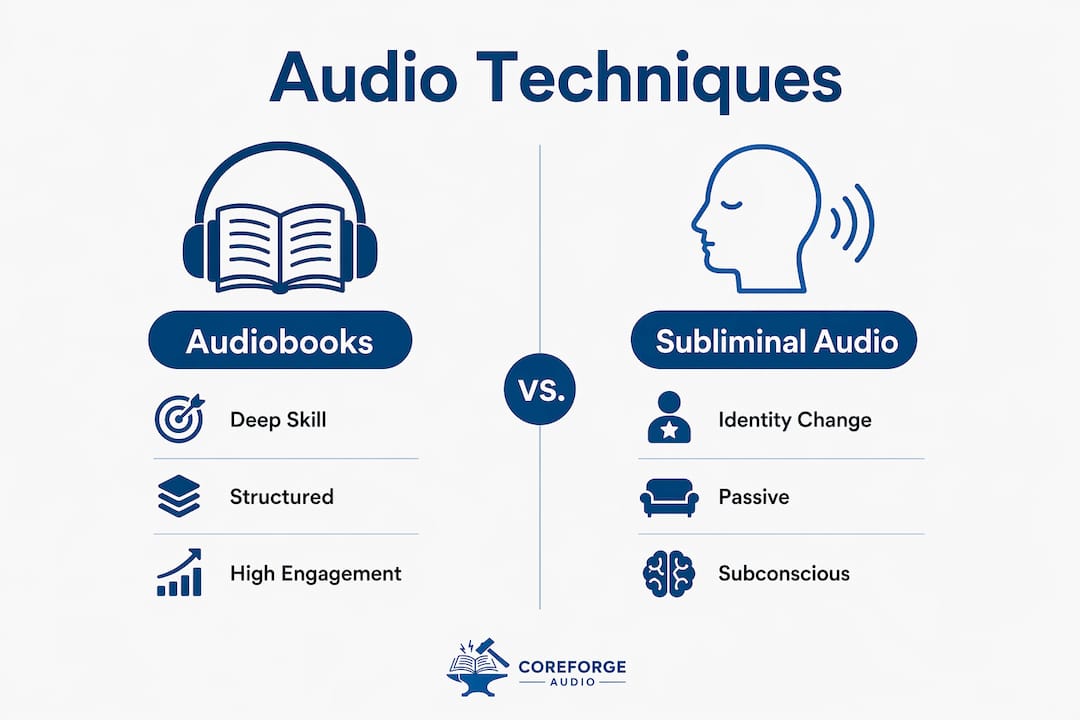
Not all audio formats serve the same purpose. Choosing the right format for your goal is the difference between progress and wasted time.
| Format | Best Use Case | Engagement Level | Key Strength |
|---|---|---|---|
| Audiobooks | Deep skill-building, mindset shifts | Medium to high | Structured, long-form knowledge |
| Podcasts | Current ideas, motivation, interviews | Medium | Conversational, accessible |
| Subliminal audio | Habit change, anxiety reduction | Low (passive) | Bypasses conscious resistance |
| Personalized affirmations | Identity-level belief change | High | Tailored to individual values |
| Multi-voice debates | Critical thinking, comprehension | High | Cognitive engagement, retention |
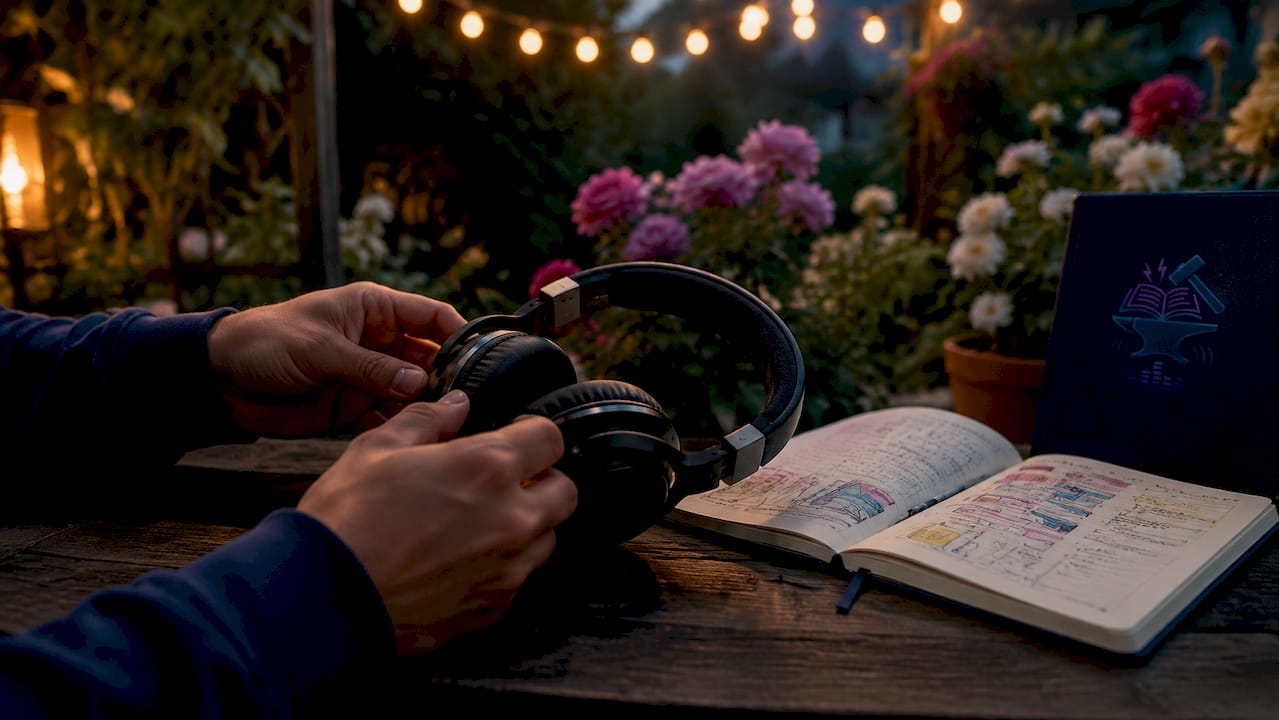
Audiobooks on platforms like Audible deliver structured, long-form content that builds knowledge systematically. They work best when you take notes or pause to reflect. Podcasts are faster and more conversational, making them ideal for commutes and motivation boosts, but they rarely go deep enough for skill mastery on their own.
Subliminal audio operates differently. Subliminal audio bypasses the conscious mind's critical filter, delivering affirmations directly to the subconscious to reinforce new neural pathways. This makes it useful for reducing anxiety or breaking habitual thought patterns, but it should not replace active learning formats. Think of it as preparation, not instruction.
Personalized affirmations outperform generic ones for a specific reason. Personalized audio affirmations aligned with your own identity produce stronger neural integration than statements written for a general audience. A generic "I am confident" lands differently than a phrase built around your specific values and experiences.
Structured multi-voice formats like debates and Socratic questioning outperform flat, monotone narration for active cognitive engagement. If you find yourself zoning out during audiobooks, switching to a debate-style podcast on the same topic often reactivates attention.
The practical takeaway: use audiobooks and personalized affirmations for deep change, podcasts for daily motivation, and subliminal audio as a low-effort supplement during sleep or routine tasks.
How can busy professionals integrate audio into their daily routine?
The biggest obstacle to audio self development is not access. It is consistency. Most people start strong and drift within two weeks. A structured daily routine solves that.
Here is a schedule that works for professionals with limited time:
- Morning (10–15 minutes): Listen to a personal development audiobook or affirmation sequence while getting ready or commuting. Morning is when the brain is most receptive to new information after sleep.
- Midday (5–10 minutes): Use a podcast episode during lunch to reinforce a theme you are working on. Keep a notes app open to capture one key idea.
- Pre-sleep (10–15 minutes): Play subliminal affirmations or a calming personal growth audio. The brain's twilight state before sleep lowers conscious resistance and heightens subconscious receptivity.
Audio frees your visual channels during routine activities, which means commuting, exercising, or doing household tasks become productive learning windows without adding anything to your schedule. That is the core efficiency argument for audio over reading.
To avoid passive consumption, pair listening with a physical anchor. Write one sentence in a journal after each session. Sketch a quick mind map. Say the key idea aloud. These micro-actions convert passive listening into retained knowledge.
Pro Tip: Batch your audio content by theme for the week. If you are working on communication skills, choose an audiobook, a podcast episode, and an affirmation sequence all focused on that single topic. Thematic repetition across formats accelerates neural reinforcement.
For a detailed framework on structuring your day around audio content, the 2026 guide on daily routines offers specific scheduling templates built for working adults.
Who benefits most, and what are the real limitations?
Audio self improvement is effective for a wide range of people, but it is not equally effective for everyone in every context. Understanding where it works best helps you set realistic expectations.
Who benefits most:
- Busy professionals who cannot carve out reading time but have commute or exercise windows
- People with dyslexia, ADHD, or visual impairments who find text-based learning frustrating or inaccessible
- Lifelong learners who want to maintain growth habits without adding structured study sessions
- Individuals working on communication confidence, where hearing language modeled aloud is directly relevant
Audio is not exclusively for auditory learners. Audio benefits all learning styles by optimizing cognitive resource use during daily routines. The format works because it fits into existing behavior, not because of a fixed personality trait.
The limitations are real and worth naming. Audiobooks support vocabulary acquisition but require explicit instruction for struggling readers to see significant gains. Audio alone does not replace structured learning for complex technical skills. If you are trying to learn data analysis or a new language from scratch, audio is a supplement, not a complete curriculum.
One underestimated barrier is emotional. Hearing your own recorded voice causes discomfort for many people, which leads to dropout from self-recording exercises and voice-based affirmation practices. The discomfort is normal and fades with repeated exposure. Treating it as data about your relationship with self-expression, rather than a reason to stop, is the more productive frame.
For people navigating personal development with a disability, the intersection of audio and accessibility opens specific pathways that text-based resources often close off. Audio removes the physical and cognitive barriers that make traditional self-help formats exclusionary.
The science on how listening builds literacy confirms that audio works best as an active supplement, not a passive cure. Receptivity, content relevance, and consistent engagement determine results more than the format itself.
Key takeaways
Audio self improvement works through consistent, active listening that leverages neuroplasticity to shift mindset, build skills, and change behavior over time.
| Point | Details |
|---|---|
| Active listening drives results | Techniques like shadowing and the Feynman Technique convert passive listening into retained knowledge. |
| Consistency beats intensity | Twenty to thirty minutes daily for 60 days produces measurable mindset shifts, per Seismic Mindshifts research. |
| Format choice matters | Match audiobooks to deep learning, podcasts to motivation, and subliminal audio to habit reinforcement. |
| Audio works for everyone | All learning styles benefit from audio because it optimizes cognitive resources during routine activities. |
| Personalization amplifies impact | Affirmations and content aligned with your specific identity produce stronger neural integration than generic material. |
Why i think most people are using audio wrong
I have spent years watching people load up their podcast queues and audiobook libraries, then wonder why nothing changes. The problem is almost never the content. It is the relationship with the content.
Most people treat audio self improvement like a vitamin. They take it daily and assume the benefit accumulates automatically. It does not work that way. The research is clear: passive listening produces minimal lasting change. You have to engage. That means pausing, reflecting, and doing something with what you heard before the next episode starts.
The other trap I see constantly is format loyalty. Someone finds a podcast they love and listens exclusively to that format for months. But podcasts are built for breadth, not depth. If you want real behavior change, you need the sustained argument of a full audiobook, the identity-level work of personalized affirmations, and the low-resistance reinforcement of subliminal audio working together. No single format does everything.
The most counterintuitive thing I have learned: the discomfort of hearing your own voice in self-recorded affirmations is not a sign the practice is not working. It is a sign it is working on exactly the right thing. That friction is where the growth is.
Start with 20 minutes a day. Pick one theme. Use at least two formats. Treat every session like a conversation you are having with a smarter version of yourself. That shift in posture changes everything.
— Sarmed
Start building your audio routine with Coreforgeaudio
If you are ready to move from passive listening to a structured audio self improvement practice, Coreforgeaudio is built for exactly that.
Coreforgeaudio is a nonprofit-focused platform that makes high-quality, human-narrated audiobooks accessible to everyone, including people with dyslexia, ADHD, visual impairments, and packed schedules. The platform integrates dyslexia-friendly fonts, adjustable narration speeds, and multilingual support so your listening experience fits your life, not the other way around. Every voice actor is fairly compensated, and every feature is designed to remove barriers rather than add them. Explore what Coreforgeaudio offers at coreforgeaudio.com and find the audio resources that match where you are right now.
FAQ
What is self improvement through audio?
Self improvement through audio is the intentional use of auditory formats like audiobooks, podcasts, and affirmations to build skills, shift mindset, and change behavior. It works by leveraging the brain's natural spoken language processing and neuroplasticity.
How long does it take to see results from audio self improvement?
The Seismic Mindshifts protocol recommends 20–30 minutes of daily listening for 60 consecutive days to produce meaningful mindset changes. Consistency over time matters more than session length or audio quality.
Can audio help with self improvement if i am not an auditory learner?
Audio benefits all learning styles, not just auditory learners, because it optimizes cognitive resource use during routine activities. Research confirms audio learning is comparable to reading for comprehension when used with active recall.
What audio formats work best for personal growth?
Audiobooks work best for deep skill-building, personalized affirmations for identity-level change, and subliminal audio for habit reinforcement during low-attention windows like sleep. Combining formats by theme produces the strongest results.
Are there limitations to self development through listening?
Audiobooks support vocabulary but require supplemental instruction for struggling readers to see significant gains. Audio works best as an active supplement to structured learning, not as a standalone curriculum for complex skills.