

If you've been searching for answers on what is microlearning audio format, you've likely encountered a lot of confusion between this approach and simply trimming a podcast down to five minutes. They are not the same thing. Microlearning audio is a deliberately designed pedagogical format built around a single learning objective, delivered in focused 2 to 10 minute modules that fit into the natural gaps of a learner's day. This guide covers the structure, benefits, design principles, and real classroom and workplace applications you need to use it effectively.
Table of Contents
- Key takeaways
- What is microlearning audio format
- Designing effective microlearning audio content
- Benefits of microlearning audio for retention and access
- Practical applications and use cases
- Designing inclusive audio microlearning
- My take on what most trainers get wrong
- How Coreforgeaudio supports accessible audio learning
- FAQ
Key takeaways
| Point | Details |
|---|---|
| Defined learning scope | Microlearning audio targets one concept per module, not a broad topic. |
| Structured by design | Effective modules follow a five-part framework, not just shortened recordings. |
| Retention advantage | Spaced repetition in audio microlearning can improve retention by up to 80%. |
| Accessibility gains | Audio format reduces screen fatigue and opens learning to multitasking and diverse learners. |
| Inclusive by intent | Audio microlearning supports learners with dyslexia, ADHD, and visual impairments when designed correctly. |
What is microlearning audio format
Think of microlearning audio as the opposite of a lecture recording. A lecture captures everything. Microlearning audio is built from the start around one specific thing a learner needs to know or do differently. The format delivers focused educational content in two to ten minutes, targeting a single skill or concept per session. That constraint is not a limitation. It is the entire design philosophy.
What separates microlearning audio from a podcast episode or audiobook chapter is pedagogical intent. Traditional audio content is meant to inform or entertain over extended listening. Microlearning audio is meant to change behavior or build a specific competency within a single sitting. Every second of that module is accounted for.
The format thrives in what trainers call "eyes-free, hands-free" contexts. Commutes, exercise, meal prep, and transit time are all windows where learners cannot look at a screen but can absorb a focused audio lesson. With over 600 million podcast listeners globally, learners are already conditioned to audio-based content delivery. Microlearning audio plugs directly into that existing behavior.
Here is what distinguishes it from other audio formats at a glance:
- Single learning objective per module, not a survey of a topic
- Designed for retention, not just comprehension
- Built-in pacing cues and recall prompts within the audio itself
- Short enough to complete in one uninterrupted listening window
- Repeatable on demand, making spaced repetition effortless
Pro Tip: When defining your module topic, test it with this rule: if the learning objective contains more than one verb, split it into two modules.
Designing effective microlearning audio content
The biggest mistake educators make is recording a full lesson and cutting it shorter. That is not what is audio-based training at its best. Designing microlearning audio from scratch requires a five-part narrative structure, and each section has a specific function.
- Hook (30 seconds). Open with a situation the learner recognizes. A scenario, a question, or a single surprising fact that connects directly to the objective. You are answering "why should I keep listening?"
- Clear objective (15 to 30 seconds). State exactly what the learner will be able to do by the end of the module. No ambiguity. This is not a preview. It is a contract.
- Core content (3 to 5 minutes). One concept explained clearly. Use one analogy, one example, and one concrete application. The five-part narrative structure keeps cognitive load low and attention on the single idea.
- Application prompt (30 to 60 seconds). Ask the learner to do something specific before the next module. Write a note, try a technique, recall a scenario. This is where transfer happens.
- Recap (30 seconds). Restate the objective and the one key idea. No new information. Just anchor what was learned.
Beyond structure, embedding recall beats with sound cues every three to eight minutes transforms passive listening into active learning. A consistent audio cue, like a short tone or chime, signals a 20 to 90 second micro-assessment moment. The learner pauses, retrieves, and then continues. This technique alone separates a well-designed audio module from one that learners forget within 24 hours.
On the technical side, quality audio production essentials matter more than most educators expect. A USB microphone, closed-back headphones for monitoring, and a pop filter to reduce harsh plosive sounds are the baseline. Poor audio quality forces cognitive effort onto sound processing instead of learning. Learners disengage faster than they realize, and they rarely come back.

Pro Tip: Record in a carpeted room or use acoustic foam panels. Reverb and echo in audio are attention killers, and they are nearly impossible to fix cleanly in post-production.
Benefits of microlearning audio for retention and access
The research case for microlearning audio is grounded, not just persuasive. Structured microlearning with spaced repetition has shown retention improvements up to 80%, according to Brandon Hall Group findings. That number matters because it reflects what happens when learners revisit the same focused concept across multiple short sessions rather than absorbing everything once in a longer format.
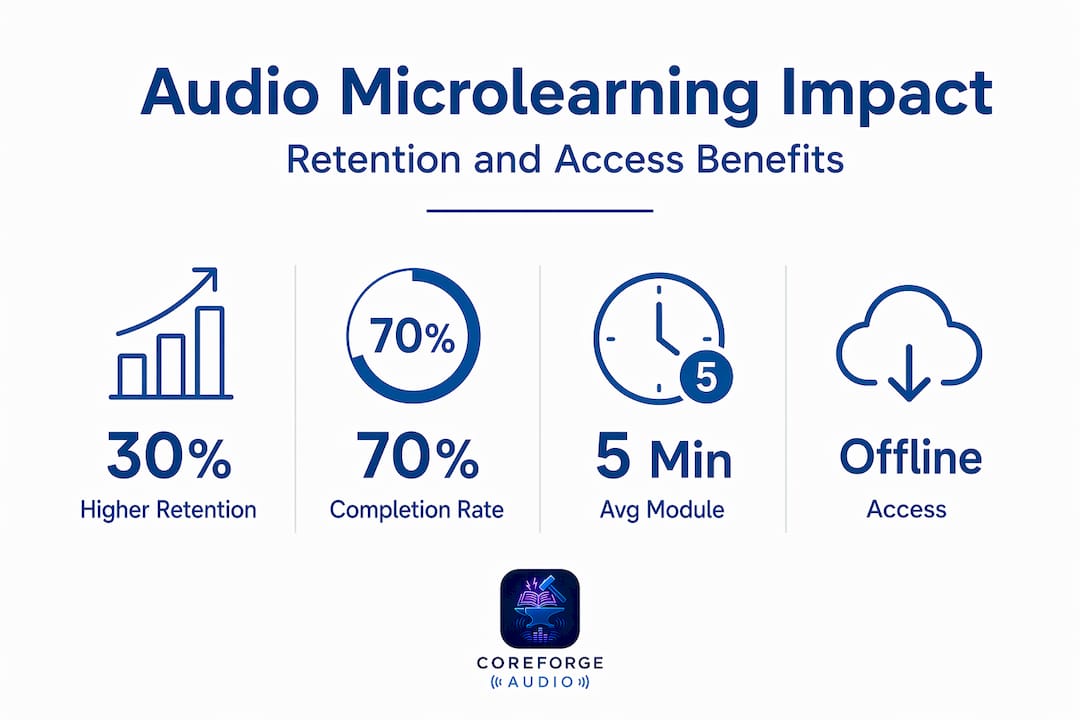
The cognitive load dimension is equally significant. When a learner encounters a microlearning audio module during commuting or other habitual daily routines, the brain is not competing with new environmental demands. The context fits the content length. That alignment is why audio microlearning works where longer formats fail: it lowers the activation energy required to start learning.
| Benefit | Traditional audio training | Microlearning audio format |
|---|---|---|
| Session length | 30 to 60 minutes | 2 to 10 minutes |
| Learning objectives per session | Multiple | One |
| Completion rate | Often low | Significantly higher |
| Screen dependency | Medium to high | None |
| Retention without follow-up | Moderate | High with spaced repetition |
Screen fatigue is a real barrier for modern learners. Average daily screen time exceeds 6 hours and 38 minutes, which means adding screen-based training on top of that creates resistance. Audio microlearning sidesteps that entirely.
"Microlearning is not just shortened content. It is a reinforcement tool designed to complement foundational training, not replace it." Source: eLearning Industry
That distinction is worth internalizing. Audio microlearning works best when it follows a deeper learning experience, reinforcing and cementing rather than introducing from scratch.
Practical applications and use cases
Understanding how to use audio microlearning in practice means recognizing the range of formats available and choosing based on your learners' context and your training goals.
The most common audio microlearning formats include:
- Mini-podcasts focused on a singular topic, typically three to ten minutes, with a clear narrative arc
- Voice notes from instructors or subject matter experts delivering quick skill reminders or updates
- Guided reflections that walk learners through a structured thinking exercise without visual aids
- Narrated articles converting written content into focused audio modules for commuting or multitasking learners
- Scenario-based audio presenting a workplace or classroom situation and asking learners to reason through it aloud or in writing
The most effective delivery strategies blend audio with other modalities. Blending audio with quizzes and graphics supports active learning by giving different cognitive pathways to the same content. A three-minute audio module followed by two quiz questions in a mobile app is a complete microlearning cycle.
Platforms designed for audio microlearning delivery typically support variable playback speeds, offline listening, and progress tracking. These features are not cosmetic. Speed control supports advanced learners and those processing content in a second language. Offline access removes the connectivity barrier for learners in transit. Progress tracking gives trainers the data they need to measure effectiveness.
To measure whether your audio microlearning program is working, track pre and post module quiz scores, module completion rates, and self-reported confidence changes from learners. Completion rate is often the first metric that reveals a design problem, not a learner motivation problem.
Pro Tip: A completion rate below 70% on a well-promoted audio module usually signals a structural problem, most often a hook that fails to connect with the learner's reality within the first 30 seconds.
Designing inclusive audio microlearning
Inclusivity in audio microlearning is not an add-on. It is a design criterion. When you shift content to audio, you remove a significant barrier for learners with dyslexia, ADHD, visual impairments, and reading challenges. But audio alone does not guarantee accessibility. How it is designed determines who actually benefits.
Learner autonomy in response modes matters here. When learners can respond to an application prompt by either recording a voice note or typing a response, you open the experience to more people without diluting the learning intent. That flexibility supports diverse learning styles without requiring parallel content tracks.
| Design approach | Standard audio training | Inclusive audio microlearning |
|---|---|---|
| Narration pace | Fixed | Adjustable speed controls |
| Response options | Single mode | Voice or text options |
| Language support | Usually one language | Multilingual transcripts available |
| Content redundancy | Audio only | Audio with downloadable transcript |
| Learner control | Linear playback | Pause, replay, and bookmark supported |
Using simple, direct language in your scripts also matters. Sentence complexity and vocabulary level affect how easily a learner with ADHD or a non-native speaker can follow along without rewinding repeatedly. If your learners include people with visual impairments, audio-based learning supports accessibility in ways no visual format can match.
Audio microlearning also aligns strongly with differentiated instruction principles. It allows learners to engage at their own pace, replay sections without judgment, and choose when in their day learning fits. For educators working with diverse learner populations, that flexibility can mean the difference between a program that works for most and one that works for all.
My take on what most trainers get wrong
I've seen a lot of educators get genuinely excited about audio microlearning, build a full library of modules, and then wonder why engagement drops off after week two. In my experience, the problem is almost never the content quality. It is that the modules were designed like mini-lectures rather than standalone learning events.
What I've learned over years of working with audio-based training programs is this: learners forgive a lot, but they do not forgive being talked at without a clear sense of what they are supposed to do with the information. The application prompt is the most skipped element in audio microlearning design, and it is the most important one. Without it, you have an audio file. With it, you have a learning experience.
I've also found that most trainers underestimate the value of learner control over pacing. When a program offers variable playback speed, engagement among advanced learners goes up significantly because it respects their time. That signal of respect builds trust in the format itself.
The unrealized opportunity I keep pointing to is audio microlearning as a tool for learner reflection, not just content delivery. A two-minute guided reflection audio that asks learners to think through a recent challenge before a live session is one of the highest-leverage tools available. Most programs simply never try it.
— Sarmed
How Coreforgeaudio supports accessible audio learning
Coreforgeaudio was built with exactly these principles in mind. The platform focuses on high-quality, human-narrated audio content that works for learners with dyslexia, ADHD, visual impairments, and anyone who learns better through listening than reading. For educators and trainers thinking seriously about audio-based learning design, Coreforgeaudio offers a mission-driven space where accessibility is not a feature toggle but a foundation. The platform supports adjustable narration speeds, multilingual content, and dyslexia-friendly display options. If you are building or scaling an audio microlearning program and want it to actually reach every learner in your cohort, Coreforgeaudio is worth exploring as both a resource and a model for accessible audio content done right.
FAQ
What is microlearning audio format in simple terms?
Microlearning audio is a short, focused audio module of two to ten minutes designed to teach one specific skill or concept. It differs from podcasts or audiobooks in that every element, including the hook, objective, core content, and recap, is structured for learning retention.
How long should a microlearning audio module be?
Most microlearning audio modules run between two and ten minutes, with three to six minutes being the most common range. Modules longer than ten minutes typically contain more than one learning objective and should be split.
What are the main advantages of audio microlearning?
The core advantages of audio microlearning include reduced screen dependency, support for learning during dead time like commutes, and significantly higher retention when spaced repetition is built in. It also expands access for learners with visual impairments, dyslexia, and ADHD.
What are examples of microlearning formats in audio?
Common examples of microlearning formats in audio include mini-podcasts, instructor voice notes, guided reflections, narrated articles, and scenario-based listening exercises. Each format suits different learning contexts, from just-in-time training to pre-session preparation.
How do you measure the effectiveness of audio microlearning?
Track module completion rates, pre and post quiz score changes, and learner-reported confidence levels. A completion rate below 70% typically signals a design issue rather than a learner motivation issue, particularly in the module's opening hook.