
Most people think multilingual audio is a marketing play. Get more views, reach more countries, grow the numbers. That framing misses the real story. Understanding how multilingual audio expands access reveals something far more significant: a tool that reshapes who gets to learn, who gets to participate, and who gets to belong. For non-native speakers, people with visual impairments, low-literacy learners, and communities historically underserved by English-only content, audio in their language is not a convenience. It is the difference between inclusion and exclusion.
Table of Contents
- Key takeaways
- How multilingual audio features work on platforms
- Educational and accessibility benefits for diverse learners
- AI advances enabling multilingual audio at scale
- Quality, trust, and the limits of multilingual audio
- Practical steps to apply multilingual audio effectively
- My perspective on multilingual audio and real inclusion
- How Coreforgeaudio supports multilingual access
- FAQ
Key takeaways
| Point | Details |
|---|---|
| Audio access is an equity issue | Multilingual audio removes language barriers that block diverse communities from education and information. |
| Scaffolding matters for learners | Audiobooks alone do not guarantee learning gains; pairing audio with structured instruction improves outcomes for struggling readers. |
| AI is lowering the cost barrier | AI-powered production can cut costs by nearly 60%, making low-resource language inclusion financially viable. |
| Quality delivery builds trust | Accuracy in translation is not enough; fluency and natural prosody in narration affect comprehension and listener trust. |
| Transcripts are non-negotiable | Accessibility compliance requires verbatim transcripts with speaker identification alongside any audio-only content. |
How multilingual audio features work on platforms
Before getting into why multilingual audio matters, it helps to understand how it actually works in practice. Most people assume platforms like YouTube automatically generate dubbed versions of content. They do not. YouTube requires creators to upload dubbed audio tracks themselves. The platform provides the infrastructure for multiple audio tracks, but the translation and recording work falls entirely on the content creator or their production team.
Here is what the process typically looks like on a major platform:
- Translate the script. A professional translator or certified translation service converts the original script into the target language. This step requires human oversight to preserve meaning, tone, and cultural nuance.
- Record the dubbed audio. A voice actor or AI narration tool records the translated script. Quality here matters enormously, which we will cover later.
- Upload the audio track. The creator uploads the secondary language track through the platform's content management system.
- Assign language metadata. The track is labeled with the correct language code so the platform can serve it to the right viewers.
- Add synced captions or transcripts. For full accessibility compliance, captions must accompany the audio track.
The payoff for this effort is measurable. Over 25% of watch time on channels using multi-language audio tracks can come from non-primary language viewers, which means one piece of content serves entirely new audiences without creating a separate channel. For nonprofits, educators, and public health organizations, that reach matters.
Educational and accessibility benefits for diverse learners
Audio content changes the equation for learners who face barriers with text. People with dyslexia, ADHD, visual impairments, and low literacy levels often struggle to access written material at the pace required in formal education. Multilingual audio adds another layer by removing the language barrier on top of those existing challenges.
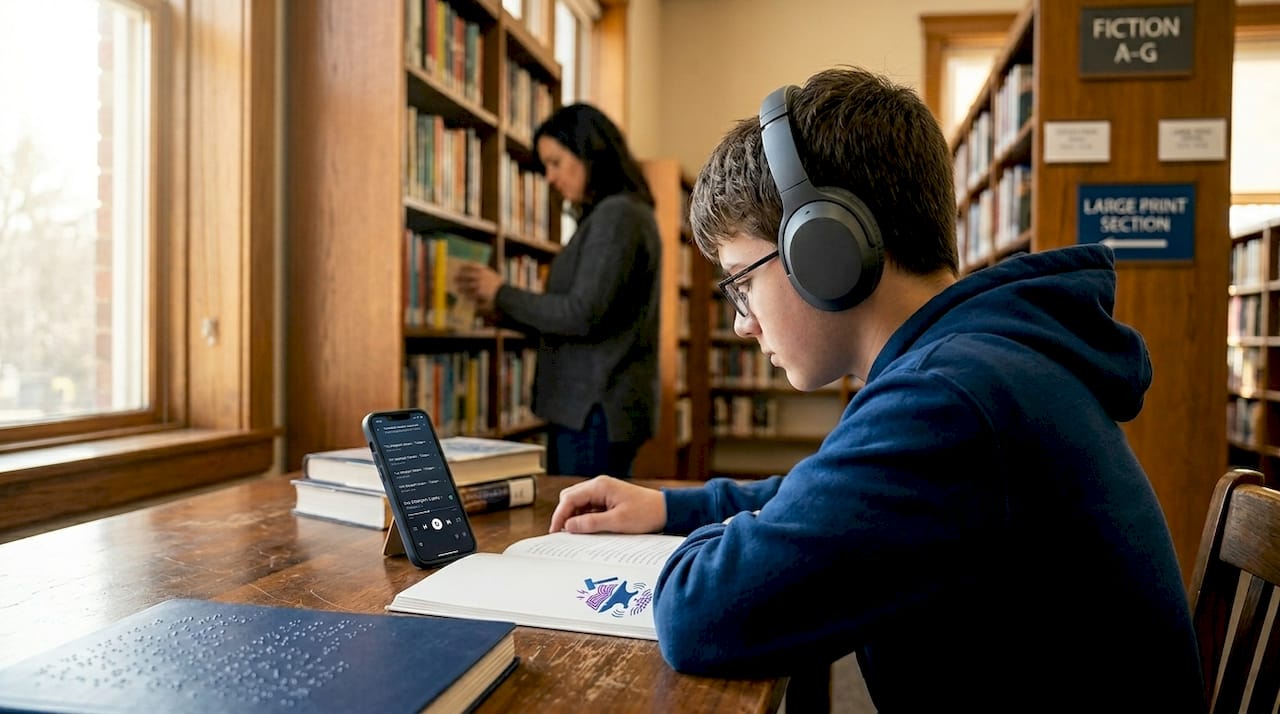
Research from MIT's McGovern Institute shows that audiobooks support vocabulary gains broadly, but with an important caveat. Children who are already struggling readers see meaningful improvement only when audiobooks are combined with explicit instruction. This finding matters deeply for anyone designing educational programs. Audio is a powerful input, but it works best inside a structured learning environment.
For visually impaired users and those who are multilingual, a well-designed audio system can be transformative. A study published in Springer Nature found that a multimodal reader with multilingual support achieved a mean opinion score above 4.5 among blind and multilingual participants, signaling high usability and satisfaction. That level of satisfaction is not accidental. It comes from intentional design.
Key accessibility best practices include:
- Providing verbatim transcripts alongside all audio-only content, with clear identification of every speaker change
- Offering adjustable playback speeds so learners can process content at their own pace
- Including synchronized captions for hearing-impaired users who may also benefit from multilingual options
- Testing audio tracks with actual users from the target language community before wide release
Digital accessibility through audio requires accompanying transcripts that identify speaker changes and match audio content precisely. Without those transcripts, users who rely on screen readers or who have both hearing and vision challenges are left without support.
Pro Tip: If you are building an audio program for a diverse learner population, treat the transcript as a first-class document, not an afterthought. A synchronized, speaker-labeled transcript dramatically increases the number of people who can fully benefit from your content. See the audio description checklist for a structured starting point.
AI advances enabling multilingual audio at scale
The cost of producing audiobooks in multiple languages used to be prohibitive. Professional studio time, voice actor fees, and the logistical complexity of working across multiple languages meant that content in Swahili, Welsh, or Tagalog simply did not get made. AI is changing that calculation significantly.
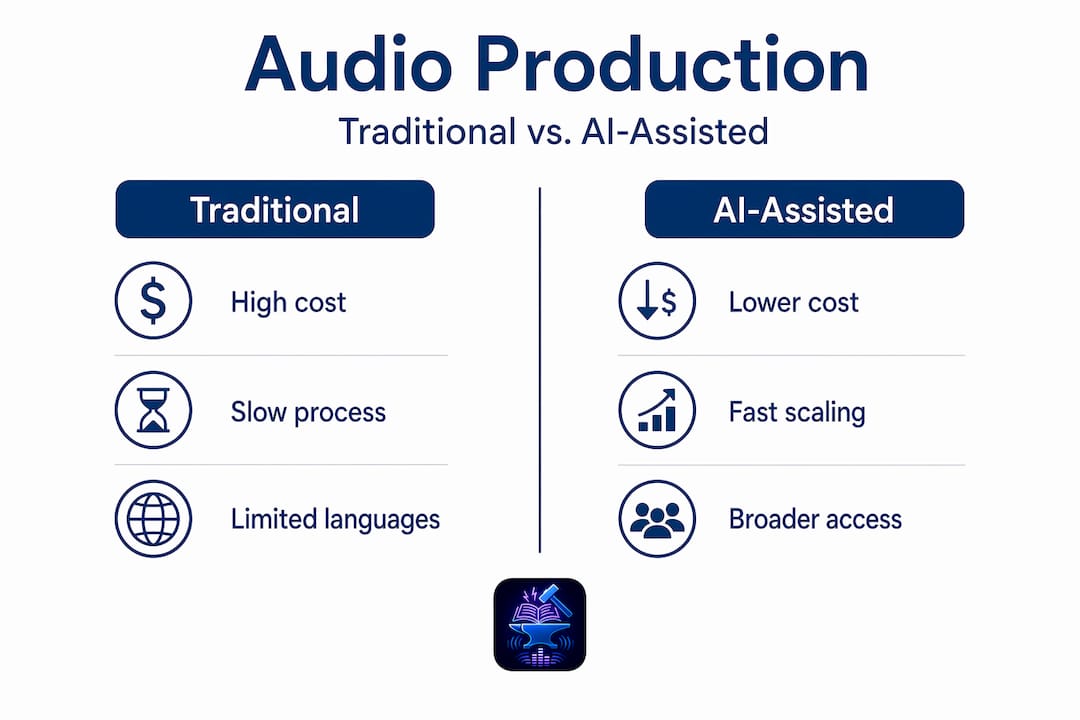
The European Commission's Horizon Europe project on AI-powered audiobooks found that AI-driven production can reduce production costs by nearly 60% while compressing production time to as little as one hour per book. For organizations serving communities that speak low-resource languages, those numbers shift what is possible.
One technology driving this shift is cross-lingual voice cloning. A single voice sample can now generate narration across multiple languages, allowing a book to feel like a unified listening experience without assembling an entire multilingual cast. That capability is meaningful for storytelling because voice consistency affects how readers connect with characters and narrative.
Here is a side-by-side comparison of traditional versus AI-assisted multilingual audiobook production:
| Factor | Traditional production | AI-assisted production |
|---|---|---|
| Cost per language | High (studio + cast per language) | Significantly reduced |
| Production time | Weeks to months | Hours to days |
| Language availability | Primarily high-resource languages | Expanding to low-resource languages |
| Voice consistency | Varies by cast | Maintained through voice cloning |
| Native-speaker review | Standard | Required for quality control |
The caveat worth naming: scaling AI production for low-resource languages demands iterative native-speaker review and curated expressive speech data. Automated translation alone does not capture regional dialects, cultural idioms, or emotional register. Organizations that skip this review step end up with content that technically exists in a language but fails to resonate with the community it is supposed to serve.
Pro Tip: Before deploying AI-generated multilingual audio for educational or community-facing programs, build a review stage with native speakers from the specific region you are targeting. A general Spanish translation will not land the same way for a community in Oaxaca as it does for one in Madrid.
Quality, trust, and the limits of multilingual audio
Availability is not the same as quality, and quality is not the same as effectiveness. A critical point often missed in conversations about the benefits of multilingual audio content is that how something is said shapes whether people actually understand and trust it.
A comparison study published in Nature npj Health Systems found that AI real-time translation meets basic accuracy thresholds but consistently underperforms human interpreters in delivery quality. The gaps show up in fluency, prosody, and the natural cadence of speech that signals credibility to a listener. In health and educational contexts, those gaps have real consequences.
Consider the implications:
- A non-native speaker listening to a health instruction audio that sounds robotic or unnaturally paced may disengage or distrust the content, regardless of whether the words are accurate.
- Students learning a second language benefit more from naturally expressive narration because prosody carries meaning beyond vocabulary.
- In communities where oral tradition is central, the quality of the voice matters as much as the content itself.
- Organizations relying entirely on automated multilingual audio for high-stakes communication should consider an interpreter-in-the-loop model that pairs AI efficiency with human quality review.
This is where the multilingual audio advantages argument gets more nuanced. The benefits are real and documented. But they depend on treating the audio experience with the same seriousness as the content itself. Treating multilingual audio as purely a marketing feature, something checked off a list, rather than a genuine accessibility tool, produces content that exists in a language without truly serving its speakers.
Practical steps to apply multilingual audio effectively
Understanding why multilingual audio matters is one thing. Applying it well is another. Here is a structured approach for educators, nonprofits, and content creators ready to act.
- Start with subtitles. Before investing in full audio dubbing, test your content with subtitles. Subtitles alone can increase video views by over 13% and improve click-through rates by 16%. That data tells you whether demand exists in a target language before you commit production resources.
- Work with qualified translators first. A voice-perfect audio track built on a poor translation fails at the foundation. Commission human translation before touching any recording workflow.
- Build transcripts in parallel. Every audio track should have a verbatim, speaker-identified transcript produced at the same time. Retrofitting transcripts later is slower and more expensive.
- Partner with community reviewers. For educational and public-service content, identify native-speaking reviewers from the specific community you are serving, not just the language group broadly.
- Integrate into existing accessibility frameworks. If your organization follows WCAG or Section 508 guidelines, multilingual audio tracks should be part of that compliance workflow from day one, not added after the fact.
- Evaluate comprehension, not just reach. Measuring success by view counts or download numbers tells you about distribution. Conduct user testing or brief surveys to understand whether the content is actually landing.
Platforms like CoreForge Audio demonstrate how integrating accessibility standards from the ground up makes multilingual support genuinely useful rather than performative.
My perspective on multilingual audio and real inclusion
I have watched organizations add multilingual audio to their content and call it an accessibility win before anyone from the target community has even heard the result. That pattern frustrates me, because the intent is good but the execution misses the point entirely.
The truth I have come to is this: multilingual audio is only as powerful as the respect behind it. When you invest in native-speaker review, when you treat the transcript as a first-class document, when you pair audio with the scaffolding struggling learners need, you are making a genuine bet on inclusion. When you automate and publish without that care, you are performing inclusion.
I have also seen the other side. A nonprofit serving immigrant families with audiobooks in their home languages, recorded by voice actors who actually share that background, watching engagement and comprehension light up. That is not a side effect of having audio in the right language. That is the result of taking the full commitment seriously.
My advice: do not let the efficiency gains from AI become an excuse to skip the human review stage. Use AI to scale what humans have validated. The combination is where the real impact of multilingual audio lives.
— Sarmed
How Coreforgeaudio supports multilingual access
At Coreforgeaudio, accessibility is not a feature added late in the process. It is the foundation. The platform is built around reaching listeners who face real barriers to reading, including dyslexia, visual impairments, ADHD, and language difference. That means multilingual support is designed alongside dyslexia-friendly fonts, adjustable narration speeds, and human-narrated quality that AI alone cannot replicate.
If you are an educator, nonprofit leader, or community advocate looking to make audio content genuinely accessible, Coreforgeaudio's approach to professional voice actor services is built with those goals in mind. Every production decision is made with equity and access as the measure of success, not just output volume. Explore how human-narrated multilingual audiobooks can serve your community at a level that actually makes a difference.
FAQ
What is multilingual audio and why does it matter?
Multilingual audio refers to spoken content produced in more than one language, allowing listeners to access the same material in their preferred or primary language. It matters because language barriers are one of the most significant obstacles to education, health information, and civic participation for non-native speakers and diverse communities.
Does adding audio in another language automatically make content accessible?
No. Accessibility through audio requires verbatim transcripts with speaker identification, not just an audio track in a second language. Without those supporting elements, users who rely on screen readers or have combined hearing and vision challenges remain excluded.
Can AI produce high-quality multilingual audiobooks?
AI can reduce audiobook production costs significantly and expand coverage to low-resource languages, but native-speaker review remains necessary to capture dialect, cultural nuance, and natural prosody. AI is most effective when it operates within a human-validated production process.
How does multilingual audio help non-native speakers learn?
Research shows that audio content supports vocabulary gains, but audiobooks work best for struggling learners when paired with explicit instructional scaffolding. For non-native speakers, hearing content in their home language while working through structured activities produces stronger comprehension outcomes than passive listening alone.
What is the first step for organizations wanting to add multilingual audio?
Start with subtitles in your target language and measure engagement before committing to full dubbing. This tests demand and builds a translation foundation that can later support a full audio track, without requiring a major upfront investment.