

"White people crazy" is cultural shorthand for a specific, exhausting experience: the racial gaslighting, systemic invalidation, and tone-deaf behavior that many Black Americans and other people of color encounter in everyday life. The phrase's most visible and substantive usage comes from Dr. Jonathan Mathias Lassiter How I Know White People Are Crazy and Other Stories, a book that reframes the phrase as a clinical and personal reckoning with whiteness in American mental health. This article covers the book's central claims, the "crazy-making" concept behind the phrase, honest critiques of overgeneralization, and where to read or listen next.
Key takeaways
The phrase "white people crazy" is clinical shorthand for racial gaslighting and systemic invalidation, not a punchline, and Dr. Lassiter's book is the most substantive treatment of what it actually means.
| Point | Details |
|---|---|
| Core definition | The phrase names racial gaslighting and systemic invalidation, not individual mockery. |
| Lassiter's central argument | Whiteness shapes U.S. mental-health systems in ways that harm Black clients and practitioners. |
| Main caution | Avoid essentialism: target concrete patterns and systems, not entire demographic groups. |
| Most useful action | Ask for specifics and context before responding to the phrase or dismissing it. |
| Coreforgeaudio | The platform offers human-narrated, accessible audio for readers with print barriers seeking titles like Lassiter's. |
Table of Contents
- What Dr. Lassiter's book reveals about "white people crazy"
- The "crazy-making" concept, whiteness as default, and how to talk about it
- Why this conversation still matters
- Accessible audio makes this book available to more readers
- Sources
What Dr. Lassiter's book reveals about "white people crazy"
Dr. Jonathan Mathias Lassiter is a psychologist, and that credential matters here. He is not writing comedy or venting frustration for its own sake. His book is a collection of essays that functions simultaneously as a memoir of a gay Black man navigating academia and clinical practice, and as a pointed critique of how whiteness shapes American psychology from training programs to patient care.
Key details about the book and its author:
- Author: Dr. Jonathan Mathias Lassiter, psychologist and cultural critic, whose professional lens gives the phrase clinical weight rather than mere rhetorical punch.
- Publisher: Hachette Book Group (Legacy Lit imprint), which frames the book as a critique of racism in mental health and a vivid personal account of overcoming oppression.
- Central claim: Lassiter uses "white people are crazy" as a diagnostic shorthand for the "crazy-making" experiences Black people face when racial gaslighting and systemic invalidation are treated as normal. He argues that whiteness actively shapes U.S. mental-health systems and patient care in ways that harm Black clients and practitioners alike.
- Themes: Whiteness as a mindset rather than a skin color; the psychological cost of navigating predominantly white institutions; critiques of how psychology training marginalizes Black experience.
- Where to get it: Available through Bookshop, major booksellers, and most public library catalogs. Multiple formats exist, including e-book and audiobook editions.
Publisher's Weekly and other reviewers have noted that the book's essays move between personal narrative and clinical analysis in a way that makes the argument land harder than a purely academic text would.
The "crazy-making" concept, whiteness as default, and how to talk about it
What "crazy-making" actually means
In clinical terms, "crazy-making" describes interactions designed, consciously or not, to make someone doubt their own perception of reality. Racial gaslighting is its systemic form: when Black people name a discriminatory experience and are told they misread it, overreacted, or are being "too sensitive," the effect is the same as classic gaslighting. The person who experienced harm is left questioning their own judgment rather than the system that harmed them.
Lassiter's book documents this pattern across mental-health settings specifically, but the dynamic shows up in workplaces, schools, and social spaces throughout American life.
Why whiteness functions as an invisible default
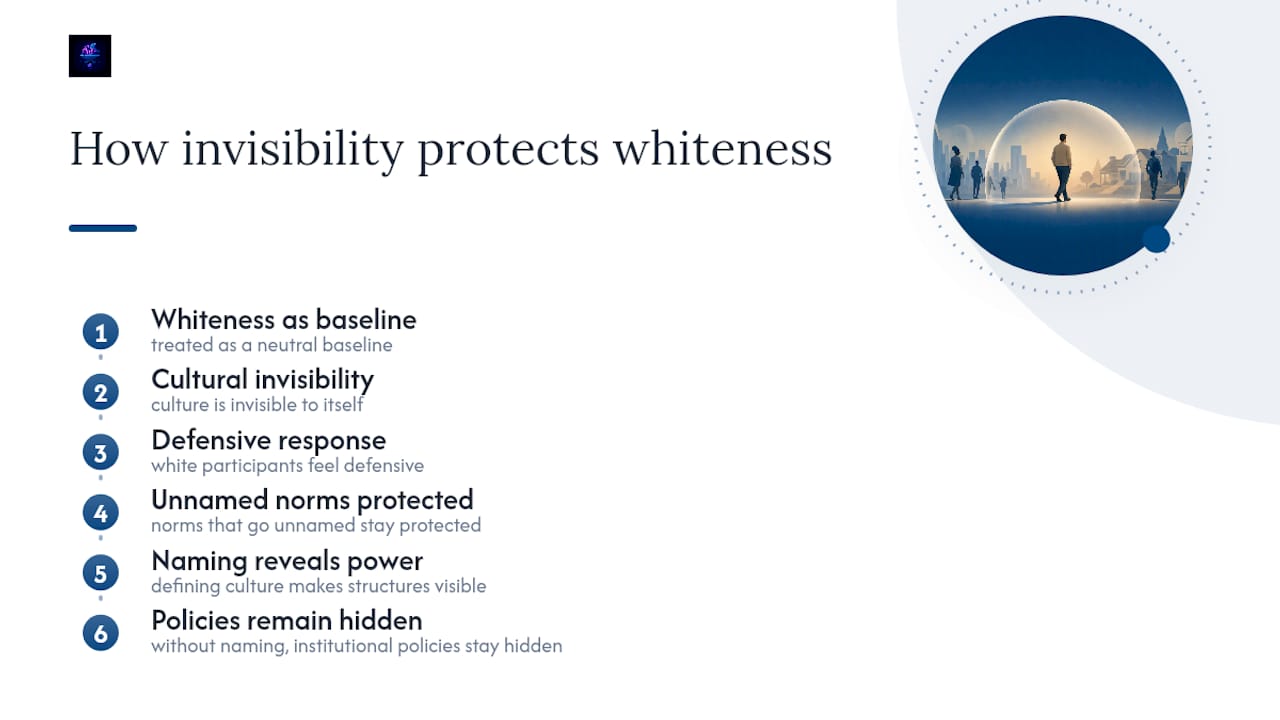
The Guardian's long-form explainer on white culture argues that whiteness is treated as a neutral baseline against which other cultures are measured. When a culture is invisible to itself, its norms feel like common sense rather than cultural choices. That invisibility is exactly what makes naming it so charged.
Facilitators who run workshops on dissecting white culture consistently report that white participants feel defensive when asked to identify their own cultural norms. That defensiveness is itself evidence of the dynamic: norms that go unnamed stay protected. Defining white culture, as The Guardian piece argues, helps make invisible power structures visible. Without naming them, institutional policies that benefit from those structures stay hidden.
Everyday examples of "crazy-making" behavior
A Michigan Daily essay on the related phrase "That's some white people shit" illustrates how cultural shorthand phrases function as both critique and self-preservation. The essay shows that these phrases protect Black joy by naming a pattern without requiring a full explanation every time it occurs.
Common "crazy-making" incidents include:
- Workplace microaggressions followed by "I didn't mean it that way" when named
- Clinical misdiagnoses that reflect cultural bias in assessment tools
- Tokenism that places one Black employee as representative of an entire community
- Dismissing a documented pattern of discrimination as an individual misunderstanding
- Structural policies that are race-neutral on paper but racially disparate in effect
Comparison: behavior categories and their typical effects
| Behavior category | Typical effect on people of color |
|---|---|
| Racial gaslighting | Self-doubt, emotional exhaustion, distrust of one's own perception |
| Whiteness-as-default norms in institutions | Exclusion, pressure to assimilate, erasure of cultural identity |
| Tokenism | Isolation, hypervisibility, added labor of "representing" a group |
| Dismissal of named discrimination | Silencing, compounded frustration, reduced willingness to report |
| Culturally biased clinical tools | Misdiagnosis, under-treatment, distrust of health systems |
The real caution: essentialism and stereotyping
The phrase carries a genuine risk. Labeling behaviors as inherently "white" can slide into the same essentialist logic it critiques. Practitioners and cultural critics consistently warn that effective critique targets concrete patterns and systems, not abstract racial character. The difference matters:
- Saying "this policy produces racially disparate outcomes" is specific and defensible.
- Saying "white people do X" as a universal claim attributes a systemic pattern to every individual in a demographic.
The phrase works as shorthand within communities that share the context. Outside that context, it can read as a blanket statement that shuts down rather than opens up conversation.
How to discuss the phrase constructively
Pro Tip: When you use the phrase or hear it used, ask: "What specific behavior or pattern are we naming?" Anchoring the conversation to a concrete incident keeps it from collapsing into a debate about whether the phrase itself is fair.
Practical conversation tips:
- Name the pattern, not the person: "That response dismissed your experience" rather than "white people always do that."
- Ask for specifics before responding defensively or dismissively.
- Acknowledge that systemic patterns and individual intent can both be true at once.
- Recognize that the phrase often signals emotional exhaustion, not a request for debate.
- Invite evidence-based dialogue: "Can you tell me more about what happened?"
Why this conversation still matters
The phrase "white people crazy" carries weight precisely because it names something real without requiring a dissertation to explain it. For readers exploring race and mental health, that kind of shorthand is not trivial. It saves emotional labor. It validates experiences that institutions have spent decades dismissing.
What Lassiter's book does that most commentary does not is ground the phrase in clinical expertise. He is not asking readers to laugh at white people. He is asking them to take seriously the psychological cost of navigating systems built around whiteness as a default. That is a harder, more useful argument.
The caution against essentialism is real, and it belongs in this conversation. But the caution should not become a reason to avoid the conversation entirely. Naming a pattern is the first step toward changing it. Readers who find the phrase uncomfortable might ask themselves whether that discomfort is about the phrase or about what it points to. For readers who have lived the experiences Lassiter describes, the phrase needs no defense. It is recognition.
Accessible audio makes this book available to more readers
Lassiter's essays deserve a wide audience, including readers who face barriers to print. Coreforgeaudio is built for exactly that reader: someone who needs human-narrated audio, dyslexia-friendly text options, or adjustable narration speeds to access the books that matter to them.

The platform is actively building its library and its accessibility features, including multilingual support and personalized voice options. Not every title is available yet, but the mission is clear: no reader should be locked out of important stories because of how their brain processes text. Check Coreforgeaudio to see current availability, sign up for updates, or support the platform's micro-donation campaign to help bring more titles like Lassiter's to readers who need them most. You can also explore how accessible reading materials support readers whose experiences are too often minimized.
Sources
- How I Know White People are Crazy and Other Stories, a book by author Dr. Jonathan Mathias Lassiter. A collection of provocative, insightful, and moving essays. At once a critique of racism in the mental health field, and vivid account of a Gay, Black man overcoming oppression to become a doctor of psychology. — Jonathan Lassiter, PhD
- How I Know White People are Crazy and Other Stories by Dr. Jonathan Lassiter | Hachette Book Group
- What is white culture? — Dissecting Whiteness
- What is white culture, exactly? Here's what the stats say
- Denying Black joy and defining what’s for white people
- Bookshop