

The Hundred Dresses is Eleanor Estes's 1944 children's novel about a Polish American girl named Wanda Petronski who is quietly, relentlessly mocked by her classmates — and what her silence ultimately reveals about dignity, cruelty, and the cost of doing nothing. This page covers everything you need to know about the book:
- Plot summary (including the ending and the drawing contest reveal)
- Character analysis of Wanda Petronski, Maddie, Peggy, and others
- Core themes — bullying, bystander guilt, empathy, and the irony of civic ideals
- Critical reception and awards, including the Newbery Honor
- Available editions and formats, including audiobook and ebook options
- Reading level and classroom use, with lesson ideas and discussion questions
- Expert and educator analysis grounded in literary scholarship
- Accessibility options for readers with barriers, including what Coreforgeaudio offers
- Useful sources for further reading and classroom planning
Illustrated by Louis Slobodkin and published originally by Harcourt, Brace and Co., the book earned its Newbery Honor in 1945 and has never left classroom reading lists since.
Table of Contents
- Quick facts about The Hundred Dresses
- What happens in The Hundred Dresses?
- Who are the main characters?
- What are the main themes in The Hundred Dresses?
- How has The Hundred Dresses been received over time?
- Where can you find The Hundred Dresses today?
- What grade level is The Hundred Dresses, and how do you teach it?
- Why educators and scholars trust this book
- Key Takeaways
- Why this book belongs on every accessible reading list
- Accessible audiobook access through Coreforgeaudio
- Useful sources
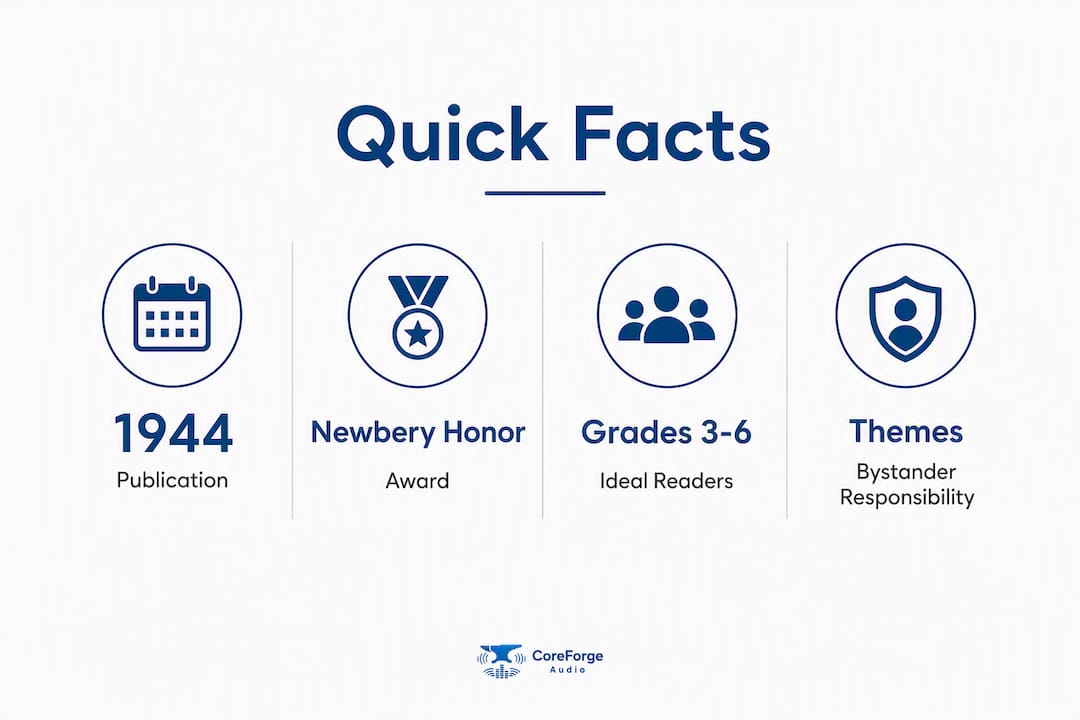
Quick facts about The Hundred Dresses
| Detail | Information |
|---|---|
| Author | Eleanor Estes |
| Illustrator | Louis Slobodkin |
| First published | 1944 |
| Original publisher | Harcourt, Brace and Co., New York |
| Award | Newbery Honor, 1945 |
| Approximate length | ~80 pages |
| Common modern edition | Harcourt paperback |
| Formats available | Hardcover, paperback, ebook, audiobook |
| Reading level | Grades 3–6 (read-aloud: K–3) |
Eleanor Estes was a librarian before she became a novelist, and that background shows in how precisely she builds the social world of Room 13. Louis Slobodkin's pencil illustrations earned their own recognition — he won the Caldecott Medal in 1944 for a different book, which gives some sense of the artistic caliber Harcourt brought to this project.
Newbery Honor, 1945: The American Library Association designated The Hundred Dresses a Newbery Honor book the year after publication, a recognition it has carried for over eighty years.
One detail worth knowing: later printings sometimes vary in how Slobodkin's illustrations are reproduced. If you are selecting an edition for classroom use, the Harcourt paperback is the most widely stocked and preserves the original illustration placement. The Library of Congress catalog record and the Internet Archive both document the original 1944 edition for those who want to compare.
What happens in The Hundred Dresses?
Wanda Petronski, a quiet Polish American girl in a Connecticut elementary school, sits alone at the back of Room 13 and wears the same faded blue dress every day. When classmates Peggy and Maddie ask her about her clothes, Wanda claims she has a hundred dresses at home — all lined up in her closet, velvet and silk, every color imaginable. The girls laugh. The "Dress Game" becomes a daily ritual of mockery that Wanda endures without visible reaction.
The story's moral engine runs on four key movements:
- The teasing begins. Peggy leads the questioning; Maddie follows along, uncomfortable but silent, afraid that speaking up will redirect the cruelty toward her.
- Wanda stops coming to school. Her absence goes unnoticed at first, until a letter from her father arrives: the family is moving to a city where people won't make fun of their name.
- The drawing contest reveals the truth. The class holds an art contest, and Wanda has submitted one hundred drawings of dresses — each one original, each one beautiful. She wins. The "hundred dresses" were real, in the only way she could make them real.
- Remorse and symbolic closure. Maddie and Peggy write to Wanda, but she has already moved. Wanda's reply gifts each girl one of her drawings. The reconciliation never happens face to face.
That ending is the book's sharpest point. Wanda's hundred drawings are not just an art-contest win — they are proof that she was telling the truth all along, and that the class's laughter was directed at something real and private. Maddie's guilt doesn't dissolve with Wanda's kind letter. It stays. Estes refuses to let the reader off the hook either.
Who are the main characters?
- Wanda Petronski — The Polish American outsider whose quiet dignity anchors the story. She never retaliates, never cries in public, and her talent is only revealed after she is gone. She represents the cost of social exclusion and the persistence of inherent worth.
- Maddie (Madeline) — The story's true protagonist. A bystander who knows the teasing is wrong but says nothing, fearing she will become the next target. Her internal conflict is where the book's moral weight lives.
- Peggy — The popular girl who initiates the Dress Game. Estes portrays her without simple villainy; Peggy genuinely does not see herself as cruel, which makes her a more unsettling character than a straightforward bully would be.
- Miss Mason — The teacher, whose announcement of Wanda's contest win triggers the class's collective shame. She models a measured, dignified response to injustice without lecturing the children directly.
- Jan Petronski (Wanda's father) — Appears only through his letter, but his words are the narrative catalyst. His decision to move the family rather than subject Wanda to further humiliation speaks volumes about the toll quiet cruelty takes on a family.
- Jake — Wanda's younger brother, a minor presence who underscores the family's outsider status in the community.
Louis Slobodkin's illustrations reinforce these dynamics visually. Wanda is drawn slightly apart from the other children in group scenes, and her expressions are composed rather than distressed — a visual choice that mirrors the text's insistence on her dignity rather than her victimhood.

What are the main themes in The Hundred Dresses?
The book's dominant theme is bystander responsibility, not bullying itself. Estes makes Maddie the center of the story precisely because Maddie is not the aggressor. Her psychological conflict — wanting to defend Wanda but staying silent to protect her own social standing — is what gives the novel its lasting moral weight. Readers who have never bullied anyone can still see themselves in Maddie, and that recognition is what makes the book work in a classroom.

The bullying itself is worth examining closely. There is no shoving, no name-calling in the traditional sense. The cruelty is social and subtle: the Dress Game, the laughter, the way Wanda's seat at the back of the room goes unremarked. Estes understood, decades before the term "social exclusion" entered educational discourse, that this kind of harm is real and cumulative.
Educators frequently use the Gettysburg Address detail as a discussion anchor. Room 13 recites it daily. The irony that a class pledging equality "for all" then systematically excludes a classmate is not subtle, but it is effective. Students who have recited similar civic texts can feel the contradiction personally.
Three discussion prompts that work well in classroom settings:
- Ask students to describe a moment when they stayed silent during something they knew was wrong, and what stopped them from speaking. This opens Maddie's perspective without requiring students to identify as bullies.
- Have students consider what Wanda's drawings represent. Were they a response to the teasing, or something she would have made regardless? The answer changes how students read her character.
- Ask whether Wanda's letter forgiving Peggy and Maddie makes the ending satisfying or uncomfortable, and why. Most students find it both, which is the right answer.
"Wanda had stood there and said nothing, but she had made them all feel ashamed." The shame comes not from punishment but from understanding — and that distinction is what separates this book from a simple morality tale.
Pro Tip: Before leading a class discussion about the Dress Game, give students a brief anonymous writing prompt asking them to describe a time they witnessed unkindness. This surfaces personal connections privately before the group conversation begins, reducing the risk that students will perform empathy rather than feel it.
How has The Hundred Dresses been received over time?
The book earned its Newbery Honor in 1945, one year after publication — a remarkably fast recognition that reflects how clearly the American Library Association saw its literary and educational value. That designation has kept the book in library collections and school reading programs for over eighty years.
Critical reception across the decades has been consistent in two respects: praise for the book's psychological realism, and recognition that it works better as a read-aloud or guided text than as independent reading for younger children. The emotional complexity of Maddie's guilt is not always accessible to a child reading alone; it opens up in conversation.
Key markers of the book's cultural standing:
- Included on teacher-curated character education lists and anti-bullying curricula across the United States
- Commonly assigned as a read-aloud for third-graders, documented in classroom research as early as 2004
- Held in the collections of major public library systems and available through WorldCat in multiple editions
The book predates the formal anti-bullying movement in American schools by several decades, yet its framing of the problem — subtle exclusion, bystander silence, the gap between stated values and actual behavior — anticipates nearly every lesson that movement would later codify. That is not coincidence. It reflects how carefully Estes observed the social dynamics of childhood.
Where can you find The Hundred Dresses today?
The book is widely available in multiple formats, which makes it easy to match to a reader's needs or a classroom's budget.
- Free digital access — the Internet Archive hosts a digitized copy of the original 1944 edition for borrowing
A note on illustration variation: later paperback printings occasionally reformat Slobodkin's illustrations, sometimes reducing their size or repositioning them relative to the text. For classroom use where the pictures support discussion, it is worth previewing the specific edition before ordering in bulk.
Narrated audiobook versions are particularly useful for students with dyslexia, ADHD, or other reading barriers. Audiobooks have documented benefits for student literacy outcomes, and for a book where tone and pacing carry so much of the emotional weight, hearing a skilled narrator deliver Wanda's silence is a different experience than reading it on the page.
What grade level is The Hundred Dresses, and how do you teach it?
At approximately 80 pages with large print and illustrations, the book sits comfortably in the grades 3–6 range for independent reading, with read-aloud use extending down to kindergarten. The text itself is accessible; the emotional content is what requires scaffolding.
Read-aloud approach for K–2
For younger children, the book works best as a teacher-led read-aloud with frequent pauses for reaction. Stop after the first Dress Game scene and ask: "How do you think Wanda feels right now? How do you know?" Young children often pick up on Wanda's composure before they can articulate why it matters. Keep the focus on feelings rather than moral judgment at this age.
Guided discussion for grades 3–5
This is the book's natural home. Students in this range can hold Maddie's perspective in mind while also tracking Wanda's experience, which is the cognitive move the book requires. The following discussion questions work well embedded in reading:
- Why does Maddie stay quiet even though she knows the teasing is wrong?
- What does Wanda mean when she says she has a hundred dresses?
- How does the class feel after Miss Mason reads the letter? Why?
- Does Wanda's gift of the drawings change how you feel about the ending?
Standards alignment is straightforward. The book supports CCSS Reading Literature standards for character analysis (RL.3.3, RL.4.3), theme and central message (RL.3.2, RL.4.2), and point of view (RL.4.6). It also pairs naturally with writing standards that ask students to write from a character's perspective.
Extension projects for grades 5 and up
Older students can write a letter from Maddie's point of view to Wanda, written after receiving the drawing. They can also compare the book's treatment of immigration and belonging to contemporary texts, or research the historical context of Polish immigration to the United States in the early twentieth century. The Gettysburg Address irony becomes a genuine analytical essay prompt at this level.
One practical classroom management note: some students will have direct personal experience with social exclusion. Frame the opening discussion around the text rather than personal experience, and give students the option to write responses privately before sharing aloud.
Why educators and scholars trust this book
The expert consensus on The Hundred Dresses is clear: its educational value comes from psychological depth, not from simplicity. Eleanor Estes drew on her own memories and librarian experience to create a story that feels observed rather than constructed, and that authenticity is what makes it hold up across decades of classroom use.
Several findings from literary analysis and classroom research are worth knowing before you teach it:
- Maddie's bystander conflict is the psychological core of the story, not Wanda's suffering. This distinction matters pedagogically: the book is designed to implicate the reader, not just generate sympathy for a victim.
- The story deliberately avoids a face-to-face reconciliation. Wanda's gift of drawings provides symbolic closure, but Maddie's guilt is never fully resolved. Teachers should prepare students for this and resist the urge to frame the ending as a happy one.
- The Gettysburg Address irony is a documented teachable moment in educator guides, useful for connecting the book to broader conversations about the gap between stated values and actual behavior.
- Estes's semi-autobiographical approach gives the story a specificity — the Connecticut setting, the Polish surname, the particular social dynamics of a small-town classroom — that generic anti-bullying narratives lack.
One common pitfall: teachers sometimes frame the ending as redemptive and move on. Students who sense that the resolution is incomplete are right. Sitting with that discomfort, rather than resolving it, is where the deepest learning happens. A follow-up prompt asking "Does Maddie feel better at the end? Should she?" tends to generate the most honest classroom conversation.
For students with reading barriers, licensed audiobook versions in teaching contexts can make the book's tonal subtleties more accessible. The narration carries emotional cues that some struggling readers miss on the page.
Key Takeaways
The Hundred Dresses is a 1944 Newbery Honor novel by Eleanor Estes whose lasting classroom power comes from centering the bystander's guilt rather than the victim's suffering, making it one of the most psychologically honest books in elementary literature.
| Point | Details |
|---|---|
| Publication and award | First published in 1944 by Harcourt, Brace and Co.; designated a Newbery Honor book in 1945. |
| Core moral focus | The story centers on Maddie's bystander guilt, not Wanda's victimhood — a distinction that makes it more effective for empathy education. |
| Classroom grade range | Best suited for grades 3–6 independent reading; read-aloud use extends to kindergarten with teacher scaffolding. |
| Ending and closure | The story avoids face-to-face reconciliation; Wanda's gift of drawings provides symbolic closure, not a tidy resolution. |
| Coreforgeaudio | Offers accessible, human-narrated audiobook options for readers with dyslexia, ADHD, or visual impairments — a format that suits this book's tonal complexity. |
Why this book belongs on every accessible reading list
Stories about exclusion hit differently when you already know what it feels like to be left out of a format. A child with dyslexia who struggles through a printed page is not getting the same experience of The Hundred Dresses that a fluent reader gets — and the book's emotional precision depends on pacing, tone, and the rhythm of Estes's sentences. That gap is real, and it matters.
What strikes me most about this book, after reading it alongside the scholarship, is how deliberately Estes constructed Wanda's dignity. She never lets Wanda cry in front of her classmates. She never lets the reader see Wanda as pitiable. The drawings reveal that Wanda had an interior life richer than anyone in Room 13 imagined — and that revelation lands harder because Wanda is already gone. You cannot apologize to someone who has moved away. That is the lesson, and it is not a comfortable one.
The tendency in classroom use is to soften that discomfort. Teachers want resolution; students want to feel that Maddie's guilt is eventually lifted. Estes does not give them that, and neither should the lesson plan. The most honest teaching of this book holds the ending open and asks students to live in the uncertainty for a while.
For educators who want to extend that experience to students who learn through listening, the audiobook format is not a lesser version of the text. It is a different and sometimes more powerful one.
Accessible audiobook access through Coreforgeaudio
For readers who learn best through listening, The Hundred Dresses is exactly the kind of book that deserves a high-quality narrated version. The story's emotional weight lives in its pacing and tone — details that a skilled human narrator can deliver in ways that printed text alone sometimes cannot.

Coreforgeaudio is building an accessible audiobook platform designed specifically for readers with dyslexia, ADHD, visual impairments, and other reading barriers. The platform features human narration (not AI-generated audio), dyslexia-friendly fonts, adjustable narration speeds, and multilingual support. For educators, classroom licensing options are in development to make accessible listening a standard part of the reading curriculum rather than an afterthought.
The platform is currently fundraising through a micro-donation campaign, with early-access reward tiers available for supporters. Educators interested in classroom audiobook access for titles like The Hundred Dresses can visit Coreforgeaudio to join the waitlist, support the campaign, or request information about classroom licensing. Every donation directly funds licensing, human narrator compensation, and accessibility tool development.
Useful sources
- The Hundred Dresses — Wikipedia — Bibliographic facts, Newbery Honor citation, classroom use data, and publication history.
- Library of Congress catalog record — Primary bibliographic record for the original 1944 edition.
- Internet Archive — original 1944 edition — Free digital borrowing of the Harcourt, Brace and Co. first edition, with full publication metadata.
- The Hundred Dresses Summary and Analysis — Litbug — Detailed plot summary and literary analysis, with strong coverage of Maddie's bystander role and the drawing contest reveal.
- The Hundred Dresses Themes — GradeSaver — Theme breakdowns and classroom discussion material, including the Gettysburg Address irony.
- Eleanor Estes — EBSCO Research Starters — Author biography, librarian background, and scholarly context for the book's educational relevance.
- ALA Newbery Honor list — Official American Library Association record of Newbery Honor designations.
- Review: The Hundred Dresses — Montclair University IAPC — Critical review with attention to the book's philosophical and educational dimensions.
- WorldCat edition record — Library holdings and edition information for locating copies through interlibrary loan.