
Finding an accessible audiobook service with clear pricing, human narration, or support for neurodiverse needs is more difficult than it should be. Many platforms hide pricing, rely mostly on synthetic voices, or lack clear support for dyslexia and ADHD accessibility settings. This comparison details features, language coverage, and accessibility design so individuals and organizations can match a platform to their needs without trial and error.
Table of Contents
CoreForge Audio
At a Glance
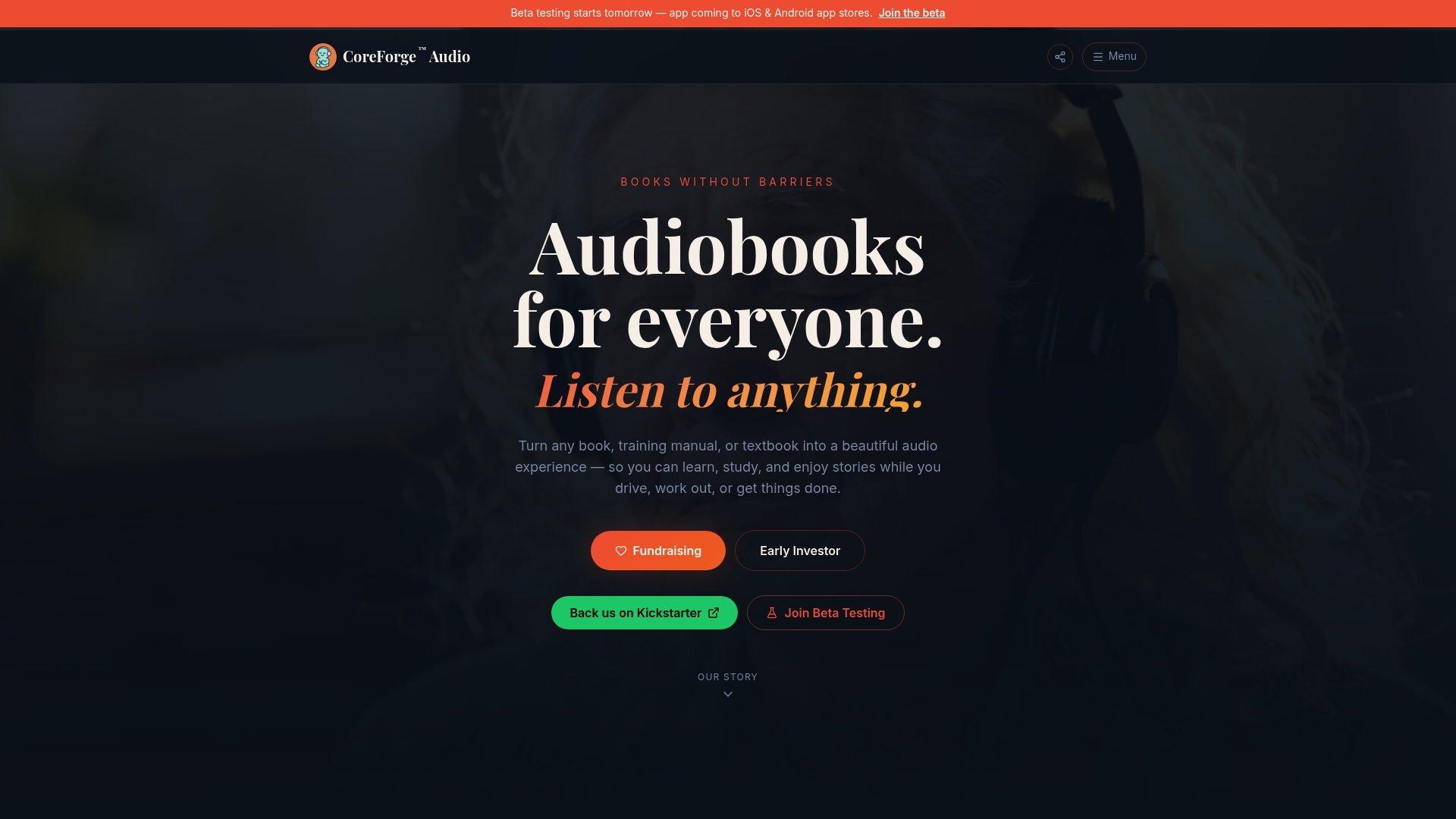
The app is in beta testing for iOS and Android. CoreForge Audio operates as a nonprofit-focused accessible audiobook platform that prioritizes fair pay for narrators. It targets readers with dyslexia, ADHD, low vision, and busy schedules by combining human narration, multilingual support, and accessible UI features.
Core Features
CoreForge Audio converts books, manuals, and PDFs into narrated audio while offering real human narrators rather than synthetic voices. The platform includes voice personalization and adjustable narration speeds, plus multilingual narration and interface options. Design choices include dyslexia-friendly fonts and layout choices that aim to reduce reading friction for neurodiverse listeners.
Key Differentiator
Built from the ground up with accessibility and human narration at its core, CoreForge Audio centers inclusive storytelling in product design. That emphasis shows in its narrator-first model and UI elements tuned for dyslexic and low-vision readers. The nonprofit focus and explicit commitment to fair pay for voice talent separate it from catalogs that rely mainly on automated voices.
Pros
The platform focuses on accessibility and inclusive design, which matters for people who cannot rely on standard ebook layouts. Using human narrators delivers expressive storytelling and supports fair compensation for voice actors. Community-driven development and an open approach let listeners influence features and priorities as the app leaves beta.
Cons
- Still in beta; features may be limited or evolving.
Who It's For
CoreForge Audio fits individuals with reading barriers such as dyslexia, visual impairment, or ADHD who prefer human narration. It also suits students and professionals who need textbooks or manuals read aloud during commutes or work. Advocates and organizations seeking ethically sourced audio content will find the platform aligned with fairness and accessibility goals.
Unique Value Proposition
Human-narrated audiobooks paired with dyslexia-friendly fonts and adjustable speeds create an audio experience tuned for people with reading barriers. The nonprofit funding model and micro-donation fundraising aim to keep costs transparent while supporting narrator pay. That model changes how institutions and individual listeners can access narrated content without relying solely on automated voices.
Real World Use Case
A college student with dyslexia listens to a required textbook on their commute using adjustable speeds and dyslexia-friendly UI. The student benefits from natural emphasis and pacing that human narrators provide. Community feedback tools let the student request improvements to navigation and bookmarking for study sessions.
Pricing
CoreForge Audio has not published pricing or subscription tiers yet. The project is still in beta and plans to announce pricing after launch. The platform uses a micro-donation fundraising approach to cover licensing, development, and accessibility tool costs while committing to fair narrator compensation.
Website: https://coreforgeaudio.com
Peech
At a Glance
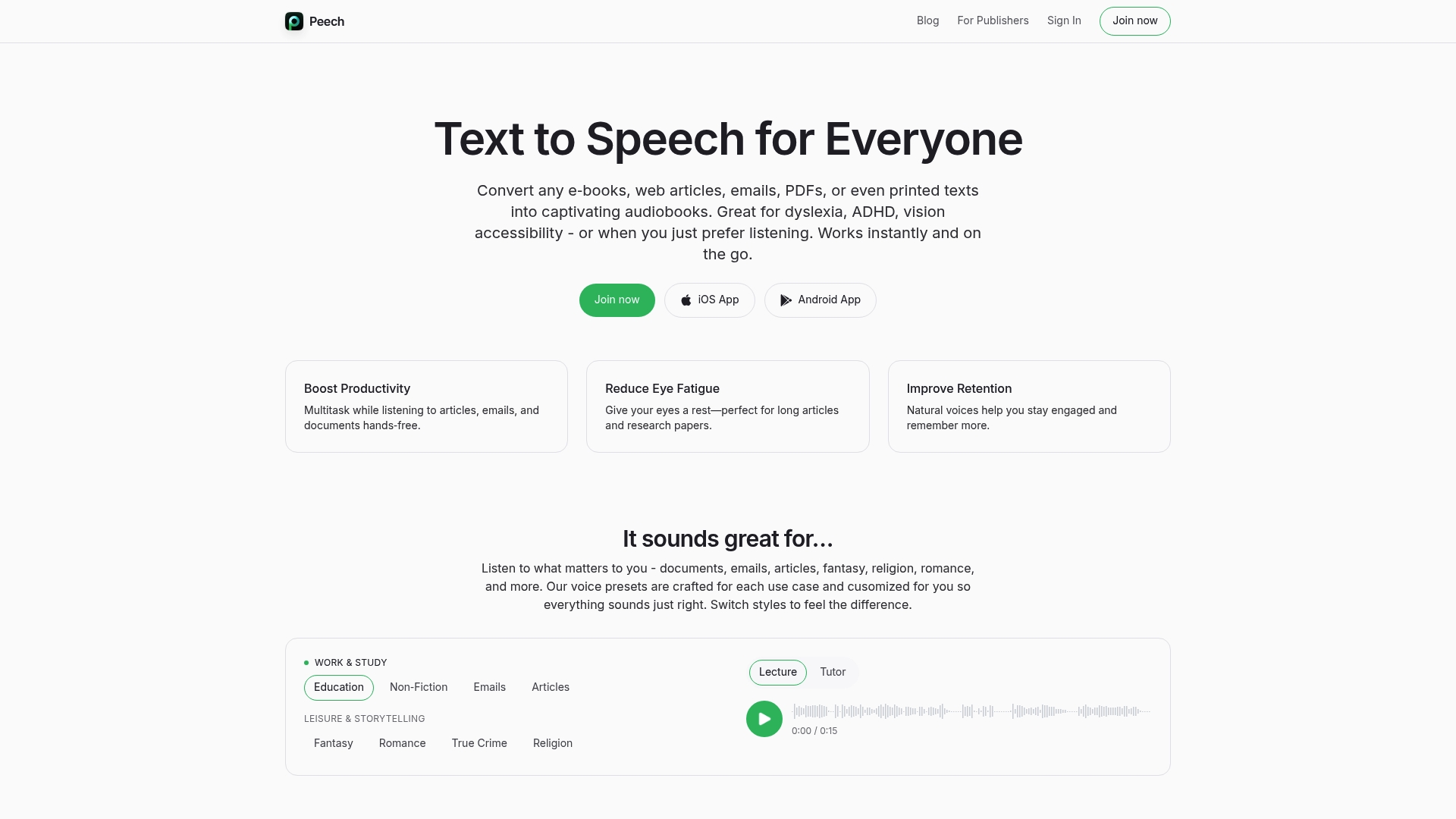
Peech advertises best-in-class OCR for handwritten notes and scanned documents. According to the company, it supports more than 60 languages and a variety of expressive voice presets. That combination targets people who need accurate text capture plus natural-sounding audio for study or accessibility.
Core Features
Peech converts PDFs, eBooks, web articles, and handwritten notes into spoken audio while offering speed control and synchronized highlighting. The platform includes multiple voice presets, including ASMR and anime styles, and supports multiline voices for structured text. Its OCR claims strong accuracy for handwritten and scanned inputs, which pairs with language support to widen content coverage.
Key Differentiator
The standout is the pairing of OCR for handwritten content with natural voice presets across many languages. That mix lets you turn lecture notes and scanned chapters into listenable audio without manual transcription. Few alternatives combine the same level of handwritten text capture and expressive voice variety.
Pros
Peech delivers natural and engaging voices that make long reading sessions less fatiguing. The synchronized highlighting helps follow along and improves focus for learners with reading barriers. Broad input support means you can feed in PDFs, web articles, eBooks, and handwritten scans without jumping between tools. Multiline voices and multiple presets give creators options for tone and pacing when producing narration.
Cons
- Pricing information is not published, which makes total cost unclear for long term use.
- Limits on number of texts or session duration are not disclosed, so workflow constraints are unknown.
- Public buyer reviews emphasize voice quality but provide little information on support response times or SLAs.
When It May Not Fit
If you need transparent pricing to budget for district or campus licenses, this product may not fit. Organizations that require published usage limits or guarantees will find missing details. Teams that depend on fast, documented support may want a vendor that lists service channels and response expectations.
Who It's For
Peech fits students, educators, and content creators who need to listen to classroom materials and scanned notes. It also serves people with dyslexia or vision impairment who rely on clear, expressive narration. Independent creators who produce audiobooks or serialized narration will value the variety of voice presets.
Real World Use Case
A university student scans handwritten lecture sheets and uploads the images to Peech. The OCR converts the notes and Peech reads them aloud with synchronized highlighting. The student listens while commuting and uses speed control to match study time.
Pricing
Pricing is not listed in the product information. The vendor presents features and use cases but does not publish subscription tiers or per-minute rates. Prospective buyers must contact the vendor for licensing or subscription details before committing.
Website: https://getpeech.com
Voicemaker
At a Glance
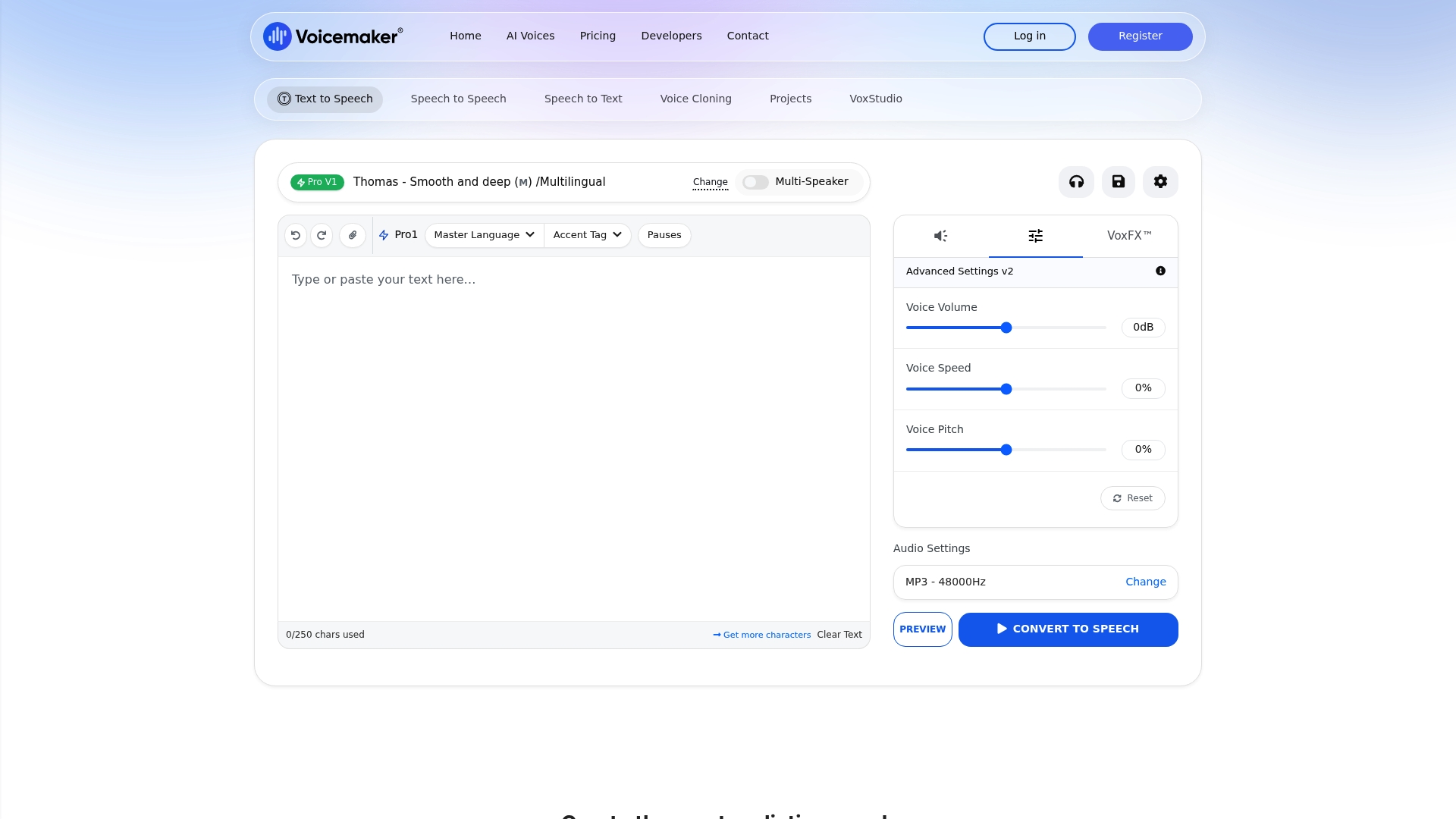
Supports over 130 languages for text to speech and voice transformation. The platform advertises real time, multi language, expressive voice cloning with AI generated effects. That range makes it a strong option for projects that need many accents or quick language variants.
Core Features
Voicemaker offers text to speech, speech to speech, and voice cloning in one product set. It includes a project manager for organizing multiple audio tracks and a pronunciation editor to keep output consistent across languages. The platform also provides API access, so developers can integrate speech synthesis into apps and workflows.
Key Differentiator
The standout feature is its real time, multi language, expressive voice cloning capability with applied AI effects. That capability lets teams generate emotive speech and adjust tone quickly for different markets. The combination of cloning plus language breadth is rare in single product offerings.
Pros
Supports a wide set of languages and accents, which reduces the need for separate regional voice vendors. The output aims for studio quality audio, so files usually need minimal post production for broadcast or online video. Advanced elements such as voice cloning and expressive models let creators match mood and pacing across episodes or campaigns, and API access supports automation for larger pipelines.
Cons
- Character count limits on lower tier plans can restrict long form work or bulk conversion.
- The interface exposes many knobs and effects, which creates a learning curve for new users.
- Free usage is limited and the character based billing may become costly for high volume projects.
When It May Not Fit
If you need unrestricted long form audiobook production on a tight budget, lower tier character limits will be a problem. If your team prefers a minimal interface, the many options here can slow onboarding. For very high volume output, per character billing may increase operational costs.
Who It's For
Content creators who need multilingual voiceovers and adjustable expression will find this product useful. Developers who want API driven text to speech and speech to speech flows can integrate it into apps. Small to large businesses that require localized audio for marketing or customer interactions will see the most value.
Real World Use Case
A media production company uses Voicemaker to build multilingual voiceovers for global marketing campaigns. They clone a brand voice, then generate local language variants for regional ads and landing pages. That approach cuts recording time and lowers coordination across markets.
Pricing
A free plan exists with limited features for testing and light use. Paid plans start at $5/month for hobbyists and $10/month for professionals, with higher tiers for business solutions. Billing is character based, so choose a plan that matches your expected monthly volume.
Website: https://voicemaker.in
ElevenLabs
At a Glance
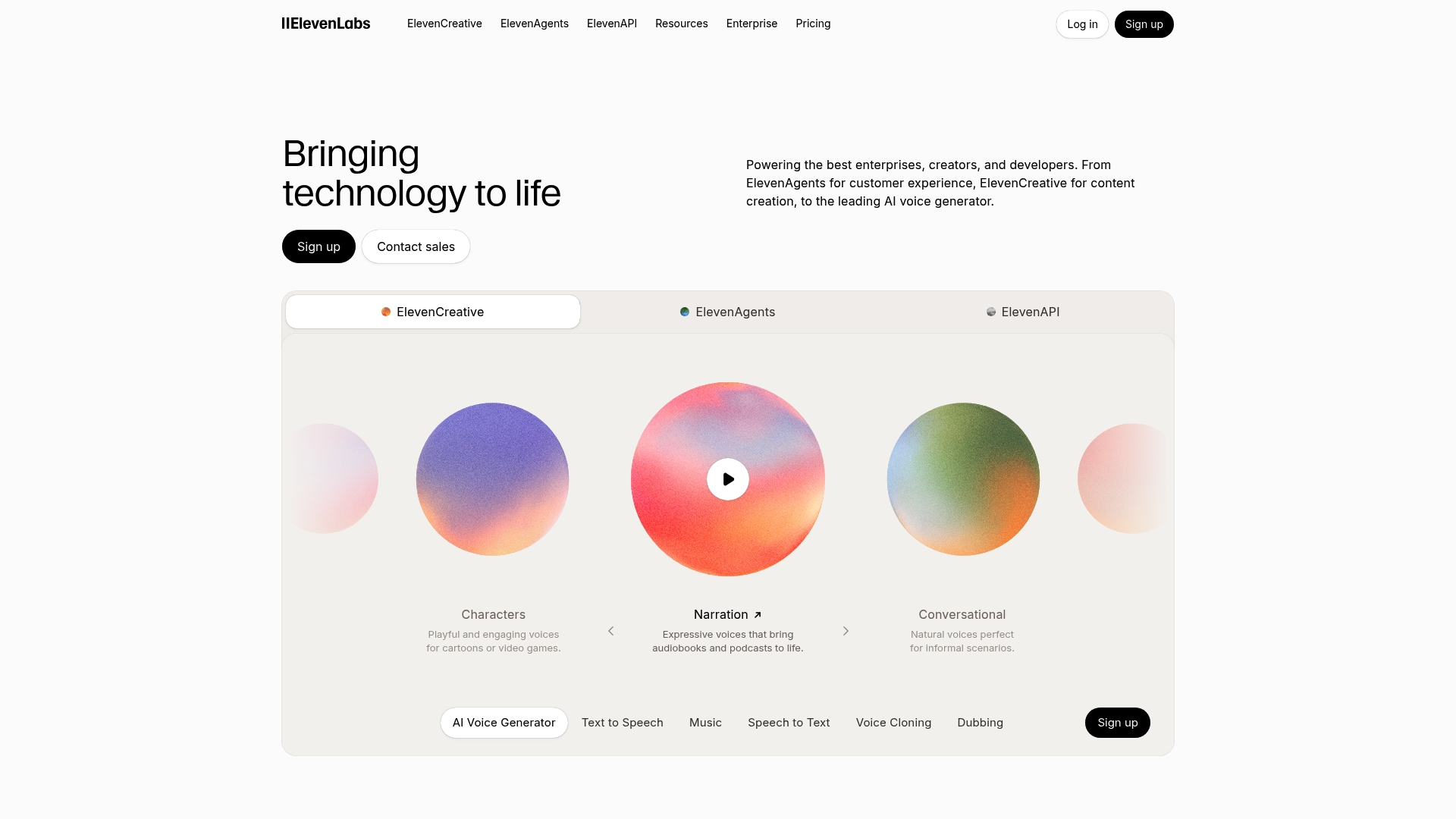
Supports more than 70 languages for speech generation, which makes multilingual audio projects feasible without piecing together separate tools. The platform markets distinct products for creators and enterprises, including ElevenCreative, ElevenAgents, and ElevenAPI. It also advertises enterprise-grade security features and regional data residency options.
Core Features
ElevenLabs combines high-fidelity voice synthesis and voice cloning with real-time speech-to-text transcription and multilingual output. The product family includes a creative studio for content production and an API for embedding voices into apps and services. The platform also offers AI-driven music and image generation alongside conversational agent tooling.
Key Differentiator
ElevenLabs focuses on emotionally expressive, near-natural voices across a broad language set while supporting enterprise security controls. That emphasis makes it a stronger fit for large brands and developer teams than for Coreforgeaudio, which centers on human-narrated audiobooks and nonprofit accessibility work.
Pros
The voice output produces realistic intonation and clear emotional cues, which helps narration and character-driven scripts. Multilingual support lets teams reuse a single voice strategy across global markets. The API and product split let developers integrate voice generation into customer support flows and content pipelines. The vendor highlights privacy and compliance features including SOC2 and GDPR support, which matters for regulated deployments.
Cons
- Pricing details are not specified. This lack of transparency makes cost planning difficult for small teams.
- Many advanced features require developer resources to integrate and scale. Nontechnical teams may need outside help.
- Limited public information about the user interface makes it hard to judge usability for nontechnical creators.
When It May Not Fit
Small publishers, solo podcasters, or nonprofits without engineering capacity may find the platform too complex and costly. Teams that prioritize human narration and voice actor compensation models will prefer a service focused on live talent. Projects that need an out-of-the-box, nontechnical app for audiobook production could face friction here.
Notable Integrations
Integrations include Salesforce, Twilio, and Zapier, which support customer service and automation workflows. The platform also lists Stripe, Zendesk, Hubspot, and Cal.com, enabling billing, ticketing, marketing, and booking use cases. Those connections make ElevenLabs easier to weave into enterprise stacks and contact center setups.
Who It's For
Enterprises, developer teams, and content studios that need scalable, customizable voice and agent technology will find this platform appropriate. Content creators with in-house engineering can use the API to automate production. Organizations that must meet privacy and compliance requirements will value the vendor's security controls.
Real World Use Case
Nvidia uses ElevenLabs technology for multilingual marketing content, turning scripts into native-sounding audio for regional campaigns. Walmart deploys voice agents built on the platform for customer support across channels. These examples show the product at scale in both creative and operational roles.
Pricing
Pricing is not listed publicly. The vendor offers custom enterprise plans and free licenses through an Impact program for nonprofits and accessibility needs. Pricing will likely vary by deployment scale and regional data residency requirements.
Website: https://elevenlabs.io
Comparison of alternatives
CoreForge Audio offers inclusive audiobook narration uniquely suited for people with reading barriers, while other providers specialize in diverse audio generation capabilities and integration solutions.
Accessibility and usability
CoreForge Audio excels in its accessibility focus, including dyslexia-friendly fonts, human narrators, and adjustable narration speeds. In contrast, ElevenLabs provides scalable AI-driven voice synthesis with multilingual output primarily suited for enterprises and developers. Peech combines OCR functionality for handwritten notes with expressive voice presets, broadening its use cases. Voicemaker supports over 130 languages and accents suitable for international projects, enhancing flexibility across markets.
Multilingual support
Voicemaker leads the domain in language diversity, with support for over 130 languages and accents. This capability enables global marketing campaigns and regional adaptations of content, a dimension by other competitors. While ElevenLabs also delivers multilingual output with natural voices, its focus shifts towards enterprise-grade environments rather than accessibility-first markets. Peech and CoreForge Audio prioritize different specializations, not emphasizing wide-reaching language applications.
Best fit
- Individuals needing accessibility features designed for dyslexia and ADHD will benefit most from CoreForge Audio.
- Teams producing multilingual voiceovers for diverse markets should consider Voicemaker.
- Producers prioritizing expressive voice generation must explore Peech for its voice presets.
- Developers requiring custom integration of voice synthesis into applications might find ElevenLabs most appropriate.
Our pick
CoreForge Audio stands out for its human-narrated audiobook feature set, delivering uniquely expressive content for accessibility-focused audiences. It is the best choice for listeners requiring accessible and inclusive audiobook narration designed for systematic reading support. Yet, for multimedia production or developer-oriented applications, other services might align better with such specialized goals.
The comparison below highlights accessible audiobook services based on their unique advantages and specific user needs.
| Product | Core Feature | Key Differentiator | Best For | Pricing | Notable Limitation |
|---|---|---|---|---|---|
| Coreforgeaudio | Human-narrated audiobooks | Accessibility-focused with nonprofit model | Readers with dyslexia, ADHD, or low vision | Price not published | Features may evolve as app exits beta |
| Peech | OCR for handwritten notes | Expressive voice presets in 60+ languages | Students needing lecture note transcription | Price not published | Workflow constraints are unclear |
| Voicemaker | Multilingual voice cloning | Real-time expressive voice cloning with AI effects | Content creators needing studio-grade output | $5/month hobbyist plans | Character count limits for lower tiers |
| ElevenLabs | Scalable voice technology | Enterprise-grade privacy and compliance features | Enterprises needing multilingual solutions | Price not published | Requires technical setup for advanced features |
Challenges in Finding Speechify.com Alternatives That Truly Support Accessibility
Many readers face barriers related to dyslexia, ADHD, or visual impairments and seek audiobook platforms with human narration and accessibility features. Automated voices often lack the natural pacing and expressiveness needed by people with reading challenges. Coreforgeaudio offers a solution focused on fair compensation for narrators and enrichment through dyslexia-friendly fonts, adjustable narration speeds, and multilingual support.
Coreforgeaudio is actively building an inclusive platform designed for students, professionals, and organizations seeking ethically sourced audiobooks. This nonprofit service highlights transparency through a micro-donation campaign that funds licensing and accessibility tools. Visit Coreforgeaudio to learn about how its human-narrated, accessible audiobooks address the limits of automated alternatives.
Coreforgeaudio invites readers with reading barriers to experience storytelling that empowers education and inclusion. Join the community now and support a platform that prioritizes fair pay for voice actors alongside user-driven accessibility features.
FAQ
How does Coreforgeaudio support accessibility for users with reading barriers?
Coreforgeaudio offers features like dyslexia-friendly fonts and adjustable narration speeds to enhance accessibility. These design elements reduce reading friction and make the platform a natural fit for individuals with dyslexia, ADHD, or low vision. Users can enjoy a more tailored audiobook experience that meets their specific needs.
What is the difference between Peech and Coreforgeaudio?
Peech excels at OCR for handwritten content, converting scanned notes into spoken audio effectively. Coreforgeaudio, on the other hand, prioritizes human narration and accessible UI features tailored for users with reading challenges. While both platforms serve different purposes, Coreforgeaudio best meets the needs of those seeking human-narrated audiobooks in an accessible format.
Can I expect community support with Coreforgeaudio?
Coreforgeaudio includes community-driven development that allows listeners to influence future features and priorities. This collaborative approach provides a supportive environment for users, helping ensure the platform evolves according to user feedback and accessibility needs.
Does Coreforgeaudio provide multilingual support?
Coreforgeaudio offers multilingual narration, making it suitable for diverse audiences. Users can benefit from the platform's focus on accessible audiobook services while enjoying content in multiple languages, enhancing its usability for non-English speakers.
How does Coreforgeaudio ensure fair compensation for narrators?
Coreforgeaudio operates under a nonprofit model dedicated to fair pay for voice talent. This commitment distinguishes it from many other platforms that rely heavily on automated voices, allowing users to support ethical audiobook production while enjoying high-quality narration.