
Accessing audiobook services that balance accessibility features, ethical narration, and flexible licensing is often a stumbling block for educators, individuals with reading barriers, and content producers. Many platforms restrict key accommodation tools behind high-tier plans, use only AI narration with little oversight, or lack transparent pricing and funding models for organizations on a budget. This comparison covers community-supported, infrastructure-ready, hybrid AI-human, and accessible audiobook services so you can choose an alternative that matches your functional needs and values without compromising on usability or ethics.
Table of Contents
- CoreForge Audio
- Adaptive Reader
- DocTunes
- Meucci
- Spoken.press
- Murf AI
- Comparison of Accessible Audiobook Solutions
CoreForge Audio
At a Glance
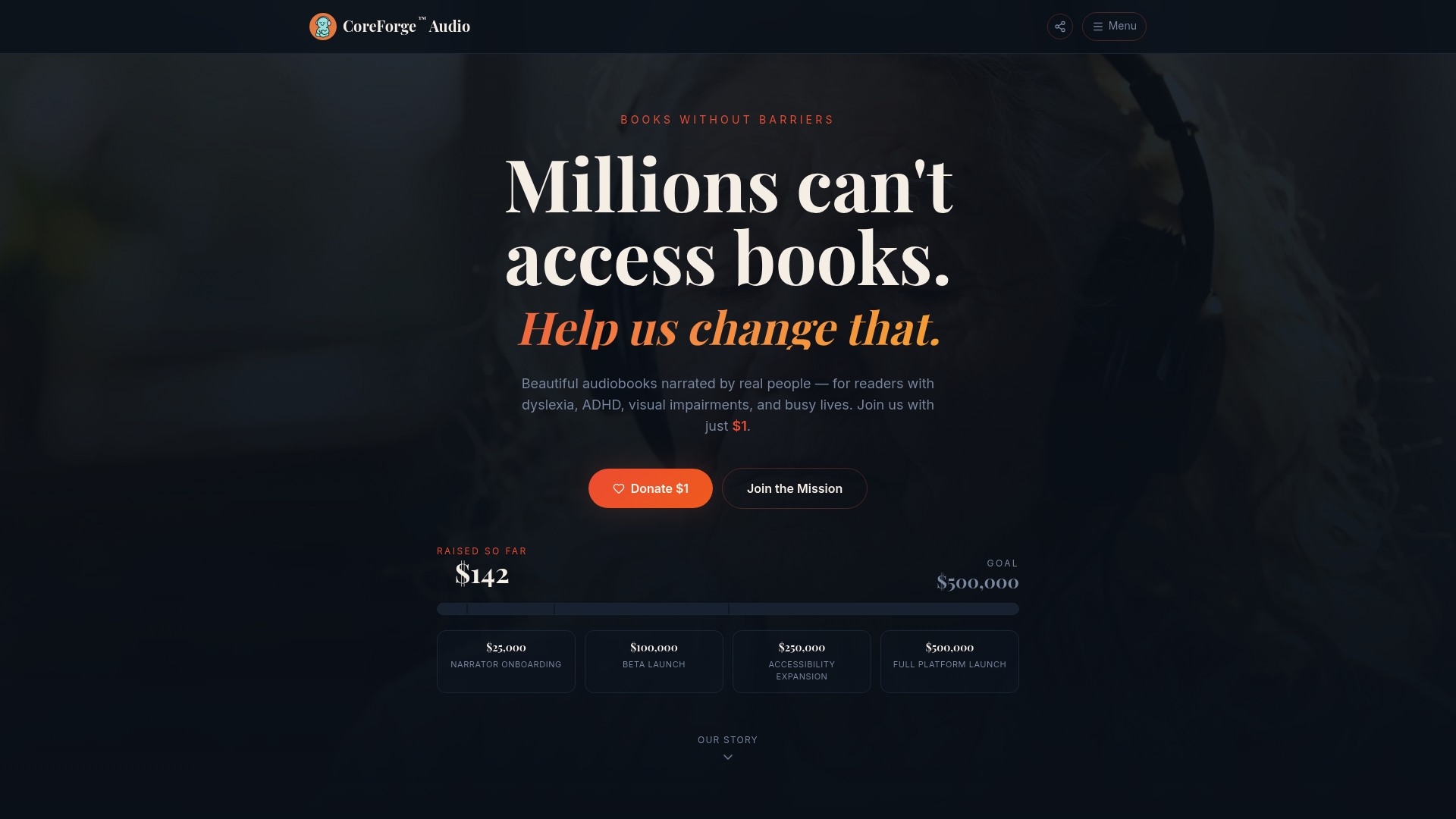
Asks for one dollar micro donations to fund licensing, development, and accessibility features rather than relying on venture capital or ad revenue. CoreForge Audio says it aims to make stories available to millions worldwide through a community supported model focused on ethical narration and accessibility.
Core Features
- Built for accessibility with dyslexia friendly fonts, adjustable narration speeds, and multilingual support for non English readers.
- Real human narrators who are licensed and paid fairly, plus voice personalization for tone, pitch, and warmth.
- AI used only for accessibility tooling such as captions, chapter navigation, and language access rather than for writing or replacing narration.
- Crowdfunding model that collects small donations to cover licensing and platform development.
Key Differentiator
Licensed, fairly paid human narrators paired with a crowdfunding model is the defining mix here. That arrangement shifts the economics of audiobook supply away from low paid gig work and towards a funded pool of narrators whose consent and pay are explicit.
Pros
-
The accessibility focus is concrete. Features like dyslexia friendly fonts and adjustable speeds target readers with dyslexia, ADHD, and visual impairment rather than treating accessibility as an afterthought.
-
The use of real human voices preserves nuance and pacing that automated narration often misses, which matters for comprehension and engagement in learners.
-
A clear stance on fair pay for narrators aligns procurement choices for libraries and schools that need ethically sourced audio content.
-
Community funding keeps recommendations transparent. For organizations that budget carefully, a micro donation model makes the cost drivers visible and tied to licensing and accessibility expenses.
-
Multilingual and customizable listening options make the catalog more usable for bilingual classrooms and multilingual households.
Cons
- Reliant on community donations, which may slow development and push launch dates if funding targets are missed; this dependence creates uncertainty about feature timelines and platform stability.
Who It's For
Individuals with reading barriers, educators, libraries, and advocacy groups seeking ethically produced audiobooks and accessibility first features. Also suited to organizations that prioritize fair compensation for narrators and want transparent funding models over corporate licensing deals.
Unique Value Proposition
Limits AI to accessibility tooling only rather than using it to generate narration. That policy preserves human performance as the primary storytelling medium while still delivering automated captions and navigation that help neurodiverse listeners. For procurement teams, the result is readable audit trails for licensing and a clearer justification when budgeting for ethical content.
Real World Use Case
A district special education team adopts CoreForge Audio to supplement classroom readers. Teachers pick dyslexia friendly versions of core texts, set slower narration speeds for some students, and rely on the captioning tools for mixed ability groups while supporting paid narrator work.
Website: https://coreforgeaudio.com
Adaptive Reader
At a Glance
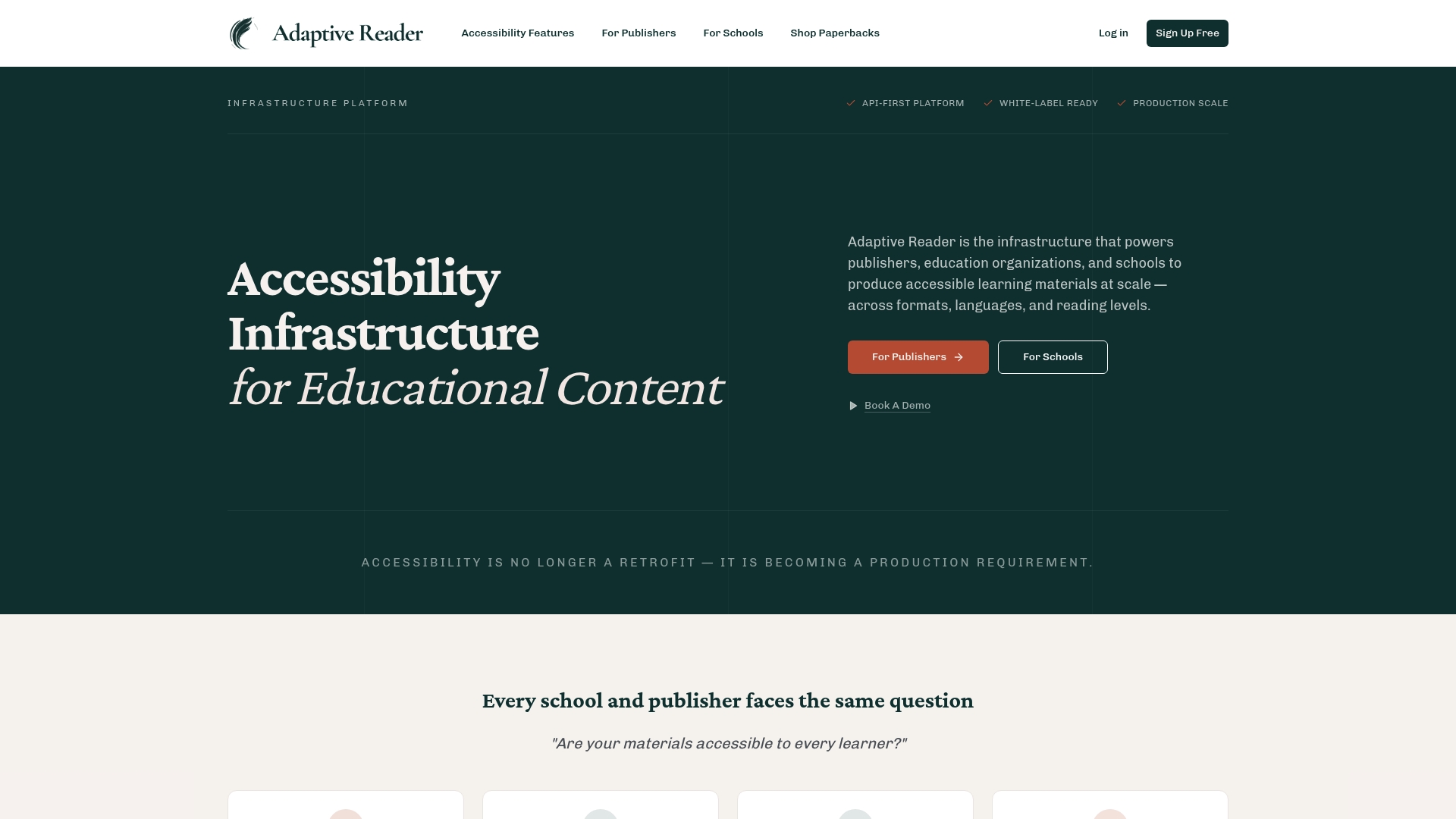
Adaptive Reader's marketing materials describe a passage-based architecture that keeps print, digital, and audio perfectly synchronized from a single source file and supports 190+ languages. The vendor also claims it shortens content remediation from months to days while meeting ADA and Section 508 requirements.
Core Features
- API-first platform for content ingestion, transformation, and delivery, built for integration into publisher and district workflows.
- White-label ready output so institutions can distribute branded accessible editions without exposing vendor UI.
- Automatic format generation that produces print, digital, and audio editions from one source using a passage-based approach.
- Production-scale tooling for high-volume catalogs and multilingual support across supported languages.
Key Differentiator
Adaptive Reader centers on that passage-based architecture so every format stays tightly aligned at the paragraph and sentence level. For organizations producing synchronized print, audio, and digital editions, that single-source model eliminates drift between formats and reduces content versioning work.
Pros
- Supports print, digital, and audio from one source file which reduces duplication of effort when updating curriculum materials.
- The vendor reports adoption by major U.S. school districts and publishers, which suggests the platform is built for institutional scale rather than one-off courses.
- The company advertises reduced remediation timelines from months to days, a claim that matters when districts face legal deadlines for accessible instructional materials.
- Privacy and compliance are prominent; the platform is designed to avoid collecting student data, which simplifies legal review for districts.
- Inclusive features such as Decode Mode™ and multilingual output expand accessibility for learners with dyslexia, limited English proficiency, or other reading barriers.
Cons
- Independent user reviews or third-party performance data are not available, so buyer validation requires a pilot or proof of concept.
- The product is infrastructure-focused, not an end-user interactive reading app, so districts that want a turnkey student reader may need a companion solution.
- Pricing is not publicly disclosed which means procurement will require direct vendor engagement and likely enterprise contracting.
When It May Not Fit
If your priority is a consumer-style reading app with built-in tutoring and engagement features, this infrastructure play will feel heavyweight and indirect. Small publishers without engineering resources may prefer hosted authoring tools rather than an API-first platform. If transparent list pricing is required to start procurement, the lack of public tiers will slow buying.
Who It's For
Educational publishers, state and large local school districts, and content service providers that must produce legally compliant accessible editions at scale. Teams with developer resources and catalog management workflows will extract the most value.
Real World Use Case
A major public school district uses Adaptive Reader to convert an entire K–12 curriculum into accessible print, digital, and audio editions. The district reduced backlog remediation time according to the vendor's materials and moved from staged fixes to near immediate access for students with reading barriers.
Pricing
Pricing is not publicly disclosed. The vendor typically engages on an enterprise basis and provides custom quotes for large catalogs, production pipelines, and white-label deployments. Expect procurement to involve a pilot and scoped pricing conversation.
Website: https://adaptivereader.com
DocTunes
At a Glance
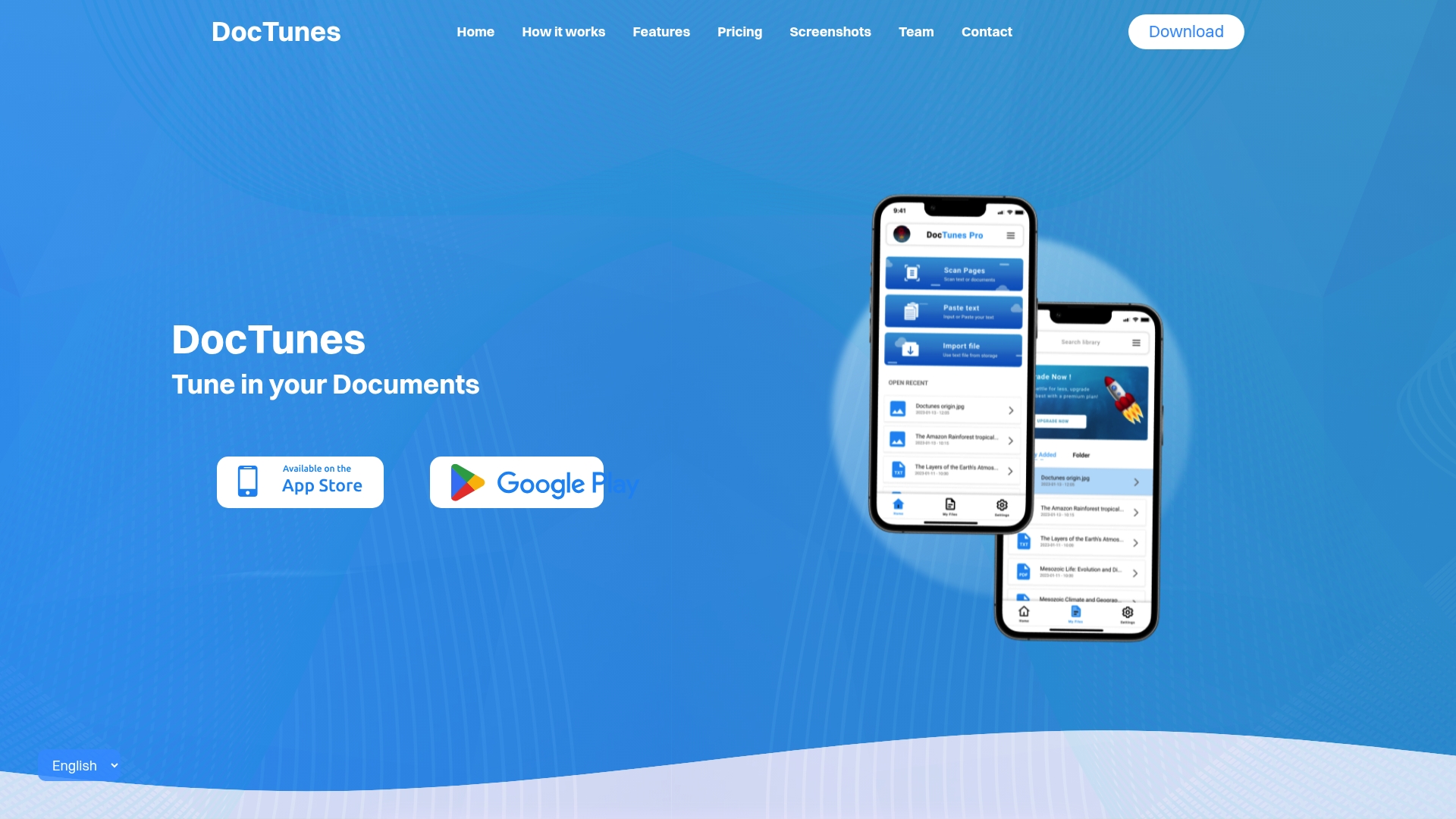
Scanned PDFs and handwritten notes convert to audio inside the mobile app, including multi-language output and adjustable voice parameters. The app blends simple playback controls with downloadable files so you can listen offline during commutes or study sessions.
Core Features
DocTunes provides a clean mobile interface for converting documents to spoken audio with custom playback settings for speed, pitch, and voice selection. It supports multiple languages and offers several premium voices for more natural delivery.
The app can process scanned PDFs and handwritten documents as a paid feature and includes offline playback so downloaded files play without a network connection.
Key Differentiator
DocTunes stands out for its combined support of multi-language conversion and scanned or handwritten source material. That mix targets users who need on-device access to nonstandard sources like photographed notes or foreign-language PDFs rather than teams that require human narration workflows and publishing controls.
Pros
-
Easy interface that gets nontechnical users listening quickly with minimal setup.
-
Multiple languages and voice options let you switch languages or accents without changing apps, useful for bilingual students and travelers.
-
Offline playback with downloads lets you keep long-form listens on your phone and avoid data charges during long trips.
-
Customizable voice parameters provide granular control over speed and pitch so listeners can match narration to comprehension preferences.
-
The app advertises high-quality AI synthesis that produces natural-sounding variation across premium voices.
Cons
-
No extended free trial beyond the base free tier; many premium capabilities require a subscription to access.
-
Full support for scanned and handwritten documents sits behind the premium plan, which raises the effective cost for heavy users.
-
The vendor provides limited information about enterprise, classroom, or team licensing, which leaves questions for institutional buyers.
When It May Not Fit
If you need verified human-narrated audiobooks with accessibility features like dyslexia-friendly fonts and guaranteed fair pay for voice actors, this app does not match that workflow. Large teams that require user management and licensing for classrooms will find the product lacking in administrative controls.
Who It's For
Individuals who convert personal notes, textbooks, or PDFs into audio for commuting, study, or language practice. It fits students, solo content creators, and accessibility-minded listeners who prefer quick mobile conversion and adjustable playback.
Real World Use Case
A multilingual student photographs handwritten lecture notes and uploads them to DocTunes. They select a slower voice, increase clarity by adjusting pitch, and download lessons for offline review during a daily train commute.
Pricing
Free tier with limited features; monthly subscription at $4.99 and a yearly plan at $49.99. Premium unlocks scanned PDF and handwritten document support plus the higher quality voice set.
Website: https://doctunes.io
Meucci
At a Glance
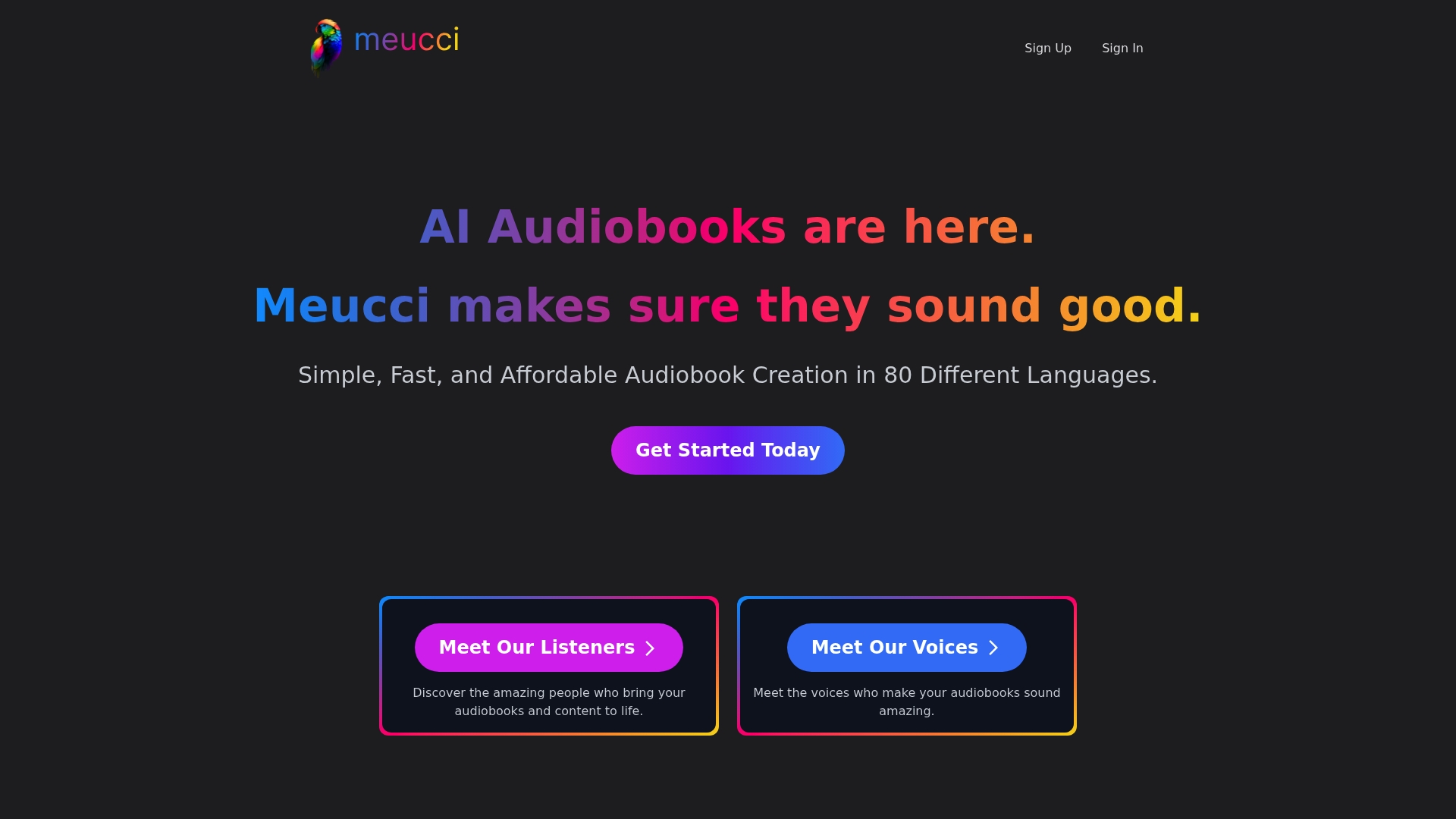
80 languages supported through an intuitive four-step workflow that pairs AI narration with human proof-listening for a finished audiobook you can download. Third-party reviews praise reliability and the platform's ability to produce custom voices, which makes it attractive to self-publishers and publishers.
Core Features
- AI-powered audiobook creation available across many languages with an emphasis on speed and exportable final files.
- A curated mix of professional voice actors and AI voices so projects can be fully human, fully synthetic, or a blend.
- Proof-listening and human quality refinement built into the workflow to catch pronunciation and pacing problems before final delivery.
- Flexible voice options, including licensed and celebrity-clone style voices where rights are cleared by the provider.
- An intuitive 4-step process: pick a voice, proof-listen, approve or request edits, then download the finished audiobook.
Key Differentiator
Meucci’s angle is the deliberate pairing of AI narration with human reviewers. That combination is positioned to reduce turnaround time while retaining human oversight for tone and errors. For teams that need bulk conversions into many languages, this hybrid model is the main selling point.
Pros
-
High-quality TTS output backed by human oversight reduces rework and speeds delivery for batch conversions.
-
Works for a wide range of publishers from independent authors to larger houses looking to scale catalog conversion.
-
Custom voice options let voice talents license their voices and let publishers request specific tone and phrasing across languages.
-
The four-step workflow keeps production simple and repeatable, which helps project managers move titles through review quickly.
-
Being German-based means multilingual support and a European operational base for rights and licensing discussions.
Cons
-
Public materials do not publish detailed transparency about pricing tiers which leaves budget planning uncertain for smaller creators.
-
The availability of celebrity-clone style voices raises ethical and licensing questions for nonprofits and projects that prioritize explicitly human narration and fair pay.
-
Relying on an AI-first pipeline may not satisfy listeners or organizations that require strictly human-narrated audiobooks for authenticity or grant reporting.
Who It's For
Self-publishers and publishing houses that need fast, language-scalable audiobook production will get the most value. Voice talents looking to license a recorded voice and audio producers combining AI efficiency with human review are also a natural fit.
Real World Use Case
A small independent press uses Meucci to convert a catalog of 20 regional nonfiction titles into four languages. Editors run the proof-listen step, request tone tweaks, and export final files within days rather than weeks, which accelerates distribution to library partners and retailers.
Website: https://meucci.org
Spoken.press
At a Glance
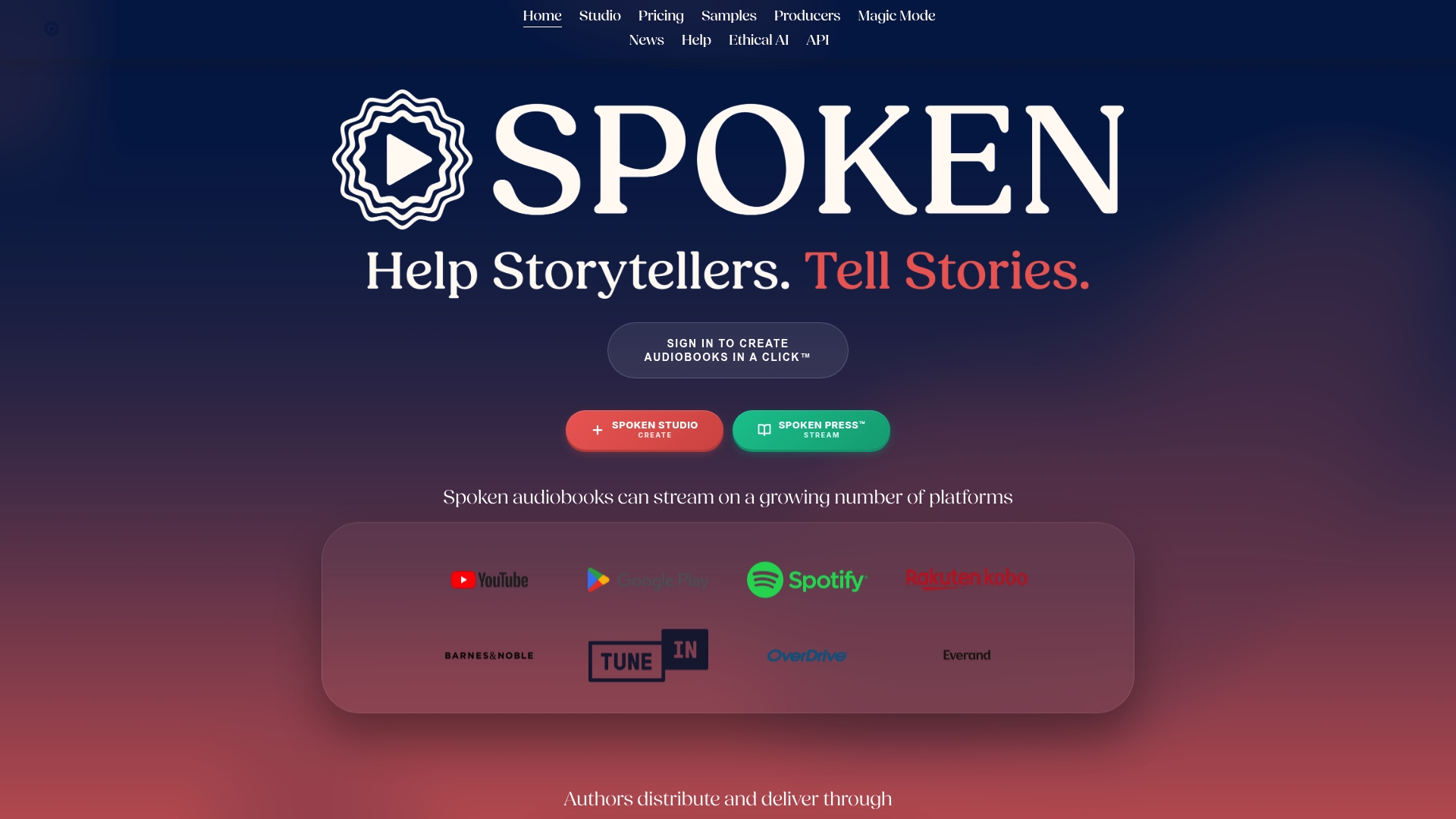
Spoken's marketing materials describe a "Pay when Perfect" workflow: you can start production for free and pay only once the audio meets your quality standards. The studio also advertises Magic Mode for cohesive multi-voice full-cast performances that sound like a directed session.
Core Features
- Custom voice generation for characters that lets you assign distinct tones and accents to cast members.
- Multiple narration formats: single narrator, dual narration, or full-cast productions tailored to dramatic and nondramatic texts.
- Magic Mode for holistic scene-level direction and pacing across multiple voices to maintain consistent performances.
- Analytical tools for story and voice customization that flag pacing, scene length, and inconsistent character voice choices.
- Built-in export and distribution workflows aimed at major platforms.
Key Differentiator
Spoken leans hard into multi-voice production with an explicit studio workflow. The combination of character-specific voice generation and scene-level orchestration via Magic Mode is meant to produce a single, cohesive performance rather than stitched-together clips. That focus makes it a production-first tool for authors who want cast-style audiobooks without hiring an ensemble.
Pros
-
Accessible cost model lowers the upfront barrier for indie authors who need studio-quality output on a budget.
-
Supports both single-narrator and full-cast approaches, so you can publish a narrated novel or a dramatized audio edition from the same project.
-
The vendor states support for distribution to YouTube, Google Play, Spotify, Kobo, and other platforms, which reduces manual distribution steps for authors.
-
Emphasizes ethical AI use with transparent voice licensing and disclosure, which simplifies rights conversations for authors and collaborators.
-
The studio environment is built for authors: tutorials, a guided workflow, and story analysis tools speed the learning curve after the first title.
Cons
-
Public, third-party reviews are sparse; the quality picture relies heavily on vendor materials and early user anecdotes.
-
The feature set is AI-centric and involves a hands-on learning curve to get character nuance and pacing right for long-form narration.
-
Some commercial channels still limit or restrict AI-narrated content, and that may reduce reach on platforms such as certain audiobook retailers.
Who It's For
Self-published authors and indie publishers who want a dramatic, cast-style audiobook without paying for a full studio. It fits writers who are comfortable iterating on voice choices and who prioritize creative control over a plug-and-play simplicity.
Real World Use Case
An indie novelist turns a 90,000-word manuscript into a full-cast audiobook. They assign unique voices to three protagonists, use Magic Mode to smooth scene transitions, refine a few chapters with the analytical tools, then export distribution-ready files for multiple stores, cutting typical production time by weeks.
Website: https://spoken.press
Murf AI
At a Glance
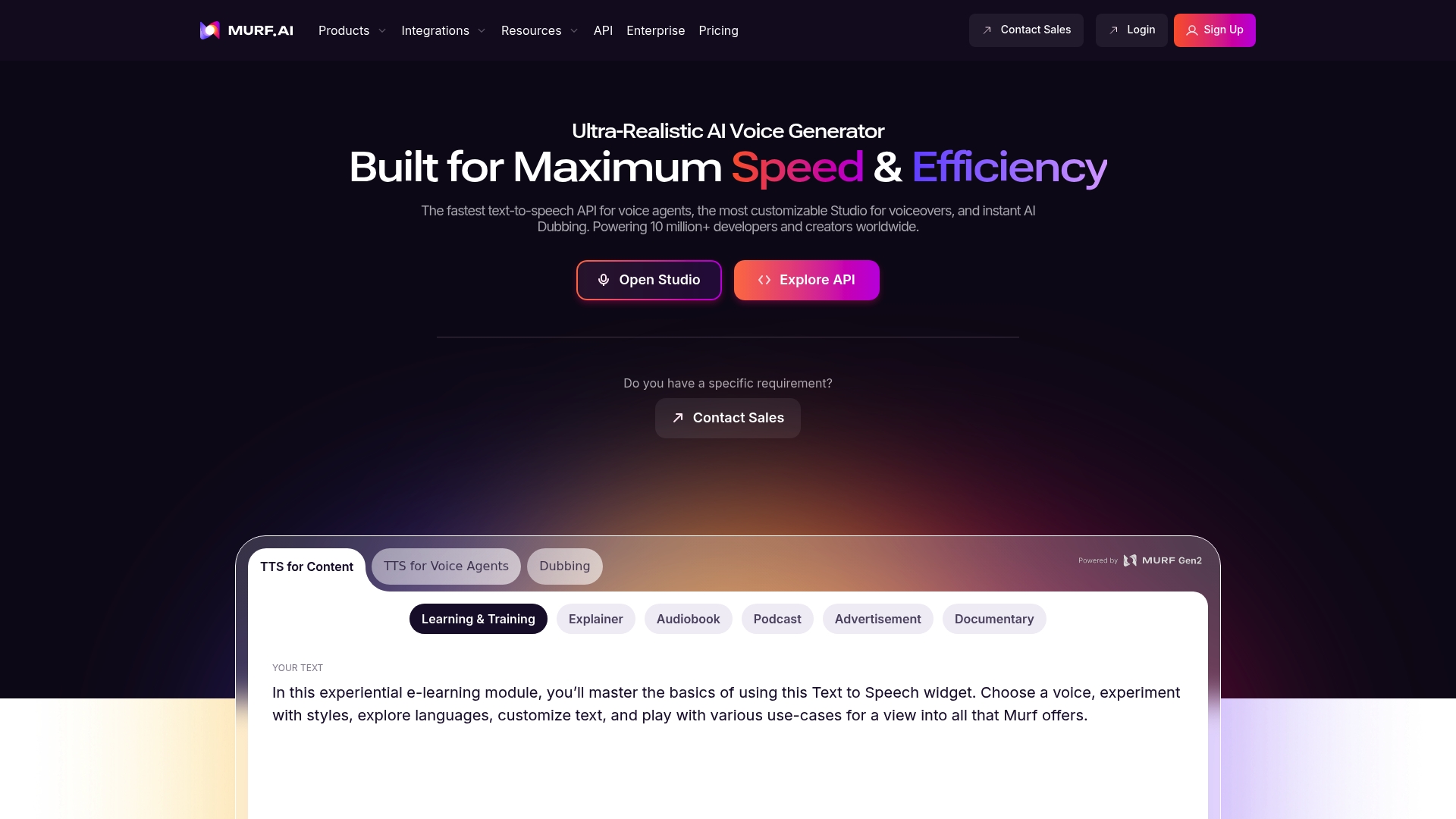
Murf AI reports more than 200 customizable voices across 35 languages and 10 accents, a large catalog for quick localization. The vendor also advertises adoption by over 300 Fortune 2000 companies and millions of creators, a marketing claim from their materials.
Core Features
- Text-to-speech conversion with 200+ voices covering 35 languages and 10 accents.
- Voice cloning and a voice changer for branded narration or character work.
- API access for building scalable voice agents and automating batches.
- Dubbing and translation across 40+ languages for multimedia localization.
- Export options and studio controls for pronunciation, emphasis, and pacing.
Key Differentiator
Murf AI positions its voice catalog and enterprise security as the differentiator. The vendor advertises enterprise-grade compliance including SOC 2, GDPR, HIPAA, and ISO 27001, paired with broad integrations for content workflows. That combination targets teams that need scale plus control.
Pros
- High-quality, natural-sounding voices speed projects. Professional teams report the voices reduce re-records and shorten production time.
- User-friendly interface lowers the ramp for editors and nontechnical stakeholders to produce voiceovers.
- Strong third-party connectivity lets multimedia teams move audio into Canva, PowerPoint, and audio suites without manual file juggling.
- Affordable entry with a free tier and paid plans starting at a modest price makes testing low-friction for creators.
- API access supports developers building voice agents or automating bulk dubbing workflows.
Cons
- Users report occasional software bugs and intermittent performance issues that require retries or workarounds.
- Some regional accents and nuanced pronunciations need manual tuning, especially on lower tiers.
- Support responsiveness varies; teams that need immediate SLA-driven help may find response times slow.
- Achieving perfect natural emphasis sometimes requires extra editing passes.
When It May Not Fit
If you need flawless regional dialects out of the box, Murf AI can demand manual phonetic tweaks or custom voice work. If your operation requires guaranteed rapid support response or zero downtime for live agents, the variable support speed is a real constraint.
Notable Integrations
Murf AI connects directly with common authoring and editing tools used in corporate and creator workflows.
- Canva
- PowerPoint
- Google Slides
- Adobe Audition
Who It's For
Content creators, product teams, and enterprises that need scalable text-to-speech for marketing videos, e-learning, and multilingual dubbing. Developers who require API access to run voice agents at scale will find the platform’s tooling and export options useful.
Real World Use Case
A global e-learning provider uses Murf AI to produce voiceovers across multiple languages for training modules, cutting turnaround and vendor costs. The company replaced multiple studio sessions with in-house edits and rapid export to LMS-ready formats.
Pricing
Try for Free with limited exports. Paid plans start at $19/month for individual creators, while enterprise solutions and custom volume pricing are available through direct contact.
Website: https://murf.ai
Comparison of Accessible Audiobook Solutions
Selecting the most suitable accessible audiobook platform requires considering several factors, such as narration quality, accessibility features, and production workflows. Below is an analysis of six solutions, highlighting their unique advantages and trade-offs.
Narration Options and Approaches
CoreForge Audio emphasizes ethical and nuanced storytelling by utilizing human narrators who are fairly compensated. This approach ensures an engaging and realistic experience for listeners. However, Meucci allows for a hybrid method, blending AI-driven narration with human proof-listening to expedite production while maintaining quality. For organizations prioritizing fast, scalable productions with human oversight, Meucci might be advantageous.
Accessibility and Integration
Adaptive Reader shines in its approach to preserving formatting consistency across print, digital, and audio formats, enhancing accessibility for large institutions. In contrast, DocTunes specializes in converting scanned and multilingual texts into audio on a mobile interface, catering to individuals looking for quick conversions during their daily routines.
Specialized Features
Spoken.press focuses on dramatized narrative creation through their "Magic Mode," enabling cohesive multi-voice productions. This functionality appeals particularly to self-publishers seeking to create engaging full-cast audiobooks. Additionally, Murf AI offers extensive multilingual customization options, making it valuable for developers and enterprises integrating voiceovers into diverse applications.
Best Fit Scenarios
- CoreForge Audio: For users prioritizing ethical sourcing, extensive accessibility features, and transparent community funding.
- Adaptive Reader: Suitable for publishers and districts requiring synchronized multi-format outputs for large-scale instructional materials.
- DocTunes: Ideal for individual learners or commuters relying on app-based audio conversions for personal documents.
- Meucci: Beneficial for projects needing scalable production capacity with human-quality oversight.
- Spoken.press: Fits independent authors focused on creating immersive full-cast narrations affordably.
Our Pick: CoreForge Audio
CoreForge Audio stands out for its commitment to ethical narration and accessible design. While other platforms cover distinct areas, its balanced focus on human storytelling, inclusive features, and transparent funding models offers a solution for many users. That said, those prioritizing institution-scale synchronizations might find Adaptive Reader's offerings better suited. Consider your production goals and audience needs to choose the platform that aligns best with your objectives.
Accessible Audiobook Platforms Comparison
Below is a comparison table to help identify the best accessible audiobook platform for your needs, emphasizing inclusivity features and ethical models.
| Platform Name | Primary Use Case | Key Differentiator | Best For | Notable Limitation |
|---|---|---|---|---|
| CoreForge Audio | Accessible audiobook support | Crowdfunded with human-narrated content | Educators and readers preferring ethical sourcing | Development depends on donation levels |
| Adaptive Reader | Multiformat content production | Passage-based format synchronization for all output types | Large districts needing high-volume production | Procurement requires vendor engagement |
| DocTunes | Mobile document to audio conversion | Scanned and custom documents with offline playback | Individuals needing language practice tools | Premium tier required for advanced features |
| Meucci | Audiobook production for publishers | AI-assisted creation with human proof-listening | Small to large publishers requiring language scalability | Limited transparency in pricing tiers |
| Spoken.press | Cast style audiobook production | Multi-voice orchestration for cohesive performances | Indie authors needing affordable studio-quality output | Learning curve due to AI focus |
| Murf AI | Scalable text-to-speech services | Wide voice catalog and enterprise compliance | Enterprises producing multilingual e-learning materials | Manual tuning needed for regional accents |
Discover an Ethical Audio Alternative Built for Accessibility and Fair Pay
When searching for trustworthy audioflo.ai alternatives that prioritize accessibility and ethical narration, Coreforgeaudio stands apart with its commitment to human-voiced audiobooks designed for readers with dyslexia, ADHD, and visual impairments. Unlike AI-driven platforms, Coreforgeaudio centers on licensed narrators paid fairly while offering useful features like dyslexia-friendly fonts, adjustable narration speeds, and multilingual support.
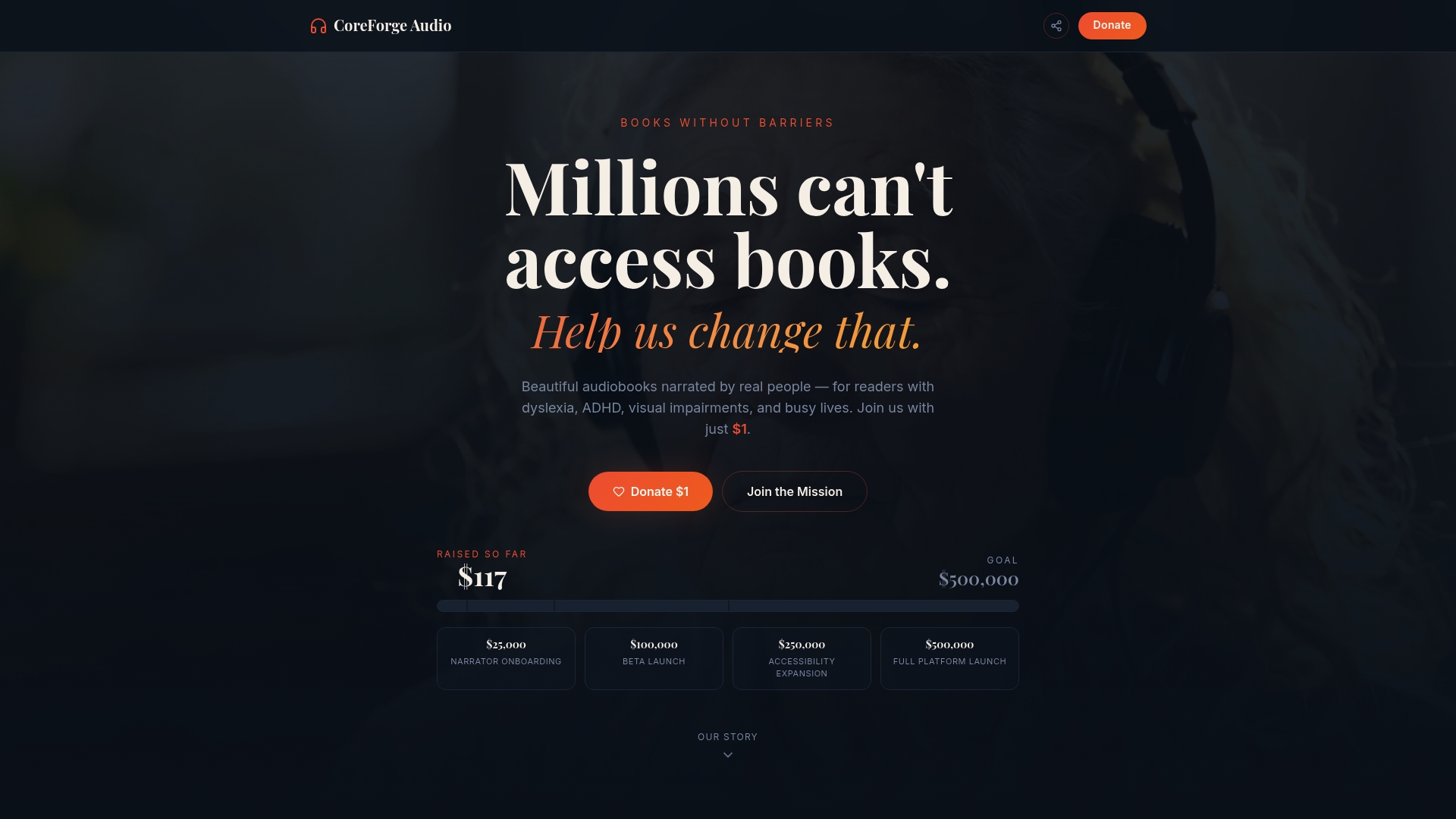
Explore how Coreforgeaudio is reshaping audiobook accessibility with community-driven funding and transparent licensing. Visit Coreforgeaudio now to learn how you can support and access high-quality audiobooks that empower diverse learners. Join the movement by donating just one dollar to help unlock inclusive storytelling experiences for everyone.
Frequently Asked Questions
What unique features does Coreforgeaudio offer for accessibility?
Coreforgeaudio includes features like dyslexia-friendly fonts, adjustable narration speeds, and multilingual support for non-English readers. These aspects are designed specifically to help individuals with reading barriers, making the platform particularly suitable for educators and librarians. Consider using Coreforgeaudio to ensure your content is accessible to a wider audience.
How does Coreforgeaudio's approach to narrator compensation compare to Meucci?
Meucci allows for a blend of AI narration and human proof-listening to speed up audiobook production, which can be beneficial for self-publishers looking for a cost-effective solution. In contrast, Coreforgeaudio focuses solely on licensed human narrators who are fairly paid, ensuring ethical sourcing of audio content. If ethical narration practices are your priority, Coreforgeaudio is the better choice.
Can I rely on Coreforgeaudio for multilingual audiobook options?
Coreforgeaudio does provide multilingual and customizable listening options, which enhance its usability for bilingual classrooms and multilingual households. This feature aims to expand accessibility to a diverse range of learners, making it a great fit for educational environments. Explore Coreforgeaudio to find audiobook options that cater to different language needs in your classroom.
What are the potential drawbacks of using Coreforgeaudio compared to Adaptive Reader?
Adaptive Reader centers on a passage-based architecture which synchronizes print, digital, and audio formats efficiently, benefiting educational publishers looking to comply with accessibility regulations. While Coreforgeaudio excels in ethically sourced narration, it may not offer the same level of infrastructure for institutions needing large-scale content production. If institutional compliance and scalability are critical for your needs, it may be worth considering both options.
What assurance does Coreforgeaudio provide regarding narrator quality?
Coreforgeaudio uses real human narrators who are licensed and paid fairly, which ensures a high level of quality in their audiobooks. This commitment to quality resonates particularly well with libraries and schools that seek ethically produced content. To assess if Coreforgeaudio fits your specific needs, you might want to listen to sample narrations.