
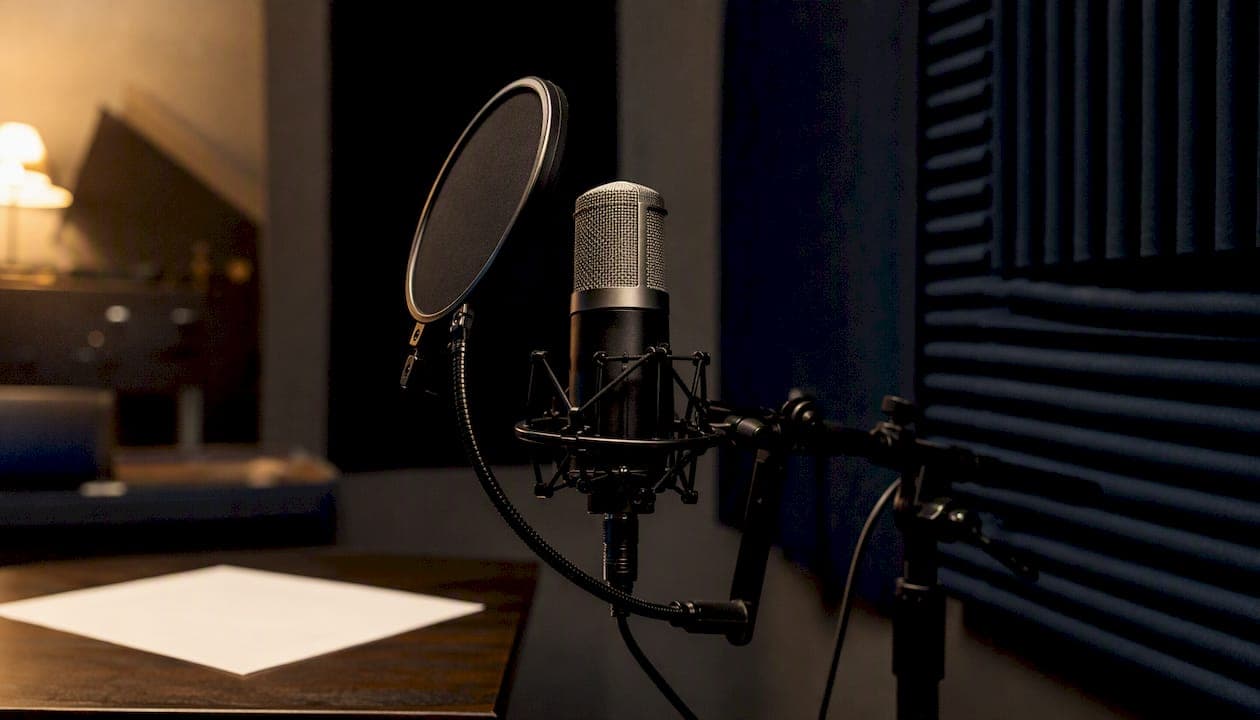
Voice actors protect their creative rights primarily through project-specific contracts, state rights-of-publicity statutes, union-negotiated AI agreements, and active monitoring for unauthorized use. The highest-impact protections available right now are: refuse any "in-perpetuity" usage clause; require written, project-specific consent before any digital replica is created; attach a NAVA AI/Synthetic Voice Rider to every contract; demand both a creation fee and per-use compensation for any AI-licensed work; and document every session with dated scripts and performer IDs.
The authoritative sources this guide draws on include SAG-AFTRA (the Replica Studios Agreement and the Interactive Media Agreement), NAVA, California Civil Code §3344, the proposed NO FAKES Act, and the FTC's voice-cloning policy work. Coreforgeaudio, as a platform built on human narration and fair pay, is used throughout as a practical example of what ethical rights management looks like in action.
Key Takeaways
Voice actors protect their creative rights most effectively through project-specific contracts, state rights-of-publicity statutes, union AI agreements, and consistent monitoring for unauthorized use.
| Point | Details |
|---|---|
| Contract specificity is your primary shield | Define scope, term, media, and compensation explicitly; never sign broad or in-perpetuity grants. |
| State publicity laws cover vocal identity | California §3344 and the Tennessee ELVIS Act provide civil and criminal remedies for unauthorized cloning. |
| Union agreements set the AI standard | The SAG-AFTRA Replica Agreement and IMA require consent, per-use pay, and data protections for digital replicas. |
| NAVA rider fills the freelance gap | Non-union voice actors can attach the NAVA AI/Synthetic Voice Rider to any contract as a baseline protection. |
| Monitoring and documentation close the loop | Quarterly platform audits, dated session logs, and a clear evidence folder are what make enforcement possible. |
Table of Contents
- How voice actors protect creative rights: the legal foundations
- Do state publicity laws actually protect your voice?
- What contract terms should every voice actor insist on?
- How do union agreements and AI riders protect you from cloning?
- A practical checklist and sample clauses for AI contracts
- How do you detect and respond to unauthorized use of your voice?
- How should you price voice work, including AI and replica uses?
- What does an ethical platform look like for voice actors?
- Why contract specificity is the only protection that actually holds
- Authoritative resources to read next
- Sources
How voice actors protect creative rights: the legal foundations
U.S. copyright law protects voice actors in two distinct ways, and understanding the gap between them is where most performers get into trouble.
A sound recording you create is protected by copyright the moment it is fixed in a tangible medium. That protection covers the specific recorded performance: the exact waveform, the timing, the expression. What copyright does NOT protect is your vocal identity itself. If someone trains an AI model on your recordings and generates new speech that sounds like you, the output is not a verbatim copy of your recording. Copyright claims frequently fail in those scenarios because the AI output is a new file, not a reproduction of the original. Right-of-publicity and false-endorsement claims under the Lanham Act are often the more practical enforcement path when cloning is involved.
The practical trap this creates: a standard buyout contract can transfer sound-recording rights to a client, who then uses those recordings to train a model. The performer has no copyright claim over the resulting AI voice because the copyright in the recording was sold. This is why contract language matters more than copyright registration alone.
Three common contract traps to watch for:
- "In perpetuity, throughout the universe" usage grants: these remove your ability to ever renegotiate or reclaim rights.
- Broad "derivative works" or "model training" language: often buried in standard work-for-hire clauses, these can authorize AI training without ever mentioning it explicitly.
- Buyouts that transfer the sound recording copyright outright: once transferred, you lose the ability to control copies of that specific recording.
Pro Tip: Keep a dated log of every session: script version, recording date, client name, and the specific usage agreed to in writing. If a dispute arises later, this documentation is what establishes the scope of the original license and gives you a factual foundation for any cease-and-desist or legal claim.
Do state publicity laws actually protect your voice?
Yes, and for AI cloning specifically, they are often more powerful than copyright.
California Civil Code §3344 treats voice as a protected aspect of personal identity and provides civil remedies for unauthorized commercial use. A company that clones your voice for an advertisement without consent can face statutory damages, attorney's fees, and injunctive relief under §3344, regardless of whether they copied a specific recording you own.
State protections vary significantly, and where your client publishes matters as much as where you live:
- California §3344: covers voice explicitly; civil remedies including statutory damages; applies to commercial use without consent.
- Tennessee ELVIS Act: extends right-of-publicity protections to AI-generated vocal likenesses; includes criminal provisions for willful violations, making it one of the strongest state-level tools currently in force.
- Washington State: biometric data laws add a separate layer of protection for voice prints used in AI training.
- Nevada and Arizona: have transparency and disclosure requirements for synthetic media, which can support enforcement even when damages are harder to prove.
The proposed federal NO FAKES Act would create a nationwide right to control digital replicas of voice and likeness, standardizing protections that currently vary state by state. Until it passes, your practical strategy is to check the publication jurisdiction of every client project and understand which state's law applies to the commercial use of your voice.
If a client publishes in California or Tennessee, you have strong statutory remedies available. If they publish in a state with no right-of-publicity statute, your contract language becomes your primary protection.
What contract terms should every voice actor insist on?
The non-negotiable elements of any voice acting contract are: scope of use (specific media, platforms, and formats), territory, term (start and end dates), compensation structure, exclusivity limits, revocation or termination rights, and audit rights. Every one of these should be defined explicitly. "Broad commercial use" is not a scope; "30-second radio spot, United States only, 12 months" is.
Buyout vs. residual: which model fits your situation
A buyout pays a single fee for a defined use. A residual model pays a base session fee plus additional payments each time the work is reused or broadcast. Neither is inherently better; the right choice depends on the project's likely reach and your career goals.
Buyouts make sense for limited-run, clearly scoped projects where the client's budget is fixed and the usage is genuinely finite. The risk is that a buyout for "internal training purposes" can quietly become a product launch if the contract doesn't define "internal" precisely.
Residuals protect you when a project's reach is unpredictable. A commercial that runs nationally for three years generates far more value than one that airs regionally for six weeks. Residual structures capture that value; a flat buyout does not.
Industry guidance is consistent: legacy contracts without AI-specific clauses leave performers exposed. Any contract signed before 2022 almost certainly lacks the language needed to address digital replicas.
Dangerous clauses to strike or limit
| Clause | Why it's risky | What to request instead |
|---|---|---|
| "In perpetuity" usage grant | Removes all future renegotiation leverage | Fixed term with renewal option at new rates |
| "Including for model training or AI development" | Authorizes cloning without separate consent | Explicit training prohibition unless separately negotiated |
| Overly broad NDA covering rights terms | Hides what rights were granted from agents and lawyers | NDA limited to confidential business information only |
| "All derivative works" language | Can include AI-generated outputs based on your voice | Derivatives limited to the specific project deliverables |
Negotiation phrases that work in practice: "I'd like to limit this to [specific media] for [specific term]." "I need a separate written consent for any AI or digital replica use." "Can we add a reversion clause triggered by change of control or company dissolution?"
How do union agreements and AI riders protect you from cloning?
This is where the most significant new protections live, and where the gap between union members and non-union freelancers is widest.

The SAG-AFTRA Replica Studios Agreement establishes transparency on intended use, informed performer consent, minimum compensation tied to session standards, limits on NDAs, and data-security protections for digital voice replicas. It restricts certain replica uses to interactive media contexts like video games and requires that performers know exactly how their replica will be deployed before they consent.
The SAG-AFTRA Interactive Media Agreement goes further on compensation mechanics. It treats vocal digital replicas as extensions of a performer's performance, requires clear and conspicuous written consent, and calculates replica compensation using a line-based metric: one "line" equals about a short sentence of output. That structure ensures that every sentence a replica speaks generates a compensable unit, rather than a one-time fee covering unlimited future output.
Pro Tip: Even if you are not a SAG-AFTRA member, you can use the IMA's consent and compensation framework as a template for your own contracts. The line-based pay structure is a practical model any freelancer can propose.
For non-union voice actors, NAVA's AI/Synthetic Voice Rider provides comparable protections in contract form. NAVA recommends project-specific consent, training prohibitions, opt-out rights, and audit/reporting requirements as baseline terms for any digital replica agreement.
Federal proposals: NO FAKES Act and the ELVIS Act
| Law / Proposal | Status | Key protection |
|---|---|---|
| NO FAKES Act | Proposed federal legislation | Nationwide right to control digital replicas of voice and likeness; civil remedies |
| ELVIS Act (Tennessee) | Enacted state law | Extends right-of-publicity to AI vocal likenesses; criminal provisions for willful violations |
| California §3344 | Existing state law | Civil remedies for unauthorized commercial use of voice as identity |
The NO FAKES Act would create a federal floor, meaning a performer in any state could bring a claim for unauthorized AI replication of their voice. Until it passes, the ELVIS Act and California §3344 are the strongest statutory tools available.
A practical checklist and sample clauses for AI contracts
Start every AI-related negotiation with these must-have elements confirmed in writing: identity and scope of the replica, permitted platforms and formats, duration with defined end date, compensation structure (creation fee plus per-use fee), revocation rights, audit and reporting rights, data storage limits and security requirements, change-of-control or reversion language, and an explicit training prohibition.
Short sample clauses in plain language (have an IP attorney formalize these before signing):
- Creation fee clause: "Performer shall receive a creation fee of $[X] for the initial recording session used to generate the digital replica. This fee does not authorize any use of the replica."
- Per-usage fee clause: "Each deployment of the digital replica in a commercial context shall trigger a per-use fee of $[X], payable within 30 days of use."
- Training prohibition: "Client shall not use Performer's recordings, voice data, or digital replica to train, fine-tune, or develop any machine learning model without a separate written agreement and additional compensation."
- Revocation/reversion clause: "Performer may revoke consent for use of the digital replica upon 30 days' written notice. Upon change of control or dissolution of Client, all replica rights revert to Performer immediately."
- Audit clause: "Client shall provide quarterly usage reports. Performer or Performer's designated representative may audit usage records once per calendar year upon 14 days' notice."
- Limited-term license: "This license is granted for [specific term] and expires automatically. Continued use after expiration requires a new written agreement."
- Data security clause: "Client shall store Performer's voice data using industry-standard encryption and shall delete all source recordings within [X] days of project completion unless otherwise agreed in writing."
- NDA scope limitation: "Any confidentiality obligation applies solely to Client's proprietary business information and does not restrict Performer from disclosing the existence or general terms of this agreement to Performer's legal or financial representatives."
A quick checklist you can paste into an email to an agent or client:
- Written, project-specific consent confirmed before any recording session
- Scope limited to named platforms and formats
- Fixed term with explicit expiration date
- Creation fee plus per-use fee structure confirmed
- Training prohibition included
- Revocation rights included
- Audit/reporting rights included
- Data storage and deletion terms confirmed
- Change-of-control reversion language included
How do you detect and respond to unauthorized use of your voice?
The first three steps when you find an unauthorized clone or reuse: document everything immediately (screenshots, URLs, timestamps, audio samples), issue a platform takedown or DMCA notice for any specific recording that was copied, and notify your union, agent, and legal counsel before taking further action.
Detection methods that work in practice:
- Reverse audio search: tools like ACRCloud and AudioTag can identify recordings that match your voice fingerprint across platforms.
- Google Alerts: set alerts for your name, stage name, and any known project titles to catch unauthorized commercial uses in text-based contexts.
- Platform monitoring: YouTube's Content ID system and similar tools on major streaming platforms can flag audio matches if you have registered recordings.
- Community reporting: other voice actors, casting directors, and agents often encounter unauthorized uses before the performer does. Staying active in professional communities (NAVA forums, SAG-AFTRA member networks) creates an informal early-warning system.
- Periodic self-audits: search your name on major ad platforms (Meta Ad Library, Google Ads Transparency Center) quarterly to check for commercial uses you did not authorize.
Enforcement options scale with severity. A platform takedown is the fastest and lowest-cost first step for any unauthorized posting. A DMCA notice applies specifically when a copyrighted recording was reproduced without permission. A cease-and-desist letter, drafted by an attorney, is appropriate when a client has exceeded the scope of a signed contract. State right-of-publicity claims under California §3344 or the ELVIS Act are available when your vocal identity was used commercially without consent, regardless of whether a specific recording was copied. The FTC's policy work on voice cloning harms supports transparency and labeling obligations at the platform level, which can strengthen your argument when filing complaints with platforms or regulators.
Real-world misuse is not hypothetical. An AI deepfake ad featuring MrBeast's likeness appeared on TikTok without his consent, illustrating how quickly unauthorized clones can reach mass audiences on major platforms. Spotify tested automated voice cloning for podcast translation without individual performer opt-in, demonstrating that even well-resourced platforms may deploy cloning features before adequate consent frameworks are in place.
Pro Tip: Create a dedicated folder for each project: save the signed contract, the original script, session recordings, and any client communications about usage. If a dispute arises six months later, this folder is your evidence package. Date every file at creation.
How should you price voice work, including AI and replica uses?
The pricing levers for voice work are: creation fee, per-use fee, royalties or residuals, session/hourly rate, and buyout premium. Which combination to use depends on the project's likely reach, the exclusivity requested, and whether AI or digital replica use is involved.
For traditional work, a session rate covers the recording time. A buyout premium is appropriate when the client wants broad, long-term usage rights and you are giving up future residual income. The premium should reflect the estimated value of that future income, not just the session time.
For AI and digital replica work, the structure shifts. Industry guidance recommends a separate creation fee for the initial recording session plus per-usage fees for each deployment. The IMA's line-based compensation model (one line ≈ ten words of replica output) provides a practical framework for calculating per-use fees on interactive media projects. Under union deals, pension and health contributions apply on top of these fees.
Factors that should raise your rate:
- Audience reach: national or global distribution commands a higher fee than regional or internal use.
- Exclusivity: if the client wants to prevent you from working with competitors, that restriction has a dollar value.
- Duration: a 12-month license is worth more than a 3-month one; price accordingly.
- Platform type: broadcast, streaming, and interactive media each carry different reach multipliers.
- Model training: if the client wants to use your recordings to train an AI model, that is a separate, additional fee, not a feature of the base session rate.
Reversion windows, renewal escalators, and change-of-control clauses are not just protective mechanisms; they are also negotiation tools. Offering a shorter initial term at a lower rate, with a renewal option at a higher rate, is often more acceptable to clients than a large upfront fee and gives you the ability to reprice as the project's value becomes clearer.
What does an ethical platform look like for voice actors?
An ethical platform protects voice actors through transparent licensing terms, human-first compensation, explicit AI opt-out policies, and accessible usage reporting. Those four elements are the minimum standard.
Specific practices to look for when evaluating a platform:
- A publicly available licensing page that defines what rights the platform takes, for how long, and on which media
- Per-use accounting with regular reporting, not a single opaque buyout
- A stated preference for human narrators over synthetic voice
- An explicit opt-out for AI training use, available at any time
- Accessible audit or reporting tools so performers can verify usage independently
- Change-of-control language that prevents your voice data from being transferred to a new owner without fresh consent
Coreforgeaudio is built around exactly these principles. The platform's core mission centers on human narration as the standard, fair compensation for voice talent, and accessibility for listeners with reading barriers including dyslexia, ADHD, and visual impairments. Its public stance on AI is clear: human voices are not interchangeable with synthetic ones, and narrators deserve transparent contracts and fair pay for every use of their work.
Platforms that treat human narration as a premium feature worth protecting, rather than a cost to be automated away, are the ones building sustainable relationships with voice talent. That stance matters for performers evaluating where to license their work.
A voice-actor safety audit checklist for any platform:
- Does the platform publish its licensing terms publicly?
- Are narrators paid per use or per project, with clear accounting?
- Is there an explicit prohibition on using narrator recordings for AI training without separate consent?
- Can narrators revoke consent and have their data deleted?
- Does the platform have a stated human-narration preference?
- Are there accessible reporting tools for usage verification?
Why contract specificity is the only protection that actually holds
The legal framework for voice actor rights is improving, but it is still fragmented. State laws vary. Federal proposals stall. Union protections cover members but not the broader freelance market. In that environment, the contract you sign is the one protection that is always in force, regardless of what state law applies or whether a federal bill has passed.
The performers who get hurt are almost always the ones who signed a standard buyout without reading the derivative-works clause, or who agreed to "broad commercial use" without defining what "commercial" means. The harm is not usually dramatic; it is quiet. A voice gets cloned for a product launch. A recording gets used to train a model. The performer finds out months later, if at all.
NAVA president Tim Friedlander has warned that ambiguous contract language is the primary risk for voice actors, and the remedy is straightforward: hire an IP-specialized attorney to review any contract that includes digital or AI use language, and strip or strictly limit any "in-perpetuity" or training-rights clause before signing.
The IAPP has tracked the legal challenges voice actors face in the generative-AI era, noting that emerging protections in the U.S. are moving in the right direction but have not yet closed the gap between what technology enables and what law prevents. That gap is your contract's job to fill.
The single most practical step any voice actor can take today is to add the NAVA AI rider to every contract that involves digital or AI-adjacent use, consult an IP attorney before signing any buyout that includes derivative-works language, and set a quarterly calendar reminder to audit your name across major ad platforms.
Authoritative resources to read next
Primary legal texts and union guidance:
- SAG-AFTRA Replica Studios Agreement FAQs (union guidance): Replica Studios Agreement FAQs — official union summary of consent, compensation, and data-security requirements for digital voice replicas.
- SAG-AFTRA IMA summary (union guidance and legal analysis): Inside the new SAG-AFTRA Interactive Media Agreement — covers the line-based compensation model and written-consent requirements for vocal replicas.
- NAVA rider and advocacy guidance (model contract language): Reasonable Description of Intended Uses — NAVA — practical rider language and consent principles for non-union voice actors.
- California Civil Code §3344 and NO FAKES Act overview (legal text and advocacy): AI voice clones, NO FAKES Act & creators — Promise Legal — explains how state publicity law applies to cloning and what the proposed federal bill would change.
- FTC voice cloning policy (regulatory guidance): Preventing harms from AI-enabled voice cloning — FTC — policy research on cloning harms and recommended safeguards for platforms and developers.
- AI licensing contract guide (practical contract guidance): Voice acting rights and AI licensing contracts — Advice for Actors — model clause recommendations and warnings about legacy buyout language.
- Voiceover usage rights explained (industry advocacy): Voiceover usage rights — Backstage — includes Tim Friedlander's guidance on ambiguous contract language and the case for IP-specialized legal review.
- IAPP legal challenges overview (policy and legal analysis): Voice actors and generative AI — IAPP — tracks emerging U.S. and international protections and the gap between current law and AI capabilities.
This article is general information, not a substitute for advice from a qualified lawyer. Consult a qualified legal professional about your own circumstances before acting on anything here.
Sources
- Replica Studios Agreement FAQs — SAG‑AFTRA
- AI voice clones, NO FAKES Act & creators — Promise Legal blog
- Reasonable Description of Intended Uses — NAVA
- Preventing harms from AI-enabled voice cloning — FTC