
Fair pay in the US voice acting industry means matching the fee to the work performed and the rights granted, not just the time spent in a recording booth. For most professional projects, that lands somewhere between $350 and $5,000. The bulk of jobs cluster in the middle of that band. The single largest cost driver is not studio time. It is usage: who hears the recording, where, and for how long.
Here are the headline ranges buyers and talent can use as a starting point:
- 30-second commercial (local/regional): $150–$400 session fee, plus usage
- 30-second commercial (national broadcast): $500–$2,500+ with usage fees on top
- Audiobook narration: $100–$400 per finished hour (PFH), depending on experience tier
- E-learning module: $0.20–$0.40 per word, or $50–$150 per finished minute
- IVR/phone system: $200–$500 flat for a standard package
- Video game (per session): $800–$2,500 union scale; $200–$800 non-union
Usage scope, union status, and experience tier each move these numbers significantly. A local 3-month radio spot and a national perpetual TV buyout start from the same booth session but end up at very different totals.
Key Takeaways
Fair pay in voice acting is determined primarily by usage scope, not booth time. Talent and buyers who separate session fees from licensing fees, use written contracts with explicit scope, and reference union minimums as a pricing floor will produce quotes that are both fair and defensible.
| Point | Details |
|---|---|
| Usage drives price | Territory, medium, and duration multiply the session fee; always quote them separately. |
| Union scale is the floor | SAG-AFTRA minimums set the baseline; experienced non-union talent often charges above scale. |
| PFH understates real labor | One finished audiobook hour requires 2–3 hours of total work; rate accordingly. |
| Contracts must specify scope | Usage term, territory, medium, and pickup policy must be written, not assumed. |
| Coreforgeaudio pays fairly | The platform sets minimum PFH rates, avoids perpetual buyouts, and earmarks donations for narrator fees. |
Table of Contents
- Quick-reference rate guide for common US voice projects
- How pricing actually works: session fees, usage, and buyouts
- What changes under SAG-AFTRA vs. non-union hiring
- Detailed rate ranges by project type
- How to build a transparent quote from scratch
- Key contract terms every voice project needs
- Practical negotiation tactics for talent and buyers
- Coreforgeaudio's approach to fair narrator compensation
- Coreforgeaudio hires narrators who are paid fairly
- Sources
Quick-reference rate guide for common US voice projects
The table below reflects typical US market ranges drawn from aggregated industry guides and practitioner benchmarks. Treat these as working floors, not ceilings.
| Project type | Typical US rate range | Pricing unit | Usage/licensing notes |
|---|---|---|---|
| 30-sec commercial (local) | $150–$500 | Per session + usage | Local market, 3–12 months |
| 30-sec commercial (national) | $1,000–$3,500 | Per session + usage | National broadcast adds significant multiplier |
| Audiobook (entry-level) | $100–$175 PFH | Per finished hour | Typically buyout; exclusivity negotiable |
| Audiobook (mid-range) | $200–$300 PFH | Per finished hour | Standard buyout; pickups billed separately |
| Audiobook (experienced/celebrity) | $350–$400+ PFH | Per finished hour | Higher for exclusive or rush delivery |
| E-learning / corporate training | $50–$150 per finished minute | Per finished minute or per word | Internal use vs. commercial distribution changes price |
| IVR / phone system | $200–$500 flat | Flat package | Typically perpetual internal use |
| Video game / animation (union) | $800–$2,500 per session | Per session | SAG-AFTRA scale; residuals may apply |
| Video game / animation (non-union) | $200–$800 per session | Per session or per hour | No residuals; buyout common |
| Promo / YouTube / indie short | $75–$300 | Per project or per minute | Indie rate guides apply; usage scope matters |
A few caveats worth keeping in mind:
- Experience level influences PFH rates significantly.
- Union projects have additional mandatory health and pension contributions.
- Market size impacts commercial rates across regions.
How pricing actually works: session fees, usage, and buyouts
Most buyers new to voice work assume the fee covers everything. It does not. Professional pricing separates two distinct components: the session fee (compensation for the performance itself) and the usage fee (compensation for the rights to use that recording).
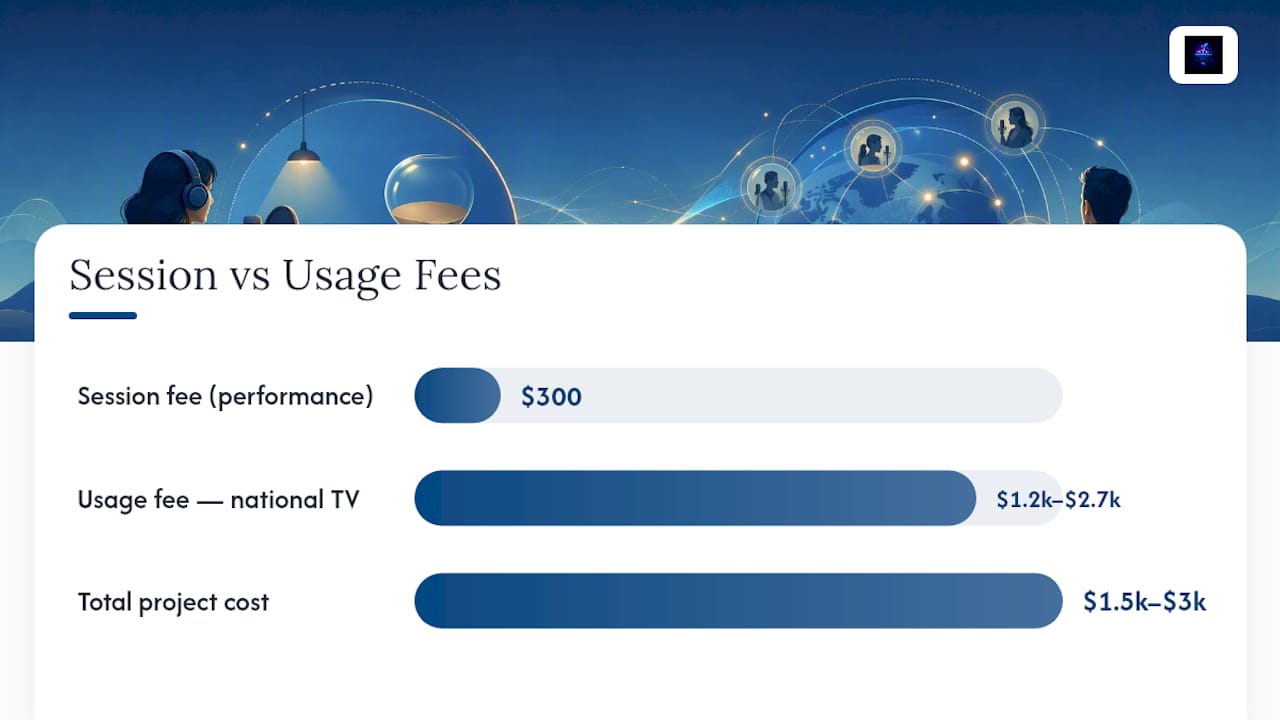
Usage and licensing are the primary cost driver in virtually every project category. A 30-second spot recorded in two hours might carry a $300 session fee. Add national TV broadcast rights for 12 months and that same recording can cost $1,500–$3,000 total. Extend it to worldwide perpetual rights and the number climbs further still.
How the three main fee structures work:
- Session fee: Covers the recording time and performance. Paid regardless of how the recording is used.
- Usage fee (licensing): Covers the right to broadcast or distribute the recording. Scales with territory (local → regional → national → worldwide), medium (radio, TV, digital, streaming), and duration (3 months, 12 months, perpetual).
- Residuals: Ongoing payments each time a spot airs, common under SAG-AFTRA contracts for broadcast work. Non-union projects typically replace residuals with a flat buyout.
Per Finished Hour (PFH) for audiobooks is a separate convention. PFH is the standard audiobook pricing metric, but it understates total actor time. A narrator producing one finished hour of audio typically spends two to three hours on prep, recording, and editing. A $200 PFH rate on a 10-hour audiobook pays $2,000 for roughly 20–30 hours of actual labor, which works out to $67–$100 per real hour before taxes and overhead.
Common add-on premiums:
- Rush delivery (under 24 hours): 25–50% above standard rate
- Exclusivity: 10–25% premium, depending on scope and duration
- Pickup sessions (re-records after delivery): $50–$150 flat, or billed at hourly rate
- Extra revision rounds beyond the contracted number: $50–$100 per round
Pro Tip: Build a simple quote by adding: Session fee + Usage fee (scaled to territory and duration) + Overhead buffer (10–15%) + Any applicable add-ons. Never quote a single flat number without specifying what usage it covers. Ambiguity on usage is the most common source of disputes.
What changes under SAG-AFTRA vs. non-union hiring
The clearest way to understand the difference: union contracts set a floor, not a ceiling, and they attach obligations to both parties.
SAG-AFTRA publishes voiceover contract resources that define guaranteed minimum rates, mandatory health and pension contributions (paid by the employer), residual structures for broadcast work, and formal dispute resolution. Non-union work has none of those protections by default.
Union scale is not just a rate. It is a package. Buyers hiring SAG-AFTRA talent pay the session minimum plus health and pension contributions, typically calculated as a percentage of the session fee. Talent receive guaranteed minimums, access to union health benefits, and the right to file a grievance if terms are violated. That structure costs more upfront and delivers more protection on both sides.
Key differences at a glance:
- Minimums: SAG-AFTRA sets guaranteed floors by contract type (TV commercial, radio, audiobook, interactive media). Non-union rates are negotiated freely, which can mean lower floors but also no ceiling.
- Health and pension: Employers on union projects contribute to talent's health and pension funds. Non-union projects carry no such obligation.
- Residuals: Union broadcast commercials generate residuals each time they air. Non-union projects typically use a flat buyout instead.
- Dispute resolution: SAG-AFTRA provides formal arbitration. Non-union disputes rely on contract language and civil remedies.
When union talent makes sense for buyers: national or regional broadcast campaigns where the recording will air repeatedly, projects where talent quality and professional accountability matter, and any work where the buyer wants the protection of a standardized contract. For interactive media and games, SAG-AFTRA's tiered budget and interactive media FAQs clarify when union rules apply and what scale looks like for smaller productions.
When non-union is appropriate: small digital runs, internal corporate training, indie projects with limited distribution, and situations where the budget genuinely cannot support union minimums plus contributions.
Established talent often charges above scale even on non-union work, because scale represents the minimum, not the market rate for experienced performers. A voice actor with a decade of national commercial credits will not record a national spot at the union floor.
Pro Tip: Converting a non-union project to a union one (called "going union") is triggered when a signatory company hires a union member. If you are a SAG-AFTRA signatory, you cannot hire union talent for non-union rates. Know your signatory status before you cast.
Detailed rate ranges by project type
Audiobooks
Audiobook narration is priced per finished hour. Entry-level narrators typically charge $100–$175 PFH; mid-range professionals charge $200–$300 PFH; experienced or in-demand narrators charge $350–$400+. A standard nonfiction book runs 8–12 finished hours, so a mid-range narrator on a 10-hour book earns $2,000–$3,000 for what amounts to 20–30 hours of actual work once prep and editing are included.
Industry rate guides consistently note that PFH understates real labor. Narrators who edit their own audio spend roughly two hours of work per finished hour. Narrators who deliver raw files and let the publisher edit spend less, but publishers then absorb that cost elsewhere.
Negotiation note: Always specify in the contract whether the PFH rate includes editing. If it does, the rate should be higher.
Commercials
A 30-second local radio spot might carry a $150–$300 session fee. The same script recorded for national TV broadcast with a 12-month license can run $1,000–$3,500 or more. Most professional voice jobs fall in the $350–$5,000 range, and commercials with wide distribution sit toward the upper end of that band.
Worked example: Session fee $400 + national digital usage (12 months) $800 + exclusivity premium 15% ($180) = $1,380 total.
E-learning and corporate training
E-learning rates typically run $0.20–$0.40 per word or $50–$150 per finished minute. A 10-minute module at $100/finished minute costs $1,000. Internal-use corporate training generally sits at the lower end; commercially distributed courses or certification programs command more.
Negotiation note: Ask whether the module will be sold or licensed externally. If so, treat it as commercial distribution and price accordingly.
Video games and animation
Union game sessions follow SAG-AFTRA scale: roughly $800–$2,500 per four-hour session depending on contract type. Non-union sessions run $200–$800. Performance capture (full body and voice) carries a premium over standard voice-only work. Per-character or per-line pricing is common for smaller indie games; per-session is standard for larger productions.
Worked example: Non-union indie game, 3-hour session at $250/hour = $750 flat, or negotiate a per-character buyout of $300–$500 for a minor role.
IVR and phone systems
IVR packages are usually sold as flat-fee bundles: a standard package of 20–30 prompts runs $200–$500. Larger enterprise systems with hundreds of prompts are quoted per prompt ($10–$25 each) or per finished minute. Usage is typically perpetual internal use, so no ongoing licensing fees apply.
Promos, YouTube, and indie shorts
The Voice Acting Club's Indie Rate Guide and the GVAA rate guide both provide benchmarks for indie and YouTube work. Typical ranges: $75–$150 for a short promo under 60 seconds; $150–$300 for a 2–5 minute YouTube narration. Indie rates apply when distribution is limited and commercial intent is low. If the YouTube channel monetizes heavily or the promo is for a commercial product, standard buyout rates apply.
Negotiation note: "Indie" is a scope designation, not a discount category. Confirm the channel's subscriber count and monetization status before applying indie rates.
How to build a transparent quote from scratch
The formula is straightforward once you separate the components. PayScale data on voice actor earnings shows wide dispersion in hourly pay, which reflects exactly this: actors who bundle session and usage into one opaque number often undercharge, while those who itemize tend to capture the full value of their work.
The core formula:
- Session fee (performance and recording time)
- Usage fee (territory × medium × duration)
- Overhead buffer (10–15% for equipment, software, platform fees, audition time)
- Add-ons (rush, exclusivity, extra revisions, pickup sessions)
- Total quote
Common line items to include in every quote:
- Script prep and read-through time
- Recording and re-takes
- Editing and file delivery (if included)
- License scope (territory, medium, duration)
- Number of revision rounds included
- Pickup fee structure if re-records are needed post-delivery
- Payment terms (net 14 or net 30 is standard)
Worked Example A: 30-second national TV spot
| Line item | Amount |
|---|---|
| Session fee | $500 |
| National TV usage, 12 months | $1,000–$3,500 |
| Exclusivity (category, 12 months) | $200 |
| Rush delivery (under 24 hours) | $175 |
| Total | $2,000–$3,000 |
Worked Example B: 9-hour audiobook at mid-range PFH
| Line item | Amount |
|---|---|
| Narration at $250 PFH × 9 hours | $2,000–$3,000 |
| Editing (included in PFH rate) | Included |
| Pickup session allowance (1 hour) | $250 |
| Total | $2,500 |
Pro Tip: When a client wants perpetual rights, price the usage fee as if the license will run for three to five years. A perpetual buyout that costs the same as a one-year license is a bad deal for the talent and sets a precedent that undervalues the work.
Key contract terms every voice project needs
A verbal agreement is not a contract. Every voice project, union or not, should have a written document that covers these items before recording begins.
Essential contract checklist:
- Usage term: Exact start and end date of the license (or "perpetual" stated explicitly)
- Territory: Geographic scope (local, national, worldwide)
- Medium: Where the recording can be used (broadcast TV, digital, streaming, internal, all media)
- Exclusivity: Whether the talent is restricted from similar work during the license period
- Delivery specs: File format, sample rate, noise floor, naming conventions
- Payment terms: Amount, due date, late fee structure
- Pickup policy: How many free pickups are included and what triggers an additional fee
- Re-use and renewal: What happens when the license expires and the client wants to extend
- Cancellation clause: Kill fee if the project is canceled after recording begins
The most common unfair clause in voice contracts is the in-perpetuity, all-media, worldwide buyout priced at a single session fee. That clause transfers unlimited rights forever for the cost of one afternoon's work. Talent should price perpetual worldwide rights as a significant multiple of the session fee, and buyers should expect to pay accordingly. Backstage's industry guidance explicitly warns against perpetual buyouts without appropriate premium.
Sample clause language (adapt for your project):
"License grants Buyer the right to use the Recording for [medium] in [territory] for a period of [duration] beginning on [start date]. Use beyond this scope requires a separate written agreement and additional compensation."
Red flags to reject:
- "All rights in perpetuity" for a flat session fee
- Vague language like "for promotional purposes" with no medium or territory specified
- Payment terms of net 60 or longer with no late fee provision
- No pickup or revision policy stated
Pro Tip: Keep a simple spreadsheet of every project: client name, license scope, expiration date, and fee paid. When a client wants to renew or extend, you have the original terms in writing and can quote a renewal fee based on the original usage structure.
Practical negotiation tactics for talent and buyers
What buyers often miss about voice actor overhead
The rate a voice actor quotes is not pure profit. Behind every session fee are costs the client never sees: professional recording equipment ($1,000–$5,000+), acoustic treatment, editing software, annual platform fees to access auditions, the time spent auditioning for jobs that do not book, self-employment taxes (roughly 15.3% on top of income tax), health insurance, and ongoing coaching or training. A $300 session fee that looks generous can net $150 or less after overhead and taxes.
Sustainable minimums for freelancers to consider:
- Calculate your monthly overhead (gear, software, platform fees, insurance, coaching)
- Add your target monthly income
- Divide by realistic billable hours per month (not total hours worked)
- That number is your floor rate per hour, before usage
Negotiation tactics that work
For talent:
- Package usage tiers rather than negotiating blind. Offer the client three options: local 6-month, national 12-month, and worldwide perpetual, each with a clear price. Clients who see the tiers understand why usage costs more.
- Define what is included in the base rate explicitly. "Two rounds of revisions included; additional rounds at $75 each" is harder to dispute than a vague "reasonable revisions."
- Never discount the session fee to win a job. If you need to offer flexibility, discount the usage fee for a shorter or narrower license instead.
For buyers:
- State your intended usage upfront. Talent who know the scope can quote accurately. Vague briefs produce vague quotes that balloon later.
- Offer exclusivity premiums only when you genuinely need the talent to be exclusive. Exclusivity costs money; if you do not need it, do not ask for it.
- For campaigns with national reach or long run times, union talent is worth the additional cost. The SAG-AFTRA contract structure provides dispute resolution and standardized terms that protect both parties.
Pro Tip: When presenting a quote to a client, separate the session fee from the usage fee on the invoice. Clients who see "Session: $400 / National digital usage 12 months: $900" understand the structure. A single line item of "$1,300" invites negotiation on the wrong number.
Coreforgeaudio's approach to fair narrator compensation
Coreforgeaudio is built on a straightforward premise: accessible audiobooks require human narrators, and human narrators deserve fair pay. That is not a marketing position. It is a budget constraint that shapes every hiring decision the platform makes.
Coreforgeaudio's narrator compensation principles:
- Baseline PFH rates: Fiction narration starts at $200 PFH minimum; nonfiction at $175 PFH minimum, with rates rising for experienced narrators.
- No predatory perpetual buyouts: Narrators retain rights beyond the platform license. Coreforgeaudio licenses recordings for defined terms and renegotiates renewals at fair market rates.
- Minimum session fees: No project pays below $150 for any session, regardless of length.
- Exclusivity handled narrowly: Exclusivity is requested only when the platform's distribution model genuinely requires it, and it carries a premium above the base PFH rate.
- Transparent overhead: Funds raised through the micro-donation campaign are earmarked with narration fees as a named line item, so donors and narrators both know where the money goes.
Fair pay for narrators is not charity. It is the quality guarantee. When narrators are paid at sustainable rates, they invest in better equipment, take time to prepare properly, and deliver performances that serve listeners with reading barriers far better than rushed, underpaid work ever could. The connection between narrator preparation and audio quality is direct and measurable.
The platform's accessibility-first design and its commitment to human narration over synthetic alternatives both depend on a funding model that keeps narrator pay viable. The micro-donation campaign exists precisely because fair compensation and accessibility are not in conflict; they are the same goal.
How these rate ranges were compiled
The ranges in this article draw from the following primary sources:
- SAG-AFTRA: Published contract minimums, health and pension contribution rates, and union scale tables for voiceover categories
- Backstage: Industry practitioner interviews and rate guidance, including the $350–$5,000 observed range
- RealVOTalent: Aggregated rate guide covering commercial, audiobook, e-learning, and IVR categories with usage-based breakdowns
- SideStackers: PFH methodology, expense-based calculators, and per-category rate floors
- PayScale: Aggregated hourly pay data for voice actors showing experience-level dispersion
- GVAA (Global Voice Acting Academy) rate guide: Indie and standard rate benchmarks by project type
- Voice Acting Club Indie Rate Guide: Benchmarks for indie, YouTube, and short-form projects
Assumptions applied throughout:
- All rates are US market figures in USD
- PFH calculations assume a 2:1 to 3:1 ratio of total labor to finished audio
- Overhead buffer of 10–15% is included in worked examples
- Union figures reflect SAG-AFTRA scale as a floor; market rates for experienced talent are higher
To verify current scales, check the SAG-AFTRA voiceover contract page directly, and cross-reference with the RealVOTalent rate guide and the GVAA guide for non-union benchmarks. Both are updated more frequently than most secondary sources.
The ethical case for paying voice actors fairly
The argument for fair pay in voice acting is not sentimental. It is structural.
When buyers consistently undercut rates, experienced talent exits the market or moves to higher-paying categories. What remains is a pool of underpaid, under-equipped performers who cannot invest in professional gear, acoustic treatment, or ongoing training. The recordings suffer. The listeners suffer. And the buyers who cut corners end up re-recording anyway.
For a platform like Coreforgeaudio, where the audience includes people with dyslexia, ADHD, and visual impairments, audio quality is not a preference. It is an accessibility requirement. A poorly recorded audiobook with inconsistent pacing or background noise is not just annoying. It is a barrier. Listening quality directly affects literacy outcomes for the readers who depend on audio most.

The voice acting industry's fair-pay standards exist because the work has real costs that are easy to ignore when you are on the buying side. Usage rights, equipment depreciation, audition time, platform fees, and self-employment taxes are invisible to a client who sees only the finished MP3. Making those costs visible, through transparent quotes and clear contracts, is not just good practice. It is how the industry stays sustainable for everyone who depends on it.
Coreforgeaudio hires narrators who are paid fairly
Coreforgeaudio is building an accessible audiobook platform where every title is narrated by a real human voice, paid at market-range rates, with no predatory perpetual buyouts. The platform's micro-donation model earmarks narrator fees as a named budget line, so every dollar contributed directly supports fair compensation for the talent who make accessibility possible.
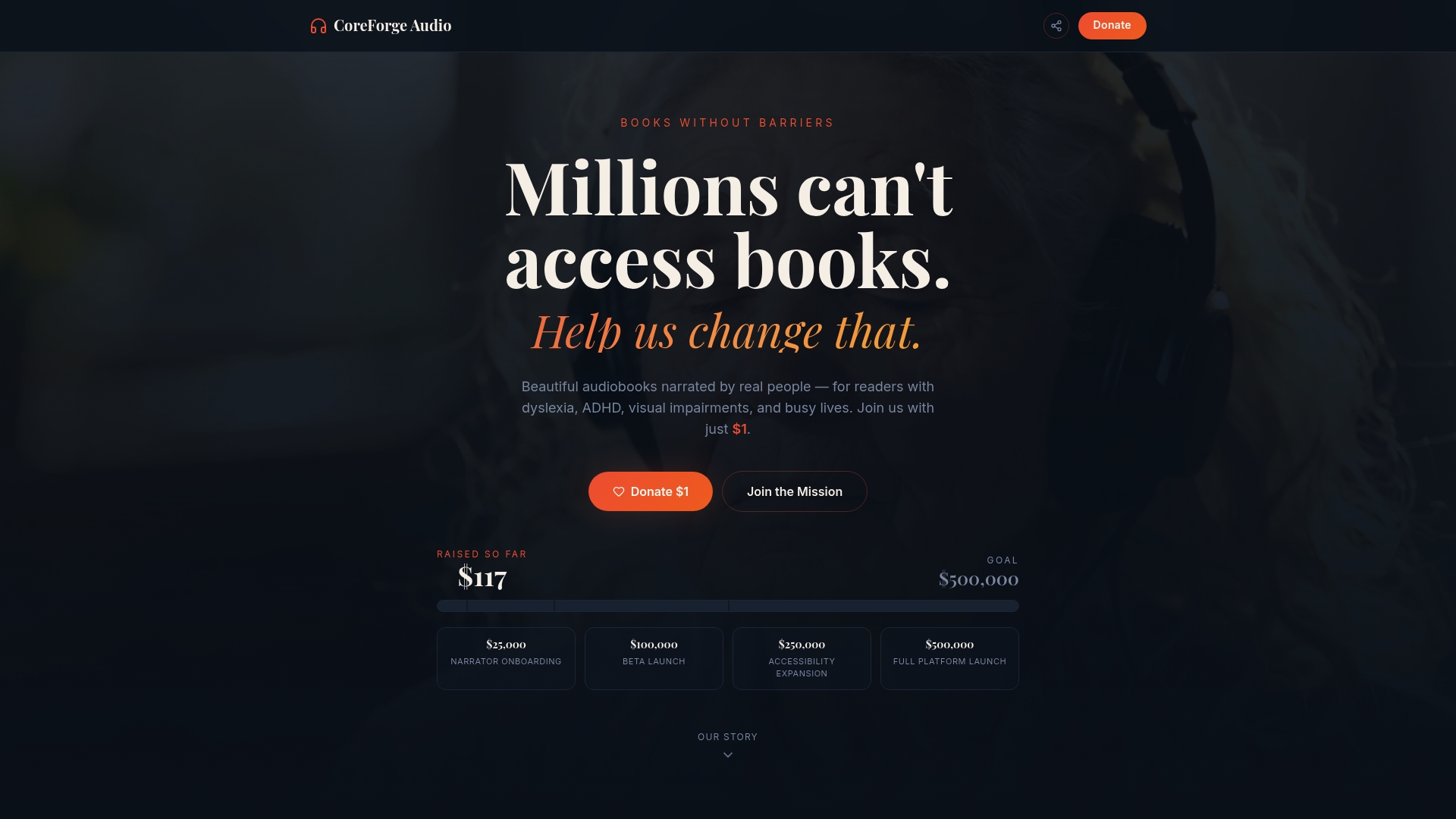
If you are a narrator looking for ethical, fairly structured work, or a reader who wants accessible audiobooks built on honest labor practices, Coreforgeaudio is the platform worth supporting. The fundraising campaign is live now, and every contribution goes toward finishing the build and paying the narrators who bring these books to life. Support the campaign and learn more at Coreforgeaudio.
Sources
Use these primary sources to verify current scales and update your quotes:
- How Much Do Voice Actors Cost? Rates and Hiring Advice | Backstage
- Voiceover | SAG-AFTRA
- How Much Does a Voiceover Cost? (2026 Rates) | RealVOTalent
- Freelance Voice Over Rates (2026): Commercial & Narration | SideStackers
When building a quote, cross-reference at least two of these sources for the relevant project type. Rates shift with market conditions; a guide that was current 18 months ago may understate what working professionals now charge.