

The three highest-risk payment pitfalls in voice acting are work-for-hire buyout traps, pay-to-play and pay-to-receive scams, and missing tax paperwork — specifically Form W-9 and Form 1099-NEC. Before you record another line, scan every contract for "work for hire" or "in perpetuity" language, refuse to send money to receive payment, and collect a signed W-9 before final delivery. SAG-AFTRA members have union protections to lean on; non-union talent must build those protections into every contract themselves.
Common voice actor payment pitfalls rarely announce themselves. They hide in vague contract clauses, too-good-to-be-true casting emails, and year-end tax surprises. Coreforgeaudio publishes this guide to give working voice actors fast, executable steps — not theory.
- Refuse "work for hire" or "all media, worldwide, in perpetuity" language without negotiated usage fees.
- Never send money to unlock, receive, or process payment.
- Collect a completed, signed W-9 before delivering final files.
- File reports with Reportfraud and the FBI IC3 if you suspect fraud.
Pro Tip: Set a one-page contract checklist as your default before every new client engagement — it takes five minutes and eliminates the most common payment mistakes before they start.
Key Takeaways
Protecting your income as a voice actor comes down to one discipline: fix the paperwork before the session, not after.
| Point | Details |
|---|---|
| Scan contracts first | Refuse "work for hire," "in perpetuity," or "all media, worldwide" without defined usage fees and a term limit. |
| Collect W-9 upfront | Payers must file Form 1099-NEC for nonemployee compensation; missing TINs trigger backup withholding. |
| Use escrow or cleared funds | Require a a significant deposit for new clients and hold final files until payment fully clears, not just shows as available. |
| Never forward money | Any request to send money to receive payment is a scam; report to FTC and IC3 immediately. |
| Coreforgeaudio for narrators | Coreforgeaudio uses signed contracts, defined usage terms, and W-9 collection before final delivery on all narrator projects. |
Table of Contents
- What are the most common voice actor payment pitfalls?
- How do contracts hide payment risk in voice acting?
- How do you recognize and stop voice acting payment scams?
- Which payment methods are safer for voice actors?
- How should you invoice and handle late payments?
- What do U.S. voice actors need to know about taxes?
- How do you judge whether a rate offer is fair?
- What should you do when a payment is late or reversed?
- Coreforgeaudio's approach to fair pay for narrators
- Coreforgeaudio is hiring narrators who want fair-pay projects
- Authoritative resources for voice actors
- Sources
What are the most common voice actor payment pitfalls?
Every item below has cost working actors real money. One-line mitigation follows each.
- Work-for-hire / buyout traps: Client owns your performance forever for a single flat fee. Ask for defined usage terms and a usage fee tied to scope.
- Pay-to-play / pay-to-receive schemes: Upfront fees to audition or "unlock" earnings. Legitimate clients never charge talent to access work or pay.
- Fake-check / overpayment scams: A counterfeit check arrives, funds appear available, you're asked to forward the difference. Stop immediately — available balance is not cleared funds.
- Late or missing payments: Voice actors on major game projects have waited months for payment, with disputes over whether the developer or recording studio is responsible. Require a deposit and hold final files until payment clears.
- Vague usage / territory clauses: "All media" with no end date means unlimited reuse. Define media, territory, and term in writing.
- Missing invoice or payment terms: No due date, no late fee clause. Set Net 15 or Net 30 with a written late fee from day one.
- No W-9 collected: Payers who skip this face backup withholding liability. Talent who skip it face year-end scrambles.
- Agency / listing scams: Fees to join a roster or get "guaranteed bookings." Real agencies earn commissions on booked work, not upfront.
Red flags to highlight immediately: requests for Western Union transfers, gift cards, or PDF cashier checks; "guaranteed booking" promises; pressure to deliver high-resolution masters before payment confirms.
How do contracts hide payment risk in voice acting?
Work-for-hire and in-perpetuity buyouts are the fastest way to lose future income. VO Pro explains that "work for hire" legally transfers ownership of your performance to the client permanently, converting what could be ongoing residual value into a single flat payment — often far below what repeated use would justify.
The practical difference matters: a buyout pays once regardless of how many times the recording runs. Residuals and usage fees pay each time the work is reused, which is how SAG-AFTRA contracts are structured for broadcast and streaming. Non-union contracts can mirror this with defined usage fees, end dates, and territory limits — but only if you negotiate them in.
Watch for these clause patterns before signing:
- "Work for hire" or "work made for hire"
- "In perpetuity" or "forever"
- "All media, worldwide" with no defined end date
- "Exclusive" without a time limit or additional compensation
Negotiable items in any contract: term (how long), territory (local vs. worldwide), media type (e-learning only vs. broadcast), exclusivity, and price escalators for scope expansion.
Questions to ask before you sign: Who owns the master recordings? Where exactly will the recording be used? Is there a buyout, and if so, what is the usage scope? What happens if the client wants to expand use beyond the original agreement?
Pro Tip: Attach a short addendum to every non-union contract that limits use to the agreed media and time period, with a clause requiring renegotiation and additional fees for any expanded scope.
The Vulture profile of Kay Hanley's residual dispute shows what happens when contracts don't capture future value — years of reuse with no additional compensation.
How do you recognize and stop voice acting payment scams?
If any client asks you to pay them, or to forward money in order to receive your payment — stop. That is a scam, every time, with no exceptions.

Classic scam mechanics follow predictable patterns. Pay-to-play schemes charge upfront fees to access auditions or join a casting platform, framing the cost as a "membership" or "submission fee." Fake-check overpayment scams send a counterfeit check for more than the agreed rate, then ask you to wire back the difference. The check bounces days later, and you're liable for the full amount you forwarded. Client-initiated chargebacks after delivery are another variant: the client disputes the payment after receiving final files, leaving you with no recording and no money. Suspicious "agency" listing fees follow the same logic — real agencies take a commission on booked work, not a fee to list you.
Step-by-step response when you suspect fraud:
- Stop all communication immediately. Do not send files, money, or personal information.
- Do not deposit any check or accept any payment until you've verified the client through independent channels.
- Contact your bank or payment provider and report the suspicious transaction.
- Preserve everything: screenshots of messages, emails, contract offers, and payment details.
- File a report with the Reportfraud.
- File a complaint with the FBI Internet Crime Complaint Center (IC3).
Red flags that should stop you cold:
- Unusual grammar or formatting in the initial outreach
- Overpayment with a request to forward the difference
- Insistence on Western Union, gift cards, Zelle, or PDF cashier checks
- Refusal to sign even a basic purchase order or contract
- Pressure to deliver high-resolution final files before any payment clears
When declining a suspicious request, a simple script works: "I require a signed agreement and confirmed cleared payment before delivering any files. I'm not able to proceed under these terms."
Which payment methods are safer for voice actors?
Prefer escrow or trusted invoicing systems. Avoid any channel that makes reversals easy for the payer or anonymity easy for either party.
- Escrow platforms (Upwork, Fiverr): Funds are held by the platform and released on delivery confirmation. Dispute channels exist if something goes wrong. Best for new or unknown clients.
- Bank wire / ACH transfer: Slower to reverse than credit cards, traceable, and appropriate for established clients. Confirm the routing details directly — never from an email attachment.
- PayPal invoicing: Offers a dispute channel and transaction records. Note that PayPal's buyer-protection policies can result in chargebacks even after delivery; use invoiced payments, not "Friends and Family," which has no dispute protection.
- Mailed checks: Legitimate but slow. Wait for full clearance — not just availability — before spending or forwarding funds.
- High-risk methods to refuse: Western Union, MoneyGram, gift cards, Zelle from unknown clients, and PDF "cashier's checks." These are one-way, largely irreversible, and the preferred tool of scammers.
Topher Keene's scam guide makes the critical distinction: a deposit showing as "available" in your account is not the same as cleared funds. Banks can reverse availability days after deposit if the original instrument bounces.
Pro Tip: For any new client, require a significant deposit before recording and hold final master files until the remaining balance clears — not just shows as available. Document every delivery with a timestamped email confirmation.
How should you invoice and handle late payments?
A clear invoice, defined payment terms, and documented delivery are your best defense against nonpayment.
Every invoice should include:
- Unique invoice number and date
- Line items: session fee, usage fee, any revisions
- Payment terms (Net 15 or Net 30) and accepted methods
- Late fee clause (typically a late fee proportionate to overdue balances)
- Your W-9 or EIN on file confirmation
When payment doesn't arrive, escalate in steps:
- Polite reminder on the due date: "Just checking in — invoice #X was due today."
- Formal written demand at 7 days overdue, referencing the contract and late fee clause.
- Platform dispute (PayPal, Upwork, Fiverr) if the project was booked through a platform.
- Bank follow-up if a check or wire was involved.
- Small claims court for amounts under your state's threshold, or SAG-AFTRA grievance process for union work.
GamesIndustry.biz documented how misaligned deliverable gates and credit systems can delay or partially deny payment — a reminder to define exactly what triggers each payment milestone in writing.
Kristine Knowlton's guidance recommends escrow or written agreements as the baseline protection for talent, especially on unfamiliar platforms.
What do U.S. voice actors need to know about taxes?
Collect a completed, signed Form W-9 before final delivery. Payers must file Form 1099-NEC for threshold amount in nonemployee compensation paid to a U.S. contractor in a calendar year.
Missing or incorrect taxpayer identification numbers (TINs) trigger backup withholding requirements. Payers who fail to collect a correct TIN and fail to withhold can face IRS liability. Per IRS draft instructions for Form W-9 requesters, a properly completed, signed W-9 protects the payer from backup withholding exposure.
- Collect W-9 before the first payment, not at year-end.
- If a talent is reluctant to share a Social Security Number, suggest using an Employer Identification Number (EIN) instead.
- Keep all W-9s date-stamped and on file for at least four years.
- If a client repeatedly delays returning tax paperwork, require a completed W-9 as a condition of final delivery.
Pro Tip: Build W-9 collection into your onboarding checklist alongside the contract — treating it as optional until tax season is one of the most common payment mistakes that creates real liability for both parties.
How do you judge whether a rate offer is fair?
Rate judgment depends on usage, territory, exclusivity, and media type. Low pay for broad or evergreen usage is a bad deal regardless of how the offer is framed.
Factors that change what a quote should be worth:
- Media type: E-learning pays differently than national broadcast or streaming. Audiobook narration has its own per-finished-hour conventions.
- Territory: Local or regional use versus worldwide distribution are not the same job.
- Duration: A 30-second spot and a full-length audiobook are priced on entirely different scales.
- Exclusivity: If you can't work for competitors, that restriction has a dollar value.
- Repeat / evergreen use: A recording used once in a training module is different from one that runs indefinitely on a platform.
SAG-AFTRA publishes rate schedules for union work. For non-union reference, the Global Voice Acting Academy (GVAA) rate guide is a widely used benchmark. Offers significantly below published guides, or any offer promising "guaranteed bookings," are worth scrutinizing carefully.
Negotiation levers: limit the term, add usage fees for renewals, charge separately for expanded scope, and require written approval before any use outside the original agreement.
What should you do when a payment is late or reversed?
Act fast, document everything, and escalate in predictable steps.
- Document immediately: Save all invoices, delivery receipts, timestamped emails, and signed acceptance confirmations.
- Contact the payer in writing: Reference the contract, invoice number, and due date. State the late fee clearly.
- Open a platform dispute: PayPal, Upwork, and Fiverr each have formal dispute channels with defined timelines. Use them.
- Contact your bank: If a check bounced or a wire was reversed, your bank's fraud desk can advise on recovery options and document the incident.
- File with FTC and IC3: For suspected fraud, file at ReportFraud.ftc.gov and IC3.gov.
- Escalate to small claims or union support: SAG-AFTRA has a grievance process for union members. Small claims court handles amounts under your state's limit without requiring an attorney.
Evidence to gather before any formal dispute: original contract or purchase order, all invoices with dates, delivery confirmation emails or platform receipts, and any written communication about the payment.
For a formal demand letter, keep it factual: state the amount owed, the invoice number, the due date, the contract reference, and a deadline for payment before further action. One paragraph is enough.
Coreforgeaudio's approach to fair pay for narrators
Coreforgeaudio prioritizes fair usage licensing, transparent payment schedules, and signed paperwork before final delivery. The platform's nonprofit mission centers on accessibility — human narration over AI-generated alternatives — and that commitment extends to how narrators are compensated.
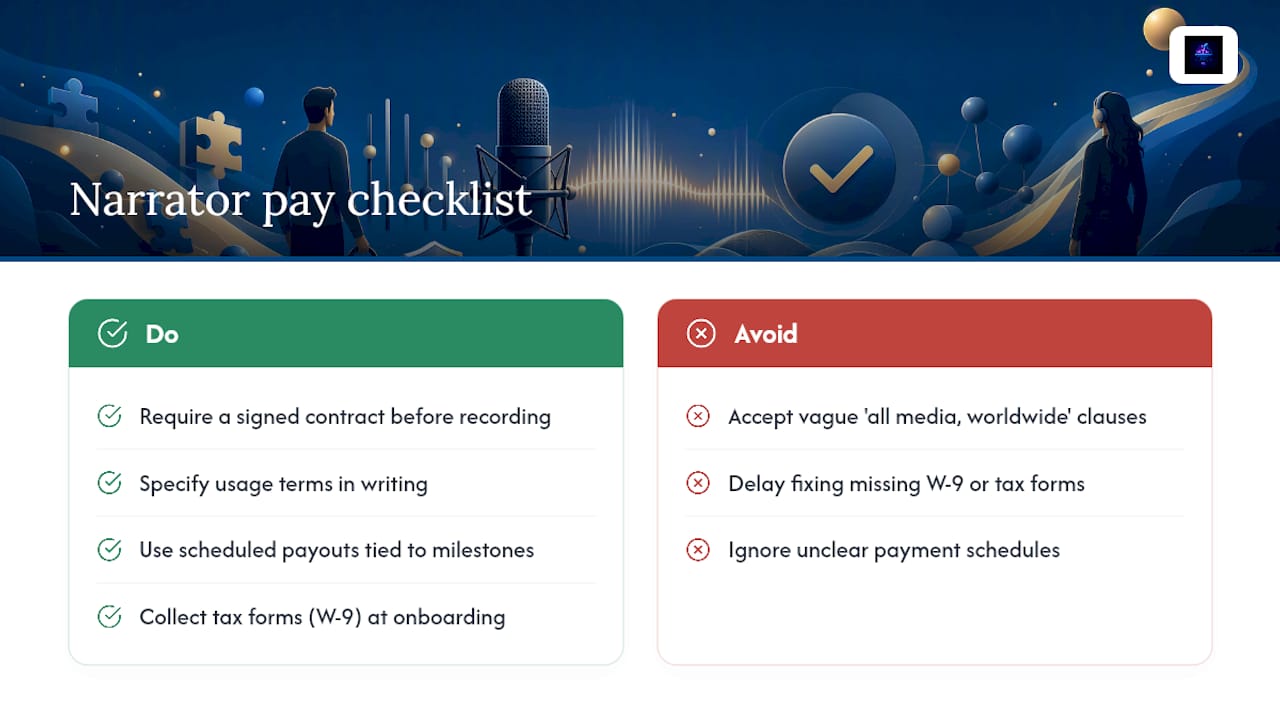
Narrator protections built into Coreforgeaudio's approach include signed contracts before recording begins, defined usage terms (no "all media, worldwide, in perpetuity" language without explicit negotiation), scheduled payouts tied to delivery milestones, and tax-document collection as a standard part of onboarding. The platform's transparency about costs and fundraising reflects the same principle applied internally: narrators deserve to know exactly what they're being paid, when, and why.
Narrator diversity and fair pay are not separate goals at Coreforgeaudio — they're the same goal. A platform that underpays narrators or buries usage rights in vague contract language can't sustain the diverse roster that makes accessible audiobooks genuinely useful.
Sarmed's take: The conventional wisdom in voice acting is that you protect yourself by getting "more experience" and eventually landing union work. That's true, but it misses the more immediate problem: most payment disputes happen in the first year, before actors know what questions to ask. The contract checklist and W-9 habit aren't advanced tactics — they're the baseline. Every actor, at every level, should treat a missing W-9 or a vague usage clause the same way they'd treat a missing payment: as a problem to fix before the session, not after.
Coreforgeaudio is hiring narrators who want fair-pay projects
Coreforgeaudio builds accessible audiobooks with human narrators, defined usage terms, and payment structures that don't hide the ball. If you're a voice actor looking for projects where the contract is clear, the usage is defined, and the paperwork is handled upfront, this is worth a look.
Review narrator terms and apply at Coreforgeaudio. The platform is in active development, and narrator applications are open now. Coreforgeaudio collects W-9s at onboarding, pays on confirmed delivery milestones, and does not use "work for hire" language without explicit negotiation — the same practices this article recommends for every voice acting engagement.
Authoritative resources for voice actors
- Form 1099-NEC reporting guidance (IRS) — official IRS page on when and how payers must report nonemployee compensation.
- Form W-9 requester instructions (IRS draft) — explains backup withholding triggers and how a signed W-9 protects both parties.
- The Work for Hire Scam: Are You Losing Thousands? (VO Pro) — detailed breakdown of buyout language, usage fees, and negotiation questions.
- How to Spot Voiceover Scams (Topher Keene) — complete red-flag guide covering fake checks, overpayment mechanics, and reporting steps.
- Voiceover Audition Scams: How to Spot and Avoid Them (Kristine Knowlton) — practical checklist for pay-to-play, fake listings, and escrow recommendations.
- Genshin Impact voice actors on payment delays (Gamespot) — real-world example of late-payment disputes and producer responsibility gaps.
- Kay Hanley on residuals (Vulture) — profile of long-term residual disputes showing why usage terms matter beyond the initial session.
- Coreforgeaudio narrator platform — narrator terms, application information, and fair-pay policies for voice actors interested in accessible audiobook projects.
This article is general information, not a substitute for advice from a qualified financial advisor. Consult a qualified financial professional about your own circumstances before acting on anything here.
Sources
- Reporting payments to independent contractors — IRS
- The Work for Hire Scam: Are You Losing Thousands? — VO Pro
- How to Spot Voiceover Scams: The Complete Red-Flag Guide — Topher Keene
- Genshin Impact voice actors say they haven't been paid in months
- Kay Hanley on Josie and the Pussycats residuals — Vulture