
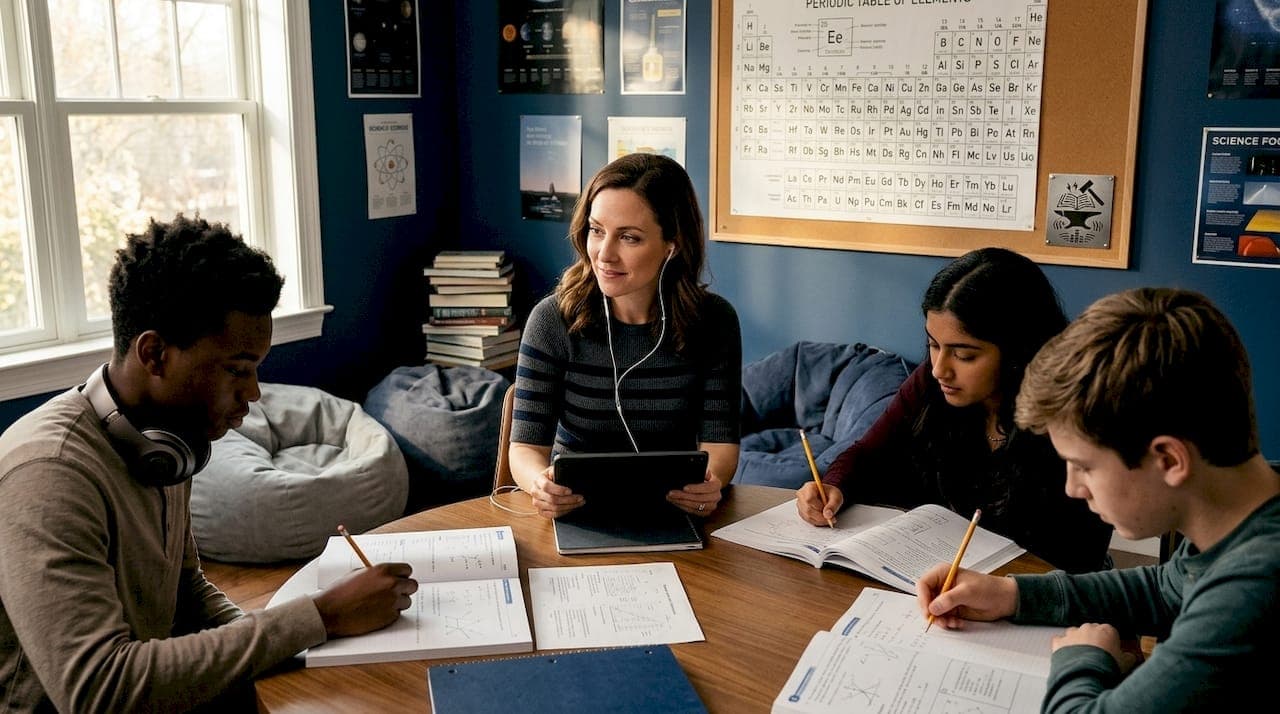
Most educators were told, at some point, that listening to a book is not the same as reading one. That audiobooks are a shortcut, a workaround, maybe even a form of academic cheating. That belief quietly shapes how STEM classrooms are designed, which students get accommodations, and which ones get left behind. The role of audio literacy in STEM education is far more significant than a simple accommodation strategy. For students with dyslexia, ADHD, visual impairments, or language processing differences, audio is not a lesser pathway. It is often the only one that works. This guide breaks down the evidence, the practical strategies, and the design principles you need to build STEM classrooms where every learner can actually engage.
Table of Contents
- Why audio literacy matters in STEM education
- How audio literacy supports vocabulary and comprehension in STEM
- Universal design and audio: making STEM accessible for all learners
- Integrating audio literacy in STEM teaching: practical strategies for educators
- Overcoming challenges and misconceptions about audio literacy in STEM
- A fresh perspective: audio literacy as a catalyst for STEM equity and creativity
- Explore audio literacy solutions for your STEM classroom
- Frequently asked questions
Key Takeaways
| Point | Details |
|---|---|
| Audio literacy enhances STEM inclusion | Using audio supports comprehension for students with reading difficulties, making STEM more accessible. |
| Pair audio with instruction | Audiobooks alone help, but combining them with scaffolded teaching yields stronger vocabulary and fluency gains. |
| Universal Design for Learning supports audio | UDL encourages multiple modes like audio to create flexible, barrier-free STEM lessons. |
| Audio reduces cognitive load | Research disproves myths that audiobooks are cheating; they help students focus and understand complex content. |
| Audio fosters creativity and equity | Integrating audio from lesson design democratizes STEM education and prepares learners for a creative, tech-rich future. |
Why audio literacy matters in STEM education
Audio literacy is the ability to understand, interpret, and apply information delivered through sound. In STEM contexts, that means processing spoken explanations of scientific concepts, following multi-step instructions in a lab setting, and building the vocabulary needed to read technical texts. For students with reading disabilities, the written word creates a bottleneck before they even reach the content. Audio learning in STEM removes that bottleneck.
The science behind audiobook learning shows that listening activates overlapping neural pathways to reading. This is not a workaround. It is a functionally equivalent route to comprehension. When a student with dyslexia hears a clear explanation of how photosynthesis works, their understanding of that concept is as real and as deep as a student who reads the same passage.
The importance of audio literacy becomes especially clear when you look at the research on interventions. A meta-analysis of 34 studies found that targeted word-reading interventions, including audio-based approaches, measurably improve literacy outcomes in students with disabilities. That is not a small finding. It means audio is not just supportive, it is transformative for a significant portion of your students.
Here is what audio literacy specifically delivers in a STEM classroom:
- Decoding support: Students spend cognitive energy understanding concepts, not decoding text letter by letter.
- Vocabulary exposure: Hearing technical terms spoken correctly in context builds familiarity faster than silent reading for many students.
- Engagement across modalities: Audio combined with visual materials creates stronger memory encoding.
- Equal access to curriculum: Students with visual impairments or print disabilities can access the same content at the same time as their peers.
"Audio does not level the playing field by lowering expectations. It levels the playing field by removing a barrier that was never about knowledge in the first place."
For educators working with students with dyslexia, the dedicated resource on audiobooks for readers with dyslexia offers a deeper look at how audio accommodations translate into real classroom outcomes.
How audio literacy supports vocabulary and comprehension in STEM
STEM subjects are, in many ways, vocabulary problems. Before a student can understand genetics, they need to own a working definition of at least a dozen terms. Before they can follow a physics explanation, they need to know what "velocity," "force," and "displacement" actually mean in context. For students with reading disabilities, acquiring that vocabulary through print alone is slow and frustrating.
This is where audio learning in STEM, paired with direct instruction, becomes a game changer. An 8-week MIT study confirmed that audiobooks combined with one-on-one scaffolding significantly improve vocabulary among students with reading difficulties. Audiobooks alone helped. Audiobooks with guided instruction helped dramatically more. The difference between passive exposure and structured engagement is measurable and meaningful.

Vocabulary does not just affect reading. It predicts listening comprehension too. Research tracking students with special educational needs found that vocabulary strongly predicts listening comprehension, which in turn influences reading fluency. That chain matters. You build audio skills for STEM first, and reading gains follow.
| Learning approach | Vocabulary gains | Listening comprehension | Practical application |
|---|---|---|---|
| Print reading only | Moderate for typical learners | Low for students with reading disabilities | Limited without decoding support |
| Audiobooks alone | Moderate improvement | Moderate improvement | Good for independent access |
| Audiobooks + scaffolded instruction | High improvement | High improvement | Strongest across all learner types |
| No structured literacy support | Minimal | Minimal | Students fall further behind |
The strategies educators use around audio matter as much as the audio itself. Pause-and-predict exercises, vocabulary journals tied to audio sessions, and small-group discussion after listening all deepen comprehension. These are not complicated interventions. They are the kind of structured engagement that transforms hearing something into knowing something.
Pro Tip: Before a STEM audio lesson, pre-teach three to five key vocabulary terms with visuals and spoken examples. Students with reading disabilities encode new words faster when they hear pronunciation and see a clear image together before encountering the term in context.
For a broader look at how listening fuels literacy strategies across learner types, including students for whom English is a second language, you will find that the principles transfer across populations. In fact, audiobooks for second-language learners highlights how audio supports language acquisition in ways that print alone simply cannot replicate.
Universal design and audio: making STEM accessible for all learners
Universal Design for Learning (UDL) is a curriculum framework built on one clear idea. Design the lesson for the full range of learners from the start, and you reduce the need for individual accommodations after the fact. Audio is one of UDL's three core representation pillars, and its role in STEM classrooms is not optional, it is foundational.
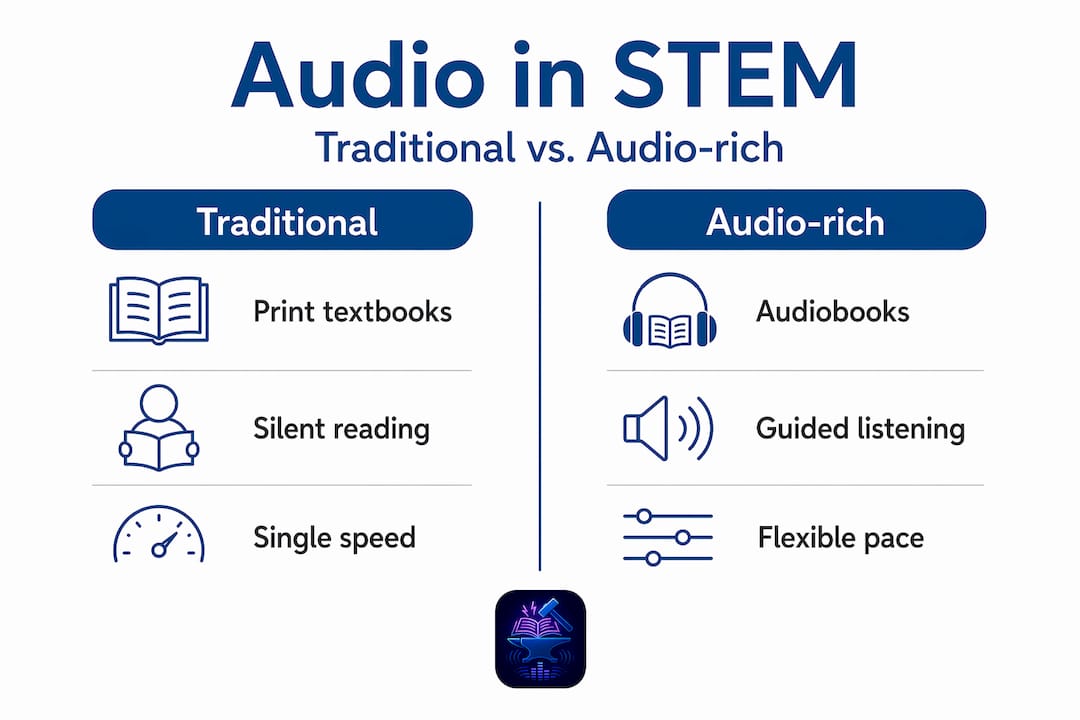
UDL principles emphasize multiple means of representation, including audio, to remove learning barriers and improve outcomes for diverse learners. When you build audio into a physics lesson from day one rather than adding it as an afterthought for one student, something shifts. The stigma around accommodations disappears. Every student benefits. And the student who most needed the audio does not feel singled out.
Here is what a UDL-informed audio approach looks like in practice:
- Visual plus audio pairing: Every diagram in a STEM lesson has an audio description students can access at their own pace.
- Multilingual audio support: Concepts are available in the student's home language for English learners who are developing science vocabulary in two languages at once.
- Flexible pacing: Adjustable narration speeds let students who need repetition hear a concept twice at 0.8x speed without interrupting whole-class instruction.
- Interactive audio labs: Students record and play back their own explanations of STEM concepts, building metacognitive awareness and audio skills together.
| Traditional STEM classroom | UDL-informed audio classroom |
|---|---|
| Print textbooks as primary resource | Audio plus print offered from lesson design |
| Accommodations added reactively | Accessibility built in proactively |
| One pace for all learners | Adjustable speed and repetition available |
| Single language instruction | Multilingual audio support available |
| Stigma around audio tools | Audio normalized for all students |
Pro Tip: Add a QR code to every printed lab sheet that links to a two-minute audio walkthrough of the experiment instructions. This requires minimal extra preparation and makes the lab immediately accessible to students with print disabilities, English learners, and students who simply process instructions better through listening.
The audiobooks classroom checklist gives educators a ready-to-use framework for auditing their current STEM materials for audio accessibility. And for curriculum developers thinking about platform-level decisions, the piece on accessibility-first audiobook design explains the technical and pedagogical principles behind tools that actually serve diverse learners.
Integrating audio literacy in STEM teaching: practical strategies for educators
Theory without application is just reading material. Here is a concrete sequence for building audio literacy into your STEM instruction from the ground up.
- Audit your current materials for audio gaps. Identify every point in your curriculum where students rely exclusively on text to access information. These are your highest-priority points for audio integration.
- Add audio to the lesson plan, not the accommodation plan. When you plan a biology unit, include the audio version of the reading in the core lesson, not the modification column. Framing matters for both you and your students.
- Use science podcasts as primary source material. Assign a five-minute episode from a science podcast as the homework reading. Students with reading disabilities complete the same assignment as their peers with no accommodation required.
- Build scaffolded listening activities. Listening is not passive. Give students a guided listening sheet with two or three focus questions before they hear the audio. Follow up with a small-group discussion.
- Incorporate sound design in student projects. Ask students to create a two-minute audio explanation of a STEM concept for a younger audience. This develops communication skills, deepens content understanding, and builds audio skills that transfer.
- Use real-world context. A recorded interview with an engineer explaining how they use calculus is more memorable than a textbook paragraph. Authentic audio makes STEM feel human.
Experts in neuroscientific STEM pedagogy advocate for shifting instruction toward experience-driven, audio-rich methods that foster creativity and multimodal literacy. The future of STEM education is not students reading about science. It is students hearing, discussing, questioning, and creating around scientific ideas.
Pro Tip: Use the teacher's audiobook checklist before the start of each new STEM unit to confirm that every major concept has at least one audio access point. This habit takes less than ten minutes and systematically closes the accessibility gaps that build up over time.
For a look at how audio content connects to broader learning productivity, the audio content productivity guide offers insights relevant to both student learning habits and educator professional development.
Overcoming challenges and misconceptions about audio literacy in STEM
Let's address the resistance directly. Some educators still believe audio is a passive activity, that students are not really learning when they listen, or that offering audio to struggling students gives them an unfair advantage. Each of these beliefs has a research rebuttal.
The most persistent myth is that listening to educational content is easier and therefore less rigorous than reading it. Cognitive neuroscientists at Harvard have debunked this directly, showing that audiobooks activate similar brain networks to reading and that the cognitive load difference is not about laziness but about access. For students with dyslexia, the cognitive load of decoding text is so high that it leaves almost no capacity for comprehension. Audio removes that barrier so the brain can do what it came to school to do: think.
Here are the most common misconceptions and what the evidence actually says:
- "Audio is cheating." No. It is an equivalent pathway to comprehension. Students with disabilities are not bypassing learning; they are accessing it.
- "Audiobooks make students lazy readers." Research shows the opposite. When students build vocabulary and comprehension through audio, they often develop stronger motivation and ability to engage with print over time.
- "Audio support is only for students with diagnosed disabilities." The impact of audio in classrooms benefits all learners, including those processing English as a second language, students with undiagnosed reading difficulties, and students who simply absorb information more effectively through sound.
- "It's too hard to implement at scale." The tools now available make integration far simpler than it was five years ago.
"The question is no longer whether audio counts as real learning. The question is why we waited so long to integrate it fully."
Students who grow up in classrooms where listening fuels literacy alongside reading build a more flexible relationship with information. That flexibility is exactly what STEM fields demand. The students who thrive in science and engineering are the ones who can process ideas across formats and communicate them clearly. Audio literacy builds that skill directly.
A fresh perspective: audio literacy as a catalyst for STEM equity and creativity
Here is the argument we want to make plainly. Audio literacy is not an accommodation. It is a core instructional principle that we have historically undervalued because our educational system was built around a single modality: print. That was a design decision, not a biological fact.
When we treat audio as a fallback for students who cannot read, we miss something much larger. Audio literacy develops critical listening, the ability to evaluate spoken arguments, follow complex reasoning, and ask sharp questions. These are skills that predict success in scientific research, collaborative engineering, and technical communication. They are not soft skills. They are fundamental to STEM practice.
The broader argument is about equity and creativity together. Audio-inclusive literacy is increasingly recognized as a fundamental human right, not a privilege for those who can access print fluently. A student in a rural district with undiagnosed dyslexia and genuine aptitude for physics should not be screened out of STEM by a reading test. Audio removes that screen without lowering any standard.
Integrating audio in education also protects something that STEM desperately needs right now: human creativity. The ability to hear a story about a scientific problem, sit with it, and generate an original response to it is a distinctly human cognitive process. When STEM education is built entirely around written tests and print-heavy textbooks, it systematically advantages one type of mind and disadvantages many others.
The educators and curriculum developers who build literacy through listening into their STEM programs are not just helping struggling readers. They are training a generation of scientists and engineers who can think, communicate, and create across every medium that modern STEM demands.
Explore audio literacy solutions for your STEM classroom
If you're ready to move from research to practice, CoreForge Audio is building the accessible infrastructure that educators need. Designed with real learners in mind including students with dyslexia, ADHD, and visual impairments, the platform offers human-narrated content with dyslexia-friendly fonts, adjustable narration speeds, and multilingual support.
Educators and curriculum developers can explore the CoreForge Audio platform to understand how accessible audiobook tools translate directly into classroom strategy. The audio literacy learning blog offers research-grounded articles designed specifically to help you build inclusive STEM programs. And when you're ready to evaluate your current classroom setup, the audiobook classroom checklist gives you a practical, immediate starting point. Accessible STEM education is not a future goal. It is something you can begin building today.
Frequently asked questions
What is audio literacy and why is it important in STEM education?
Audio literacy is the ability to understand and apply information delivered through sound. It is critical in STEM because listening supports comprehension and inclusion for students whose reading difficulties would otherwise block access to scientific content.
How can audiobooks improve vocabulary and reading skills for students with disabilities?
Audiobooks paired with structured instructional support deliver measurable gains. Research confirms audiobooks improve vocabulary in students with reading difficulties, and stronger vocabulary directly strengthens listening comprehension and reading fluency over time.
What is Universal Design for Learning and how does it relate to audio literacy?
Universal Design for Learning is a curriculum framework that builds flexible access into lessons from the start. UDL emphasizes multiple representations, including audio, so STEM content is accessible to all learners without requiring reactive accommodations.
Are audiobooks considered less effective or 'cheating' compared to reading print?
No. Neuroscience confirms audiobooks are not cheating and that listening activates similar brain networks as reading, making it a valid and rigorous pathway to comprehension, particularly for students with print-based learning barriers.
How can educators effectively integrate audio literacy into STEM teaching?
Start by building audio into lesson planning rather than accommodation plans. Audio-rich, experience-driven STEM pedagogy that combines storytelling, scaffolded listening, and real-world audio sources produces stronger engagement and better learning outcomes across all student types.